




- Medical Devices
- Continuous Glucose Monitoring Systems Market
Continuous Glucose Monitoring Systems Market Size, Share, and Growth Forecast 2026 - 2033
Continuous Glucose Monitoring Systems Market by Product Type (Sensors, Transmitters, Receivers & Monitors, Others), by Connectivity (Bluetooth-enabled CGM, NFC-enabled CGM, Smartphone-connected CGM, Others), by Distribution Channel (Hospital Pharmacies, Retail Pharmacies, Online Pharmacies, Others), by Regional Analysis, 2026 - 2033 8

Continuous Glucose Monitoring Systems Market Size and Trend Analysis
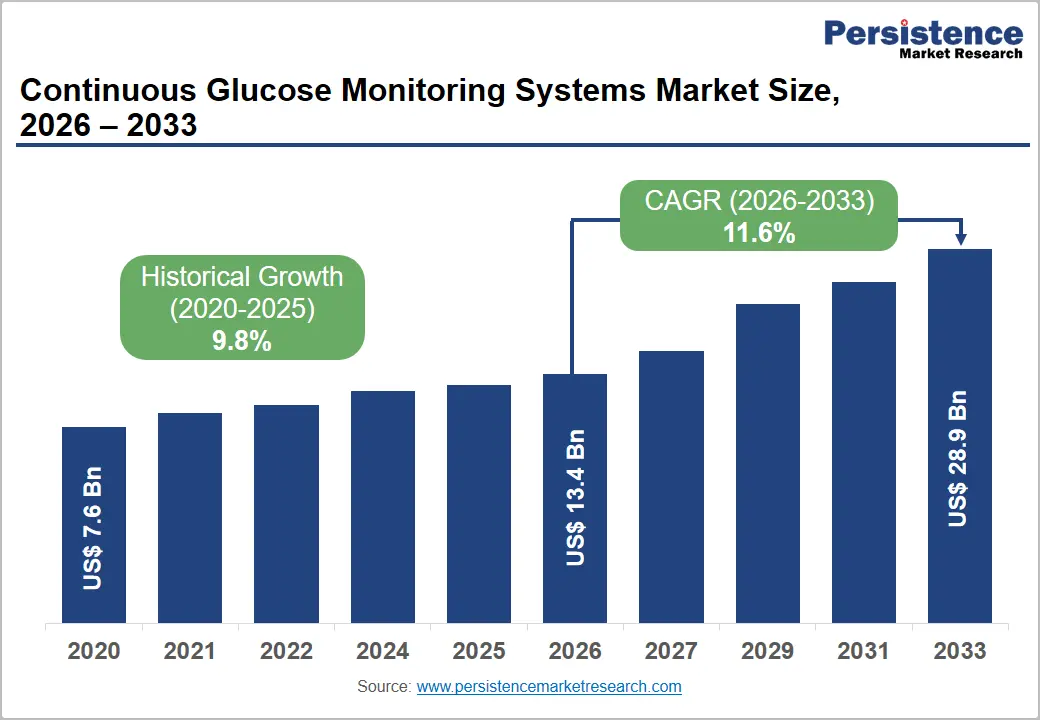
The global continuous glucose monitoring systems market size is expected to be valued at US$ 13.4 billion in 2026 and projected to reach US$ 28.9 billion, growing at a CAGR of 11.6% between 2026 and 2033. This robust expansion is primarily fueled by the surging global burden of diabetes, with the International Diabetes Federation (IDF) estimating that 537 million adults were living with diabetes in 2021, a figure forecast to reach 783 million by 2045.
The escalating adoption of real-time glucose monitoring by both Type 1 and Type 2 diabetic patients, combined with expanding insurance coverage and growing physician recommendations for wearable biosensor-based devices, is accelerating demand for CGM solutions across developed and emerging economies alike.
Key Industry Highlights:
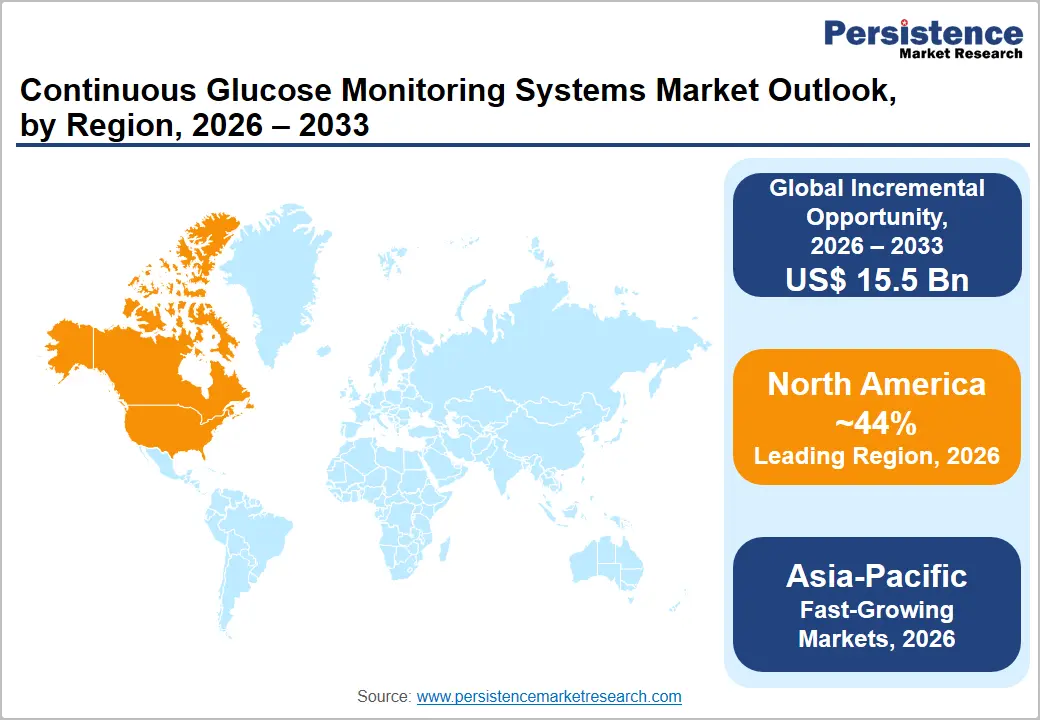
- Leading Region: North America leads the global market with approximately 44% revenue share in 2026, driven by the U.S.'s high diabetes prevalence, favorable Medicare reimbursement expansion under CMS, and dominant presence of DexCom, Inc. and Abbott Laboratories.
- Leading Region: Asia Pacific is the fastest-growing regional market for CGM systems, fueled by China's 140 million and India's 101 million diabetic adults, rising healthcare investments, and expanding domestic manufacturing capabilities by local players such as Sinocare, Inc.
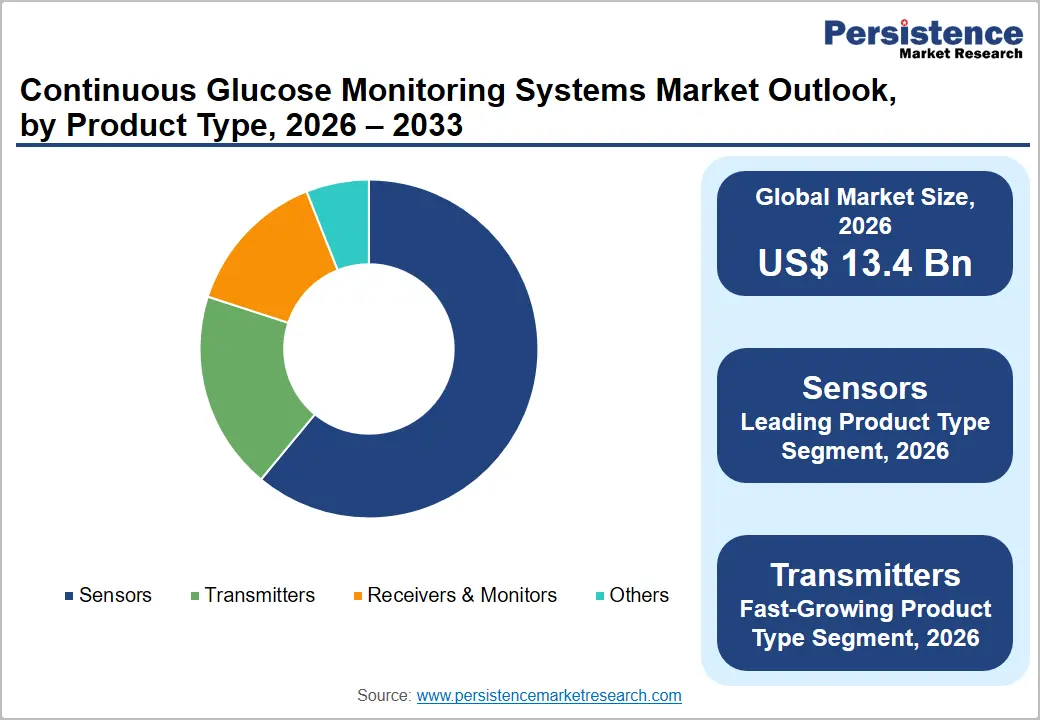
- Leading Product Type: The sensors segment is likely to dominate the continuous glucose monitoring systems market (CGM) product type category with ~61% market share in 2026, underpinned by the high-frequency consumable replacement model that generates sustained recurring revenues and positions sensors as the highest-volume, highest-value product category.
- Fast-growing Product Segment: Transmitters are the fastest-growing product segment in the CGM market, driven by increasing demand for miniaturized, long-lasting wireless-transmission hardware compatible with next-generation CGM sensor platforms and closed-loop automated insulin delivery systems.
- Opportunity: The integration of CGM platforms with AI-powered predictive analytics and expansion into the non-insulin-dependent Type 2 diabetes and consumer wellness monitoring segments represent the most significant near- to medium-term commercial opportunities for CGM market participants seeking new revenue streams.
Market Dynamics
Drivers - Rising Global Diabetes Prevalence Accelerating CGM Adoption
The escalating global prevalence of diabetes stands as the single most powerful demand catalyst for continuous glucose monitoring systems. According to the World Health Organization (WHO), the number of people diagnosed with diabetes has nearly quadrupled over the past four decades, reaching approximately 422 million globally as of recent estimates. The Centers for Disease Control and Prevention (CDC) reports that over 37.3 million Americans, roughly 11.3% of the U.S. population, currently have diabetes.
Increasing diagnosis rates, combined with the clinical recognition that tighter glycemic control significantly reduces long-term complications such as neuropathy, nephropathy, and cardiovascular disease, are pushing healthcare providers to transition patients from intermittent fingerstick testing to continuous real-time CGM platforms. This clinical imperative is directly translating into sustained volume growth across CGM device manufacturers worldwide.
Technological Innovation and Integration with Digital Health Ecosystems
Advances in sensor miniaturization, biocompatible materials, and wireless transmission protocols are dramatically improving CGM accuracy, wear comfort, and user experience, driving strong upgrade cycles within the existing installed base. The integration of CGM devices with automated insulin delivery (AID) systems, commonly known as closed-loop or artificial pancreas systems, represents a landmark technological leap. The U.S. Food and Drug Administration (FDA) has approved multiple hybrid closed-loop systems that pair CGM sensors with insulin pumps, enabling autonomous insulin dosing decisions.
Furthermore, seamless connectivity with smartphones, cloud platforms, and electronic health records is enabling remote patient monitoring and telemedicine workflows, amplifying the clinical and commercial value proposition of CGM technology across diverse care settings.
Restraints - High Device Costs and Limited Reimbursement in Emerging Markets
Despite considerable clinical benefits, the relatively high cost of CGM systems remains a formidable barrier to widespread adoption, particularly in low- and middle-income countries. A single CGM sensor typically costs between USD 30 and USD 100 for a 10- to 14-day wear period, with annual expenditure often exceeding USD 3,000 to USD 5,000 per patient without insurance coverage. In markets where public health insurance schemes do not cover CGM devices, particularly across large parts of Southeast Asia, Sub-Saharan Africa, and Latin America, out-of-pocket costs effectively preclude adoption for the majority of the diabetic population, constraining market penetration and slowing volume growth in high-potential regions.
Opportunities - Expansion into Type 2 Diabetes and Non-Diabetic Wellness Monitoring Segments
Historically, CGM adoption was concentrated among insulin-dependent Type 1 diabetes patients. However, accumulating clinical evidence now supports CGM use among non-insulin-dependent Type 2 diabetes patients as an effective behavioral intervention tool. A landmark study published in JAMA Internal Medicine demonstrated that CGM use in adults with non-insulin-treated Type 2 diabetes resulted in statistically significant reductions in HbA1c levels compared with standard care.
Beyond diabetes management, a nascent but rapidly growing consumer wellness market is emerging, with health-conscious individuals utilizing CGM devices to optimize nutrition, athletic performance, and metabolic health. Companies positioning wearable CGM platforms for the broader US$ 1 trillion global wellness economy can unlock entirely new revenue streams beyond the traditional prescription medical device channel.
Category-wise Insights
Product Type Analysis
Within the product-type segmentation, the Sensors segment holds the dominant position, capturing approximately 61% of the global CGM market in 2026. This leadership is structurally entrenched by the consumable, subscription-like nature of CGM sensors, which require replacement every 7 to 14 days depending on the platform, generating recurring revenue that far outweighs the one-time hardware purchases of transmitters and receivers.
The clinical performance differentiation between competing sensor platforms has also intensified, with leading manufacturers investing heavily in next-generation electrochemical sensing materials and factory-calibrated designs that eliminate the need for fingerstick calibration. DexCom's G7 and Abbott's FreeStyle Libre 3 sensors, both cleared by the FDA and CE-marked in Europe, exemplify how iterative sensor innovation is driving category volume growth and sustaining high replacement rates across the global installed base.
Connectivity Insights
Bluetooth-enabled CGM systems represent the leading connectivity segment, accounting for an estimated 58% market share in 2026, driven by their widespread compatibility with consumer smartphones and dedicated receiver devices across both iOS and Android ecosystems. Bluetooth Low Energy (BLE) technology enables seamless, real-time transmission of glucose data to paired devices within a range of up to 6 meters, supporting continuous monitoring without user intervention.
The rapid penetration of smartphones globally, with the GSMA Intelligence reporting over 5.4 billion unique mobile subscribers worldwide, has made Bluetooth-enabled CGM the default connectivity architecture for new platform launches. Leading players including DexCom, Inc. and Abbott Laboratories have standardized on BLE for their flagship CGM lines, reinforcing the segment's commercial dominance and creating a strong compatibility-driven network effect that further entrenches Bluetooth as the primary CGM connectivity standard.
Regional Insights
North America Continuous Glucose Monitoring Systems Market Trends and Insights
North America leads the CGM systems market due to high diabetes prevalence, advanced healthcare infrastructure, strong reimbursement coverage, and rapid adoption of digital health devices. According to the CDC (U.S. Centers for Disease Control and Prevention), over 38 million Americans have diabetes, creating sustained demand for continuous monitoring solutions. The region benefits from early adoption of wearable medical technologies and strong presence of key manufacturers such as Dexcom and Abbott.
U.S. Continuous Glucose Monitoring Systems Market Trends and Insights
The U.S. dominates North America due to high Type 1 and Type 2 diabetes burden and strong insurance coverage for CGM devices. CDC reports that 1 in 10 Americans has diabetes, and CGM adoption is increasing in both insulin-dependent and non-insulin users. Expansion of Medicare reimbursement and integration with insulin pumps is accelerating usage. Advanced digital health infrastructure and the expansion of telehealth further support the adoption of real-time glucose monitoring across hospitals and home care settings.
Canada Continuous Glucose Monitoring Systems Market Trends and Insights
Canada is witnessing strong CGM growth, driven by rising diabetes incidence and provincial healthcare programs that support device reimbursement. Diabetes Canada estimates over 3.7 million people live with diabetes, with rising prevalence expected in the coming years. Government-supported reimbursement for CGM in several provinces is improving accessibility. Growing awareness of preventive diabetes care and increasing adoption of remote patient monitoring tools are further accelerating CGM penetration across both urban and semi-urban populations.
Europe Continuous Glucose Monitoring Systems Market Trends and Insights
Europe is a key CGM market supported by universal healthcare systems, strong diabetes screening programs, and growing focus on preventive care. According to the International Diabetes Federation (IDF), Europe has over 61 million adults living with diabetes. Countries such as Germany, the UK, and France are increasing adoption of advanced glucose monitoring systems through public reimbursement schemes and hospital integration.
Germany Continuous Glucose Monitoring Systems Market Trends and Insights
Germany leads Europe due to its strong statutory health insurance system and early adoption of digital diabetes management technologies. The Federal Ministry of Health supports reimbursement for CGM devices for Type 1 diabetes patients, boosting penetration. Germany has over 6 million diabetics, according to Robert Koch Institute. High clinical adoption in hospitals and growing use of hybrid closed-loop insulin systems are strengthening demand for continuous glucose monitoring technologies.
UK Continuous Glucose Monitoring Systems Market Trends and Insights
The UK is experiencing rapid CGM growth due to NHS-led reimbursement expansion and national diabetes prevention programs. NHS England has progressively expanded CGM access for patients with Type 1 diabetes, significantly boosting adoption. Diabetes UK reports over 4.3 million people with diabetes in the country. Increasing focus on remote monitoring and digital health transformation within the NHS is driving faster integration of CGM systems into routine diabetes management.
Asia Pacific Continuous Glucose Monitoring Systems Market Trends and Insights
Asia Pacific is the fastest-growing CGM systems market due to the rising burden of diabetes, expanding healthcare infrastructure, and increasing affordability of wearable medical devices. According to WHO and IDF data, the region accounts for more than 230 million adults with diabetes, with China and India contributing the largest share. Growing awareness and expanding insurance coverage are accelerating adoption of CGM systems across hospitals and homecare settings.
China Continuous Glucose Monitoring Systems Market Trends and Insights
China leads the region due to its massive diabetic population and strong government focus on chronic disease management. According to the Chinese CDC, over 140 million adults live with diabetes, making it the largest diabetic population globally. Rapid expansion of domestic CGM manufacturers such as Sinocare and POCTech is improving affordability. Government initiatives supporting digital health and hospital modernization are significantly increasing CGM adoption across urban healthcare centers.
India Continuous Glucose Monitoring Systems Market Trends and Insights
India is the fastest-growing CGM market driven by rising diabetes prevalence, urban lifestyle changes, and increasing awareness of preventive healthcare. According to ICMR, India has over 101 million people with diabetes. Expanding private healthcare infrastructure, growing insurance penetration, and rising adoption of wearable health technologies are accelerating CGM uptake. The increasing use of smartphone-based health monitoring solutions is further driving rapid market expansion in both metropolitan and tier-2 cities.
Competitive Landscape
The global continuous glucose monitoring systems market exhibits a moderately consolidated competitive structure, with DexCom, Inc. and Abbott Laboratories collectively commanding the dominant share of the real-time CGM segment. These market leaders differentiate through continuous sensor innovation, proprietary algorithm-driven accuracy improvements, and deep integration with digital health platforms. Mid-tier players including Medtronic plc and F. Hoffmann-La Roche Ltd. compete through their established hospital relationships and integrated diabetes management ecosystems.
Emerging strategies include strategic partnerships with insulin pump manufacturers, direct-to-consumer digital health channel development, and AI-powered predictive analytics integration. Asian manufacturers such as Sinocare, Inc. are challenging incumbents through aggressive price competition in cost-sensitive emerging markets.
Key Developments
- May 2026: Dexcom had unveiled its next-generation G8 Continuous Glucose Monitoring (CGM) system, designed to enhance real-time glucose tracking for patients with diabetes. The company had positioned the new device as an advancement over previous-generation CGM platforms, focusing on improved accuracy, faster sensor response, and seamless integration with mobile applications.
- August 2025: Abbott had launched its next-generation FreeStyle Libre® 2 Plus system, an upgraded continuous glucose monitoring (CGM) device designed to deliver improved real-time glucose visibility for people with diabetes. The system had provided continuous glucose readings every minute, enhancing monitoring accuracy and enabling more responsive diabetes management compared to earlier versions.
Companies Covered in Continuous Glucose Monitoring Systems Market
- DexCom, Inc.
- Abbott Laboratories
- Medtronic plc
- F. Hoffmann-La Roche Ltd.
- Senseonics Holdings, Inc.
- Sinocare, Inc.
- i-SENS, Inc.
- Zhejiang POCTech Co., Ltd.
- GlucoRx Limited
- Bionime Corporation
- Nemaura Medical Inc.
- Others
Frequently Asked Questions
The global continuous glucose monitoring systems market is estimated to be valued at US$ 13.4 billion in 2026.
Rising diabetes prevalence, increasing wearable adoption, real-time monitoring demand, reimbursement support, and technological advancements drive growth.
North America is the leading region in the global CGM market, accounting for approximately 44% of total market revenues in 2025.
Expansion in non-invasive CGM technologies and emerging markets presents major future growth opportunities globally.
DexCom, Inc., Abbott Laboratories, Medtronic plc, F. Hoffmann-La Roche Ltd., and Senseonics Holdings, Inc.


