




- Industrial Machinery
- Continuous Flow Stirred Tank Reactor (CSTR) Market
Continuous Flow Stirred Tank Reactor (CSTR) Market Size, Share, and Growth Forecast 2026 - 2033
Continuous Flow Stirred Tank Reactor (CSTR) Market by Operation Type (Continuous CSTR, Batch CSTR, Semi-continuous CSTR), Size Type (Small Scale CSTR, Others), Application (Chemical Production, Others), and Regional Analysis for 2026 - 2033

Continuous Flow Stirred Tank Reactor (CSTR) Market Size and Trend Analysis
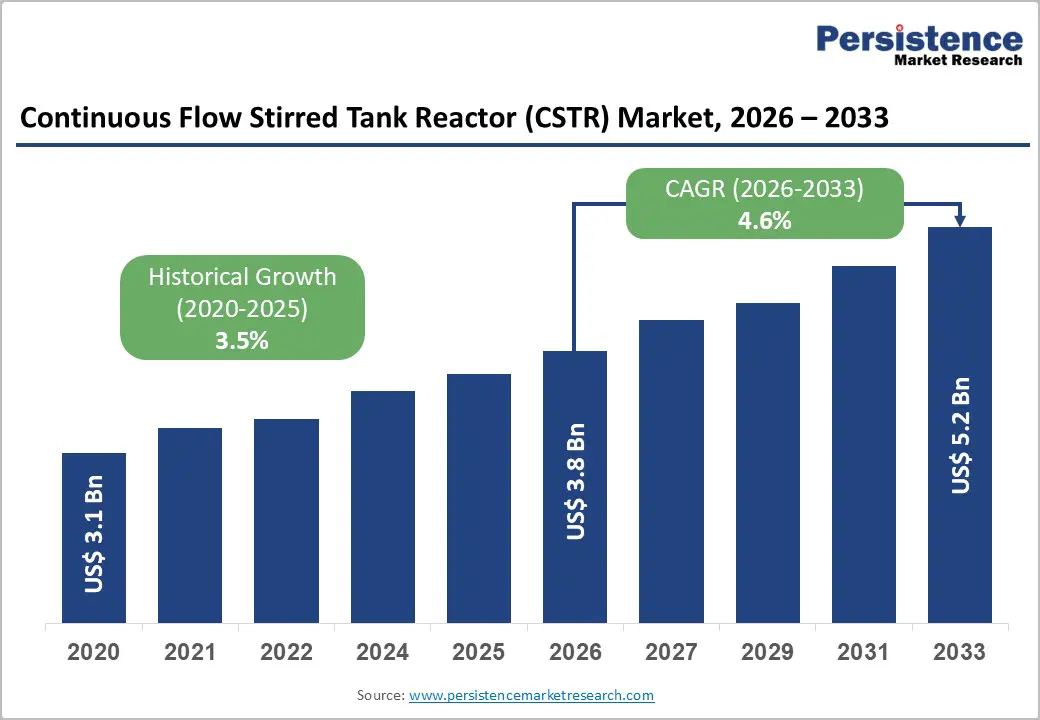
The global continuous flow stirred tank reactor (CSTR) market size is likely to be valued at US$3.8 billion in 2026 and is expected to reach US$5.2 billion by 2033, growing at a CAGR of 4.6% during the forecast period from 2026 to 2033, driven by the rising adoption of continuous processing to improve operational efficiency, product consistency, and process safety across industries such as pharmaceuticals, chemicals, petrochemicals, and wastewater treatment.
The increasing regulatory emphasis on sustainable manufacturing, reduced waste generation, and energy efficiency is driving the shift from traditional batch systems to continuous reactor technologies. Advancements in automation, digital monitoring, and modular reactor design are enhancing scalability and cost-effectiveness, making CSTRs attractive for both large-scale industrial production and specialized applications.
Key Industry Highlights
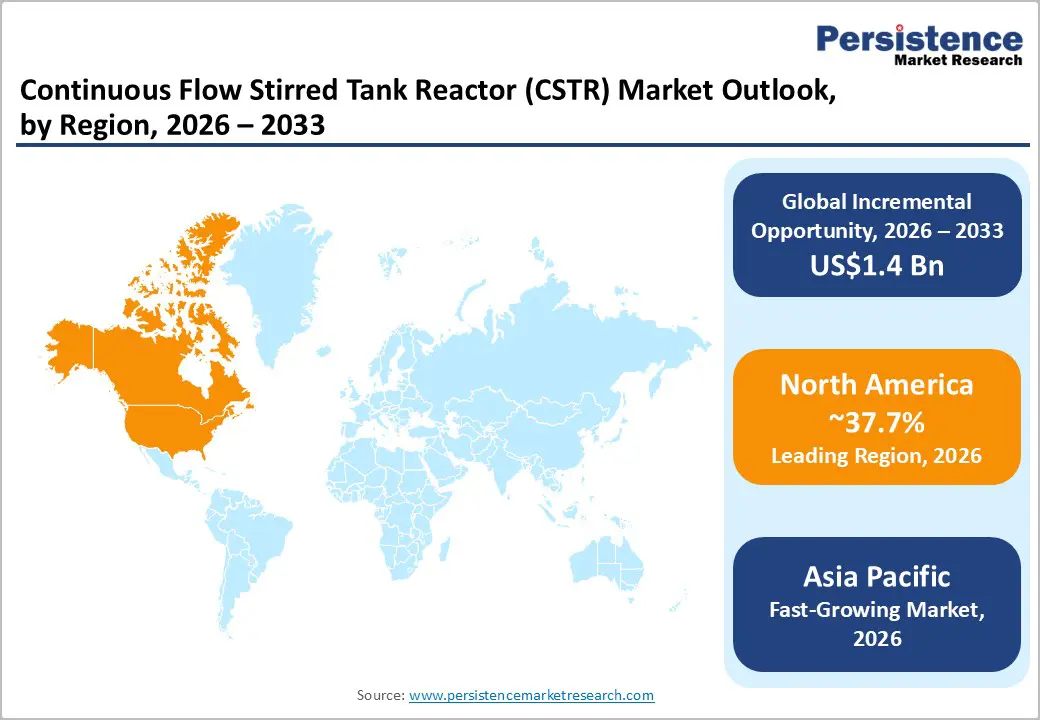
- Leading Region: North America is projected to lead the market in 2026, accounting for approximately 37.7% share, driven by strong R&D spending, rapid adoption of continuous processing technologies, robust manufacturing infrastructure, and stringent regulatory standards that encourage high-efficiency and environmentally compliant production.
- Fastest-growing Region: Asia Pacific is likely to be the fastest-growing region in 2026, driven by rapid industrialization across China, India, and ASEAN nations, cost-effective manufacturing strengths, expanding chemical and pharmaceutical industries, and increasing investments in automation and sustainable production technologies.
- Leading Operation Type: The continuous CSTR is projected to lead the operation type segment in 2026, with approximately 54% revenue share, driven by its ability to maintain a steady flow and ensure consistent product quality in large-scale production.
- Leading Size Type: The medium-scale CSTR is expected to lead the segment in 2026 with around 46% revenue share owing to its balanced cost efficiency and broad adoption across pharmaceuticals, chemicals, and wastewater treatment.
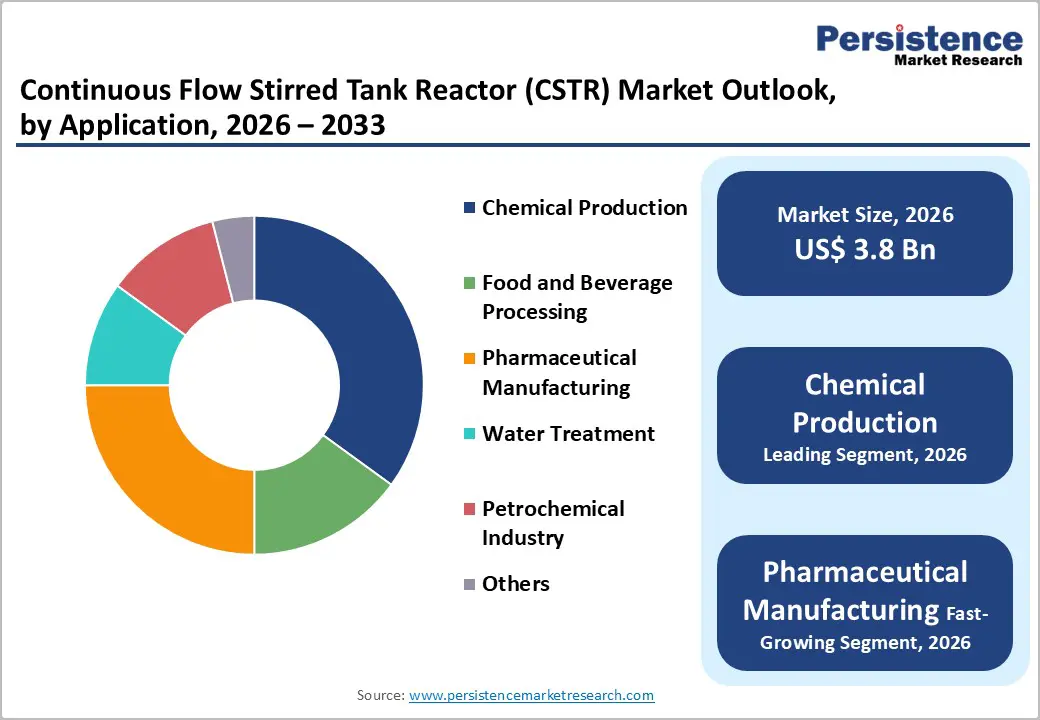
- Leading Application: Chemical production is projected to lead in 2026 with approximately 42% revenue share, propelled by sustained demand for high-volume and continuous chemical manufacturing.
| Key Insights | Details |
|---|---|
|
Continuous Flow Stirred Tank Reactor (CSTR) Market Size (2026E) |
US$3.8 Bn |
|
Market Value Forecast (2033F) |
US$5.2 Bn |
|
Projected Growth CAGR (2026-2033) |
4.6% |
|
Historical Market Growth (2020-2025) |
3.5% |
Market Factors - Growth, Barriers, and Opportunity Analysis
Rising Demand for Chemical and Pharmaceutical Production
The chemical industry continues to expand as demand for polymers, specialty chemicals, solvents, and industrial intermediates used across manufacturing, agriculture, energy, and consumer goods grows. As manufacturers prioritize high-volume production, consistency, and stricter quality standards, CSTRs offer an optimized solution by enabling uniform mixing, constant reaction conditions, and stable output profiles. The shift toward continuous processing helps reduce batch-to-batch variability, improve operational efficiency, and support safer handling of complex or hazardous reactions.
In the pharmaceutical sector, rising drug demand, biologics production, and stricter regulatory norms for quality and process validation further reinforce the need for advanced reactor technologies. Pharmaceutical companies are increasingly adopting continuous manufacturing to achieve superior process control, improved reaction safety, and reduced production costs. CSTRs support these goals by enabling precise temperature, pH, and agitation control crucial for APIs and complex formulations, while also facilitating scalability from laboratory to commercial production and faster regulatory approval through consistent process validation.
High Initial Capital and Operational Costs
Modern CSTR setups frequently incorporate advanced features such as digital monitoring, corrosion-resistant materials, high-precision control systems, and continuous operation modules, all of which significantly elevate upfront spending. Customization requirements based on reaction type, pressure, temperature, and material compatibility increase capital investment, especially for pharmaceutical and specialty chemical applications. Integration with automation platforms, safety interlocks, and real-time analytics also raises installation and commissioning costs. These factors can deter small and mid-scale manufacturers from rapid adoption, particularly in cost-sensitive markets.
Operational costs pose a long-term restraint, as continuous CSTR systems require regular maintenance, sensor calibration, skilled operators, and strict adherence to process safety regulations. Energy consumption remains substantial, especially in chemical, pharmaceutical, and petrochemical applications where precise temperature control and continuous agitation are essential. Costs associated with catalyst replacement, waste handling, cleaning-in-place systems, and unplanned downtime further add to operational expenses. Compliance with environmental and safety regulations increases ongoing expenditures, impacting overall profitability for end users.
Technological Convergence and Digital Integration
The adoption of advanced technologies such as IoT-enabled sensors, automated control systems, machine learning models, and digital twins is transforming how CSTRs are monitored, optimized, and maintained. These technologies enable real-time performance tracking, predictive maintenance, and improved fault detection, reducing downtime and enhancing reactor reliability. Integration of smart sensors allows operators to continuously adjust process parameters for optimal reaction efficiency. This convergence significantly improves safety and process transparency across chemical and pharmaceutical operations.
Digital integration is also reshaping process development by enabling more precise modeling, simulation, and scale-up capabilities for chemical, pharmaceutical, and bioprocessing applications. Companies in Asia Pacific, North America, and Europe are increasingly investing in smart reactor systems to support continuous manufacturing and Industry objectives. Cloud-based control platforms, AI-driven optimization engines, and modular automation architectures are making CSTR systems more flexible and adaptive to evolving production needs. These advancements open new opportunities for cost optimization, faster commercialization, and improved product consistency across multiple end-use industries.
Category-wise Insights
Operation Type Analysis
The continuous CSTR segment is projected to lead the CSTR market in 2026, capturing approximately 54% revenue share due to its ability to maintain uninterrupted flow conditions and deliver uniform product quality in large-scale chemical and pharmaceutical production. Industries increasingly prefer continuous operations as they support higher throughput, reduce batch-to-batch variations, and enable better control over reaction kinetics. For example, BASF widely deploys continuous stirred tank reactors in its large-scale chemical manufacturing facilities to ensure consistent output and improved process efficiency.
The semi-continuous CSTR is likely to be the fastest-growing operation type in 2026, driven by its flexible operational capability and suitability for variable production volumes. This configuration is gaining traction in specialty chemicals, bioprocessing, and R&D-oriented manufacturing, where both adaptability and controlled reaction environments are critical. Semi-continuous systems allow manufacturers to optimize throughput without fully committing to a continuous line, making them ideal for transitional facilities and multi-product plants facing fluctuating demand patterns. For example, Companies such as Lonza utilize semi-continuous reactor setups in specialty chemical and pharmaceutical development to balance scalability with flexibility.
Size Type Analysis
Medium-scale CSTRs are expected to lead the market in 2026, capturing approximately 46% of revenue share, driven by their broad suitability across the pharmaceutical, chemical, specialty materials, and wastewater treatment industries. These reactors offer an optimal balance between capacity and cost, making them the preferred choice for facilities seeking efficient output without the heavy investment required for large systems. For example, Amar Equipments Pvt. Ltd. supplies medium-scale CSTR systems extensively used by pharmaceutical and chemical manufacturers for multipurpose production.
Large-scale CSTR size is likely to be the fastest-growing type in 2026, driven by the expansion of industrial plants requiring high-volume production capabilities. Increasing investments in petrochemicals, bulk chemicals, polymers, fertilizers, and large-scale water treatment facilities are driving the adoption of large reactors capable of handling continuous, high-throughput operations. Advancements in automation, thermal control, and safety systems are streamlining maintenance demands, increasing the appeal of large-scale CSTRs for high-capacity industrial projects. For example, Dow Chemical employs large-scale continuous stirred tank reactors in polymer and petrochemical processing operations.
Application Type Analysis
Chemical production is expected to be the leading application segment in 2026, accounting for approximately 42% of revenue share, driven by the sector’s ongoing need for high-volume, consistent, and controlled reaction environments essential to producing polymers, solvents, resins, and specialty chemicals. CSTRs are preferred for their ability to maintain uniform reaction conditions, manage exothermic reactions safely, and support continuous or large-batch operations. Rising demand for industrial chemicals in construction, automotive, electronics, and agriculture is boosting CSTR adoption. For example, SABIC (Saudi Basic Industries Corporation) utilizes CSTR technology across multiple chemical production lines to ensure stable and scalable manufacturing.
The pharmaceutical segment is likely to be the fastest-growing application segment in 2026, fueled by the rapid shift toward continuous manufacturing to enhance product quality, reduce production time, and meet stringent regulatory requirements. CSTRs are increasingly integrated into drug development, API synthesis, and complex reaction pathways due to their scalability and precise process control. Growth is boosted by investments in advanced reactors, biologics production, and automated, digitally monitored systems. Vertex Pharmaceuticals, for example, has adopted continuous-flow and stirred-tank technologies to improve efficiency and regulatory compliance in drug manufacturing.
Regional Insights
North America Continuous Flow Stirred Tank Reactor (CSTR) Market Trends
North America is expected to dominate the continuous-flow stirred-tank reactor (CSTR) market, capturing an estimated 37.7% share by 2026. This growth is largely driven by the region's robust chemical and pharmaceutical sectors and by substantial investments in research and development. Innovation trends highlight a surge in automation, digital controls, and real-time monitoring, with AI-powered process optimization enhancing throughput, reaction control, and operational safety, especially within pharmaceutical and fine-chemical manufacturing.
Companies such as Corning Incorporated are pushing the boundaries of continuous reactor technologies for chemical and pharmaceutical processing, facilitating scalable and controlled production environments. The region's technological advancement in CSTR applications is further bolstered by investments in modern reactor systems and the expansion of high-value chemical and specialty drug production. The increasing focus on process intensification and regulatory compliance is accelerating CSTR adoption across industries such as active pharmaceutical ingredients (APIs), fine chemicals, and water treatment.
Europe Continuous Flow Stirred Tank Reactor (CSTR) Market Trends
Europe is expected to be a major market for continuous flow stirred tank reactors (CSTR) by 2026, driven by stringent environmental regulations, sustainability efforts, and substantial government-supported R&D. Countries such as Germany and the U.K. are home to numerous laboratories and industrial sites that have adopted flow-reactor systems, including CSTRs, for producing fine chemicals, specialty chemicals, and pharmaceutical active ingredients (APIs). Companies such as Vapourtec Ltd. are at the forefront of facilitating the shift from batch to continuous processing with advanced laboratory and pilot-scale flow reactor solutions. Both local and regional players are expanding flow chemistry infrastructure to improve control and consistency by moving from batch to continuous processing.
The chemical and biotech industries in Europe are increasingly adopting continuous-flow methods because they align with green chemistry principles, thereby reducing solvent use, energy consumption, and hazardous waste. This has accelerated the adoption of CSTR and other flow reactor technologies for applications such as fine chemical synthesis, agrochemicals, pharmaceuticals, and specialty compounds. The growing investments in sustainable manufacturing practices and circular economy initiatives are further driving the deployment of continuous reactors across the region. Strict environmental regulations are pushing companies to replace traditional batch systems with more efficient, low-emission CSTR-based processes.
Asia Pacific Continuous Flow Stirred Tank Reactor (CSTR) Market Trends
The Asia Pacific region is expected to experience the fastest growth in the continuous flow stirred tank reactor (CSTR) market by 2026. This growth is driven by rapid industrialization and the expansion of chemical, pharmaceutical, and specialty chemical manufacturing in countries such as China, India, Japan, and South Korea. The region's extensive manufacturing base and increasing demand for scalable and efficient reactor systems make CSTRs especially appealing for both production and research purposes. For instance, Amar Equipments Pvt. Ltd. in India provides customized stirred-tank reactor systems that support pharmaceutical, chemical, and research-driven manufacturing.
Asia Pacific is also seeing a surge in the adoption of automation, digital integration, and advanced reactor technologies, which enhance process control, safety, and output consistency. Continuous-flow systems are becoming increasingly preferred over traditional batch processes for chemical, pharmaceutical, and specialty chemical synthesis. This shift reflects a broader trend towards modern, efficient, and sustainable production methods in the region. The growing domestic manufacturing capabilities and government support for local chemical production are driving the demand for scalable CSTR systems. Investments in industrial water treatment and energy-efficient processes are also expanding the potential applications of continuous stirred tank reactors.
Competitive Landscape
The global continuous flow stirred tank reactor (CSTR) market exhibits a moderately fragmented structure, driven by a mix of established chemical-engineering specialists and newer technology-focused firms offering flow-chemistry solutions. With key leaders including Corning Incorporated, Syrris Ltd., Vapourtec Ltd., Chemtrix BV, AM Technology, and Amar Equipment Pvt. Ltd.
These players compete through continuous innovation in reactor design, automation, scalability, and materials, for instance, offering modular flow reactors, glass-lined or stainless steel CSTRs, and systems compatible with industrial regulatory standards. Strategic partnerships, global distribution networks, and expansion into emerging markets also shape competition as firms seek to meet diverse end-use demands across pharmaceuticals, fine chemicals, specialty chemicals, and wastewater applications.
Key Industry Developments:
- In September 2025, Vapourtec introduced the eBPR-GL, an electronically adjustable back pressure regulator designed for gas and gas-liquid continuous-flow systems. Addressing common issues such as gas leakage, pressure instability at low flow rates, and gas pocket formation, the eBPR-GL ensures precise pressure control from 0.1 to 10 bar (gauge) across flow rates of 0.01–20 ml/min, with a temperature tolerance up to 100 °C. Featuring a low internal volume and a chemically resistant flow path made from PTFE and PFA fluoropolymers with perfluoroelastomer seals, it is ideal for advanced flow chemistry and CSTR-based gas-liquid reactions.
- In March 2024, researchers, including U. Gnädinger, D. Poier, C. Trombini, M. Dabros, and R. Marti, developed a mini-CSTR using 3D printing, designed for safer and more efficient organic synthesis with optimized gas-liquid mass transfer and handling of exothermic reactions.
Continuous Flow Stirred Tank Reactor (CSTR) Market Scope
| Report Attribute | Details |
|---|---|
|
Historical Data/Actuals |
2020 - 2025 |
|
Forecast Period |
2026 - 2033 |
|
Market Analysis |
Value: US$ Bn |
|
Geographical Coverage |
|
|
Segmental Coverage |
|
|
Competitive Analysis |
|
|
Report Highlights |
|
Companies Covered in Continuous Flow Stirred Tank Reactor (CSTR) Market
- Vapourtec
- PDC Machines
- Nano-Mag Technologies
- Amar Equipments Pvt Ltd.
- Weihai Global Chemical Machinery Mfg Co. Ltd.
- Marches Biogas Ltd.
- Terralab Laboratory
Frequently Asked Questions
The global continuous flow stirred tank reactor (CSTR) market is expected to reach US$5.2 billion by 2033, reflecting robust growth.
Key drivers include rising demand from chemical production, technological advancements in automation and reactor design, and rapid industrialization in Asia Pacific.
The continuous flow stirred tank reactor (CSTR) market segment holds the largest market share due to its efficiency and scalability.
North America leads the market with around 37.7% share, driven by strong R&D spending, rapid adoption of continuous processing technologies, robust manufacturing infrastructure, and stringent regulatory standards that encourage high-efficiency and environmentally compliant production.
A key opportunity in the continuous flow stirred tank reactor (CSTR) market lies in the integration of digital technologies such as AI and IoT. This offers substantial growth potential by improving operational efficiency and enhancing product quality.


