




- Retail
- Coaching Platform Market
Coaching Platform Market Size, Share, and Growth Forecast, 2026 - 2033
Coaching Platform Market by Coaching Type (Career Coaching, Wellness Coaching, Executive Coaching, Others), Mode of Learning (One-on-One Coaching, Others), End-user (Individuals, Corporations and Organizations, Others), and Regional Analysis for 2026 – 2033

Coaching Platform Market Size and Trends Analysis
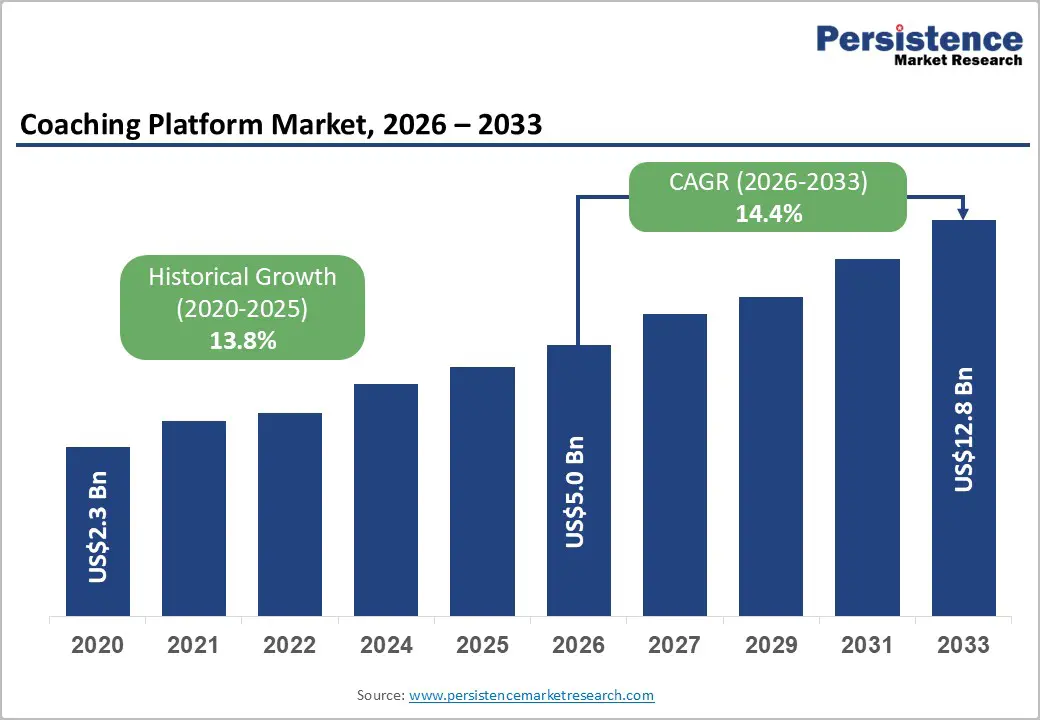
The global coaching platform market size is likely to be valued at US$5.0 billion in 2026, and is expected to reach US$12.8 billion by 2033, growing at a CAGR of 14.4% during the forecast period from 2026 to 2033, driven by the increasing prevalence of remote and hybrid work models, rising demand for personalized professional development, and advancements in AI-powered coaching tools and analytics.
Rising demand for scalable, results-driven coaching platforms, particularly executive and career coaching solutions for corporate clients, is accelerating the adoption across end-user segments. Innovations in hybrid learning models and mobile-first design are further driving uptake by enhancing accessibility and user engagement. The growing recognition of coaching platforms as essential tools for employee retention, leadership development, and mental well-being among emerging talent markets remains a key driver of market expansion.
Key Industry Highlights:
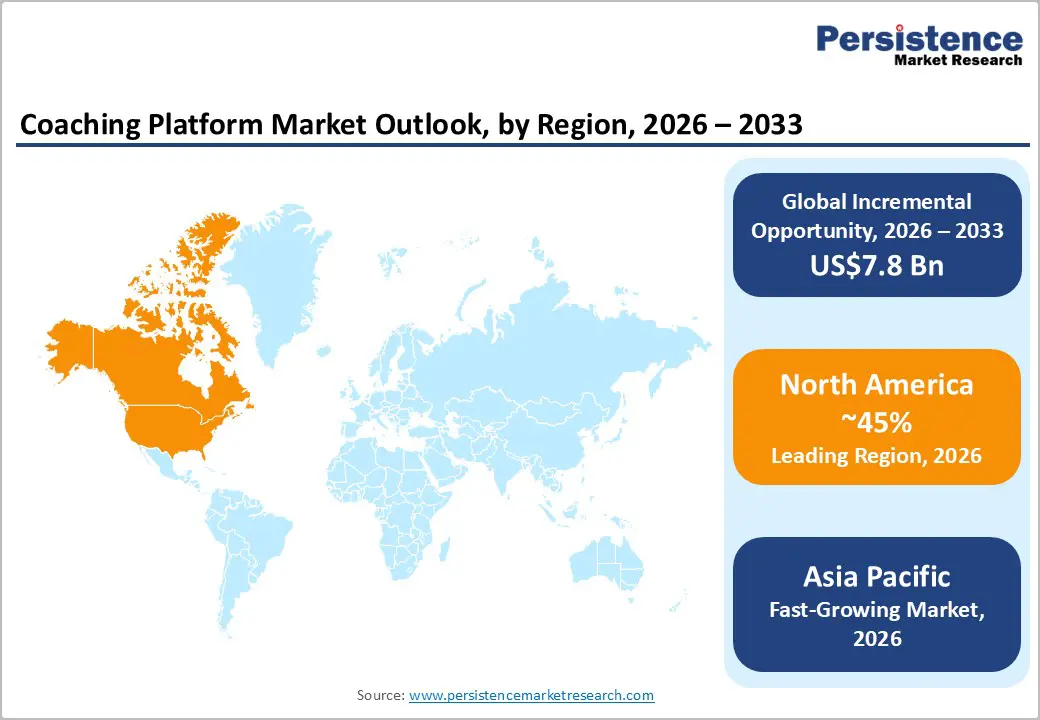
- Leading Region: North America, anticipated to account for a 45% market share in 2026, with high levels of corporate investment in leadership development, strong SaaS adoption, and premium demand in the U.S.
- Fastest-growing Region: Asia Pacific, fueled by rapid digital transformation, expanding corporate wellness programs, and growing investments in upskilling in India and China.
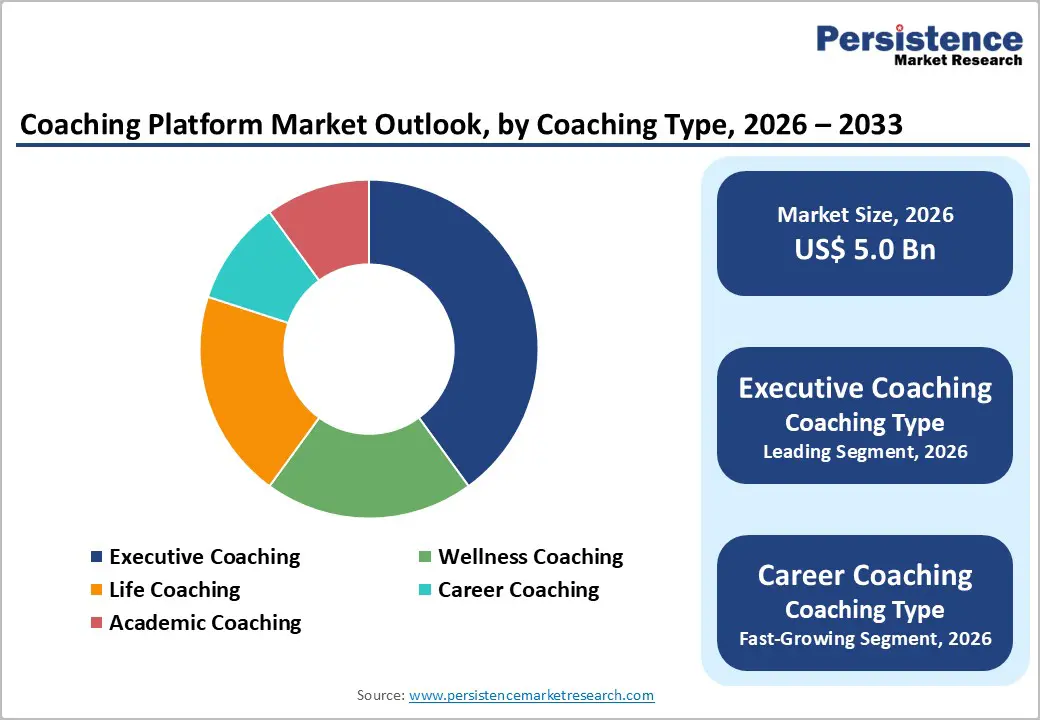
- Dominant Coaching Type: Executive coaching, to hold approximately 35% of the market share, as it remains the highest-value segment for enterprises.
- Leading Mode of Learning: Hybrid models are expected to account for more than 45% of market revenue due to their flexibility and scalability.
- Leading End-user: Corporations and organizations, to contribute nearly 50% of the market revenue, due to large-scale employee development budgets.
| Report Attribute | Details |
|---|---|
|
Coaching Platform Market Size (2026E) |
US$5.0 Bn |
|
Market Value Forecast (2033F) |
US$12.8 Bn |
|
Projected Growth (CAGR 2026 to 2033) |
14.4% |
|
Historical Market Growth (CAGR 2020 to 2025) |
13.8% |
Market Factors – Growth, Barriers, and Opportunity Analysis
Increasing Demand for Remote Work and Personalized Professional Development
The rapid shift toward remote and hybrid work models has fundamentally reshaped how professionals learn, grow, and advance their careers, driving strong demand for personalized professional development solutions. As organizations expand geographically and manage distributed teams, traditional, one-size-fits-all training programs are proving inadequate. Employees now expect learning experiences that are flexible, digital-first, and tailored to their individual roles, skill gaps, and career aspirations.
Remote work has intensified the need for continuous upskilling in areas such as digital collaboration, cybersecurity awareness, data literacy, and virtual leadership. Professionals are seeking coaching and development programs that align with their personal goals, work styles, and learning preferences. Personalized professional development platforms leverage AI, analytics, and adaptive learning paths to recommend targeted courses, mentoring, and coaching interventions, ensuring higher engagement and measurable performance improvement. This trend delivers strategic advantages. Customized development programs help attract and retain top talent in a highly competitive labor market, improve productivity across remote teams, and build future-ready capabilities without the high costs of in-person training.
Quality and Standardization Challenges
Quality and standardization remain major restraints for the coaching platform market as the industry lacks a universally accepted framework for evaluating coaches, content, and outcomes. Coaching platforms aggregate professionals with diverse backgrounds, experiences, and certifications, resulting in wide variation in coaching quality. Without common benchmarks, organizations struggle to assess whether a coach’s methods, credentials, and results meet consistent professional standards. This inconsistency can erode buyer confidence, especially for enterprises that invest heavily in leadership and career development programs.
Standardization is further complicated by the personalized nature of coaching. While customization is a key value driver, it makes it difficult to apply uniform metrics for performance, progress tracking, and return on investment. Different coaches may use different methodologies, assessment tools, and success indicators, leading to fragmented data and limited comparability across programs. For platform providers, ensuring quality requires continuous vetting, training, and monitoring of coaches, along with robust feedback and rating systems.
Advancements in AI-Powered and Hybrid Coaching Delivery Platforms
Advancements in AI-powered and hybrid coaching delivery platforms are creating significant growth opportunities in the coaching platform market. Artificial intelligence is transforming how coaching is delivered by enabling intelligent coach–client matching based on goals, behavior patterns, learning preferences, and performance data. AI-driven assessments and sentiment analysis help identify skill gaps and development priorities, allowing coaching journeys to be more targeted and outcome-oriented. Automated progress tracking, personalized recommendations, and real-time feedback improve user engagement while reducing administrative workload for coaches and organizations.
Hybrid coaching models, which combine digital tools with human-led sessions, are further enhancing scalability and effectiveness. Virtual sessions, chat-based support, and on-demand micro-coaching provide flexibility, while live interactions preserve the depth, empathy, and accountability essential to professional development. This blended approach allows organizations to balance cost efficiency with high-quality, personalized support across distributed workforces.
Category-wise Analysis
Coaching Type Insights
Executive coaching is anticipated to dominate the market, accounting for approximately 35% of the market share in 2026. Its dominance is driven by the growing need for strong, adaptive leadership in an increasingly complex business environment. Organizations are investing heavily in executive coaching to strengthen strategic thinking, decision-making, and change management capabilities among senior leaders. As digital transformation, hybrid work models, and global competition intensify, companies require leaders who can align teams, drive performance, and sustain culture. Executive coaching delivers measurable ROI through improved leadership effectiveness, employee engagement, and business outcomes, making it a top priority for corporations worldwide. Google provides executive coaching as part of its leadership development initiatives, offering tailored coaching programs for its senior leaders to improve strategic decision-making, team leadership, and communication skills. This investment in executive coaching has supported Google’s reputation for strong leadership and contributed to high rankings on workplace best-employer lists, reflecting positive impacts on employee engagement and organizational performance.
Career coaching is likely to be the fastest-growing segment, as individuals increasingly seek personalized guidance to navigate evolving job markets, skill shifts, and career transitions. With technological advancements transforming roles and industries, professionals are prioritizing career alignment, continuous learning, and purposeful work paths. Career coaching helps clients identify strengths, set clear goals, build marketable skills, and create actionable plans to achieve career success. This demand is especially strong among early-career professionals and mid-career changers who face greater competition and shifting employer expectations. BetterUp has expanded its career coaching offerings beyond leadership development to include personalized career growth and transition support, helping professionals improve skills, navigate career decisions, and advance in rapidly changing job markets. Its digital platform connects users with expert career coaches and AI tools, reflecting strong demand for accessible, scalable career guidance. The significant investment in BetterUp’s coaching technology and its adoption by corporate clients underscore the expanding market for career coaching services.
Mode of Learning Insights
Hybrid models are anticipated to lead the market, holding approximately 45% of the share in 2026, driven by the strengths of both in-person and digital coaching, offering flexibility, broader access, and personalized support. Organizations and individuals prefer hybrid approaches that allow face-to-face interaction for deeper engagement alongside virtual sessions for convenience and scalability. This balance enhances learning outcomes, reduces costs, and accommodates diverse schedules, making hybrid delivery the most widely adopted format in the coaching industry. Exos, a performance coaching and well-being provider, partnered with a large global food and beverage company to implement a hybrid coaching model that blended in-person support with always-available digital access through the Exos app. Employees could engage with expert coaches face-to-face at corporate locations or virtually on their own schedules, ensuring consistent, flexible support across the workforce.
Group coaching is likely to be the fastest-growing segment, as it enables collective learning, collaboration, and shared experiences at a lower cost per participant than one-on-one coaching. Organizations use group coaching to build team cohesion, foster peer support, and develop leadership capabilities across larger cohorts simultaneously. The format encourages diverse perspectives, accelerates skill transfer, and enhances problem-solving through interactive dialogue. Its scalability and effectiveness in driving cultural change are making group coaching increasingly popular in corporate and professional development programs. CoachHub partnered with Sodiaal, a major French dairy cooperative, to run a group coaching program called “Lait Talenteuses.” This initiative brought together women employees from across the company in group coaching sessions focused on professional growth, shared learning, and peer support. Participants reported increased engagement, confidence, and leadership skills, and the program helped foster a more inclusive culture within the organization.
End-user Insights
Corporations and organizations are projected to account for nearly 50% of market revenue in 2026, driven by increased investment in structured coaching programs to strengthen leadership capabilities, enhance performance, and support large-scale talent development. As businesses face complex challenges such as digital transformation and talent retention, coaching becomes a strategic tool to enhance employee skills, engagement, and productivity. Large-scale corporate adoption delivers measurable returns, making organizational spending the largest revenue driver in the coaching industry. BetterUp is a professional coaching platform widely adopted by corporations such as Meta and Salesforce to deliver coaching at scale for leadership development and workforce growth, reflecting how large organizations invest heavily in coaching to improve performance and talent outcomes. BetterUp’s enterprise model, which includes tailored coaching programs for thousands of employees, illustrates why corporate spending contributes a significant share of industry revenue.
Individuals are expected to be the fastest-growing segment, fueled by a strong focus on self-development and an expanding role in career transitions. This segment benefits from convenient, quick, and accessible growth solutions that appeal to professionals seeking flexible, personalized settings. Increased outreach initiatives, a growing emphasis on the gig economy, and the wider availability of both routine and premium digital platforms are further accelerating adoption, driving rapid uptake across urban and semi-urban regions. For example, The Muse’s Coach Connect enables individuals to directly access personalized career coaching for job search strategies, resume optimization, interview preparation, and career planning. The platform has supported over 23,000 individuals through one-on-one coaching sessions, highlighting strong demand for accessible and flexible career support beyond traditional corporate programs.
Regional Insights
North America Coaching Platform Market Trends
North America is projected to dominate the market, accounting for nearly 45% of the revenue in 2026, driven by the region’s mature corporate training ecosystem, strong SaaS adoption, and high public awareness of leadership development benefits. Deployment systems in the U.S. and Canada provide extensive support for coaching programs, ensuring broad access to coaching platforms across executive, career, and wellness populations. Increasing demand for hybrid, convenient, and easy-to-scale forms is further accelerating adoption, as these formats improve engagement and reduce barriers associated with traditional coaching.
Innovation in coaching platform technology, including stable AI matching, improved hybrid delivery, and targeted outcome enhancement, is attracting significant investments from both public and private sectors. Government initiatives and talent campaigns continue to address skill-gap risks, turnover concerns, and emerging leadership threats, creating sustained market demand. The growing focus on career grades and specialty uses, particularly for individuals and others, is expanding the target applications for coaching platforms.
Europe Coaching Platform Market Trends
Europe is propelled by increasing awareness of the benefits of professional development, robust regulatory systems, and government-led skills programs. Countries such as Germany, France, and the U.K. have well-established HR frameworks that support routine coaching and encourage the adoption of innovative platform delivery methods, including coaching platforms. These scalable formulations are particularly appealing for corporate populations, regulation-conscious organizations, and wellness users, improving retention and coverage rates.
Technological advancements in coaching platform development, such as enhanced analytics, application-targeted delivery, and improved hybrid grades, are further boosting market potential. European authorities are increasingly supporting research and trials for platforms against both routine and specialized needs, strengthening market confidence. The growing emphasis on convenient, measurable options aligns with the region’s focus on preventive talent development and on reducing skill gaps. Public awareness campaigns and promotion drives are expanding reach in both urban and rural areas, while suppliers are investing in AI and novel variants to increase efficacy.
Asia Pacific Coaching Platform Market Trends
Asia-Pacific is likely to be the fastest-growing market for coaching platforms in 2026, driven by rising digitalization, increased government initiatives, and expanding application programs across the region. Countries such as India, China, Japan, and Southeast Asian nations are actively promoting platform campaigns to address leadership growth and emerging wellness needs. Coaching platforms are particularly attractive in these regions due to their scalable administration, ease of deployment, and suitability for large-scale corporate drives in both urban and rural populations.
Technological advancements are enabling the development of stable, effective, and easy-to-adopt coaching platforms that can withstand challenging connectivity conditions and minimize dependence on engagement. These innovations are critical for reaching remote teams and improving overall development coverage. Growing demand for executive, career, and wellness applications is contributing to market expansion. Public-private partnerships, increased L&D expenditure, and rising investment in platform research and manufacturing capacity are further accelerating growth. The convenience of platform delivery, combined with improved outcomes and reduced risk of disengagement, positions coaching platforms as a preferred choice.
Competitive Landscape
The global coaching platform market features competition between established leadership development providers and emerging AI-driven platforms. In North America and Europe, BetterUp and Coachhub lead through strong R&D, distribution networks, and enterprise ties, bolstered by innovative executive and hybrid programs. In Asia Pacific, local providers advance with localized solutions, enhancing accessibility. AI-powered delivery boosts personalization, cuts cost risks, and enables mass integrations across regions. Strategic partnerships, collaborations, and acquisitions merge expertise, expand features, and speed commercialization. Hybrid formulations solve accessibility issues, aiding penetration in remote areas.
Key Industry Developments
- In January 2025, BetterUp, the human transformation company and inventor of virtual coaching, announced the launch of a new AI coach offering, which was designed to provide access to coaching at scale. This innovative solution was made available on BetterUp’s human transformation platform and was developed using evidence-based approaches to deliver highly customized coaching experiences to all employees, ensuring alignment with everyone’s unique role, personality, preferred learning style, and organizational culture.
Companies Covered in Coaching Platform Market
- BetterUp
- International Coaching Federation
- Highspot
- Ascorb Technologies
- Coachhub
- Coaching.com
- Bravely
- Sounding Board Inc.
- EZRA
- Simply. Coach
- Coach Ready
- Skyline G
Frequently Asked Questions
The global coaching platform market is projected to reach US$5.0 billion in 2026.
The coaching platform market is driven by increasing corporate investment in employee engagement, leadership development, and talent retention programs.
The coaching platform market is poised to witness a CAGR of 14.4% from 2026 to 2033.
The coaching platform market presents significant opportunities in AI-powered personalized coaching and hybrid delivery models, enabling scalable, flexible, and highly engaging learning experiences for both individuals and organizations.
BetterUp, Coachhub, EZRA, Sounding Board Inc., and Bravely are the key players.


