




- Pharmaceuticals
- Clostridium Difficile Infection Treatment Market
Clostridium Difficile Infection Treatment Market Size, Share, and Growth Forecast 2026 - 2033
Clostridium Difficile Infection Treatment Market by Drug Type (Metronidazole, Vancomycin, Fidaxomicin, Others), Route of Administration (Oral, Injectable, Others), End-user (Hospital Pharmacies, Retail Pharmacies, Online Pharmacies, Others), and Regional Analysis, 2026 - 2033

Clostridium Difficile Infection Treatment Market Share and Trends Analysis
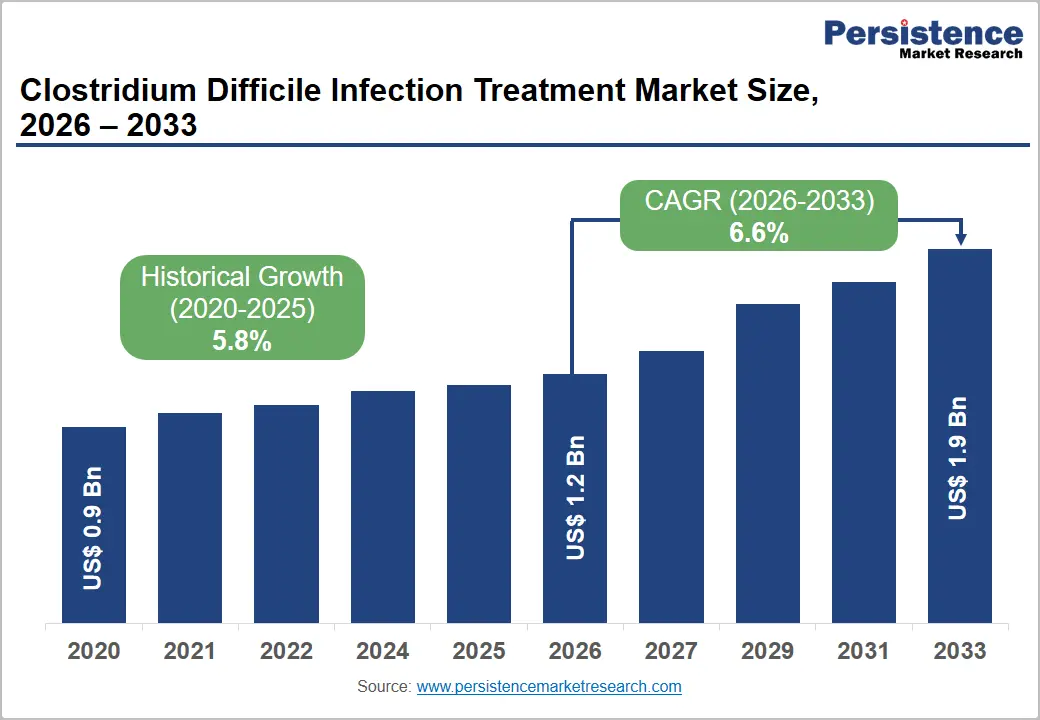
The global Clostridium Difficile Infection (CDI) Treatment market size is expected to be valued at US$ 1.2 billion in 2026 and projected to reach US$ 1.9 billion, growing at a CAGR of 6.6% between 2026 and 2033.
Growing health-associated infections, widespread antibiotic use, and increasing recurrence rates among patients drive the demand for CDI treatment. CDI remains a major cause of antibiotic-associated diarrhea, particularly in hospitalized and elderly populations. Treatment demand is evolving from conventional antibiotics toward advanced therapies such as narrow-spectrum agents, monoclonal antibodies, and microbiome restoration approaches. Growing awareness of gut microbiota disruption and infection control measures is further supporting market growth.
Key Industry Highlights:
- Leading Region: North America leads the CDI Treatment market with approximately 38% revenue share in 2025, anchored by the U.S. CDC's classification of C. difficile as an Urgent Threat affecting 500,000 Americans annually, comprehensive CMS reimbursement, and world-leading FDA approvals of novel LBP therapeutics Vowst and Rebyota.
- Fast-growing Market: Asia Pacific is the fastest-growing CDI treatment market, driven by improved HAI surveillance revealing previously under-reported CDI burden, China's NHC antimicrobial stewardship expansion, Japan's aging population with high CDI susceptibility, and growing fidaxomicin availability across regional corporate hospital networks.
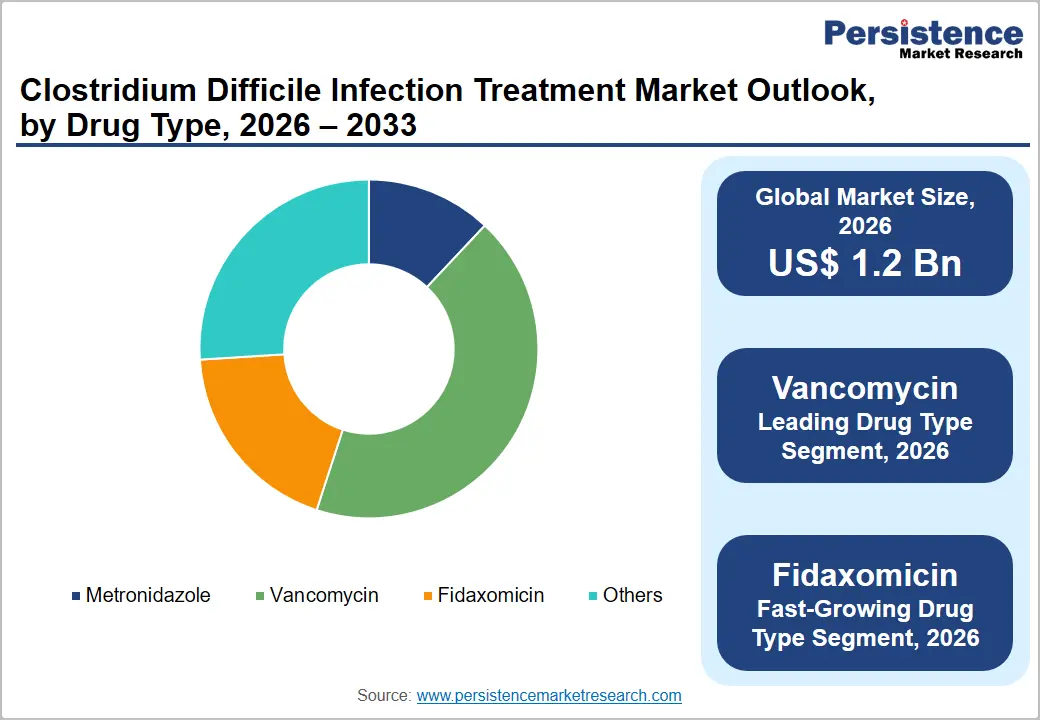
- Leading Drug Type: Vancomycin dominates the drug type category with approximately 43% market share in 2026, sustained by decades of clinical familiarity, off-patent affordability, broad Medicare Part D and GKV reimbursement, and flexible tapering/pulse dosing protocols recommended by IDSA/SHEA guidelines for managing recurrent CDI episodes.
- Fast-growing Drug Type: Fidaxomicin (Dificid) is the fast-growing drug segment, propelled by IDSA/SHEA 2021 guideline elevation to preferred therapy for initial non-severe CDI, supported by pivotal trial data demonstrating 40% lower recurrence versus vancomycin in SOLO I/II trials published in the New England Journal of Medicine.
Market Dynamics
Drivers - Rising CDI Incidence Rates in Aging Populations and Healthcare-Associated Infection Burden
Persistently high healthcare-associated Clostridioides difficile infection rates, particularly among elderly, immunocompromised, and antibiotic-exposed patients, constitute the most powerful structural demand driver for the CDI treatment market. The CDC designates C. difficile as an Urgent antimicrobial resistance threat, with the agency's data documenting approximately 223,900 hospitalized cases and 12,800 deaths in U.S. hospitals annually, in addition to over 280,000 community-associated CDI cases. The European Centre for Disease Prevention and Control (ECDC) reports that C. difficile is the most commonly reported healthcare-associated infection (HAI) pathogen across EU member states.
With WHO projections indicating that the global population aged 65 and over will double to 1.5 billion by 2050, the population at highest CDI risk is structurally expanding, ensuring sustained and growing antibiotic treatment prescription volumes across all major therapeutic agents, including vancomycin, fidaxomicin, and metronidazole.
Restraints - Generic Competition Eroding Revenue for First-Line Metronidazole and Oral Vancomycin
The widespread genericization of metronidazole and, increasingly, oral vancomycin hydrochloride has substantially compressed average selling prices for these foundational CDI antibiotic treatments. Generic oral vancomycin capsules previously priced at over USD 3,000 per treatment course for branded Vancocin are now available at a fraction of this cost following patent expiry and multiple generic manufacturer market entries, reducing per-treatment antibiotic revenue for pharmaceutical manufacturers. This generic price erosion necessitates manufacturers' increasing dependence on novel-mechanism premium products (fidaxomicin, bezlotoxumab, LBPs) to sustain portfolio revenue growth, adding market development complexity and investment requirements.
High Cost of Novel CDI Therapies Limiting Broad Institutional and Patient Access
While fidaxomicin (Dificid), bezlotoxumab (Zinplava), and approved microbiome therapeutics Vowst and Rebyota offer clinically superior outcomes for recurrent CDI, their high treatment costs create significant access barriers. A single course of fidaxomicin costs approximately USD 3,000–5,000, while Vowst treatment approaches USD 10,000–17,000 per course before insurance negotiation. Medicare and commercial insurance coverage criteria for LBPs remain narrow, requiring documented recurrence history before reimbursement approval limiting prescriber adoption among patients experiencing initial or first-recurrence CDI episodes and constraining the novel therapy segments' volume ramp-up.
Opportunities - Fidaxomicin: Fastest-Growing Drug Segment Driven by Superior Recurrence Prevention and Guideline Upgrades
Fidaxomicin (Dificid), marketed by Merck & Co. in the United States and Astellas Pharma in Europe, represents the fastest-growing drug segment in the CDI treatment market, propelled by guideline elevation and growing clinical evidence of its superior recurrence prevention versus vancomycin. The IDSA/SHEA 2021 CDI Clinical Practice Guidelines upgraded fidaxomicin to a preferred over vancomycin recommendation for initial non-severe CDI treatment, a landmark guideline revision reflecting clinical trial data documenting fidaxomicin's 40% relative reduction in CDI recurrence in the pivotal SOLO I and SOLO II trials published in the New England Journal of Medicine. As IDSA guideline adoption penetrates hospital antimicrobial stewardship programs globally, fidaxomicin prescription share is expected to expand materially at the expense of vancomycin in formulary-compliant institutions.
Category-wise Analysis
Drug Type Insights
Vancomycin leads the CDI treatment market by drug type with approximately 43% of global revenues in 2026, maintaining its dominant position as the most widely prescribed antibiotic for CDI treatment despite the IDSA/SHEA guideline preference for fidaxomicin in initial non-severe cases. Vancomycin's commercial durability reflects its decades-long clinical familiarity among infectious disease and hospital medicine physicians, established hospital pharmacy formulary inclusion, broad payer reimbursement coverage including Medicare Part D, and availability in both branded (Vancocin) and low-cost generic oral capsule and solution formulations that accommodate cost-conscious institutional procurement.
While guideline evolution is gradually shifting prescribing toward fidaxomicin, vancomycin's deep market penetration, off-patent cost-competitiveness, and flexibility for dose-tapering and pulse protocols in recurrent CDI management sustain its leading revenue position across global markets in the near-to-medium term.
Route of Administration Insights
The Oral route of administration leads the CDI treatment market, representing approximately 78% of global revenues in 2026. The dominance of oral therapy reflects the fundamental clinical rationale of CDI treatment where the infectious organism resides within the gastrointestinal tract and oral antibiotic delivery achieves the highest local colonic drug concentrations with minimal systemic absorption.
All three major antibiotic therapies (metronidazole, vancomycin, and fidaxomicin) are primarily administered orally, as are the approved microbiome therapeutics Vowst and Rebyota. The IDSA/SHEA guidelines strongly prefer oral vancomycin and fidaxomicin over intravenous metronidazole except in patients unable to tolerate oral medications, institutionally reinforcing oral administration as the standard of care that anchors the overwhelming majority of CDI treatment prescription volumes globally.
End-user Insights
Hospital pharmacies constitute the leading end-user segment for CDI treatment products, accounting for approximately 64% of global revenues in 2026. This dominance reflects the fundamentally hospital-centric epidemiology of CDI where the CDC documents that the majority of CDI cases are acquired in hospital or long-term care facility settings and the high severity of inpatient CDI requiring intensive antibiotic treatment and, for recurrent cases, novel biotherapeutic interventions. Hospital pharmacies dispense both acute CDI treatment courses and novel LBP administrations in inpatient and hospital outpatient infusion settings, process the highest-cost CDI treatment products including fidaxomicin and bezlotoxumab, and serve as the primary institutional formulary gatekeepers governing CDI treatment product access across their affiliated healthcare networks.
Regional Insights
North America Clostridium Difficile Infection Treatment Market Trends and Insights
North America leads the global CDI treatment market with approximately 38% revenue share in 2025, driven by the United States' high CDI incidence (500,000 annual infections per CDC), comprehensive Medicare and Medicaid coverage for CDI therapies, pioneering FDA approvals of novel LBP treatments including Vowst and Rebyota, and the most advanced antimicrobial stewardship infrastructure globally with TJC (The Joint Commission) mandating antibiotic stewardship programs across all accredited U.S. hospitals.
U.S. Clostridium Difficile Infection Treatment Market Size
The United States accounts for approximately 88% of North American revenues, anchored by nearly 500,000 annual CDI infections and approximately 29,000 CDI-related deaths (CDC data), along with the world's most commercially advanced CDI treatment landscape incorporating fidaxomicin, bezlotoxumab (Zinplava), and the newly approved LBPs Vowst and Rebyota all under active CMS reimbursement consideration.
Europe Clostridium Difficile Infection Treatment Market Trends and Insights
Europe is the second-largest CDI treatment market, supported by the ECDC's HAI surveillance framework documenting C. difficile as the leading healthcare-associated pathogen across EU hospitals, national antimicrobial stewardship mandates under EU action plans on antimicrobial resistance, and evolving clinical guidelines from the European Society of Clinical Microbiology and Infectious Diseases (ESCMID) recommending fidaxomicin as the preferred initial CDI therapy in eligible patients.
Germany Clostridium Difficile Infection Treatment Market Size
Germany holds approximately 22% of European CDI treatment revenues, driven by high hospital-acquired infection rates monitored through the KISS (Krankenhaus-Infektions-Surveillance-System) national HAI network, GKV statutory reimbursement for approved CDI treatments including fidaxomicin, and a dense hospital network with established antimicrobial stewardship programs integrating newer CDI treatment protocols.
U.K. Clostridium Difficile Infection Treatment Market Size
The United Kingdom accounts for approximately 18% of European revenues, supported by NHS England's longstanding C. difficile mandatory surveillance and reduction target program, NICE technology appraisals guiding fidaxomicin prescribing for recurrent CDI, and active UK Health Security Agency (UKHSA) guidance on CDI management in hospital and community settings that promotes evidence-based treatment selection.
France Clostridium Difficile Infection Treatment Market Size
France represents approximately 15% of European CDI treatment revenues, underpinned by Santé Publique France HAI surveillance data documenting consistent C. difficile incidence in French hospitals, Assurance Maladie reimbursement for approved CDI therapies, and the Société Française de Microbiologie (SFM) and SPILF clinical guidelines increasingly aligning with ESCMID recommendations for fidaxomicin use in non-severe initial CDI episodes.
Asia Pacific Clostridium Difficile Infection Treatment Market Trends and Insights
Asia Pacific is the fast-growing CDI treatment market, driven by rapidly improving HAI surveillance capabilities revealing previously under-reported CDI burden, expanding antibiotic use in hospital settings increasing CDI risk, and growing awareness of novel treatment options among infectious disease specialists. China's national healthcare quality improvement programs under the National Health Commission (NHC) are strengthening hospital infection control and antimicrobial stewardship protocols, creating the clinical infrastructure for guideline-consistent CDI treatment adoption.
India Clostridium Difficile Infection Treatment Market Size
India accounts for approximately 14% of Asia Pacific revenues, representing the region's fastest-growing national CDI treatment market. Rising corporate hospital-associated CDI recognition, expanding CDSCO-approved CDI antibiotic availability, and growing infectious disease specialist training in C. difficile management through the Infectious Diseases Society of India (IDSI) are collectively advancing diagnosis and treatment penetration across tertiary care centers.
Competitive Landscape
The global clostridium difficile infection treatment market is highly competitive and characterized by a mix of established pharmaceutical leaders and emerging biotechnology innovators. Large global players dominate the antibiotic-based treatment space due to strong distribution networks, extensive clinical adoption, and cost-effective generic offerings. However, competition is gradually shifting toward advanced therapies focused on microbiome restoration and targeted biologics, which are gaining attention for reducing recurrence rates. Smaller biotech firms are driving innovation through novel live biotherapeutics and fecal microbiota-based approaches, creating a strong pipeline of differentiated products.
Key Developments
- In December 2025, researchers reported the development of a targeted anti-toxin therapeutic approach for Clostridioides difficile (C. difficile) infections, focusing on neutralizing the bacterium’s key toxin (TcdB) rather than killing the bacteria itself.
- In October 2024, researchers from the University of Pennsylvania and Children’s Hospital of Philadelphia developed a novel mRNA-LNP vaccine for Clostridioides difficile (C. diff). In animal studies, it prevented infections, boosted immunity, and cleared bacteria, paving the way for clinical trials.
Companies Covered in Clostridium Difficile Infection Treatment Market
- Merck & Co.
- Ferring Pharmaceuticals
- Seres Therapeutics
- Pfizer
- Johnson & Johnson
- Sanofi
- AbbVie
- Takeda Pharmaceutical Company
- Vedanta Biosciences
- Biocodex
- Nestlé Health Science
- Astellas Pharma
- Roche
Frequently Asked Questions
The global clostridium difficile infection treatment market is estimated to be valued at US$ 1.2 billion in 2026.
The primary demand drivers for the Clostridioides difficile infection (CDI) treatment market are rooted in rising disease burden, healthcare-associated transmission, and recurrence challenges that are difficult to manage with standard antibiotics.
North America leads with approximately 38% of global revenues in 2026, with the United States as a dominant market.
A major opportunity is the expansion of microbiome-based therapies, such as fecal microbiota transplantation (FMT) alternatives and standardized microbiota restoration products, which aim to re-establish healthy gut flora and significantly reduce recurrence rates one of the biggest unmet needs in CDI management.
The leading companies include Merck & Co., Inc. (fidaxomicin/Dificid), Ferring Pharmaceuticals (Rebyota), Seres Therapeutics / Nestlé Health Science (Vowst), Astellas Pharma Inc. (European fidaxomicin), Takeda Pharmaceutical Company Limited, Vedanta Biosciences, AbbVie Inc., Pfizer Inc., Johnson & Johnson, Sanofi S.A., Biocodex, Roche, Amneal Pharmaceuticals, and Akorn Operating Company.


