




- Biotechnology
- Global Chemiluminescence Immunoassay Market
Global Chemiluminescence Immunoassay Market Size, Share, Growth, and Regional Forecast, 2026 to 2033
Global Chemiluminescence Immunoassay Market by Product (Instruments, Consumables, Reagents, and Software & Services), by Sample (Blood, Urine, Saliva, and Others), by Application (Therapeutic Drug Monitoring, Oncology, Cardiology, Endocrinology, Infectious Disease, Autoimmune Disease, and Others) by End User (Hospitals, Clinical Laboratories, Pharmaceutical & Biotechnology Companies, and Others), and Regional Analysis from 2026 to 2033.

Chemiluminescence Immunoassay Market Share and Trend Analysis
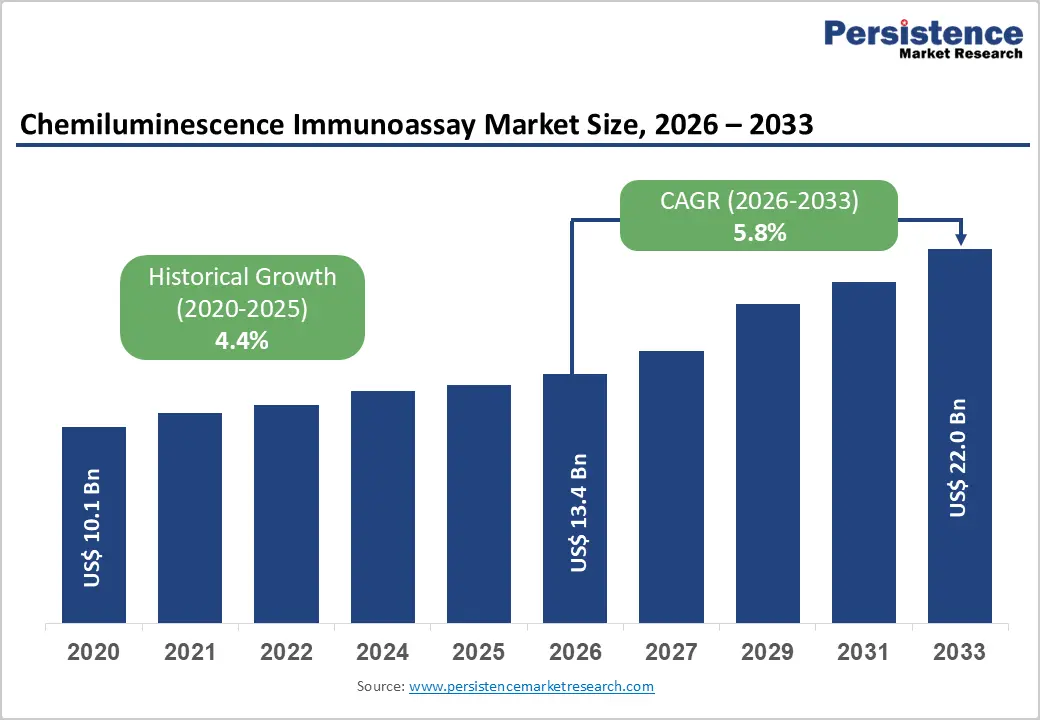
The global chemiluminescence immunoassay market size is estimated to grow from US$ 13.4 Bn in 2026 to US$ 22.0 Bn by 2033. The market is projected to record a CAGR of 5.8% during the forecast period from 2026 to 2033.
Global demand for chemiluminescence immunoassay systems is increasing steadily, driven by rising prevalence of chronic and infectious diseases, expanding laboratory infrastructure, and growing reliance on high-sensitivity, rapid diagnostic testing across hospitals, clinical laboratories, and reference centers. Increasing volumes of routine and specialized diagnostic tests, adoption of multiplex assays, and the need for accurate and reproducible biomarker measurements are supporting sustained market growth across both developed and emerging healthcare systems. Higher utilization of automated analyzers, AI-assisted result interpretation, and integrated laboratory information systems, coupled with growing test volumes for oncology, endocrine, cardiovascular, and autoimmune conditions, is further accelerating demand. Continuous improvements in assay sensitivity, reagent quality, throughput speed, and workflow automation are enhancing laboratory efficiency and diagnostic accuracy. In addition, growing investments in healthcare infrastructure, laboratory modernization, and digital health integration are further propelling the global chemiluminescence immunoassay market.
Key Industry Highlights
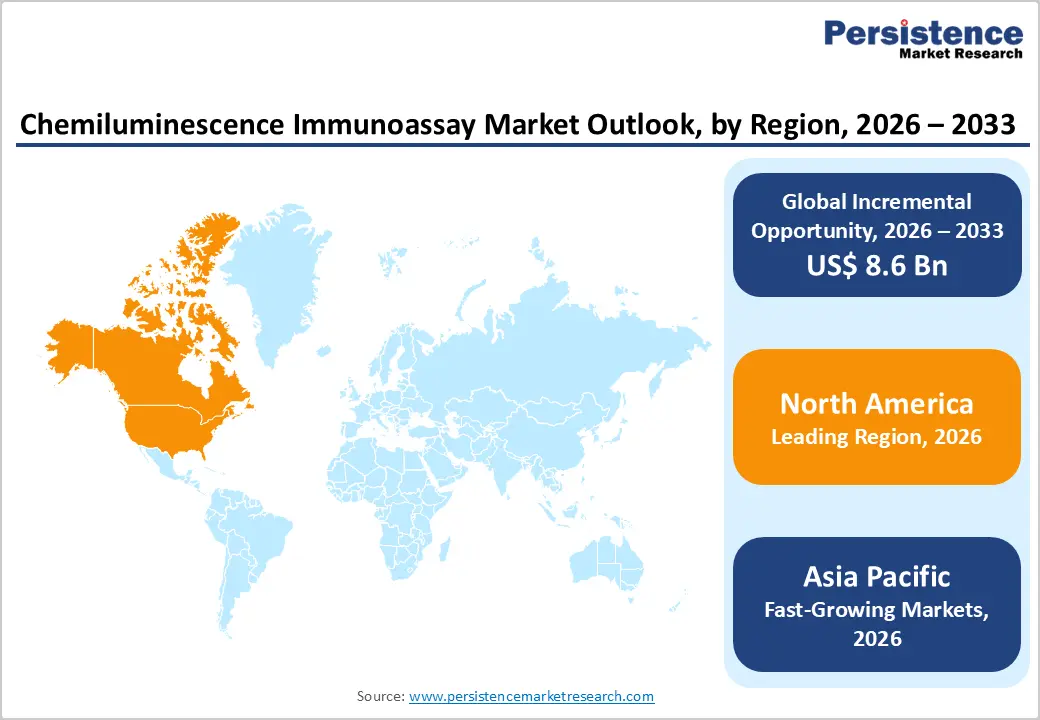
- Leading Region: North America holds the largest share at 46.7%, supported by advanced healthcare infrastructure, widespread laboratory automation, strong reimbursement frameworks, and the presence of major CLIA system providers.
- Fastest-Growing Region: Asia Pacific is expanding fastest due to rapid development of healthcare infrastructure, rising disease burden, increasing laboratory installations, and growing government healthcare investments.
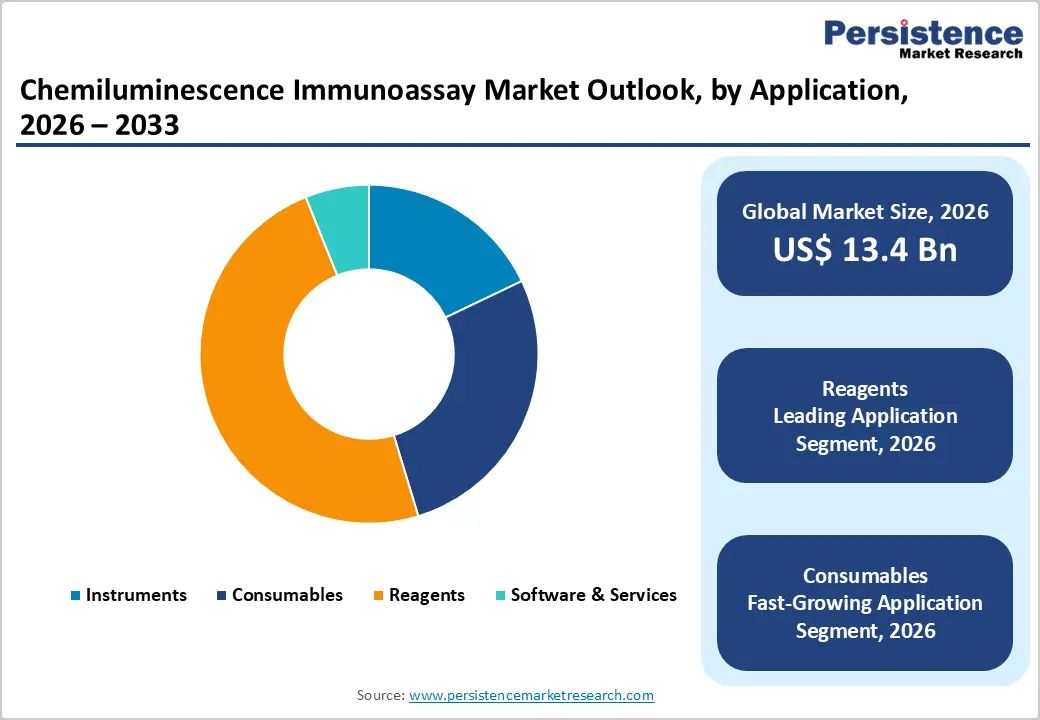
- Leading Product Segment: Reagents dominates the market due to its recurring and long-term use across all CLIA workflows, including routine testing, high-sensitivity assays, and quality control processes.
- Fastest-Growing Product Segment: Consumables are expanding rapidly as demand rises for multiplex testing, high-throughput platforms, and AI-assisted result validation.
- Leading Application Segment: Blood remains the most widely adopted sample type, driven by its critical role in accurate biomarker detection and routine clinical testing.
- Fastest-Growing Application Segment: Urine is scaling quickly as laboratories adopt faster processing, higher analytical sensitivity, and expanded use in non-invasive monitoring and screening.
| Key Insights | Details |
|---|---|
|
Chemiluminescence Immunoassay Market Size (2026E) |
US$ 13.4 Bn |
|
Market Value Forecast (2033F) |
US$ 22.0 Bn |
|
Projected Growth (CAGR 2026 to 2033) |
5.8% |
|
Historical Market Growth (CAGR 2020 to 2025) |
4.4% |
Market Dynamics
Driver – Rising Disease Burden and Growing Adoption of High-Throughput Immunoassays
The global expansion of chemiluminescence immunoassay adoption is being strongly propelled by increasing prevalence of chronic and infectious diseases worldwide, coupled with the rising demand for early and precise diagnostic testing. High-sensitivity CLIA platforms are now integral for detecting biomarkers in oncology, endocrinology, cardiology, autoimmune disorders, and infectious diseases, enabling clinicians to initiate targeted therapies and monitor treatment outcomes effectively. Growing awareness of preventive healthcare, rising laboratory automation, and the need for rapid turnaround times in high-volume clinical settings are further stimulating uptake.
Additionally, hospitals, diagnostic laboratories, and reference centers are prioritizing reproducibility, accuracy, and efficiency, which drives continuous utilization of automated analyzers and reagent kits. The expanding geriatric population intensifies the demand, as older patients are more susceptible to chronic conditions and infections, necessitating frequent monitoring. Emerging markets, where access to advanced diagnostic technologies is improving, are witnessing rapid adoption due to rising healthcare spending and infrastructure growth. Together, these factors are creating sustained demand for CLIA systems capable of delivering fast, reliable, and highly reproducible results, reinforcing their central role in modern diagnostic workflows and long-term market expansion.
Restraints – High Costs, Technical Complexity, and Regulatory Requirements
Growth is constrained by several financial, operational, and regulatory challenges associated with deploying advanced chemiluminescence immunoassay systems. The initial investment in automated analyzers, high-quality reagent kits, and laboratory information system integration can be substantial, limiting adoption among smaller hospitals and mid-sized diagnostic centers. Operational complexity, including system calibration, validation, and routine maintenance, demands specialized technical expertise, which may not be readily available in all regions. Integration with pre-existing laboratory workflows and diverse instrumentation can further extend deployment timelines and increase reliance on skilled personnel.
Stringent regulatory compliance, such as adherence to ISO standards, FDA approvals, or CE marking, adds layers of documentation, validation, and quality assurance, which can slow technology implementation. Frequent software updates, cybersecurity considerations for connected analyzers, and ongoing staff training also contribute to operational and financial burdens. In cost-sensitive healthcare systems, reimbursement limitations and budget constraints can restrict purchases, particularly in emerging economies where resource allocation is tightly monitored. These financial, technical, and compliance-related factors collectively act as significant barriers to rapid penetration of CLIA technologies, especially in smaller facilities and regions with limited infrastructure.
Opportunity – AI Integration, Multiplex Testing, and Expansion into Emerging Diagnostics Markets
Significant growth opportunities are emerging as CLIA manufacturers incorporate digital, AI-driven, and multiplex testing solutions into their platforms. Integration of artificial intelligence and machine learning is enhancing assay precision, automating result interpretation, and enabling predictive analytics for early disease detection. Multiplex immunoassays that allow simultaneous detection of multiple biomarkers are gaining traction in oncology, infectious disease, and autoimmune diagnostics, offering time and cost efficiencies for high-volume laboratories.
Expansion of laboratory infrastructure in emerging economies represents another key opportunity, as governments and private providers invest in modern diagnostics, training of laboratory personnel, and adoption of automated immunoassay platforms. Cloud-based data management, remote monitoring, and modular analyzer designs are lowering entry barriers, allowing smaller laboratories to leverage advanced technology without excessive upfront investment. Additionally, growing emphasis on personalized medicine, patient-specific treatment monitoring, and rapid diagnostic turnaround times is encouraging providers to adopt high-sensitivity, automated immunoassays. As clinical confidence in automated, AI-enabled CLIA systems grows, vendors are well-positioned to capture long-term demand across both mature and developing markets, creating sustained opportunities for revenue growth and technological innovation.
Category-wise Analysis
By Product, Reagents Lead Due to Their Essential Role in Every CLIA Test Cycle
The reagents segment is projected to dominate the global chemiluminescence immunoassay market in 2026, accounting for a revenue share of 48.6%. This dominance is driven by the indispensable role of reagents in every CLIA test, as they are consumed with each diagnostic run and directly determine assay sensitivity, specificity, and reproducibility. Unlike instruments, reagents generate recurring demand across high-volume testing environments such as hospitals and clinical laboratories. Growing test volumes for infectious diseases, oncology biomarkers, endocrine disorders, and autoimmune conditions are significantly increasing reagent consumption.
Continuous expansion of assay menus, including high-sensitivity and multiplex tests, further reinforces demand. In addition, frequent lot replacements, quality control requirements, and regulatory-driven validation contribute to consistent reagent purchases. The shift toward fully automated, high-throughput CLIA platforms also favors standardized reagent kits optimized for specific analyzers, strengthening long-term revenue stability and reinforcing the segment’s leadership position.
By Application, Therapeutic Drug Monitoring Leads Due to Its Critical Role in Treatment Optimization
The therapeutic drug monitoring segment is expected to dominate the global chemiluminescence immunoassay market in 2026, accounting for a revenue share of 23.0%. This leadership is driven by the growing need for precise measurement of drug concentrations to ensure optimal dosing, minimize toxicity, and improve treatment outcomes. CLIA-based assays are widely used for monitoring immunosuppressants, antiepileptics, antibiotics, and oncology drugs due to their high sensitivity and rapid turnaround times.
Increasing prevalence of chronic diseases, rising organ transplant procedures, and broader use of personalized medicine approaches are expanding the clinical importance of therapeutic drug monitoring. Hospitals and reference laboratories rely heavily on CLIA platforms to support routine and repeat testing throughout treatment cycles. Additionally, stricter clinical guidelines emphasizing therapeutic range compliance and patient safety continue to accelerate adoption, positioning therapeutic drug monitoring as the most revenue-generating application segment.
By End User, Hospitals Dominate Due to High Testing Volumes and Integrated Diagnostic Infrastructure
The hospitals segment is projected to dominate the global chemiluminescence immunoassay market in 2026, accounting for a revenue share of 30.0%. Hospitals represent the primary setting for diagnosis, disease monitoring, and treatment decision-making, resulting in high and consistent utilization of CLIA-based testing. Large patient inflows for infectious diseases, oncology, cardiology, and endocrine disorders drive continuous demand for rapid and accurate immunoassays.
Hospitals are more likely to invest in fully automated, high-throughput CLIA analyzers integrated with laboratory information systems, enabling efficient workflow management and faster clinical reporting. The presence of specialized departments, centralized laboratories, and trained laboratory professionals further supports adoption. Additionally, expansion of tertiary care hospitals and multispecialty facilities, particularly in emerging economies, continues to reinforce hospitals as the dominant end-user segment within the global market.
Region-wise Insights
North America Chemiluminescence Immunoassay Market Trends
North America is expected to dominate the global chemiluminescence immunoassay market with a value share of 46.7% in 2026, led primarily by the United States. The region benefits from a highly advanced healthcare system, widespread adoption of automated laboratory diagnostics, and strong emphasis on early disease detection. High prevalence of infectious diseases, cancer, cardiovascular disorders, and endocrine conditions drives sustained demand for high-sensitivity immunoassays.
Clinical laboratories and hospitals in North America routinely adopt advanced CLIA platforms to support large test volumes and rapid turnaround requirements. Favorable reimbursement frameworks and well-established clinical guidelines encourage routine use of immunoassay testing across care settings. The region is also home to several leading CLIA manufacturers, enabling rapid commercialization of new assays and continuous technological upgrades. Strong regulatory oversight ensures high diagnostic standards, while growing adoption of personalized medicine and companion diagnostics further supports long-term market leadership.
Europe Chemiluminescence Immunoassay Market Trends
The Europe chemiluminescence immunoassay market is expected to grow steadily, supported by well-established public healthcare systems, increasing disease burden, and a strong focus on diagnostic accuracy. Countries such as Germany, the U.K., France, Italy, and the Nordic nations show high utilization of laboratory immunoassays across hospitals and centralized diagnostic facilities. Aging populations and rising prevalence of chronic diseases, including cancer and autoimmune disorders, are increasing demand for routine and specialized CLIA testing. Europe demonstrates strong adherence to regulatory standards and quality assurance protocols, which supports consistent use of validated immunoassay platforms.
Public healthcare funding ensures broad access to diagnostic services, maintaining steady test volumes across regions. In addition, growing emphasis on early diagnosis, preventive screening programs, and laboratory automation is driving adoption of high-throughput CLIA systems. Continued investment in healthcare modernization and diagnostic infrastructure is expected to support sustained market expansion across Europe.
Asia Pacific Chemiluminescence Immunoassay Market Trends
The Asia Pacific chemiluminescence immunoassay market is expected to register a relatively higher CAGR of around 7.9% between 2026 and 2033, driven by rapid expansion of healthcare infrastructure and rising diagnostic demand. Large populations in China, India, Japan, and Southeast Asia, combined with increasing prevalence of infectious diseases, diabetes, cancer, and cardiovascular conditions, are significantly boosting immunoassay testing volumes. Governments across the region are investing in hospital expansion, laboratory modernization, and diagnostic capacity building to improve access to healthcare services.
Growing medical tourism in countries such as India, Thailand, and Malaysia further increases demand for reliable and cost-effective diagnostic solutions. Price-sensitive markets are encouraging adoption of scalable CLIA platforms offered by regional manufacturers. Additionally, improving insurance coverage, increasing awareness of early disease diagnosis, and wider availability of automated laboratory systems are expected to sustain long-term growth across the Asia Pacific region.
Market Competitive Landscape
The global chemiluminescence immunoassay market is highly competitive, with strong participation from companies such as DiaSorin S.p.A., Abbott Laboratories, Shenzhen Mindray Bio-Medical Electronics Co., Ltd., Immunodiagnostic Systems, and Siemens Healthineers. These players leverage extensive global distribution and service networks, strong brand recognition, and continuous innovation across automated analyzers, high-sensitivity reagents, and integrated laboratory informatics to deliver accurate, high-throughput, and reliable immunoassay testing across clinical settings.
Rising demand for early and precise disease diagnosis, increasing testing volumes for infectious diseases, oncology, endocrinology, and autoimmune disorders, and growing adoption of fully automated laboratory workflows are driving portfolio expansion and competitive differentiation. Vendors are increasingly focusing on enhanced assay sensitivity, reduced turnaround times, broader test menus, and seamless integration with laboratory information systems (LIS). Strategic priorities include strengthening partnerships with hospitals and diagnostic laboratories, expanding presence in emerging healthcare markets, and sustained investment in R&D to support next-generation CLIA platforms and multiplex assay capabilities, thereby supporting long-term market growth.
Key Industry Developments:
- In January 2026, AIIMS Delhi launched free in?house Therapeutic Drug Monitoring tests for epilepsy patients, measuring blood levels of key anti?epileptic drugs to ensure safe and effective dosing, reduce treatment toxicity, and lower patient costs.
- In January 2025, Anbio Biotechnology, a global pioneer in diagnostic technologies, unveiled its Dry Chemiluminescence Immunoassay (CLIA) Solution ADL-1000, a cutting-edge platform engineered to provide fast, accurate, and cost-efficient diagnostic results. Designed for a wide range of clinical environments, this innovative solution meets the increasing need for efficient workflows and high-performance immunoassay testing.
Companies Covered in Global Chemiluminescence Immunoassay Market
- DiaSorin S.p.A.
- Abbott Laboratories
- Shenzhen Mindray Bio-Medical Electronics Co., Ltd.
- Immunodiagnostic Systems
- Siemens Healthineers
- Beckman Coulter Inc.
- F. Hoffmann-La Roche AG
- Inova Diagnostics, Inc.
- Maccura Biotechnology Co., Ltd.
- Ortho Clinical Diagnostics
- Thermo Fisher Scientific Inc.
- PerkinElmer Inc.
- Sysmex Corporation
- Autobio Diagnostics Co., Ltd
- Others
Frequently Asked Questions
The global chemiluminescence immunoassay market is projected to be valued at US$ 13.4 Bn in 2026.
Rapidly increasing prevalence of infectious and chronic diseases worldwide, elevating demand for early, accurate, and high-throughput diagnostic solutions.
The global chemiluminescence immunoassay market is poised to witness a CAGR of 5.8% between 2026 and 2033.
Expansion into emerging markets and integration of advanced digital, AI-enabled, and multiplex CLIA technologies for broader applications.
DiaSorin S.p.A., Abbott Laboratories, Shenzhen Mindray Bio-Medical Electronics Co., Ltd., Immunodiagnostic Systems, and Siemens Healthineers are some of the key players in the chemiluminescence immunoassay market.


