




- Medical Devices
- Bowie-Dick Test Kit Market
Bowie-Dick Test Kit Market Size, Share, and Growth Forecast, 2026 - 2033
Bowie-Dick Test Kit Market by Product Type (Single-use, Reusable), End-User (Pharmaceutical & Medical Device Company, Laboratories, Clinics, Hospitals), Sterilization Process (Steam, Air Removal, Pre-Vacuum Steam), and Regional Analysis for 2026-2033

Bowie-Dick Test Kit Market Share and Trends Analysis
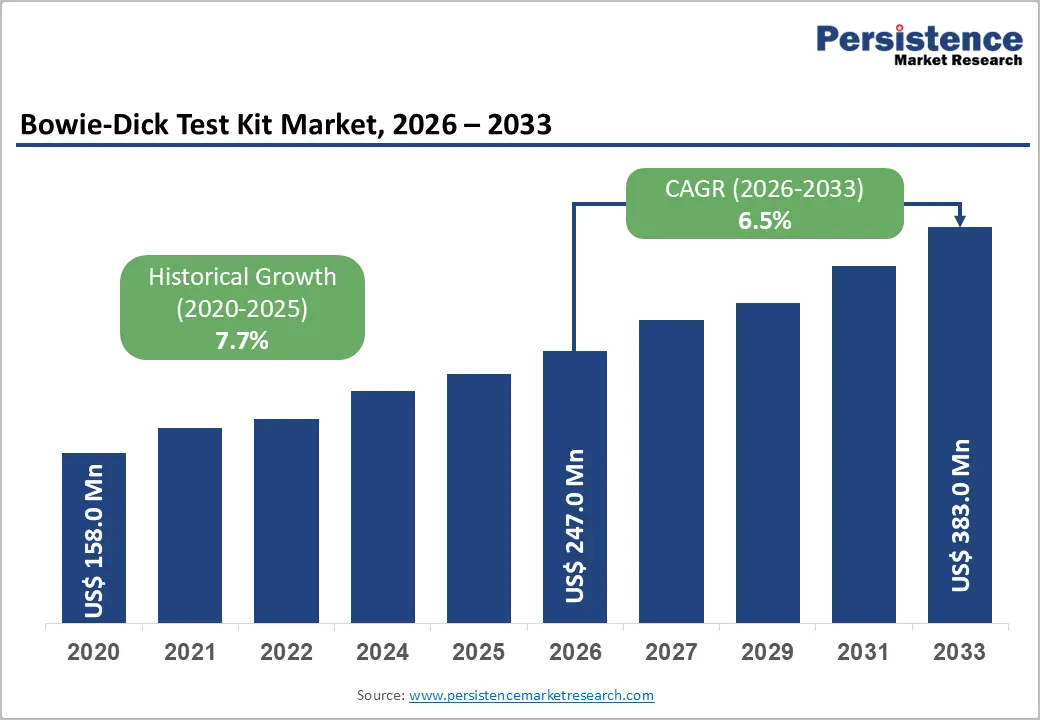
The global Bowie-Dick test kit market size is likely to be valued at US$ 247.0 million in 2026, and is projected to reach US$ 383.0 million by 2033, growing at a CAGR of 6.5% during the forecast period 2026−2033.
Market expansion is being driven by stronger global focus on infection prevention and stricter sterilization verification requirements across healthcare and pharmaceutical facilities. Regulatory oversight is increasing the need for reliable autoclave monitoring, which is strengthening demand for compliant sterilization testing solutions. Healthcare providers are deploying Bowie-Dick test packs to validate the performance of pre vacuum steam sterilizers and ensure proper air removal during sterilization cycles.
Hospitals, laboratories, and pharmaceutical manufacturers are adopting single use test kits to meet sterilization assurance standards and maintain patient safety protocols. Infection control programs addressing hospital acquired infections (HAIs), guided by frameworks from the World Health Organization (WHO) and the U.S. Centers for Disease Control and Prevention (CDC), are reinforcing routine sterilization monitoring practices and supporting steady adoption of Bowie-Dick testing systems across healthcare infrastructure.
Key Industry Highlights
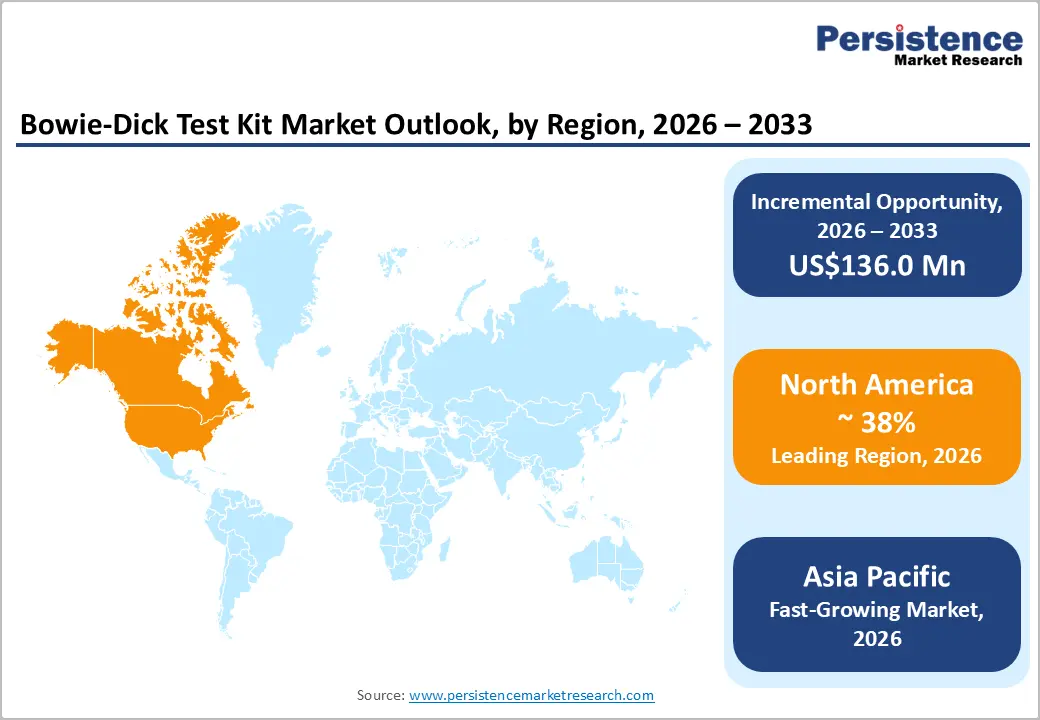
- Dominant Region: North America is expected to command about 38% market share in 2026, owing to stringent regulatory frameworks and a high level of awareness about infection control.
- Fastest-growing Market: The Asia Pacific market is poised to be the fastest-growing during the 2026-2033 forecast period, due to rapidly expanding healthcare sector and increasing medical tourism.
- Leading & Fastest-growing Product Type: Single-use kits are likely to dominate with about 62% revenue share in 2026, while reusable is set to be the fastest-growing segment through 2033.
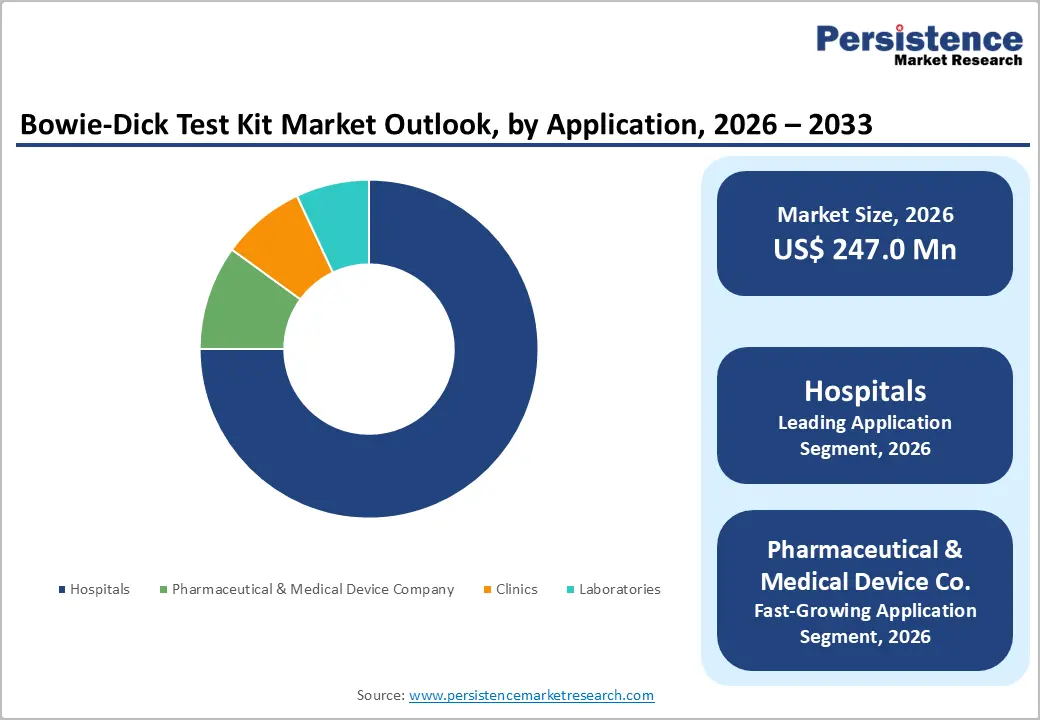
- Leading & Fastest-growing End-User: Hospitals are expected to lead with approximately 75% revenue share in 2026, whereas pharmaceutical & medical device companies are likely to be the fastest-growing segment over the 2026-2033 forecast period.
| Key Insights | Details |
|---|---|
|
Bowie-Dick Test Kit Market Size (2026E) |
US$ 247.0 Mn |
|
Market Value Forecast (2033F) |
US$ 383.0 Mn |
|
Projected Growth (CAGR 2026 to 2033) |
6.5% |
|
Historical Market Growth (CAGR 2020 to 2025) |
7.7% |
Market Factors – Growth, Barriers, and Opportunity Analysis
Stringent Regulatory Mandates for Sterilization Validation
Regulatory agencies are strengthening sterilization governance across healthcare environments, which is reinforcing demand for Bowie Dick test kits. In the United States, the Food and Drug Administration (FDA) requires healthcare facilities to follow the Association for the Advancement of Medical Instrumentation and American National Standards Institute standard for steam sterilization (ANSI/AAMI ST79). In Europe, the European Union (EU) Medical Device Regulation (MDR) requires detailed documentation that verifies sterilization performance. These frameworks require daily Bowie Dick testing in pre vacuum sterilizers to detect residual air pockets and confirm effective pathogen removal. Healthcare providers are prioritizing compliance to reduce operational risks and maintain regulatory approval.
Hospitals and pharmaceutical production sites are integrating routine sterilization verification into operational protocols to meet these requirements. High volume facilities are documenting test outcomes for regulatory audits while strengthening patient safety practices. Manufacturers are developing improved test kits that simplify result interpretation and reduce operator error. Global alignment of sterilization standards is increasing confidence in standardized monitoring procedures across healthcare systems. Regulatory bodies are also strengthening traceability requirements, which is reinforcing long term demand for validated sterilization testing solutions.
Expansion of Surgical Infrastructure in Emerging Markets
Hospital networks and surgical facilities are expanding rapidly across Asia Pacific, the Middle East, and Latin America as governments and private investors strengthen healthcare infrastructure. National programs are supporting this growth, including the Ayushman Bharat initiative in India, which is establishing extensive health and wellness centers to expand treatment capacity. In China, the Fourteenth Five Year Plan is directing investment toward secondary and tertiary hospitals equipped with advanced operating facilities. Private healthcare providers are also developing specialty clinics and outpatient centers in major urban areas. These developments are increasing procedure volumes and reinforcing the need for reliable sterilization systems.
Healthcare providers across these regions are aligning operations with international sterilization standards, which is strengthening demand for Bowie-Dick test kits. Facilities are deploying pre vacuum sterilizers in routine workflows and performing daily verification tests to confirm effective air removal. Procurement teams are establishing long term supply agreements with equipment providers to maintain compliance with sterilization protocols. Manufacturers are localizing production to reduce logistics costs and accelerate product delivery. Partnerships between global companies and regional healthcare organizations are also supporting technology transfer and improving standardization across sterilization practices.
Availability of Alternative Sterilization Monitoring Technologies
Alternative sterilization assurance technologies are creating competitive pressure for the Bowie-Dick test kit market. Healthcare facilities are adopting biological indicators (BIs), chemical indicators (CIs), and integrated electronic monitoring systems that operate within modern autoclaves. Advanced sterilizers now include built in data logging and real time cycle validation that provide detailed performance records without relying on external testing kits. Hospitals are known to generally prefer these technologies as they deliver precise monitoring and simplify workflow management. Healthcare institutions are also expanding the use of ethylene oxide (EtO) and hydrogen peroxide plasma sterilization for heat sensitive medical devices, which eliminates the need for air removal verification tests.
Advanced healthcare systems are increasingly adopting integrated sterilization monitoring platforms that support digital documentation and remote access to operational data. These capabilities reduce dependence on standalone consumable test kits. However, regulatory requirements for multilayer sterilization validation still require Bowie-Dick testing in facilities operating pre vacuum steam sterilizers. Equipment suppliers are responding by developing hybrid indicators that integrate with digital monitoring platforms and improve compatibility with modern sterilization infrastructure. Procurement teams are also evaluating total cost of ownership when selecting sterilization assurance tools, which is encouraging adoption of flexible solutions that adapt to evolving healthcare technology environments.
High Cost Sensitivity in Price-Constrained Healthcare Environments
Bowie-Dick test kits function as routine consumables within sterilization workflows, yet recurring procurement costs are influencing purchasing decisions. Public hospitals and healthcare facilities operating under limited budgets are carefully evaluating these expenses. Administrators in regions such as Sub Saharan Africa, Southeast Asia, and parts of Latin America are seeking cost efficient solutions while maintaining sterilization compliance. Procurement teams are comparing branded products with generic alternatives and adjusting testing practices to manage operational spending. Suppliers often encounter slower market penetration in these regions as buyers prioritize affordability over advanced product features.
Budget constraints are shaping long term adoption patterns in price sensitive healthcare systems. Facility managers are negotiating bulk procurement agreements or sourcing products locally to reduce unit costs. High volume hospitals are securing discounts through long term contracts, while smaller clinics are evaluating multipurpose sterilization indicators that reduce overall consumption. Manufacturers are introducing cost optimized variants that meet regulatory requirements while lowering price points. Partnerships with regional distributors are also strengthening training and technical support, which helps healthcare providers justify investments through improved operational efficiency.
Digital Integration and Smart Sterilization Monitoring
Digital integration is creating new opportunities for Bowie-Dick test kit manufacturers as healthcare facilities adopt connected sterilization management systems. Providers are developing test kits that interface with electronic health records (EHRs) and central sterile services department (CSSD) software platforms. These solutions allow healthcare staff to track sterilization compliance in real time and generate automated audit records. Facilities are linking physical test results with digital documentation systems through technologies such as quick response (QR) codes and radio frequency identification (RFID) tags. This approach reduces manual data entry errors and strengthens regulatory reporting across hospital sterilization operations.
Equipment suppliers are leveraging digital convergence to introduce advanced sterilization monitoring products with added analytical capabilities. Partnerships with healthcare software developers are ensuring interoperability across clinical data systems and accelerating adoption in hospitals and pharmaceutical facilities. Digital integration also enables predictive analytics that identify sterilization equipment issues before operational failures occur. Healthcare organizations are prioritizing integrated monitoring ecosystems that strengthen compliance oversight and operational efficiency. Manufacturers are investing in scalable digital solutions that align with healthcare infrastructure upgrades and support long term sterilization quality management.
Technological Advancements in Sterilization and Testing Methods
Manufacturers are introducing redesigned Bowie-Dick test packs that use advanced materials to improve sensitivity and durability. These enhancements enable healthcare staff to detect air removal failures in pre vacuum sterilizers with greater accuracy during routine verification procedures. Updated kits also feature clearer color change indicators that simplify result interpretation and reduce operational errors in busy sterilization departments. Hospitals and pharmaceutical facilities are adopting these improved designs to strengthen compliance with international sterilization standards while maintaining efficient workflow management.
Modern sterilization environments are also integrating Bowie-Dick testing with automated monitoring systems. Advanced autoclaves now include built in sensors that complement physical verification tests and provide comprehensive cycle validation. Test outcomes are increasingly uploaded to centralized systems, which reduces manual documentation and improves data accuracy. Manufacturers are embedding features such as scannable codes that enable seamless data capture within digital sterilization platforms. This integration is strengthening quality assurance processes and positioning Bowie-Dick test kits as essential components within digitally managed sterilization ecosystems.
Category-wise Analysis
Product Type Insights
Single-use kits are expected to dominate the product type category by accounting for about 62% of the Bowie-Dick test kit market revenue share in 2026. Healthcare facilities prefer these kits because they provide simple sterilization validation without the need for requalification between uses. Hospitals and smaller medical centers adopt them to reduce cross contamination risks and maintain strict infection prevention practices. Their disposable design supports consistent daily air removal verification in pre-vacuum sterilizers, which aligns with patient safety protocols and regulatory compliance requirements.
Reusable Bowie-Dick test kits are projected to record the fastest growth from 2026 to 2033. These systems support repeated sterilization cycles, which lowers long term operational costs for high volume facilities. Large hospitals, laboratories, and pharmaceutical production sites are adopting reusable packs because they provide durable performance during frequent sterilization validation procedures. Manufacturers are producing these kits with robust materials that maintain testing accuracy across repeated cycles, allowing healthcare providers to balance cost efficiency with reliable sterilization monitoring.
End-User Insights
Hospitals represent the dominant application area and are projected to account for about 75% of the Bowie-Dick test kit market share in 2026. Healthcare facilities operate under strict sterilization protocols designed to reduce healthcare associated infections (HAIs). Clinical staff perform daily Bowie Dick tests to verify sterilizer performance and confirm effective pathogen removal from surgical instruments and medical devices. Growing surgical volumes and expanding healthcare infrastructure are increasing reliance on these verification procedures. Central sterile services departments (CSSDs) integrate Bowie-Dick test packs into routine sterilization workflows to maintain operational safety and regulatory compliance.
Pharmaceutical and medical device manufacturers are expected to record the fastest growth during the 2026 to 2033 period. Production facilities operate under Good Manufacturing Practice (GMP) regulations that require frequent sterilization validation across high throughput manufacturing environments. Operators perform routine Bowie-Dick testing to verify air removal during sterilization cycles used for injectables and implantable devices. Expansion of biotechnology manufacturing and rising demand for complex therapeutics are increasing sterilization requirements across production lines. Companies are adopting reliable testing solutions to meet strict regulatory audits and prevent costly product recalls.
Regional Insights
North America Bowie-Dick Test Kit Market Trends
North America is anticipated to secure about 38% of the Bowie-Dick test kit market value in 2026, supported by advanced healthcare infrastructure and strict regulatory oversight. In the United States, the FDA requires compliance with the Association for the Advancement of Medical Instrumentation and American National Standards Institute standard for steam sterilization. These regulations require daily Bowie-Dick testing in pre vacuum sterilizers across hospitals and laboratories.
Healthcare facilities rely on these kits to verify air removal and ensure sterile surgical instruments. The region also hosts several leading sterilization technology providers, which supports innovation in test kit design and distribution networks.
Healthcare systems across North America are expanding CSSD capabilities to meet growing procedural demand. Hospitals are adopting digital compatible test packs that integrate with autoclave monitoring software to strengthen traceability during regulatory audits. A mature healthcare ecosystem is enabling rapid adoption of advanced sterilization indicators that reduce operational errors in high volume environments. Strong collaboration between healthcare providers and equipment manufacturers is sustaining demand for validated sterilization testing solutions.
Regional buyers are prioritizing quality assurance and regulatory compliance, which supports stable market growth and reinforces North America’s leadership position.
Europe Bowie-Dick Test Kit Market Trends
Europe stands out as a significant market for Bowie-Dick test kits due to its well established healthcare systems and strict regulatory oversight. Germany, France, and the United Kingdom are leading adoption across hospitals and pharmaceutical production facilities. The EU MDR requires detailed sterilization documentation, which obligates healthcare providers to perform routine air removal verification in pre vacuum sterilizers. Facilities integrate Bowie-Dick testing into standard sterilization protocols to confirm equipment performance and protect patient safety.
Manufacturers are also introducing improved kit designs that simplify result interpretation and support efficient compliance management.
Healthcare systems across Europe are investing in modern CSSDs to strengthen infection prevention and support rising procedural demand. Hospitals and pharmaceutical manufacturers are integrating sterilization monitoring data with digital compliance platforms to improve audit readiness and operational transparency. Equipment suppliers are collaborating with regulatory authorities to develop standardized indicators that meet diverse national requirements across the EU. These efforts are enabling healthcare organizations to strengthen quality assurance practices and reduce sterilization process risks, which is sustaining steady demand for Bowie-Dick verification tools.
Asia Pacific Bowie-Dick Test Kit Market Trends
Asia Pacific is forecast to be the fastest-growing market for Bowie-Dick test kits through 2033, driven by rapid healthcare infrastructure expansion and stronger infection prevention initiatives. China, India, and Japan are investing in new hospitals and pharmaceutical manufacturing facilities that require modern sterilization systems. Government programs are supporting healthcare modernization by installing pre vacuum sterilizers that require routine air removal verification.
Medical tourism centers are also adopting international sterilization protocols to attract global patients, which is strengthening demand for standardized testing practices. Regional manufacturers are scaling production while healthcare providers are training staff to perform reliable sterilization validation procedures.
The region is expected to strengthen its role as a major growth engine by the end of the forecast period as public and private investment expands healthcare capacity. Hospitals are integrating Bowie-Dick testing within CSSD operations to maintain quality assurance amid rising procedure volumes. Suppliers are introducing cost efficient product variants tailored to diverse healthcare facilities, which supports wider adoption across emerging economies. Technology partnerships are improving regional sterilization expertise and strengthening compliance capabilities.
Large healthcare networks are also leveraging bulk procurement strategies that balance affordability with consistent sterilization performance.
Competitive Landscape
The global Bowie-Dick test kit market exhibits a moderately consolidated structure, with leading companies such as 3M, Steris, Getinge, Crosstex International, and Terragene together accounting for about 60% of total market revenue. These organizations maintain strong positions through advanced product development and extensive distribution networks across healthcare and pharmaceutical sectors. Manufacturers are enhancing test pack designs to deliver higher accuracy in air removal detection during sterilization validation procedures. Companies are also investing in research and development (R&D) to introduce improved testing solutions that meet evolving sterilization compliance requirements.
Competitive dynamics are shaped by strategic partnerships, mergers, and acquisitions that expand technological capabilities and geographic presence. Industry participants are collaborating to combine expertise in sterilization monitoring technologies and strengthen product portfolios. Consolidation strategies are also enabling companies to accelerate market entry in emerging healthcare regions and address diverse customer requirements. These initiatives are supporting broader adoption of advanced sterilization verification tools across hospitals, laboratories, and pharmaceutical manufacturing facilities.
Key Industry Developments
- PRIMA Bowie-Dick Autoclave Test Packs are disposable chemical indicator packs designed for daily performance checks of pre-vacuum steam sterilizers. They verify proper air removal and steam penetration during sterilization cycles and produce a clear color change to confirm effective autoclave operation under standard conditions.
- Steraffirm Bowie-Dick Test Packs are pre-assembled, single-use chemical indicator packs designed to verify air removal efficiency in pre-vacuum steam sterilizers. They deliver a clear yellow-to-blue/purple color change for easy interpretation, support traceable documentation, and comply with ISO 11140 Type 2 sterilization monitoring standards.
- VERIFY Bowie-Dick Test Cards by Steris are chemical indicator cards designed to evaluate air removal and steam penetration efficiency in pre-vacuum steam sterilizers. The card is placed in the sterilizer chamber and produces a distinct color change that confirms proper air displacement and sterilization performance, while also providing a recordable indicator sheet for documentation.
Companies Covered in Bowie-Dick Test Kit Market
- 3M Company
- Steris plc
- Getinge AB
- Crosstex International
- Hu-Friedy
- Terragene S.A.
- Sychem Limited
- Propper Manufacturing
- Mediset International
- GKE GmbH
- Andersen Sterilizers
- Tuttnauer Co. Ltd.
- Shinva Medical Instrument
- Matachana Group
- Nanning Surgitex Medical
Frequently Asked Questions
The global bowie-dick test kit market is projected to reach US$ 247.0 million in 2026.
Unprecedented healthcare expansion and rising number of hospital-acquired infection cases are driving consistent demand in the market.
The market is poised to witness a CAGR of 6.5% from 2026 to 2033.
Major opportunities lie in rapid infrastructure growth in the Asia Pacific, which is opening opportunities amid medical tourism and standardization efforts.
3M Company, Steris plc, Getinge AB, Crosstex International, and Terragene S.A. are some of the key players in the market.


