




- Sensors & Controls
- Baggage Scanner Market
Baggage Scanner Market Size, Share, and Growth Forecast, 2026 - 2033
Baggage Scanner Market by Product Type (X-ray Scanners, CT Scanners, Metal Detectors, Others), Application (Airports, Railway Stations, Border Checkpoints, Others), Component (Hardware, Software, Services), and Regional Analysis for 2026-2033

Baggage Scanner Market Share and Trends Analysis
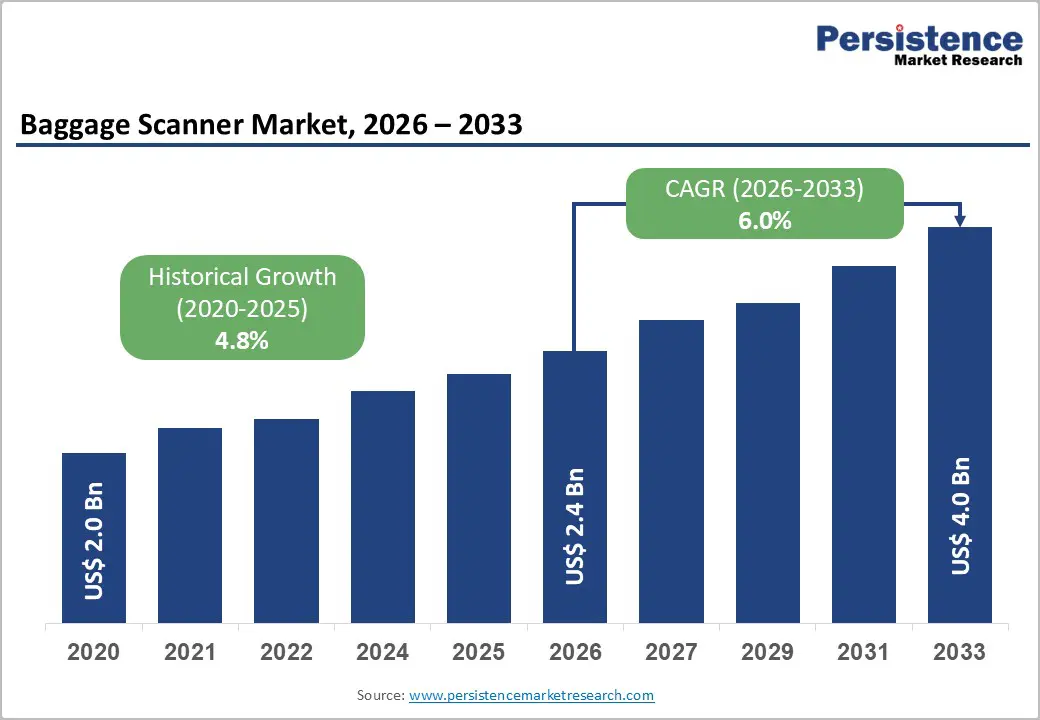
The global baggage scanner market size is likely to be valued at US$ 2.4 billion in 2026, and is projected to reach US$ 4.0 billion by 2033, growing at a CAGR of 6.0% during the forecast period 2026−2033. Market growth is supported by rising global air passenger traffic and stricter security requirements across transportation infrastructure.
Airports and border authorities are adopting computed tomography (CT)-based screening systems that deliver higher detection accuracy. Governments are also increasing investment in security infrastructure, while artificial intelligence (AI)-enabled threat detection technologies are improving screening efficiency across both developed and emerging economies.
Key Industry Highlights
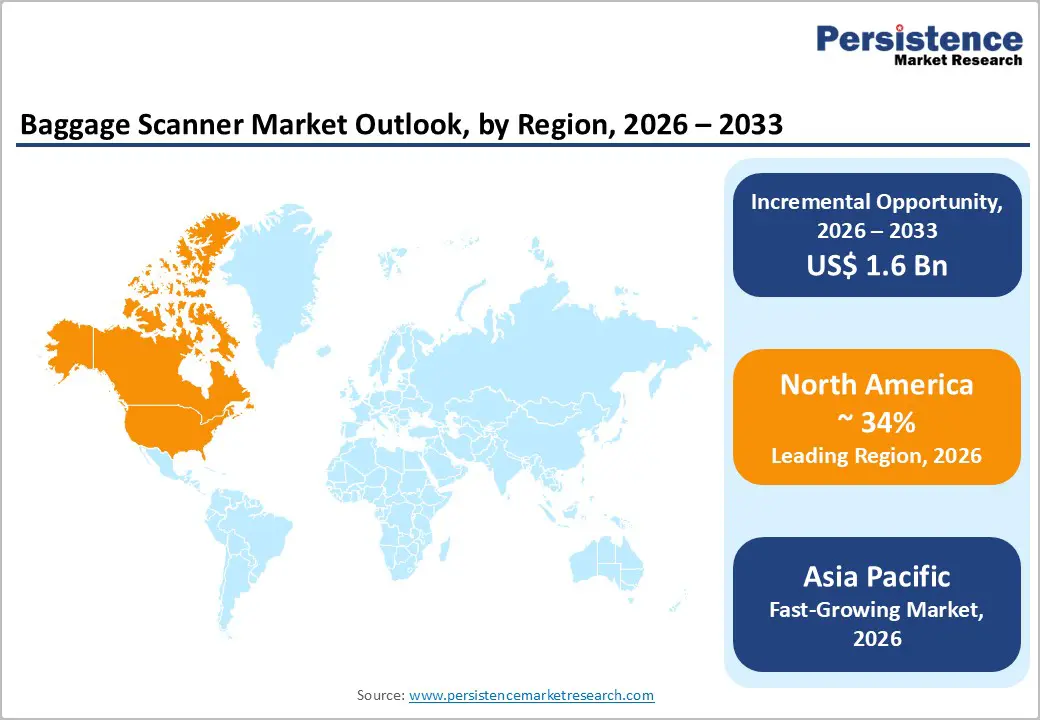
- Dominant Region: North America is expected to hold a market share of about 34% share in 2026, driven by a robust transportation infrastructure and stringent security regulations.
- Leading & Fastest-growing Product Type: X-ray baggage scanners are set to command approximately 58% revenue share in 2026, while CT scanners are likely to be the fastest-growing segment during the 2026-2033 forecast period.
- Fastest-growing Market: Asia Pacific is poised to be the fastest-growing market through 2033, due to escalating air passenger traffic.
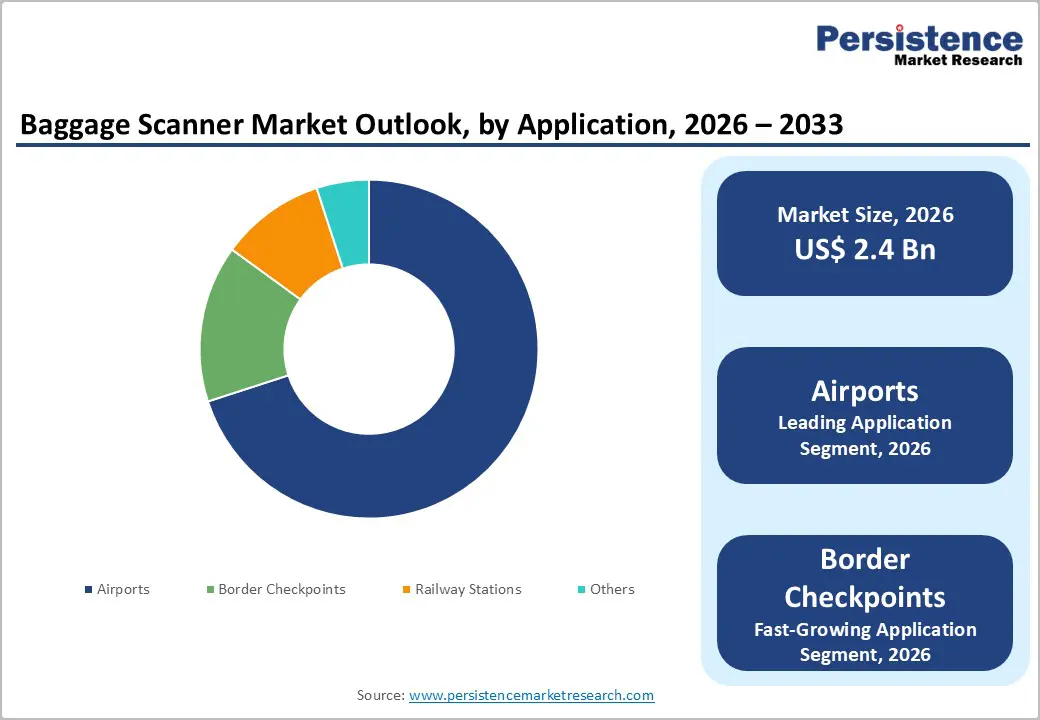
- Leading & Fastest-growing Application: Airports are projected to capture roughly 80% of market revenue share in 2026, with border checkpoints growing the fastest from 2026 to 2033.
- October 2025: Ahmedabad’s Sardar Vallabhbhai Patel International Airport launched a cutting-edge customs baggage screening system unique to Indian airports, allowing officials to track luggage through nine streamlined steps.
| Key Insights | Details |
|---|---|
| Baggage Scanner Market Size (2026E) | US$ 2.4 Bn |
| Market Value Forecast (2033F) | US$ 4.0 Bn |
| Projected Growth (CAGR 2026 to 2033) | 6.0% |
| Historical Market Growth (CAGR 2020 to 2025) | 4.8% |
Market Factors – Growth, Barriers, and Opportunity Analysis
Surge in Global Air Travel and Airport Infrastructure Investment
Global aviation traffic is rebounding after the pandemic, which is driving airport modernization programs across major regions. Airports Council International (ACI) reports that operators are allocating significant capital toward infrastructure upgrades, particularly security systems. Countries in Asia Pacific and the Middle East are leading these investments through national aviation development programs. India is expanding regional connectivity through the Ude Desh ka Aam Naagrik (UDAN) initiative, while the UAE and Saudi Arabia are advancing airport expansion under Saudi Vision 2030. These initiatives are supporting the construction of new terminals and the expansion of existing aviation hubs.
Modern airport facilities require advanced screening systems capable of processing rising passenger volumes while maintaining high security standards. Operators are deploying scanners that incorporate AI-driven threat detection and automated image analysis to improve screening accuracy. These systems are reducing false alarms and accelerating passenger throughput at security checkpoints. Governments are also tightening aviation security regulations, which is prompting airports to replace aging equipment with modern solutions. Emerging markets are benefiting significantly from this shift as they install scalable security infrastructure aligned with projected traffic growth. Technology providers are strengthening partnerships with airport developers to integrate screening systems seamlessly with baggage handling networks and terminal operations.
Technological Advancement in AI Integration and CT Scanning
The aviation security market is shifting from conventional X-ray screening systems to CT-based baggage scanners. These advanced systems integrate AI algorithms that generate detailed three-dimensional images for clearer inspection. Security personnel can distinguish between organic and inorganic materials with greater accuracy, which improves threat identification. Airports are adopting this technology to strengthen detection performance and reduce operational inefficiencies caused by false alarms. Improved imaging clarity is also accelerating passenger screening by enabling faster security decisions.
Companies such as Smiths Detection and Analogic Corporation are developing systems that automatically identify explosives and restricted items using real-time data analysis. These machines flag suspicious objects without manual intervention, which enhances screening reliability. Governments and international aviation authorities are supporting the transition through updated security regulations and standardized imaging requirements. Airports are replacing legacy equipment with AI-enabled scanners while training staff to operate user-friendly interfaces. Equipment suppliers are also collaborating with airport technology integrators to connect screening systems with baggage handling networks, which improves operational flow and reduces maintenance complexity.
High Capital and Lifecycle Costs
Advanced CT baggage scanners involve high acquisition costs, which is slowing adoption across many airports. Budget constraints in developing economies are limiting investment in these systems because operators are prioritizing essential airport services over major security upgrades. Installation also requires specialized technicians and detailed calibration to ensure accurate imaging performance. Staff must receive training to operate complex interfaces, while maintenance programs require dedicated components and technical support. These requirements increase the total cost of ownership. As a result, airports in cost-sensitive markets are retaining conventional 2D X-ray scanners because they remain familiar and require lower investment.
Procurement cycles are therefore becoming longer for equipment suppliers. Airport expansion projects often exceed initial budgets, which forces governments to reallocate funds and delay security technology purchases. Operators are exploring financing mechanisms such as public private partnerships (PPPs) to distribute investment costs over longer periods. Leasing arrangements are also emerging as practical options for gradual technology adoption across airport terminals. Equipment manufacturers are responding by introducing modular scanner platforms that allow phased upgrades and flexible deployment. Some suppliers are also bundling maintenance and service agreements to reduce upfront costs. Although legacy systems remain in use, tightening aviation security regulations are expected to accelerate modernization over time.
Regulatory Complexity and Lengthy Certification Processes
Baggage screening systems must meet strict certification standards set by multiple aviation security authorities. The Transportation Security Administration (TSA) in the United States requires rigorous validation of threat detection performance. The European Civil Aviation Conference (ECAC) establishes harmonized evaluation procedures across member states to ensure consistent aviation security standards. National aviation regulators also define additional requirements based on regional risk assessments. Equipment manufacturers must therefore conduct extensive laboratory testing, field trials, and performance validation before receiving operational approval. Certification processes require detailed technical documentation and repeated system evaluations, which often extend product deployment timelines.
Regulatory complexity affects smaller technology vendors more significantly than established manufacturers. Large firms can distribute compliance costs across global product portfolios and maintain dedicated regulatory teams. Smaller companies often face resource constraints when pursuing approvals across several jurisdictions simultaneously. This dynamic strengthens the position of established suppliers and contributes to consolidation within the aviation security technology sector. Manufacturers are addressing these challenges by designing modular platforms that adapt to different regulatory environments with limited engineering changes. International efforts to harmonize aviation security standards may gradually reduce certification barriers and enable faster deployment of advanced screening technologies at airports worldwide.
AI Integration for Superior Threat Detection
AI integration is transforming the global baggage scanner market by improving threat detection and operational efficiency. AI algorithms are analyzing scan data in real time and identifying suspicious items with greater accuracy than traditional manual inspection methods. Machine learning models are training on large image datasets to recognize prohibited materials and unusual patterns. This capability is reducing false alarms and enabling security personnel to focus on verified threats. Airports are therefore managing rising passenger volumes while maintaining strict safety standards.
AI-enabled systems are also strengthening long-term security readiness through adaptive learning mechanisms. These platforms are updating detection models using new operational data collected from global deployments. Security teams are receiving automated alerts with detailed risk assessments, which supports faster decision making during screening procedures. Integration with baggage handling infrastructure is improving workflow coordination across terminals. Manufacturers are working closely with airport authorities to tailor algorithms for regional risk environments. Cloud-based platforms are enabling remote software updates and system monitoring without interrupting operations. This technological shift is lowering operational costs while enhancing detection capabilities as airports prepare for sustained growth in air travel demand.
Non-Aviation Adoption across Rail, Ports, and Critical Infrastructure
Baggage and parcel scanning technologies are expanding beyond aviation into several public infrastructure sectors. Railway stations are deploying screening systems to inspect passenger luggage during high traffic periods. Seaports are installing scanners for cargo parcels and passenger baggage to strengthen port security operations. Government facilities are also using these systems to screen visitors at building entrances. Large public venues such as sports stadiums and concert arenas are adopting portable scanning units to manage crowd safety during major events. Policy initiatives are reinforcing this trend. The European Union (EU) Rail Security Action Plan is promoting standardized protection across railway networks, while the U.S. Department of Homeland Security (DHS) is introducing screening requirements for transit infrastructure.
Expansion into non-aviation sectors is also enlarging the total addressable market for scanning technology providers. Security equipment suppliers are gaining stable revenue streams from infrastructure segments that are less dependent on aviation traffic cycles. Railway modernization programs are allocating funds for integrated passenger screening solutions. Port authorities are strengthening cargo inspection procedures to protect trade logistics. Event organizers are selecting rapid deployment systems that support temporary security checkpoints for large gatherings. Governments are also mandating compliance with safety regulations, which is accelerating adoption across multiple facilities. Equipment manufacturers are therefore designing versatile scanning platforms that can operate across transportation hubs, public institutions, and large venues while addressing sector specific operational needs.
Category-wise Analysis
Product Type Insights
X-ray baggage scanners are expected to lead by accounting for about 58% of the revenue share in 2026. These systems are widely deployed because they provide reliable detection of prohibited items during routine security inspections. X-ray beams generate clear internal images of luggage, which enables security personnel to identify potential threats quickly. Technological improvements such as dual-view and multi-view imaging are strengthening detection accuracy and operational efficiency at high-traffic checkpoints. Airports are also upgrading legacy equipment with improved X-ray units because these systems integrate easily into existing security infrastructure.
CT baggage scanners are projected to register the fastest growth during the 2026-2033 forecast period. These systems use computed tomography imaging to generate detailed three dimensional representations of bag contents. Security operators are able to gain improved visibility that supports accurate identification of explosives, weapons, and other restricted materials. Aviation authorities are encouraging deployment of CT systems as security regulations become stricter across international airports.
High passenger traffic regions are adopting these scanners to improve screening capacity while maintaining strong detection performance. Airports are gradually integrating CT technology into checkpoint operations as part of long-term security modernization strategies.
Application Insights
Airports are set to be the dominant the application are, estimated to capture nearly 80% of the baggage scanner market revenue share in 2026. Skyrocketing global passenger traffic is increasing demand for reliable security infrastructure across international aviation hubs. Airports are deploying high throughput baggage scanning systems to inspect checked luggage efficiently during peak travel periods. Compliance with global aviation security regulations is also reinforcing investment in advanced screening technologies.
Operators are upgrading checkpoint infrastructure to process growing passenger volumes while maintaining strict safety standards. Equipment suppliers are providing aviation compliant systems designed for continuous operation in high traffic airport environments.
Border checkpoints are likely to be the fastest-growing application through 2033. Governments are strengthening land and maritime border security to prevent smuggling of illicit goods, weapons, and explosives. Baggage scanning systems are supporting authorities in detecting concealed contraband during routine inspections. Rising geopolitical tensions and cross border security concerns are encouraging investment in advanced screening infrastructure. Authorities are deploying systems equipped with AI and machine learning (ML) capabilities that enhance threat detection accuracy. These technologies are enabling security agencies to respond more effectively to evolving risk patterns at border control facilities.
Regional Insights
North America Baggage Scanner Market Trends
North America is projected to account for about 34% of the baggage scanner market share in 2026. Extensive transportation infrastructure that supports high passenger volumes across major airports and transit hubs are factors favoring market growth in the region. Security regulations issued by the TSA in the United States establish strict screening standards that drive technology adoption. Airports are deploying advanced scanning equipment to strengthen detection capabilities and address evolving security threats. Government funding programs are supporting modernization of aging security infrastructure, while operators are integrating AI-enabled systems to improve threat identification accuracy.
Security modernization efforts are also extending beyond aviation facilities. Governments are investing in upgraded screening technologies at border checkpoints and other transportation nodes as geopolitical risks influence security priorities. Equipment manufacturers are developing systems tailored for high traffic environments that require reliable performance and seamless operational integration. Training initiatives are preparing security personnel to manage advanced scanning platforms efficiently.
Public private partnerships are supporting long term infrastructure investment, which strengthens regional security capabilities. As a result, North America is often serving as an early deployment market for emerging technologies such as CT baggage scanners.
Europe Baggage Scanner Market Trends
Europe holds a strong position in the market for baggage scanners, on the back of its extensive transportation networks and strict security oversight. Major transit hubs are strengthening screening infrastructure at airports and railway stations to manage rising passenger movement. Public venues are also installing scanning systems to protect large crowds during major events. Regulatory coordination led by the ECAC is ensuring consistent aviation security standards across member states. Governments of the United Kingdom, Germany, and France are investing in airport modernization and railway security programs that include advanced scanning technologies.
Technological development is supporting steady market expansion across multiple security applications. AI-powered systems are improving detection accuracy at high traffic checkpoints. Manufacturers are designing user friendly interfaces that simplify operator training and system management. Railway authorities are linking security infrastructure with centralized monitoring platforms that strengthen operational oversight. Airport operators are replacing aging scanners during routine modernization cycles to maintain regulatory compliance. Public safety programs are also funding portable screening units for temporary venues and large gatherings.
Asia Pacific Baggage Scanner Market Trends
Asia Pacific is anticipated to register the fastest 2026-2033 growth in the baggage scanner market. Rapid urbanization and expanding transportation networks are increasing demand for modern security infrastructure. Air passenger traffic is rising across major metropolitan centers, which is encouraging governments to invest in airport expansion and new terminal construction. China is developing large aviation hubs to accommodate increasing travel volumes, while India is strengthening regional connectivity through the UDAN program.
Policy frameworks that encourage foreign direct investment in security technologies are also supporting market expansion. Regional manufacturers are producing cost efficient scanning systems designed for varied climate conditions and high throughput screening environments.
Large infrastructure programs across the region are accelerating deployment of advanced security solutions. New railway corridors and port facilities require reliable baggage and parcel inspection technologies to maintain safety standards.
Governments are introducing regulations that promote adoption of advanced imaging equipment across transportation hubs. Equipment suppliers are collaborating with infrastructure developers to integrate scanning systems directly into baggage handling operations. AI features are improving threat detection across diverse operational settings. Training programs are also building the necessary technical expertise among local operators to ensure efficient system management.
Competitive Landscape
The global baggage scanner market showcases a moderately fragmented structure. Top companies such as Smiths Detection, Leidos Holdings, Analogic Corporation, Astrophysics Inc., and Adani Systems collectively control 35-40% of the total market share. Industry participants are expanding regional presence and strengthening product portfolios to address rising security requirements across transportation hubs and public infrastructure. Competitive positioning is increasingly shaped by technological capability and the ability to deliver reliable threat detection systems for complex operational environments.
Manufacturers are investing in research and development (R&D) to enhance scanning accuracy and system performance. Strategic collaborations, mergers, and acquisitions are helping companies expand technological capabilities and strengthen distribution networks. Integration of AI and ML technologies is improving automated threat recognition and reducing manual screening workloads. Firms that are able to combine advanced imaging capabilities with scalable system architecture are strengthening their competitive advantage while capturing growth opportunities in expanding aviation and public security markets.
Key Industry Developments
- In December 2025, Delhi Metro Rail Corporation (DMRC) deployed 76 AI-powered X-BIS baggage scanners with high-resolution entry/exit cameras at key stations to enhance security. These next-generation systems automatically detect threats such as knives, firearms, and explosives, marking them on screens for quick staff response while storing footage for review.
- In October 2025, Smiths Detection launched the SDX 10080 SCT, a modular CT-based hold baggage and air cargo screening system designed for airports to meet evolving standards such as ECAC 3.2 and future upgrades. Available in CT-only or CT-plus-high-resolution line scanner (SCT LS) variants, it offers 1,800+ bags/hour throughput, energy-efficient operation, and drop-in compatibility with existing setups.
- In September 2025, Dubai International Airport (DXB) rolled out AI-powered CT scanners from Smiths Detection across all terminals in phases, eliminating the need for passengers to remove laptops, tablets, liquids over 100ml, or other electronics from carry-on bags during security checks.
Companies Covered in Baggage Scanner Market
- Smiths Detection Group Ltd.
- Leidos Holdings Inc.
- Analogic Corporation
- Astrophysics Inc.
- Adani Systems Inc.
- OSI Systems / Perion Security
- Nuctech Company Ltd.
- Rapiscan Systems
- Rohde & Schwarz
- Vanderlande Industries
- Morpho Detection
- IDIS Security
- Gilardoni S.p.A.
- Teledyne ICM
Frequently Asked Questions
The global baggage scanner market is projected to reach US$ 2.4 billion in 2026.
The market is driven by soaring air travel volumes and strict security regulations, and technological upgrades such as AI-powered and CT scanners to enhance daily efficiency.
The market is poised to witness a CAGR of 6.0% from 2026 to 2033.
Major opportunities lie in the developing economies of Asia Pacific, where airports are being aggressively upgraded with cutting-edge security technologies.
Smiths Detection, Leidos Holdings, Analogic Corporation, Astrophysics Inc., and Adani Systems are some of the key players in the market.


