• Home
  • Home
  • Pharmaceuticals
  • Home
  • Attention Deficit Hyperactivity Disorder Therapeutics Market

Attention Deficit Hyperactivity Disorder Therapeutics Market Size, Share, and Growth Forecast for 2025 - 2032

Attention Deficit Hyperactivity Disorder Therapeutics Market by Drug (Stimulants [Amphetamine, Lisdexamfetamine Dimesylate], Non-stimulants [Atomoxetine, Bupropion, Guanfacine, Clonidine]), by Age Group (Pediatric and Adolescent, Adults), by Distribution Channel (Specialty Clinics, Retail Pharmacies, E-Commerce), and Regional Analysis

ID: PMRREP4222
Calendar

March 2025

250 Pages

Author : Abhijeet Surwase

Attention Deficit Hyperactivity Disorder Therapeutics Market Size and Share Analysis

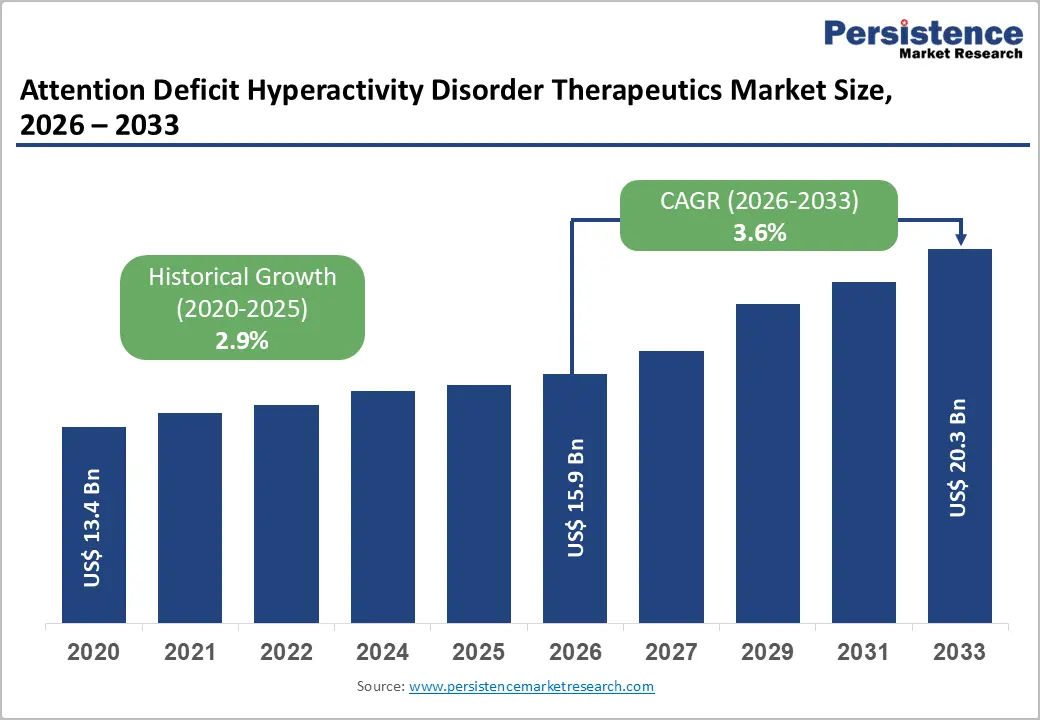
The global revenue from the attention deficit hyperactivity disorder therapeutics market is expected to reach US$ 15.3 Bn in 2025, with the global market expected to grow at a CAGR of 3.6% to reach a valuation of approximately US$ 19.6 Bn by the end of 2032.

Market Size (2025)

US$ 15.3 Bn

Projected Market Value (2032)

US$ 19.6 Bn

Global Market Growth Rate (2025-2032)

3.6% CAGR

Market Share of Top 5 Countries

74.9%

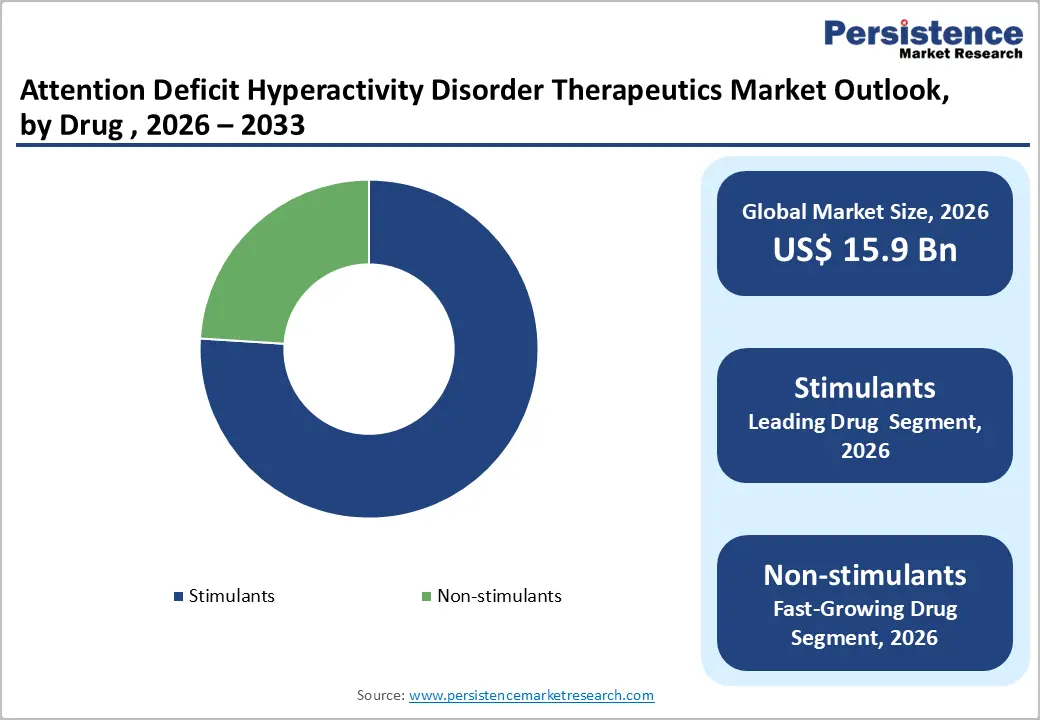
As assessed by Persistence Market Research, stimulants hold a market value of around US$ 12.8 Bn by 2024. Overall, attention deficit hyperactivity disorder therapeutics market sales account for approximately 26.9% revenue share in the global neurological disorder drugs market, which was valued at around US$ 79.4 Bn in 2024.

Sales Analysis of Market from 2019 to 2024 Vs Market Outlook for 2025 to 2032

The global market recorded a historic CAGR of 5.3% in the last 5 years from 2019 to 2024.

Attention deficit hyperactivity disorder (ADHD) is a neurobiological behavioural disease that affects children, adolescents, and adults. It is characterised by issues with focus, hyperactivity, and impulsivity and is brought on by an imbalance of the chemical neurotransmitters dopamine and noradrenaline in the brain. Methylphenidate and amphetamines are examples of psychostimulant first-line treatments for ADHD. Atomoxetine is an example of a non-psychostimulant first-line medication.

In order to be diagnosed with ADHD, a person must have both functional limitations across numerous contexts and symptoms of inattention, hyperactivity, and/or impulsivity that are developmentally inappropriate. Academic performance, peer interactions, and family functioning are among the functional areas that ADHD affects. The main justification for clinical referral is typically functional limitations rather than newly appearing symptoms.

According to a systematic review and meta-analysis published in Neuroscience & Biobehavioral Reviews, Volume 99, 2019, the high incidence of ADHD makes it a significant public health issue worldwide. It currently ranks as the most prevalent neuropsychiatric disorder, affecting 5–10% of adolescents and children.

While the majority of research focus on children aged 7 to 17, it is crucial to note that adults can also have ADHD. It has been hypothesised that more adults now suffer with ADHD than there were 20 years ago. A portion of this rise can be attributed to 76% of diagnosed patients still experiencing ADHD symptoms as adults.

ADHD indicates significant difficulties with academic, interpersonal, and professional performance. Numerous environmental factors that occur during various phases of the central nervous system's development, such as the gestational and perinatal periods, are linked to the incidence of ADHD.

Numerous studies have shown that the aetiology of ADHD has a significant genetic component. Numerous genes that have been linked to ADHD are involved in synaptogenesis, neurotransmission, neurogenesis, and receptor placement in synapses, among other activities.

The effectiveness of various treatments for each type of ADHD presentation and stage of development has still not been thoroughly analysed. Given its high incidence and high cost of treatment, ADHD is frequently diagnosed in children and poses a global public health issue, driving demand in the global market.

The global market is thus likely to show high growth over the coming years at a CAGR of 3.6% and reach a global market size of US$ 19.6 Bn by 2032.

How Can the Global Market Grow?

Establishment of Adjuvant Therapies

ADHD is currently treated symptomatically with medication, which considerably reduces the primary symptoms. However, medication alone does not often provide adequate relief from both the primary and secondary symptoms of ADHD. Due to side effects, drug treatment anxiety, and ADHD children's and their guardians' adherence to and rejection of drugs, interest in additional non-pharmaceutical treatments that can support drug therapy is rising.

Behaviour therapy is the most common non-drug treatment used for ADHD. Adjuvant therapy known as digital therapy (DTx) has recently been established as a result of the advancement of mobile-based software technologies.

With the help of DTx, it is possible to increase drug adherence, monitor patients without regard to location or time, and facilitate daily communication with patients, all of which can be extremely helpful for long-term psychiatric diseases like ADHD.

Video-based gaming exercise has been efficient for health-related aspects such as movement patterns, cognitive ability, fatigue, and depressed mood. This was found to have nearly the same influence as standard therapies in terms of enhancing the quality of treatment, according to a recent trial looking at the effect on cognitive function as well as other neurological illness symptomatology in patients with multiple sclerosis.

Patients who choose alternative treatments or outcomes free of many pharmacological side effects can benefit from adjuvant therapy employing these digital media.

Additionally, the great accessibility of mobile-based functional games for young children can contribute to an increase in interest in learning about ADHD treatment and active motivation, resulting in enhancements to the therapeutic learning capacity.

The market is expected to expand over the forecasted period as a result of the above-mentioned advances in ADHD therapeutics.

Can the Market Growth Be Affected in Any Way?

Side-Effects of Pharmacological Therapy, and Limitations of Adjuvant Therapies

The medications used to treat ADHD have two distinct types of limitations. The first type of concern is that these drugs may have unpleasant side effects like insomnia, lack of appetite, or nausea. But for the majority of people, lowering the dose or switching drugs helps control these side effects.

The second category of issues concerns stimulant drugs, which have addictive elements. Despite the fact that taking stimulant drugs as directed will not cause addiction, they might be misused in a way that does. They may also be transferred to others for either substance abuse or enhanced productivity. This is a particular challenge for stimulants with immediate release.

Additionally, similar to those found for stimulant medication therapy, behavioural interventions for ADHD have limits. For example, compared to their classmates who are usually developing, children with ADHD typically do not exhibit normalised behavioural function when receiving behaviour therapy as a sole form of treatment.

Additionally, some kids do not show progress after a behaviour modification programme. The necessity for ongoing intervention, the complexities of the therapy, the reliance on parental and academic participation, and the comparatively high expense of implementing behavioural therapies relative to pharmacological interventions all contribute to the possibility that using behaviour therapy may be challenging.

Country-wise Insights

Why is the U.S. Market Booming?

“Rising Incidence of Adults with ADHD, and Expansion of the Biopharmaceutical Industry”

The U.S. accounted for around 62.9% share in the global market in 2024.

Drug manufacturers frequently conduct paediatric studies on their products to expand their markets. However, the market is evolving in the opposite direction for medications for attention deficit and hyperactivity disorder (ADHD) that were mainly created with children in mind, with more adults now using the medications than children.

In reality, the growth of the biopharmaceutical industry in the development of novel therapies for ADHD treatment is responsible for the fact that adult Americans are using ADHD medications at a rate that is almost twice as fast as the entire market.

Will Germany Be a Lucrative Market for Attention Deficit Hyperactivity Disorder Therapeutics?

“Rising Focus on Underdiagnosed ADHD in Germany”

Germany held around 2.8% market share of the global market in 2024.

In Germany, both the administrative incidence of adult ADHD diagnoses and the level of adult ADHD medication use have increased recently. This could be seen as a sign that patients and doctors are becoming more aware of the possibilities of adult ADHD. However, compared to the frequency seen in epidemiologic studies, the prevalence of diagnosed ADHD continues to be lower. This would suggest that ADHD is now underdiagnosed and undertreated in adults.

The low incidence of medication use among teenagers with ADHD who are approaching adulthood contributes to the nation's rising demand for ADHD treatments, driving the market's overall growth throughout the forecast period.

How is China Emerging as a Prominent Market?

“Incorporation of ADHD Therapeutics through Regional Expansion”

China held a market share of about 2.5% of the global market in 2024. Growing investments in ADHD research in China, as well as the emergence of market players within the region, are factors promoting the growth of the global market.

In December 2022, Tris Pharma, Inc. and Pediatrix Therapeutics, a pediatrics-focused business that seeks to provide children and families in China with high quality, pediatric-friendly, and affordable therapeutics, announced that they had expanded their partnership. Pediatrix Therapeutics now has the exclusive right to market the entirety of Tris's FDA-approved ADHD portfolio in addition to ADHD pipeline products in China.

These activities are set to promote the stance of China within the global market, over the forecast period.

Category-wise Insights

Which Drug is Driving Demand within the Global Market?

“Stimulants as Greater Preferred Choice of Treatment with Greater Efficacy”

The stimulants segment held around 86.1% share of the total market in 2024.

The most popular class of prescription medication used by doctors to treat ADHD is stimulants. With the most research supporting their efficacy, they have the longest history of treating ADHD. Several commonly used medications fall under the stimulant drug category, including Adderall, Dexedrine, Focalin, and Ritalin.

It is thought that stimulants function by raising dopamine levels in the brain. A neurotransmitter called dopamine is linked to motivation, pleasure, focus, and movement. Stimulant medicines help many ADHD patients concentrate and focus better while lowering hyperactive and impulsive behaviours.

Which Age Group is Largely in Focus within the Global Market?

“Development of Self-Report Scale for Adults Suspecting ADHD”

The adult age group segment holds a share of about 50.7% in 2024.

Adults who have undiagnosed ADHD account for a sizable portion of the global population. A thorough evaluation by a mental health expert is necessary for an adult to receive a diagnosis of ADHD. During this evaluation, the adult will be questioned about their impulsivity, hyperactivity, and attention span. A self-screening test to see whether someone might have adult ADHD has been developed by the World Health Organization.

The Adult Self-Report Scale (ASRS) Screener aids in the identification of adult ADHD symptoms and indications. As a result, this age group segment has become the largest shareholder in the global market due to growing concerns about adults with ADHD.

Which Distribution Channel Offers the Market a Profitable Outlook?

“Rising Patient Pool and Ease of Availability of Prescribed Medications”

Retail pharmacies hold a share of about 44.5% in 2024.

This is due to the ease of access and widespread availability of ADHD medications. The amount of money paid to physicians who frequently treat children and adolescents has increased along with the number of prescriptions written for stimulants, such as those prescribed to manage ADHD in children. The majority of ADHD patients are treated in outpatient settings, which has fueled the segment's expansion.

Patient care programs that provide patients with personal Electronic Health Records (EHRs) to maintain track of their medical history and obtain primary care are also receiving more attention, driving market growth globally.

Competition Landscape

Manufacturers hope to expand their respective market shares by developing novel ADHD drugs at reduced prices.

To cut their manufacturing costs and compete in the market with lower pricing, the corporations are concentrating on outsourcing the production of ADHD medications to the Asian region. Companies gain product portfolio augmentation through mergers and acquisition activities.

Moreover, companies are engaging in mergers and acquisitions to increase their product offerings and global market presence.

Some key instances of development include:

  • Japan granted approval for the use of UCB's Vimpat® (lacosamide) in January 2019 to treat partial-onset seizures in children aged 4 and older.
  • Pfizer Inc. purchased Array, a biopharmaceutical firm specialising in the discovery and marketing of small molecule drugs, in July 2019.

Similarly, the team at Persistence Market Research has tracked recent developments related to companies in the attention deficit hyperactivity disorder therapeutics market, which are available in the full report.

Companies Covered in Attention Deficit Hyperactivity Disorder Therapeutics Market

  • Pfizer Inc.
  • Eli Lilly and Company
  • Novartis AG
  • GlaxoSmithKline PLC
  • Mallinckrodt Pharmaceuticals
  • Hisamitsu Pharmaceutical Co., Inc.
  • Johnson & Johnson
  • UCB S.A.
  • Purdue Pharma L.P.
Frequently Asked Questions

The market is expected to reach US$ 19.1 billion by 2032.

The market is projected to grow at a CAGR of 3.6% during this period.

Stimulants are the most preferred treatment, holding 86.1% of the market in 2024.

The U.S. has a high prevalence of adult ADHD and a strong biopharmaceutical industry, driving market growth.

Increased awareness and diagnosis of adult ADHD contribute to the growing market.

Attention Deficit Hyperactivity Disorder Therapeutics Industry Report Scope

Attribute

Details

Forecast Period

2025 to 2032

Historical Data Available for

2019 to 2024

Market Analysis

Value: US$ Bn/Mn, Volume: As applicable

Key Countries Covered

  • U.S.
  • Canada
  • Brazil
  • Argentina
  • Mexico
  • Germany
  • France
  • U.K.
  • Italy
  • Spain
  • Russia
  • BENELUX
  • India
  • Thailand
  • Malaysia
  • Indonesia
  • China
  • Japan
  • South Korea
  • Australia
  • New Zealand
  • Turkey
  • GCC
  • North Africa
  • South Africa

Key Market Segments Covered

  • Drug
  • Age Group
  • Distribution Channel
  • Region

Key Companies Covered

  • Pfizer Inc.
  • Eli Lilly and Company
  • Novartis AG
  • GlaxoSmithKline PLC
  • Mallinckrodt Pharmaceuticals
  • Hisamitsu Pharmaceutical Co., Inc.
  • Johnson & Johnson
  • UCB S.A.
  • Purdue Pharma L.P.
Report Highlights
  • Market Forecast and Trends
  • Competitive Intelligence & Share Analysis
  • Growth Factors and Challenges
  • Strategic Growth Initiatives
  • Pricing Analysis & Technology Roadmap
  • Future Opportunities and Revenue Pockets
  • Industry Market Analysis Tools

Customization & Pricing

Available upon Request

Key Segments Covered in Attention Deficit Hyperactivity Disorder Therapeutics Industry Research

Drug:

  • Stimulants
    • Amphetamine
    • Methylphenidate
    • Dextroamphetamine
    • Dexmethylphenidate
    • Lisdexamfetamine Dimesylate
  • Non-stimulants
    • Atomoxetine
    • Bupropion
    • Guanfacine
    • Clonidine

Age Group:

  • Pediatric and Adolescent
  • Adults

Distribution Channel:

  • Specialty Clinics
  • Hospital Pharmacies
  • Retail Pharmacies
  • E-Commerce

Region:

  • North America
  • Latin America
  • Europe
  • South Asia
  • East Asia
  • Oceania
  • Middle East & Africa

Related Reports

1. Executive Summary

    1.1. Global Market Outlook

    1.2. Demand Side Trends

    1.3. Supply Side Trends

    1.4. Analysis and Recommendations

2. Market Overview

    2.1. Market Coverage / Taxonomy

    2.2. Market Definition / Scope / Limitations

    2.3. Inclusions and Exclusions

3. Key Market Trends

    3.1. Key Trends Impacting the Market

    3.2. Market Innovation / Development Trends

4. Key Success Factors

    4.1. Drug Adoption/Usage Analysis

    4.2. Disease Epidemiology

    4.3. Reimbursement Scenario

    4.4. Pipeline Analysis

    4.5. Value Chain Analysis

    4.6. Key Regulatory Scenario

    4.7. PESTEL Analysis

    4.8. Porter’s Analysis

5. Market Background

    5.1. Macro-Economic Factors

        5.1.1. Global GDP Growth Outlook

        5.1.2. Global Healthcare Outlook

        5.1.3. Global Neurological Disorder Drugs Market Overview

    5.2. Forecast Factors - Relevance & Impact

        5.2.1. Impact of Lifestyle on Disease Progression

        5.2.2. Rising Awareness on Neurological and Neuropsychiatric Disorders

        5.2.3. Growing Disease Prevalence Globally

        5.2.4. Rising R&D Efforts for Novel Drug Development

        5.2.5. Availability of Treatment Modalities

        5.2.6. Established Genetic Impact on the Etiology of ADHD

        5.2.7. Cost of Treatment

    5.3. Market Dynamics

        5.3.1. Drivers

        5.3.2. Restraints

        5.3.3. Opportunity Analysis

6. COVID-19 Crisis Analysis

    6.1. COVID-19 and Impact Analysis

        6.1.1. By Drug

        6.1.2. By Age Group

        6.1.3. By Distribution Channel

        6.1.4. By Country

    6.2. 2022 Market Scenario

7. Global Attention Deficit Hyperactivity Disorder Therapeutics Market Demand (in Value or Size in US$ Mn) Analysis 2019-2023 and Forecast, 2024-2032

    7.1. Historical Market Value (US$ Mn) Analysis, 2019-2023

    7.2. Current and Future Market Value (US$ Mn) Projections, 2024-2032

        7.2.1. Y-o-Y Growth Trend Analysis

        7.2.2. Absolute $ Opportunity Analysis

8. Global Attention Deficit Hyperactivity Disorder Therapeutics Outlook, 2019 - 2032, By Drug

    8.1. Introduction / Key Findings

    8.2. Historical Market Size (US$ Mn) Analysis By Drug, 2019-2023

    8.3. Current and Future Market Size (US$ Mn) Analysis and Forecast By Drug, 2024-2032

        8.3.1. Stimulants

            8.3.1.1. Amphetamine

            8.3.1.2. Methylphenidate

            8.3.1.3. Dextroamphetamine

            8.3.1.4. Dexmethylphenidate

            8.3.1.5. Lisdexamfetamine Dimesylate

        8.3.2. Non-stimulants

            8.3.2.1. Atomoxetine

            8.3.2.2. Bupropion

            8.3.2.3. Guanfacine

            8.3.2.4. Clonidine

    8.4. Market Attractiveness Analysis By Drug

9. Global Attention Deficit Hyperactivity Disorder Therapeutics Outlook, 2019 - 2032, By Age Group

    9.1. Introduction / Key Findings

    9.2. Historical Market Size (US$ Mn) Analysis, By Age Group, 2019-2023

    9.3. Current and Future Market Size (US$ Mn) Analysis and Forecast By Age Group, 2024-2032

        9.3.1. Pediatric and Adolescent

        9.3.2. Adults

    9.4. Market Attractiveness Analysis By Age Group

10. Global Attention Deficit Hyperactivity Disorder Therapeutics Outlook, 2019 - 2032, By Distribution Channel

    10.1. Introduction / Key Findings

    10.2. Historical Market Size (US$ Mn) Analysis, By Distribution Channel, 2019-2023

    10.3. Current and Future Market Size (US$ Mn) Analysis and Forecast By Distribution Channel, 2024-2032

        10.3.1. Specialty Clinics

        10.3.2. Hospital Pharmacies

        10.3.3. Retail Pharmacies

        10.3.4. E-Commerce

    10.4. Market Attractiveness Analysis By Distribution Channel

11. Global Attention Deficit Hyperactivity Disorder Therapeutics Outlook, 2019 - 2032, By Region

    11.1. Introduction

    11.2. Historical Market Size (US$ Mn) Analysis By Region, 2019-2023

    11.3. Current and Future Market Value (US$ Mn) Analysis and Forecast, 2024-2032

        11.3.1. North America

        11.3.2. Latin America

        11.3.3. Europe

        11.3.4. East Asia

        11.3.5. South Asia

        11.3.6. Oceania

        11.3.7. Middle East and Africa (MEA)

    11.4. Market Attractiveness Analysis By Region

12. North America Attention Deficit Hyperactivity Disorder Therapeutics Outlook, 2019 - 2032

    12.1. Introduction

    12.2. Historical Market Size (US$ Mn) Trend Analysis By Market Taxonomy, 2019-2023

    12.3. Current and Future Market Value (US$ Mn) Analysis and Forecast, 2024-2032

        12.3.1. By Country

            12.3.1.1. U.S.

            12.3.1.2. Canada

        12.3.2. By Drug

        12.3.3. By Age Group

        12.3.4. By Distribution Channel

    12.4. Market Attractiveness Analysis

        12.4.1. By Country

        12.4.2. By Drug

        12.4.3. By Age Group

        12.4.4. By Distribution Channel

    12.5. Market Trends

    12.6. Drivers and Restraints - Impact Analysis

    12.7. Key Players – Intensity Mapping

    12.8. Country Level Analysis & Forecast

        12.8.1. U.S. Attention Deficit Hyperactivity Disorder Therapeutics Market Analysis

            12.8.1.1. Introduction

            12.8.1.2. Market Analysis and Forecast by Market Taxonomy

                12.8.1.2.1. By Drug

                12.8.1.2.2. By Age Group

                12.8.1.2.3. By Distribution Channel

        12.8.2. Canada Attention Deficit Hyperactivity Disorder Therapeutics Market Analysis

            12.8.2.1. Introduction

            12.8.2.2. Market Analysis and Forecast by Market Taxonomy

                12.8.2.2.1. By Drug

                12.8.2.2.2. By Age Group

                12.8.2.2.3. By Distribution Channel

13. Latin America Attention Deficit Hyperactivity Disorder Therapeutics Outlook, 2019 - 2032

    13.1. Introduction

    13.2. Historical Market Size (US$ Mn) Trend Analysis By Market Taxonomy, 2019-2023

    13.3. Current and Future Market Value (US$ Mn) Analysis and Forecast, 2024-2032

        13.3.1. By Country

            13.3.1.1. Mexico

            13.3.1.2. Brazil

            13.3.1.3. Argentina

            13.3.1.4. Rest of Latin America

        13.3.2. By Drug

        13.3.3. By Age Group

        13.3.4. By Distribution Channel

    13.4. Market Attractiveness Analysis

        13.4.1. By Country

        13.4.2. By Drug

        13.4.3. By Age Group

        13.4.4. By Distribution Channel

    13.5. Market Trends

    13.6. Drivers and Restraints - Impact Analysis

    13.7. Key Players – Intensity Mapping

    13.8. Country Level Analysis & Forecast

        13.8.1. Mexico Attention Deficit Hyperactivity Disorder Therapeutics Market Analysis

            13.8.1.1. Introduction

            13.8.1.2. Market Analysis and Forecast by Market Taxonomy

                13.8.1.2.1. By Drug

                13.8.1.2.2. By Age Group

                13.8.1.2.3. By Distribution Channel

        13.8.2. Brazil Attention Deficit Hyperactivity Disorder Therapeutics Market Analysis

            13.8.2.1. Introduction

            13.8.2.2. Market Analysis and Forecast by Market Taxonomy

                13.8.2.2.1. By Drug

                13.8.2.2.2. By Age Group

                13.8.2.2.3. By Distribution Channel

        13.8.3. Argentina Attention Deficit Hyperactivity Disorder Therapeutics Market Analysis

            13.8.3.1. Introduction

            13.8.3.2. Market Analysis and Forecast by Market Taxonomy

                13.8.3.2.1. By Drug

                13.8.3.2.2. By Age Group

                13.8.3.2.3. By Distribution Channel

14. Europe Attention Deficit Hyperactivity Disorder Therapeutics Outlook, 2019 - 2032

    14.1. Introduction

    14.2. Historical Market Size (US$ Mn) Trend Analysis By Market Taxonomy, 2019-2023

    14.3. Current and Future Market Value (US$ Mn) Analysis and Forecast, 2024-2032

        14.3.1. By Country

            14.3.1.1. Germany

            14.3.1.2. Italy

            14.3.1.3. France

            14.3.1.4. U.K.

            14.3.1.5. Spain

            14.3.1.6. BENELUX

            14.3.1.7. Russia

            14.3.1.8. Rest of Europe

        14.3.2. By Drug

        14.3.3. By Age Group

        14.3.4. By Distribution Channel

    14.4. Market Attractiveness Analysis

        14.4.1. By Country

        14.4.2. By Drug

        14.4.3. By Age Group

        14.4.4. By Distribution Channel

    14.5. Market Trends

    14.6. Drivers and Restraints - Impact Analysis

    14.7. Key Players – Intensity Mapping

    14.8. Country Level Analysis & Forecast

        14.8.1. Germany Attention Deficit Hyperactivity Disorder Therapeutics Market Analysis

            14.8.1.1. Introduction

            14.8.1.2. Market Analysis and Forecast by Market Taxonomy

                14.8.1.2.1. By Drug

                14.8.1.2.2. By Age Group

                14.8.1.2.3. By Distribution Channel

        14.8.2. Italy Attention Deficit Hyperactivity Disorder Therapeutics Market Analysis

            14.8.2.1. Introduction

            14.8.2.2. Market Analysis and Forecast by Market Taxonomy

                14.8.2.2.1. By Drug

                14.8.2.2.2. By Age Group

                14.8.2.2.3. By Distribution Channel

        14.8.3. France Attention Deficit Hyperactivity Disorder Therapeutics Market Analysis

            14.8.3.1. Introduction

            14.8.3.2. Market Analysis and Forecast by Market Taxonomy

                14.8.3.2.1. By Drug

                14.8.3.2.2. By Age Group

                14.8.3.2.3. By Distribution Channel

        14.8.4. U.K. Attention Deficit Hyperactivity Disorder Therapeutics Market Analysis

            14.8.4.1. Introduction

            14.8.4.2. Market Analysis and Forecast by Market Taxonomy

                14.8.4.2.1. By Drug

                14.8.4.2.2. By Age Group

                14.8.4.2.3. By Distribution Channel

        14.8.5. Spain Attention Deficit Hyperactivity Disorder Therapeutics Market Analysis

            14.8.5.1. Introduction

            14.8.5.2. Market Analysis and Forecast by Market Taxonomy

                14.8.5.2.1. By Drug

                14.8.5.2.2. By Age Group

                14.8.5.2.3. By Distribution Channel

        14.8.6. BENELUX Attention Deficit Hyperactivity Disorder Therapeutics Market Analysis

            14.8.6.1. Introduction

            14.8.6.2. Market Analysis and Forecast by Market Taxonomy

                14.8.6.2.1. By Drug

                14.8.6.2.2. By Age Group

                14.8.6.2.3. By Distribution Channel

        14.8.7. Russia Attention Deficit Hyperactivity Disorder Therapeutics Market Analysis

            14.8.7.1. Introduction

            14.8.7.2. Market Analysis and Forecast by Market Taxonomy

                14.8.7.2.1. By Drug

                14.8.7.2.2. By Age Group

                14.8.7.2.3. By Distribution Channel

15. East Asia Attention Deficit Hyperactivity Disorder Therapeutics Outlook, 2019 - 2032

    15.1. Introduction

    15.2. Historical Market Size (US$ Mn) Trend Analysis By Market Taxonomy, 2019-2023

    15.3. Current and Future Market Value (US$ Mn) Analysis and Forecast, 2024-2032

        15.3.1. By Country

            15.3.1.1. China

            15.3.1.2. Japan

            15.3.1.3. South Korea

        15.3.2. By Drug

        15.3.3. By Age Group

        15.3.4. By Distribution Channel

    15.4. Market Attractiveness Analysis

        15.4.1. By Country

        15.4.2. By Drug

        15.4.3. By Age Group

        15.4.4. By Distribution Channel

    15.5. Market Trends

    15.6. Drivers and Restraints - Impact Analysis

    15.7. Key Players – Intensity Mapping

    15.8. Country Level Analysis & Forecast

        15.8.1. China Attention Deficit Hyperactivity Disorder Therapeutics Market Analysis

            15.8.1.1. Introduction

            15.8.1.2. Market Analysis and Forecast by Market Taxonomy

                15.8.1.2.1. By Drug

                15.8.1.2.2. By Age Group

                15.8.1.2.3. By Distribution Channel

        15.8.2. Japan Attention Deficit Hyperactivity Disorder Therapeutics Market Analysis

            15.8.2.1. Introduction

            15.8.2.2. Market Analysis and Forecast by Market Taxonomy

                15.8.2.2.1. By Drug

                15.8.2.2.2. By Age Group

                15.8.2.2.3. By Distribution Channel

        15.8.3. South Korea Attention Deficit Hyperactivity Disorder Therapeutics Market Analysis

            15.8.3.1. Introduction

            15.8.3.2. Market Analysis and Forecast by Market Taxonomy

                15.8.3.2.1. By Drug

                15.8.3.2.2. By Age Group

                15.8.3.2.3. By Distribution Channel

16. South Asia Attention Deficit Hyperactivity Disorder Therapeutics Outlook, 2019 - 2032

    16.1. Introduction

    16.2. Historical Market Size (US$ Mn) Trend Analysis By Market Taxonomy, 2019-2023

    16.3. Current and Future Market Value (US$ Mn) Analysis and Forecast, 2024-2032

        16.3.1. By Country

            16.3.1.1. India

            16.3.1.2. Indonesia

            16.3.1.3. Malaysia

            16.3.1.4. Thailand

            16.3.1.5. Rest of South Asia

        16.3.2. By Drug

        16.3.3. By Age Group

        16.3.4. By Distribution Channel

    16.4. Market Attractiveness Analysis

        16.4.1. By Country

        16.4.2. By Drug

        16.4.3. By Age Group

        16.4.4. By Distribution Channel

    16.5. Market Trends

    16.6. Drivers and Restraints - Impact Analysis

    16.7. Key Players – Intensity Mapping

    16.8. Country Level Analysis & Forecast

        16.8.1. India Attention Deficit Hyperactivity Disorder Therapeutics Market Analysis

            16.8.1.1. Introduction

            16.8.1.2. Market Analysis and Forecast by Market Taxonomy

                16.8.1.2.1. By Drug

                16.8.1.2.2. By Age Group

                16.8.1.2.3. By Distribution Channel

        16.8.2. Indonesia Attention Deficit Hyperactivity Disorder Therapeutics Market Analysis

            16.8.2.1. Introduction

            16.8.2.2. Market Analysis and Forecast by Market Taxonomy

                16.8.2.2.1. By Drug

                16.8.2.2.2. By Age Group

                16.8.2.2.3. By Distribution Channel

        16.8.3. Malaysia Attention Deficit Hyperactivity Disorder Therapeutics Market Analysis

            16.8.3.1. Introduction

            16.8.3.2. Market Analysis and Forecast by Market Taxonomy

                16.8.3.2.1. By Drug

                16.8.3.2.2. By Age Group

                16.8.3.2.3. By Distribution Channel

        16.8.4. Thailand Attention Deficit Hyperactivity Disorder Therapeutics Market Analysis

            16.8.4.1. Introduction

            16.8.4.2. Market Analysis and Forecast by Market Taxonomy

                16.8.4.2.1. By Drug

                16.8.4.2.2. By Age Group

                16.8.4.2.3. By Distribution Channel

17. Oceania Attention Deficit Hyperactivity Disorder Therapeutics Market 2015-2023 and Forecast 2023-2033

    17.1. Introduction

    17.2. Historical Market Size (US$ Mn) Trend Analysis By Market Taxonomy, 2019-2023

    17.3. Current and Future Market Value (US$ Mn) Analysis and Forecast, 2024-2032

        17.3.1. By Country

            17.3.1.1. Australia

            17.3.1.2. New Zealand

        17.3.2. By Drug

        17.3.3. By Age Group

        17.3.4. By Distribution Channel

    17.4. Market Attractiveness Analysis

        17.4.1. By Country

        17.4.2. By Drug

        17.4.3. By Age Group

        17.4.4. By Distribution Channel

    17.5. Market Trends

    17.6. Drivers and Restraints - Impact Analysis

    17.7. Key Players – Intensity Mapping

    17.8. Country Level Analysis & Forecast

        17.8.1. Australia Attention Deficit Hyperactivity Disorder Therapeutics Market Analysis

            17.8.1.1. Introduction

            17.8.1.2. Market Analysis and Forecast by Market Taxonomy

                17.8.1.2.1. By Drug

                17.8.1.2.2. By Age Group

                17.8.1.2.3. By Distribution Channel

        17.8.2. New Zealand Attention Deficit Hyperactivity Disorder Therapeutics Market Analysis

            17.8.2.1. Introduction

            17.8.2.2. Market Analysis and Forecast by Market Taxonomy

                17.8.2.2.1. By Drug

                17.8.2.2.2. By Age Group

                17.8.2.2.3. By Distribution Channel

18. Middle East and Africa (MEA) Attention Deficit Hyperactivity Disorder Therapeutics Outlook, 2019 - 2032

    18.1. Introduction

    18.2. Historical Market Size (US$ Mn) Trend Analysis By Market Taxonomy, 2019-2023

    18.3. Current and Future Market Value (US$ Mn) Analysis and Forecast, 2024-2032

        18.3.1. By Country

            18.3.1.1. GCC Countries

            18.3.1.2. Turkey

            18.3.1.3. North Africa

            18.3.1.4. South Africa

            18.3.1.5. Rest of Middle East and Africa

        18.3.2. By Drug

        18.3.3. By Age Group

        18.3.4. By Distribution Channel

    18.4. Market Attractiveness Analysis

        18.4.1. By Country

        18.4.2. By Drug

        18.4.3. By Age Group

        18.4.4. By Distribution Channel

    18.5. Market Trends

    18.6. Drivers and Restraints - Impact Analysis

    18.7. Key Players – Intensity Mapping

    18.8. Country Level Analysis & Forecast

        18.8.1. GCC Countries Attention Deficit Hyperactivity Disorder Therapeutics Market Analysis

            18.8.1.1. Introduction

            18.8.1.2. Market Analysis and Forecast by Market Taxonomy

                18.8.1.2.1. By Drug

                18.8.1.2.2. By Age Group

                18.8.1.2.3. By Distribution Channel

        18.8.2. Turkey Attention Deficit Hyperactivity Disorder Therapeutics Market Analysis

            18.8.2.1. Introduction

            18.8.2.2. Market Analysis and Forecast by Market Taxonomy

                18.8.2.2.1. By Drug

                18.8.2.2.2. By Age Group

                18.8.2.2.3. By Distribution Channel

        18.8.3. South Africa Attention Deficit Hyperactivity Disorder Therapeutics Market Analysis

            18.8.3.1. Introduction

            18.8.3.2. Market Analysis and Forecast by Market Taxonomy

                18.8.3.2.1. By Drug

                18.8.3.2.2. By Age Group

                18.8.3.2.3. By Distribution Channel

        18.8.4. North Africa Attention Deficit Hyperactivity Disorder Therapeutics Market Analysis

            18.8.4.1. Introduction

            18.8.4.2. Market Analysis and Forecast by Market Taxonomy

                18.8.4.2.1. By Drug

                18.8.4.2.2. By Age Group

                18.8.4.2.3. By Distribution Channel

19. Market Structure Analysis

    19.1. Market Analysis by Tier of Companies

    19.2. Market Share Analysis of Top Players

    19.3. Market Presence Analysis

20. Competition Analysis

    20.1. Competition Dashboard

    20.2. Competition Benchmarking

    20.3. Competition Deep Dive

        20.3.1. Pfizer Inc.

            20.3.1.1. Overview

            20.3.1.2. Product Portfolio

            20.3.1.3. Sales Footprint

            20.3.1.4. Key Financials

            20.3.1.5. SWOT Analysis

            20.3.1.6. Strategy Overview

        20.3.2. Eli Lilly and Company

            20.3.2.1. Overview

            20.3.2.2. Product Portfolio

            20.3.2.3. Sales Footprint

            20.3.2.4. Key Financials

            20.3.2.5. SWOT Analysis

            20.3.2.6. Strategy Overview

        20.3.3. Novartis AG

            20.3.3.1. Overview

            20.3.3.2. Product Portfolio

            20.3.3.3. Sales Footprint

            20.3.3.4. Key Financials

            20.3.3.5. SWOT Analysis

            20.3.3.6. Strategy Overview

        20.3.4. GlaxoSmithKline PLC

            20.3.4.1. Overview

            20.3.4.2. Product Portfolio

            20.3.4.3. Sales Footprint

            20.3.4.4. Key Financials

            20.3.4.5. SWOT Analysis

            20.3.4.6. Strategy Overview

        20.3.5. Mallinckrodt Pharmaceuticals

            20.3.5.1. Overview

            20.3.5.2. Product Portfolio

            20.3.5.3. Sales Footprint

            20.3.5.4. Key Financials

            20.3.5.5. SWOT Analysis

            20.3.5.6. Strategy Overview

        20.3.6. Hisamitsu Pharmaceutical Co., Inc.

            20.3.6.1. Overview

            20.3.6.2. Product Portfolio

            20.3.6.3. Sales Footprint

            20.3.6.4. Key Financials

            20.3.6.5. SWOT Analysis

            20.3.6.6. Strategy Overview

        20.3.7. Johnson & Johnson

            20.3.7.1. Overview

            20.3.7.2. Product Portfolio

            20.3.7.3. Sales Footprint

            20.3.7.4. Key Financials

            20.3.7.5. SWOT Analysis

            20.3.7.6. Strategy Overview

        20.3.8. UCB S.A.

            20.3.8.1. Overview

            20.3.8.2. Product Portfolio

            20.3.8.3. Sales Footprint

            20.3.8.4. Key Financials

            20.3.8.5. SWOT Analysis

            20.3.8.6. Strategy Overview

        20.3.9. Purdue Pharma L.P.

            20.3.9.1. Overview

            20.3.9.2. Product Portfolio

            20.3.9.3. Sales Footprint

            20.3.9.4. Key Financials

            20.3.9.5. SWOT Analysis

            20.3.9.6. Strategy Overview

21. Assumptions and Acronyms Used

22. Research Methodology

Research Methodology Framework for Market Research Excellence

At Persistence Market Research, we implement a comprehensive, validated, and multi-dimensional approachto market analysis that delivers actionable insights across complex market landscapes. Our methodology combines the analytical rigor of leading consulting firms with innovative research techniques, ensuring robust market assessments that guide strategic decision-making with confidence.

Core Research Philosophy

Our methodology is built on four foundational pillars:

Research Philosophy Image

At Persistence Market Research, our methodology is designed to transcend conventional market studies by combining analytical rigor, multi-source validation, and future-focused insights.

We integrate advanced research frameworks, robust data collection strategies, cutting-edge analytics, and innovative technologies to deliver a 360-degree view of complex markets.

We integrate advanced research frameworks, robust data collection strategies, cutting-edge analytics, and innovative technologies to deliver a 360-degree view of complex markets.

Each stage spanning from strategic scoping and hypothesis-building to competitive intelligence, quality validation, and actionable recommendations is engineered to provide clients with unmatched clarity, precision, and confidence in decision-making.

By embedding innovation and technology at the core, our approach ensures that insights are not only comprehensive but also predictive, empowering businesses to seize opportunities, mitigate risks, and achieve sustainable growth

Research Philosophy Image

Capturing Key Information and Events

During this phase, key research objectives focus on essential information and data points for assessing the market, including:

Research Philosophy Image

TAM-SAM-SOM Framework Implementation

We employ both top-down and bottom-up approaches to ensure accurate market sizing.

Top-Down Market SizingBottom-Up Market Sizing
Universe Definition: Total global/regional market identificationUnit Economics: Average transaction values, purchase frequencies, customer lifecycle
Segmentation Filters: Geographic, demographic, and behavioral constraintsCustomer Segmentation: Detailed buyer persona development and sizing
Market Share Analysis: Competitive landscape assessment and share allocationPenetration Analysis: Market penetration rates by segment and geography
Growth Rate Application: Historical trends and forward-looking growth assumptionsScaling Methodology: Extrapolation techniques with confidence intervals

Validation & Cross-Verification

  • Triangulation: Comparing top-down and bottom-up results for consistency
  • Sensitivity Analysis: Testing key assumptions and parameter variations
  • Peer Benchmarking: Comparison with analogous markets and industry benchmarks
  • Expert Review: External validation through industry specialist consultation

Research Philosophy Image

Forecasting & Projection Modeling

Our proprietary forecasting models incorporate multiple variables and scenarios.

Forecasting Components

  • Historical Trend Analysis: 10-year historical growth patterns and cyclical variations
  • Driver-Based Modeling: Economic indicators, demographic shifts, technology adoption
  • Scenario Planning: Base case, optimistic, and conservative projections
  • Monte Carlo Simulations: Probability-weighted outcomes and risk assessments

Model Validation

  • Back-Testing: Historical accuracy assessment over 3–5-year periods
  • Cross-Validation: Multiple modeling approaches for result comparison
  • External Benchmarking: Comparison with established market forecasts
  • Continuous Calibration: Quarterly model updates based on new data

Comprehensive Data Collection Strategy

Our secondary research phase establishes a robust knowledge base utilizing diverse, credible sources.

Secondary Data Sourcess

  • Industry Publications & Reports
  • Government & Regulatory Data
  • Financial Intelligence (filings & reports)
  • Academic Research & Digital Intelligence

Quality Assurance Protocol

  • Source credibility assessment and publication date validation
  • Data consistency checks across multiple sources
  • Bias identification and neutralization techniques
  • Information gap tracking for primary research prioritization

Research Philosophy Image

Primary Research Excellence

Our primary research methodology employs best-in-class techniques to capture unique market insights.

Quantitative Research Methods

  • Large-Scale Surveys: Statistically representative samples with 95% confidence intervals
  • Survey Methodology: Multi-channel deployment (online, telephone, in-person)
  • Question Architecture and Response Optimization

Qualitative Research Methods

  • Executive Interviews
  • Focus Groups
  • Expert Consultations

Quality Assurance & Validation Framework

Multi-Stage Validation Process

  • Source Verification and Consistency Testing
  • Outlier Detection and Bias Assessment
  • Peer Review Process and External Validation
  • Sensitivity Analysis and Confidence Intervals

Research Philosophy Image

Methodology Validation & Credibility

Our research methodology has been extensively validated through:

  • Academic Partnerships: Collaborations with top-tier business schools and research institutions
  • Client Success Stories: Documented case studies demonstrating research impact and ROI
  • Continuous Benchmarking: Performance comparison with leading global research firms

This comprehensive methodology framework positions Persistence Market Research at the forefront of market intelligence, combining the analytical sophistication of top-tier consulting firms with innovative research techniques. Our approach ensures that every market assessment delivers precise, actionable, and strategically valuable insights that drive business success in competitive market environments.

Ready to unlock your market potential? Contact our research experts to discuss how our validated methodology can transform your strategic decision-making with data-driven market intelligence.

Copyright © 2026 Persistence Market Research. All Rights Reserved

Connect With Us -