




- Biotechnology
- Metagenomics Market
Metagenomics Market Size, Share, Growth, and Regional Forecast, 2026 - 2033
Metagenomics Market by Product (Kits & Reagents, Sequencing & Data Analytics Services, Instruments & Consumables, and Software), Technology (Shotgun Sequencing, 16S Sequencing, Whole Genome Sequencing, and Others), Application (Environmental Monitoring, Clinical Diagnostics, Drug Discovery, Food & Nutrition, Agriculture, and Others) End-user (Pharmaceutical Companies, Contact Research Organizations, and Others), and Regional Analysis from 2026 - 2033

Metagenomics Market Share and Trends Analysis
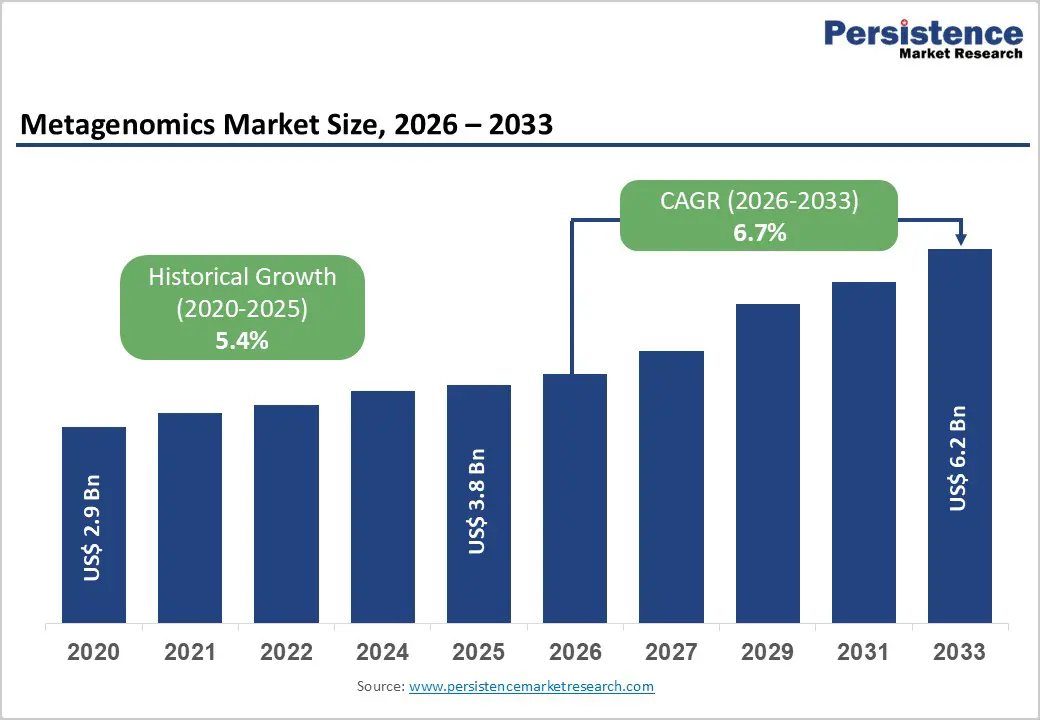
The global metagenomics market size is estimated to grow from US$ 3.8 billion in 2026 to US$ 6.2 billion by 2033, at a CAGR of 6.7% from 2026 to 2033. Global demand for metagenomics is accelerating as research institutions, clinical laboratories, and public-health agencies increasingly shift toward genomic-driven approaches for pathogen detection, microbiome profiling, and environmental surveillance.
Rising prevalence of infectious diseases, antimicrobial resistance (AMR), chronic disorders linked to the microbiome, and emerging zoonotic threats is driving the adoption of high-throughput sequencing and advanced bioinformatics workflows. Growing awareness of the limitations of traditional culture-based testing is prompting healthcare systems to invest in metagenomic solutions that enable rapid, culture-independent identification of complex microbial communities.
Key Industry Highlights:
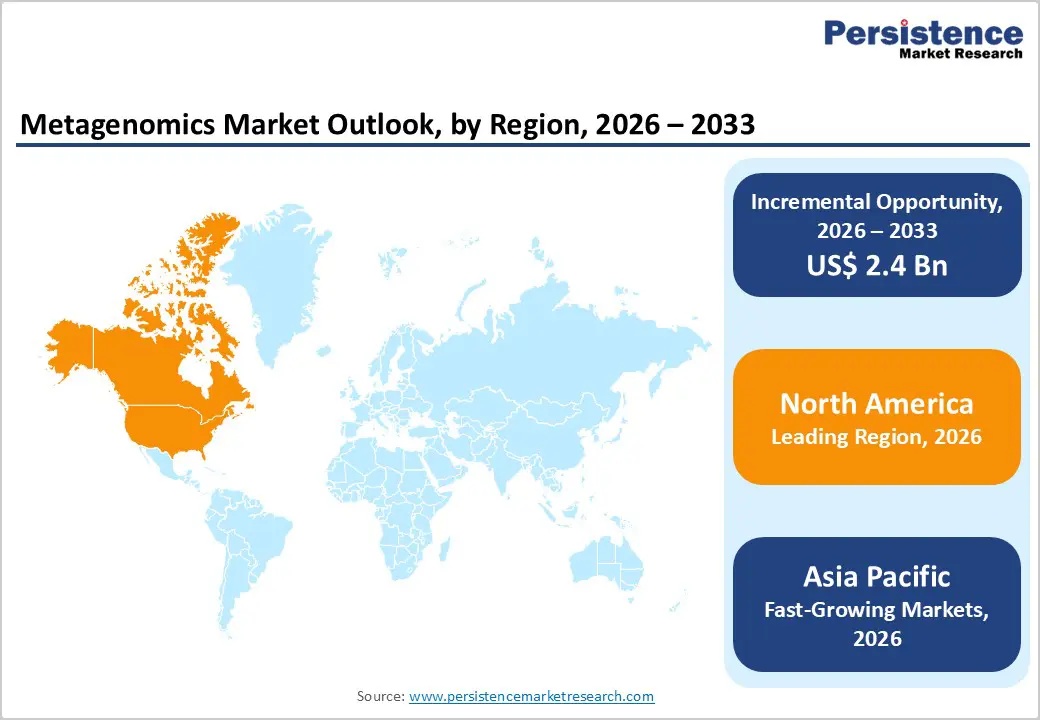
- Leading Region: North America leads with 46.8% share due to strong adoption of NGS technologies, robust government funding for genomic research, and widespread integration of metagenomics into clinical and environmental surveillance programs.
- Fastest-Growing Region: Asia Pacific grows fastest owing to expanding genomic infrastructure, rising infectious-disease burden, and significant public and private investments in sequencing capacity and bioinformatics.
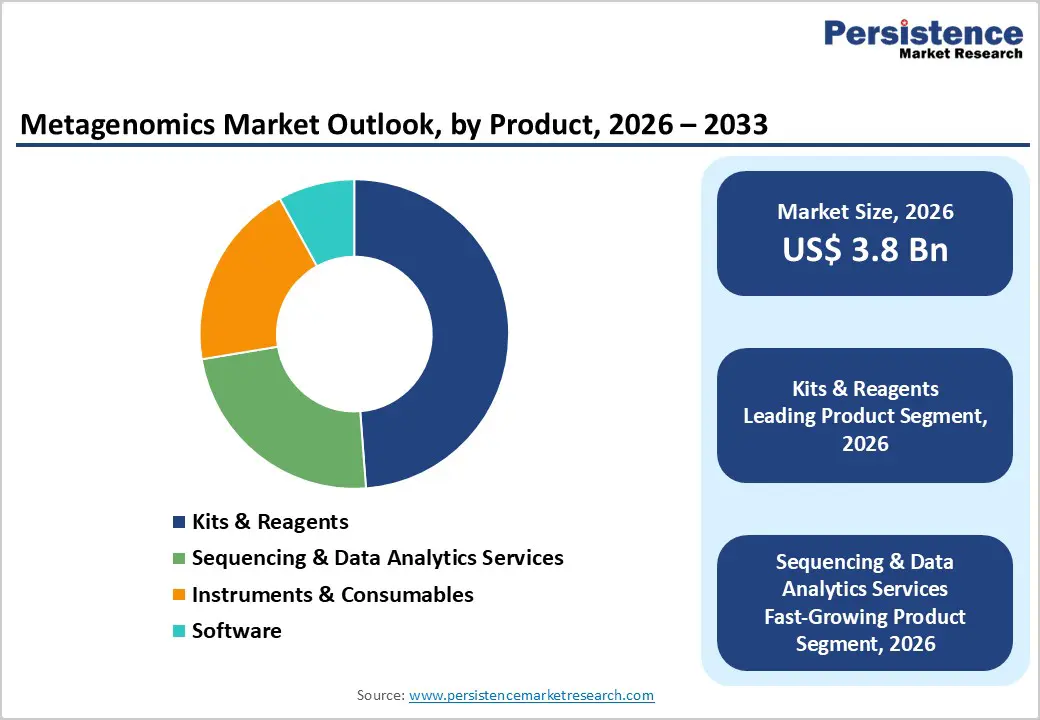
- Leading Product Segment: Kits & reagents dominate, driven by their high recurring consumption in DNA extraction, library preparation, amplification, and microbiome research across academic, clinical, and industrial laboratories.
- Fastest-Growing Product Segment: Sequencing & data analytics services expand rapidly as institutions increasingly outsource complex sequencing workflows and rely on specialized bioinformatics providers for high-volume sample processing and advanced microbial analysis.
- Leading Technology Segment: Shotgun sequencing leads due to its ability to deliver comprehensive, unbiased microbial community profiling and detect both known and unknown pathogens across diverse sample types.
- Fastest-Growing Technology Segment: 16S sequencing grows fastest as researchers and clinicians seek cost-efficient, rapid, and high-throughput solutions for routine microbial identification, ecological studies, and large cohort microbiome screening.
| Key Insights | Details |
|---|---|
|
Metagenomics Market Size (2026E) |
US$ 3.8 Bn |
|
Market Value Forecast (2033F) |
US$ 6.2 Bn |
|
Projected Growth (CAGR 2026 to 2033) |
6.7% |
|
Historical Market Growth (CAGR 2020 to 2025) |
5.4% |
Market Dynamics
Driver - Growing Adoption of Genomic Technologies for Infectious Disease Surveillance and Population Health
The global metagenomics market is experiencing strong momentum as the burden of infectious diseases, emerging pathogens, and antimicrobial resistance (AMR) continues to rise worldwide. Traditional culture-based diagnostics often fail to detect fast-evolving or unculturable microbes, prompting healthcare systems to adopt rapid, comprehensive, and culture-independent metagenomic sequencing. For instance, in 2023, the World Health Organization (WHO) reported that around 8.2 million people were newly diagnosed with tuberculosis, the highest number since global TB monitoring began in 1995. The surge from 7.5 million cases in 2022 highlights significant diagnostic gaps, reinforcing the need for rapid, culture-independent metagenomic tools that can detect TB and drug-resistant strains more efficiently, thereby accelerating the adoption of metagenomic sequencing in infectious disease surveillance.
The increasing frequency of outbreaks, hospital-associated infections, and zoonotic spillovers further accelerates the shift toward advanced genomic tools capable of identifying entire microbial communities in a single test. Simultaneously, the expansion of AMR surveillance programs is reinforcing the need for high-resolution genomic data to monitor resistance mechanisms and guide targeted interventions.
Technological advances in next-generation sequencing (NGS) and bioinformatics are propelling adoption. Enhanced sequencing chemistries, long-read platforms, automated extraction and library-preparation workflows, and AI-driven taxonomic classification are dramatically improving accuracy, scalability, and turnaround times. These innovations align with growing government investments in genomics, including population-scale sequencing projects, wastewater-based epidemiology programs, and national pathogen surveillance networks. Public-health agencies across North America, Europe, and Asia are integrating metagenomic sequencing into early-warning systems and environmental monitoring frameworks, further positioning the technology as an essential tool for modern infectious disease control and genomic-driven healthcare.
Restraints - High Expenses, Complex Data, and Unclear Regulations
High implementation costs and technical barriers continue to restrict broader adoption of metagenomics, particularly in low-resource settings. Sequencing instruments, library preparation kits, high-performance computing infrastructure, and cloud-based storage significantly raise operational expenses for laboratories. For several academic centers, public health labs, and institutions in low- and middle-income countries, these costs limit routine use of metagenomic workflows.
Additionally, regulatory ambiguity surrounding clinical metagenomics further slows adoption. Region-specific approval pathways, evolving standards for analytical validity, and limited clarity around reimbursement for metagenomic tests have created uncertainty for companies and healthcare providers planning clinical integration.
Moreover, the complexity of metagenomic data itself presents substantial challenges. Interpreting large, heterogeneous datasets requires specialized expertise in computational biology, which many institutions lack due to the global shortage of trained bioinformaticians. Advanced skills are needed to manage contamination, minimize analytical biases, ensure reproducibility, and derive clinically relevant insights from microbial communities. This skills gap, combined with limited standardized pipelines, makes it difficult for labs to implement metagenomics reliably. Moreover, the computational demand for processing high-depth sequencing further adds to cost and operational burden, collectively restraining the market’s growth trajectory.
Opportunity - Expanding Environmental Applications and Next-Gen Sequencing Innovations
The global metagenomics market is poised for strong growth as new applications in environmental and public health surveillance gain momentum. Wastewater-based epidemiology is rapidly emerging as a critical tool for tracking viral outbreaks, antimicrobial resistance patterns, and community-level pathogen circulation. Metagenomics is also being adopted for pollution assessment, soil and water microbiome evaluation, and biodiversity conservation, opening strong opportunities across government monitoring agencies and environmental research organizations. These non-clinical applications are expanding the customer base beyond traditional laboratories and enabling consistent, large-scale sequencing demand.
Furthermore, the rapid evolution of microbiome therapeutics is creating fresh avenues for growth. Pharmaceutical and biotech companies are investing aggressively in microbiome-based drug discovery, clinical modeling, and biomarker identification, each of which relies heavily on metagenomic analysis. Complementing this trend, advances in portable and point-of-care sequencing technologies are enabling real-time genomic assessment in remote settings, on farms, at field research stations, and in outbreak zones. Compact sequencers and cloud-based analytics reduce dependency on centralized labs, significantly widening market accessibility. Together, these advancements are accelerating adoption across environmental sciences, precision medicine, agriculture, and global health, positioning metagenomics as a foundational tool for next-generation biological intelligence.
Category-wise Analysis
By Product Insights
Kits & reagents are expected to account for 48.8% of revenue in 2026, making them the leading product category in the global metagenomics market, owing to their essential role in DNA extraction, library preparation, amplification, and sample-quality optimization. Their recurring, high-frequency usage across research laboratories, clinical diagnostic centers, and environmental testing facilities makes them the most revenue-intensive product category. Increasing adoption of next-generation sequencing (NGS), rapid pathogen detection, and microbiome profiling is driving significant reagent consumption, especially in workflows requiring high-sensitivity and high-throughput analyses.
Manufacturers are introducing improved enzyme formulations, contamination-resistant chemistry, and automation-ready reagent kits that enhance sequencing accuracy and reduce turnaround time. Rising investments in microbiome therapeutics, agricultural genomics, and wastewater surveillance are further elevating demand for specialized reagents tailored for complex microbial samples. As sequencing platforms advance and multi-omics integration expands, reagent-intensive protocols continue to scale, reinforcing the dominance of kits & reagents across academic, clinical, and industrial research settings.
By Application Insights
The environmental monitoring segment is projected to hold a 38.9% share of the metagenomics market in 2026, owing to its critical role in tracking biodiversity, detecting emerging pathogens, and assessing ecological health. Governments, research institutes, and environmental agencies increasingly rely on metagenomic sequencing for water-quality assessment, soil microbiome analysis, ocean health monitoring, and wastewater-based epidemiology. The ability to identify unculturable organisms and provide high-resolution microbial community data gives metagenomics a major advantage over traditional culture-based methods.
Rising global focus on climate change, pollution assessment, and antimicrobial resistance (AMR) surveillance is strengthening adoption across environmental programs. Advancements in portable sequencing devices, automated sample-preparation workflows, and AI-based taxonomic classification are enabling large-scale, real-time environmental monitoring. With expanding applications in agriculture, aquaculture, public health, and conservation biology.
By End-user Insights
Pharmaceutical companies are projected to command a 52.7% revenue share in 2026, making them the dominant distribution channel in the metagenomics market. This leadership is due to the increasing integration of microbial genomics into drug discovery, therapeutic development, and clinical research pipelines. Metagenomic sequencing enables identification of novel microbial metabolites, characterization of host–microbe interactions, and development of microbiome-based therapeutics-all of which are gaining strong industry traction. Biopharmaceutical firms leverage metagenomics for immuno-oncology research, antibiotic discovery, vaccine development, and the study of drug–microbiome interactions that influence treatment outcomes.
Growing investment in precision medicine, combined with the rising number of partnerships between pharma companies and genomic sequencing providers, is accelerating technology adoption. Companies are also expanding in-house sequencing capabilities and outsourcing large-scale metagenomic analyses to enhance R&D productivity. The pharmaceutical sector is increasingly prioritizing multi-omics integration, real-time pathogen analytics, and personalized therapeutic strategies.
Regional Insights
North America Metagenomics Market Trends
North America is expected to dominate the global market with a 45.8% share in 2026. The U.S. leads the region due to large-scale microbiome research initiatives, integrated bioinformatics infrastructures, and increasing use of metagenomic tools in infectious-disease surveillance, environmental monitoring, and precision medicine. Expanding clinical applications such as rapid pathogen detection, antimicrobial resistance (AMR) tracking, and oncology-focused microbial profiling are further enhancing market penetration.
Technological advancements, including long-read sequencing, AI-powered taxonomic classification, and cloud-based analytics platforms, are transforming data accuracy, scalability, and turnaround times. Growing partnerships between academic institutions, biopharma companies, and national health agencies are driving the development of metagenomic biomarkers and translational research programs. Rising demand for outsourced sequencing, coupled with strong venture capital investment in microbiome therapeutics and diagnostic startups, continues to strengthen regional growth.
Europe Metagenomics Market Trends
Europe is witnessing steady expansion driven by growing microbiome research, strong regulatory support for genomic innovation, and increasing adoption of metagenomic workflows in hospital laboratories and environmental agencies. Countries such as the UK, Germany, France, and the Netherlands are actively integrating metagenomic sequencing into infectious-disease surveillance, food-safety testing, wastewater pathogen detection, and agricultural microbiome studies.
Robust national research programs and EU-funded initiatives including Horizon Europe and One Health collaborations are accelerating the adoption of high-throughput sequencing and advanced bioinformatics tools. For instance, in January 2025, the UK Health Security Agency (UKHSA) launched mSCAPE, the world’s first national metagenomics initiative for rapid detection of infectious disease threats. Developed with NHS and academic partners, the program pilots real-time metagenomic surveillance across the UK. Such large-scale government-led adoption boosts demand for sequencing platforms, analytics software, and metagenomic workflows, creating strong growth opportunities for market players operating in public health and infectious disease monitoring.
Innovation is rising as European manufacturers and academic centers develop AI-enhanced analysis pipelines, portable sequencing systems, and standardized microbial reference datasets. The growing shift toward personalized nutrition, precision agriculture, and microbiome-based therapies is expanding the market’s application base. Strengthening cross-border research networks, expanding digital-health infrastructure, and increasing private investment in genomics startups are collectively making Europe one of the most active regions for metagenomics-driven scientific discovery.
Asia Pacific Metagenomics Market Trends
Asia Pacific is projected to grow at the fastest pace, with a CAGR of 9.1%, supported by increasing investments in genomic research, rising burden of infectious diseases, and the rapid expansion of national sequencing programs. Countries such as China, Japan, India, South Korea, and Australia are integrating metagenomic sequencing into disease-surveillance systems, AMR monitoring programs, agricultural productivity enhancement, and environmental sustainability initiatives. Growing government support, such as China’s Precision Medicine Initiative and India’s Genome India Project, is accelerating infrastructure development and expanding access to advanced sequencing technologies.
The region is witnessing rising demand for cost-effective reagents, high-throughput sequencing platforms, and cloud-based analytics tailored for large-scale microbiome and pathogen studies. Emerging biotech companies are introducing affordable sequencing services, while global players are partnering with hospitals, academic institutions, and public health agencies to strengthen their regional presence. Increasing awareness of microbiome science, rapid growth in biopharmaceutical research, and expanding investments in smart agriculture and food-safety testing position the Asia Pacific as a key growth hub for metagenomics solutions.
Competitive Landscape
The global metagenomics market is moderately competitive, with key players including Bio-Rad Laboratories, Inc, Illumina, Inc., PerkinElmer, Thermo Fisher Scientific, Novogene Co., Ltd., and Promega Corporationare. These companies compete through broad sequencing portfolios, strong partnerships with research institutes and clinical laboratories, and continuous advancements in NGS platforms, metagenomic library-prep kits, and bioinformatics pipelines. Competition is intensifying as manufacturers focus on higher-throughput workflows, improved reagent chemistry, cloud-based analytics, and cost-efficient sequencing solutions tailored for microbiome, pathogen, and environmental applications.
Leading players are increasingly investing in next-generation metagenomic innovations such as ultra-long-read sequencing, AI-driven taxonomic classification, real-time pathogen surveillance tools, and integrated sample-to-answer platforms. Strategic priorities include expanding market penetration in rapidly growing regions across Asia-Pacific, strengthening collaborations with academic and clinical research networks, and enhancing service-based offerings such as outsourced sequencing, cloud bioinformatics, and integrated microbiome analysis solutions.
Key Industry Developments:
- In November 2025, Metagenomi, Inc. reported new dose-range–finding data from its MGX-001 hemophilia A program, showing curative Factor VIII activity in non-human primates. The results support a clinical dosing strategy and position MGX-001 as a potential best-in-class gene-editing therapy.
- In October 2025, scientists at the Earlham Institute introduced MARTi, an advanced real-time analysis tool for nanopore metagenomics. The software significantly accelerates pathogen detection and response by enabling rapid, high-resolution microbial identification, supporting faster decision-making in clinical diagnostics, outbreak monitoring, and environmental surveillance.
- In May 2025, MapMyGenome acquired Canadian firm Microbiome Insights, a globally recognized leader in microbial sequencing, to strengthen its global footprint and enhance scientific capabilities. This acquisition expands access to advanced sequencing expertise, boosts cross-border microbiome research, and supports growing demand for metagenomic analysis across clinical, environmental, and therapeutic applications.
- In April 2025, Metabolon, Inc. launched a comprehensive microbiome research solution that integrates metagenomics sequencing, advanced bioinformatics, and a new microbiome metabolite panel. This combined platform offers one of the industry’s most powerful toolkits for decoding microbial communities, enabling deeper functional insights for applications in health, disease, and therapeutic discovery.
Companies Covered in Metagenomics Market
- Illumina Inc
- Perkin Elmer Inc .
- Trivitron Heathcare Pvt. Ltd.
- Qiagen N.V.
- Thermo Fisher Scientific
- Symbio Scientific Pvt. Ltd.
- Infobio
- Bio-Rad Laboratories
- Merck KgaA
- Promega Corporation
- Others.
Frequently Asked Questions
The global metagenomics market is projected to be valued at US$ 3.8 Bn in 2026.
Rising adoption of next-generation sequencing for pathogen detection, microbiome analysis, and ecological monitoring drives the global metagenomics market.
The global metagenomics market is poised to witness a CAGR of 6.2 between 2026 and 2033.
Expanding applications in clinical diagnostics, precision medicine, agricultural genomics, and environmental surveillance create major growth opportunities in the global metagenomics market.
Bio-Rad Laboratories, Inc, Illumina, Inc., PerkinElmer, Thermo Fisher Scientific, Novogene Co., Ltd., Promega Corporationare some of the key players in the metagenomics market.


