




- Clothing, Footwear, & Accessories
- Garnet Market
Garnet Market Size, Share, and Growth Forecast, 2026 - 2033
Garnet Market by Product Type (Almandine, Andradite, Grossular, Pyrope, Spessartin, Uvarovite, Misc.) Application (Water Jet Cutting, Abrasive Blasting, Water Filtration, Abrasive Powder, Misc.), and Regional Analysis for 2026 - 2033

Garnet Market Size and Trends Analysis
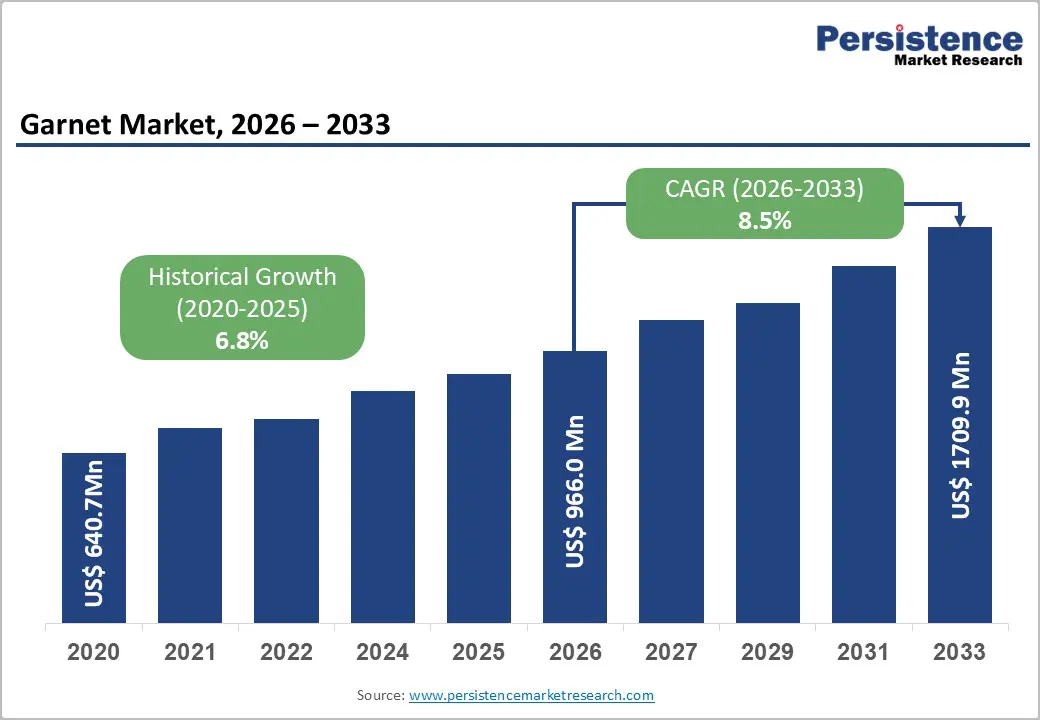
The global garnet market size was valued at US$966.0 Mn in 2026 and is projected to reach US$1,709.9 Mn by 2033, growing at a CAGR of 8.5% between 2026 and 2033.
The market's robust expansion is driven by accelerating demand from aerospace and automotive sectors requiring precision surface preparation, sustained industrial applications across water jet cutting and abrasive blasting operations, and regulatory mandates establishing garnet as a preferred sustainable alternative to silica-based abrasives.
The convergence of stringent occupational health regulations eliminating silica sand, industrial infrastructure development across emerging economies, and technological advancement in precision cutting applications creates sustained expansion momentum within the Garnet Market through the forecast period.
Key Industry Highlights:
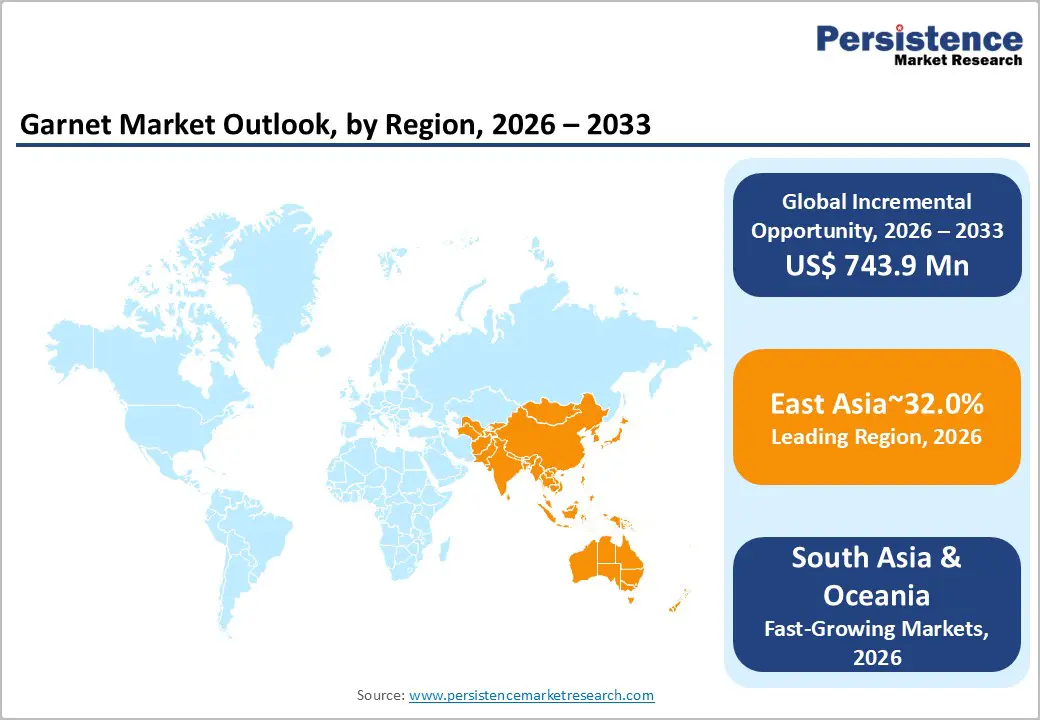
- Regional Leadership: East Asia leads the global garnet market with 32% share, driven by China and India’s industrial manufacturing expansion, infrastructure development, and water treatment investments.
- Mature Market Presence: North America holds 24% market share, supported by stringent OSHA silica regulations, aerospace precision manufacturing, and automotive EV component preparation.
- Strong European Demand: Europe accounts for 26% market share, fueled by regulatory mandates restricting silica abrasives, advanced aerospace and automotive manufacturing, and sustainable sourcing trends.
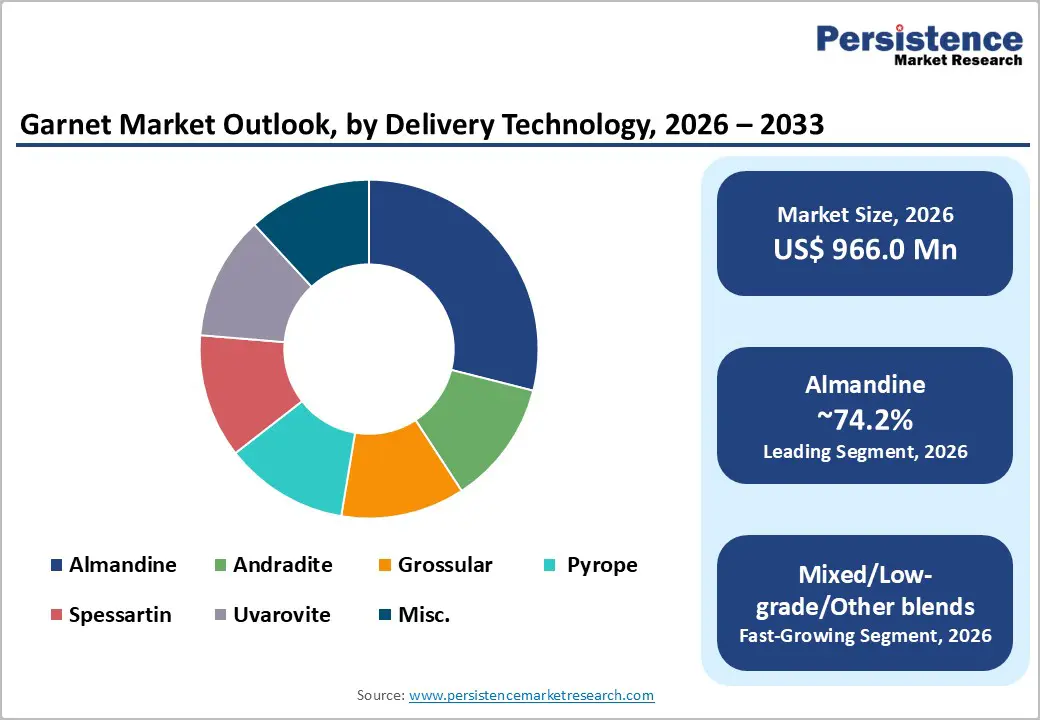
- Leading Product Segment: Almandine garnet dominates with 74% share due to superior hardness, regulatory compliance recognition, and established supply chains in Australia and India.
- Top Application Segment: Abrasive blasting represents the largest use at 41% share, driven by industrial equipment maintenance, aerospace surface preparation, and maritime hull cleaning.
| Global Market Attributes | Key Insights |
|---|---|
| Garnet Market Size (2026E) | US$ 966.0 Mn |
| Market Value Forecast (2033F) | US$ 1,709.9 Mn |
| Projected Growth (CAGR 2026 to 2033) | 8.5% |
| Historical Market Growth (CAGR 2020 to 2025) | 6.8% |
Market Dynamics
Growth Drivers
Regulatory Substitution Mandates Replacing Silica-Based Abrasives with Non-Toxic Alternatives
Occupational safety regulations across North America and Europe have systematically eliminated silica sand from industrial abrasive applications, establishing garnet as the mandatory replacement for surface preparation and blasting operations. The Occupational Safety and Health Administration (OSHA) silica exposure standards, implemented with phased compliance through 2025, restrict crystalline silica dust emissions to 50 micrograms per cubic meter, compelling manufacturers to transition to safer alternatives.
The European Union's Regulation 1107/2009 similarly restricts silica-based blasting materials, explicitly recognizing garnet's non-toxic, naturally derived composition as meeting occupational health mandates. This regulatory environment creates structural demand expansion for the Garnet Market, as industrial operators cannot utilize conventional silica abrasives regardless of cost considerations. Global surface preparation abrasives market, with garnet-based solutions representing the fastest-adoption category among occupational-health-compliant alternatives.
The compliance timeline creates mandatory adoption acceleration through 2026, directly catalyzing Garnet Market expansion as manufacturers replace existing supply chains with guarantee-qualified suppliers meeting regulatory specifications. Regulatory recognition of garnet's superior safety compared to synthetic alternatives establishes sustained competitive advantages supporting premium positioning and margin expansion for garnet producers.
Aerospace and Automotive Sector Expansion Demanding Precision Surface Preparation Technologies
The aerospace sector's structural growth, driven by commercial air traffic recovery and defense modernization programs, creates accelerating demand for precision surface preparation technologies where garnet abrasives demonstrate superior performance characteristics. The global aerospace and defense sector represents US$640 billion in annual spending, with surface preparation and coating applications representing 8 to 12 percent of component manufacturing processes across aircraft assembly, engine manufacturing, and aircraft maintenance operations.
Garnet abrasives' superior hardness and low dust emission profile enable precision preparation of aerospace-grade alloys, composite materials, and titanium components without producing hazardous crystalline silica dust contaminating manufacturing facilities. The automotive sector's acceleration toward electric vehicle manufacturing and lightweight composite material adoption directly increases surface preparation demand, as composite layup preparation, adhesive bonding surface conditioning, and corrosion prevention coating application require garnet-based abrasive technologies.
North American automotive production of 10.6 million vehicles annually relies substantially on precision abrasive surface preparation for component assembly and protective coating application. The integration of garnet abrasives into aerospace maintenance protocols supports the global aircraft fleet's sustained expansion, with 28,000 plus commercial aircraft requiring regular exterior maintenance, interior component refurbishment, and protective coating restoration. The Market directly benefits from aerospace and automotive sector expansion momentum, as these precision-demanding industries establish garnet as non-negotiable for quality assurance and regulatory compliance in surface preparation protocols.
Water Infrastructure Development and Multibillion-Dollar Global Investment in Water Treatment Systems
Global water treatment infrastructure investment exceeded US$150 billion in 2024, driven by urbanization across emerging economies, regulatory compliance requirements for drinking water quality, and industrial water recycling mandate expansion. The World Health Organization estimates 2 billion people worldwide affected by contaminated drinking water, establishing water treatment as critical infrastructure investment priority for developing nations and developed market operators seeking capital replacement.
Garnet's superior performance characteristics in filtration media applications including high specific gravity (4.0 g/cm³), chemical inertness, and minimal free silica contamination establish garnet as preferred filtration media in multistage sand filtration systems. Municipal water treatment facilities across North America and Europe increasingly implement garnet in support bed applications combined with anthracite and sand, enabling higher flow rates (180plus gallons per minute per square foot), extended filter run duration, and superior solids removal efficiency compared to conventional sand-only systems.
Industrial water recycling for manufacturing, cooling water treatment, and process water purification applications represent the fastest-adoption category within water filtration, with industries investing capital to reduce freshwater consumption and minimize discharge contamination. The Market benefits directly from water infrastructure development momentum, as municipal authorities and industrial operators mandate garnet integration into capital-intensive filtration system upgrades supporting regulatory compliance and operational efficiency objectives.
Market Restraining Factors
Environmental Concerns Surrounding Industrial Garnet Mining Operations and Land Degradation Impacts
Environmental regulations and sustainability pressures create constraints on garnet mining expansion, particularly in premium production regions including Australia and India where alluvial garnet mining operations require extensive land surface disturbance and sediment management protocols. Mining operation decommissioning, land reclamation, and environmental restoration represent substantial cost burdens reducing profitability for producers, particularly at lower commodity pricing levels. Water contamination risks associated with garnet processing operations, including grinding and washing processes, create regulatory compliance costs and potential operational suspension risks if environmental monitoring data indicates ecosystem contamination. Community opposition to garnet mining expansions, particularly in regions with sensitive environmental ecosystems or indigenous land considerations, creates permitting delays and project cancellation risks constraining supply expansion for Garnet Market participants.
Key Market Opportunities
Waterjet Cutting Technology Adoption in Precision Manufacturing and Custom Component Production
Waterjet cutting technology adoption represents substantial growth opportunity for the Garnet Market, driven by aerospace, automotive, and custom component manufacturing sectors demanding precision cutting capabilities without thermal distortion or material hardening. The global waterjet cutting machines market is directly catalyzing demand for abrasive garnet in waterjet cutting applications where precision, material versatility, and zero thermal impact establish garnet as non-substitutable input.
Waterjet cutting enables manufacturers to produce intricate aerospace components, automotive structural elements, and architectural decorative elements with tolerances as tight as +/- 0.002 inches (.05 mm) without introducing heat-affected zones or material degradation. The technology's cold-cutting process and applicability to diverse materials including aerospace-grade composites, titanium alloys, stainless steel, and specialty ceramics establish waterjet as preferred manufacturing methodology for precision component production.
The Market benefits from waterjet adoption acceleration, as abrasive garnet represents the enabling input technology for waterjet systems capable of processing materials exceeding 4 inches in thickness with precision tolerances. Manufacturers transitioning from conventional laser and plasma cutting to waterjet technology require garnet abrasive sourcing as capital-intensive manufacturing systems become operational, establishing multi-year supply agreements supporting predictable revenue streams for garnet producers.
Oil and Gas Drilling Operations Utilizing Garnet as Proppant Material and Fracturing Fluid Additive
Oil and gas extraction operations present emerging application opportunity for the Garnet Market through garnet's functional characteristics as proppant material in hydraulic fracturing operations and reservoir stimulation processes. Garnet's high specific gravity, crush-resistance properties, and minimal chemical leaching characteristics enable sustained fracture conductivity in hydraulic fracturing applications, with garnet proppants demonstrating performance advantages compared to conventional sand proppants.
The global oil and gas sector maintains capital investment momentum in unconventional extraction technologies including shale oil and natural gas production, requiring sustained proppant demand across North American and international production operations.
Garnet proppant applications reduce negative environmental impacts compared to conventional sand proppants, supporting regulatory acceptance in jurisdictions with stringent environmental oversight. Emerging markets including India, Southeast Asia, and Middle Eastern production regions represent growth opportunities as hydrocarbon production development accelerates requiring capital-intensive drilling operations. The Garnet Market expansion through proppant applications enables producers to develop specialized product grades optimized for subsurface conditions and reservoir characteristics, establishing differentiated positioning that supports premium pricing compared to commodity garnet applications.
Category-wise Analysis
Product Type Insights
Almandine garnet maintains market leadership with share of 74.2% through proven performance characteristics, established manufacturing infrastructure, and regulatory familiarity across industrial applications spanning abrasive blasting, waterjet cutting, and water filtration. Almandine's superior hardness rating (7.0-7.5 Mohs scale), high specific gravity (3.8-4.2 g/cm³), and angular fracture geometry establish exceptional cutting efficiency and durability characteristics supporting extended service life across abrasive applications.
Global production concentrated in Australia and India provides reliable supply capacity supporting established customer relationships and long-term supply agreements. Almandine's regulatory compliance recognition across OSHA silica substitution mandates, European occupational health standards, and water quality certifications (NSF/ANSI Standard 61) establishes competitive advantages through proven safety documentation and regulatory acceptance pathways. Market dominance reflects established infrastructure, consumer education regarding performance characteristics, and regulatory pathway maturation supporting rapid commercialization of almandine-based product formulations across diverse applications.
Mixed-grade and low-grade garnet blends represent fastest-growing product segment, driven by emerging applications requiring customized particle size distributions, specialized density characteristics, and blended abrasive compositions optimized for specific manufacturing processes.
Application Insights
Abrasive blasting applications command 41% market share, driven by universal adoption across aerospace maintenance, maritime vessel hull preparation, industrial equipment surface preparation, and construction project cleanup operations. The global surface preparation abrasives market, with garnet commanding the largest market share among occupational-health-compliant alternatives following silica abrasive regulatory elimination. Garnet's superior performance characteristics including low dust emission, reduced operator respiratory exposure, and superior cutting efficiency compared to alternative abrasives establish garnet as preferred blasting media across North American and European markets.
Aerospace maintenance requirements for 28,000 plus commercial aircraft requiring regular exterior preparation, protective coating restoration, and corrosion prevention treatment create sustained demand momentum for blasting-grade garnet. Industrial equipment maintenance including oil and gas platform corrosion management, bridge infrastructure protection, and maritime vessel hull preservation represents substantial market segments supporting abrasive blasting demand expansion.
Water jet cutting applications represent fastest-adoption segment within the Garnet Market, driven by precision manufacturing expansion across aerospace components, automotive structural elements, and custom architectural design applications.
Regional Insights and Trends
North America Market Trend
North America represents 24% global market share, characterized by mature industrial infrastructure, stringent occupational health regulations accelerating garnet adoption, and aerospace-led precision manufacturing sector expansion. The region accounts for substantial aerospace manufacturing capacity with commercial aircraft production, defense modernization programs, and aircraft maintenance operations requiring precision surface preparation technologies where garnet abrasives establish performance standards. U.S. garnet production in 2024 reached 56,400 metric tons from operations in Montana and New York, contributing 8 percent of global supply while importing substantial volumes from Australia and India to satisfy industrial demand.
OSHA's crystalline silica exposure standards, implemented with phased compliance through 2025, eliminated silica sand from industrial abrasives, establishing structural demand for garnet replacement across North American manufacturing facilities.
The region's aerospace sector, representing US$280 plus billion in annual spending, requires precision surface preparation across commercial aircraft assembly, defense contracting operations, and aircraft maintenance facilities, establishing sustained garnet demand momentum. North American automotive sector expansion toward electric vehicle manufacturing and lightweight composite material adoption creates incremental surface preparation requirements supporting garnet demand growth across component assembly and protective coating application processes. Water treatment infrastructure modernization across municipal systems and industrial water recycling applications represents emerging growth opportunity, as North American utilities implement multistage filtration systems incorporating garnet support bed media meeting AWWA B100 standards for drinking water treatment.
East Asia Market Trend
East Asia commands 32% global market share, establishing the region as primary Garnet Market growth engine driven by China's garnet production expansion, India's alluvial mining output, and accelerating industrial demand across manufacturing and infrastructure development sectors.
China's government commitment of US$30 billion over five years for manufacturing sector modernization, combined with strategic infrastructure development priorities including water treatment systems and precision manufacturing expansion, creates sustained garnet demand momentum. The region's aerospace sector expansion, including domestic aircraft manufacturing programs and commercial aviation fleet growth supporting Chinese carriers' international expansion, establishes precision surface preparation demand supporting garnet adoption across manufacturing and maintenance operations.
Water infrastructure development across South Asia, including municipal water treatment facility expansion and industrial water recycling system implementation, creates incremental filtration media demand supporting garnet adoption for water quality assurance and treatment efficiency optimization.
Europe Market Trend
Europe represents 26% global market share, characterized by stringent environmental regulations, advanced manufacturing technologies, and emphasis on sustainable material sourcing driving precision garnet application development. The region's aerospace and automotive sectors represent substantial precision manufacturing demand, with European commercial aircraft manufacturers, automotive component suppliers, and defense contracting operations requiring garnet abrasives for surface preparation and precision cutting applications meeting exacting quality standards.
European regulatory environment, including EU Regulation 1107/2009 restricting silica-based abrasives and emerging nanomaterial oversight requirements, creates favorable conditions for garnet adoption through regulatory pathway clarity and safety documentation recognition. Germany's advanced manufacturing sector, representing 12 percent of European industrial output, incorporates garnet abrasives across precision surface preparation, waterjet cutting, and polishing applications supporting automotive and aerospace component manufacturing excellence standards. The region's environmental consciousness and circular economy mandate implementation drive interest in recycled garnet blends and sustainable abrasive sourcing, creating market opportunities for producers developing eco-friendly garnet formulations and demonstrating supply chain sustainability credentials.
Competitive Landscape
The competitive landscape of the global garnet market is moderately consolidated, with a small number of vertically integrated producers holding a significant share of global supply, particularly industrial-grade garnet. GMA Garnet Group remains the dominant player with integrated mining, processing, distribution, and recycling capabilities supporting abrasive blasting and waterjet cutting segments worldwide. Other notable companies such as Barton International, Indian Ocean Garnet Sands Company, Trimex Sands, Mohawk Garnet Inc., and V.V. Mineral participate competitively based on resource access, processing specialization, and export capabilities.
Supply chains are influenced by geological concentration in Australia, India, and China, giving integrated miners and processors a strategic advantage over traders and distributors. Barriers to entry are shaped by resource licensing, environmental compliance, and beneficiation technology, reinforcing the position of established players in high-spec industrial applications.
Key Industry Developments
- 22 April 2024, Jebsen & Jessen Group announced the acquisition of GMA Garnet Group, the world’s largest and only fully integrated industrial garnet company. The deal represents Jebsen & Jessen’s largest investment to date and supports GMA’s next phase of development, including expansion of mining and processing capacities. The strategic move strengthens GMA’s global market leadership in abrasive blasting, waterjet cutting, and protective coatings applications.
- 22 May 2023 - Mineral Commodities Limited (MRC) & GMA Group (Offtake + Funding Agreement) Mineral Commodities Limited and its partner Blue Bantry entered into formal agreements with GMA Group securing long-term garnet offtake volumes through 2033 and a US$10M loan for constructing a Mineral Separation Plant in South Africa. The deal supports increased finished garnet production capacity at the Tormin operations and aligns with MRC’s strategy to move up the value chain from concentrates to finished garnet products, reinforcing supply security for GMA and accelerating processing infrastructure development for MRC.
Companies Covered in Garnet Market
- GMA Garnet Group
- Indian Ocean Garnet Sands Company Ltd
- Trimex Sands Private Limited
- Barton International
- Zircon Mineral Co
- Mohawk Garnet Inc.
- Opta Minerals Inc
- V.V. Mineral Pvt Ltd.
- Beach Minerals Company
- Rizhao Garnet
Frequently Asked Questions
The global Garnet Market is projected to be valued at US$ 966.0 Mn in 2026.
The Almandine segment is expected to account for approximately 74.2% of the Global Garnet Market by product Type in 2026.
The market is expected to witness a CAGR of 8.5% from 2026 to 2033.
Garnet market growth is driven by regulatory mandates replacing silica-based abrasives with non-toxic alternatives, aerospace and automotive sector expansion demanding precision surface preparation, and increasing global investment in water treatment infrastructure utilizing garnet as filtration media.
The garnet market offers growth opportunities through rising adoption of waterjet cutting technology in precision manufacturing and increasing use of garnet as a proppant and fracturing fluid additive in oil and gas drilling operations.
Key players in the Garnet Market includes GMA Garnet Group,Barton International, Indian Ocean Garnet Sands Company, Trimex Sands, Mohawk Garnet Inc., and V.V. Mineral.


