




- Beauty & Personal Care
- Depilatory Products Market
Depilatory Products Market Size, Share, and Growth Forecast, 2026 - 2033
Depilatory Products Market by Product Type (Creams, Razors, Others), Application (Bikini, Face & Upper Lip, Others), Skin (Sensitive, Dry, Normal), Distribution Channel (Supermarkets/Hypermarkets, Others), and Regional Analysis for 2026 - 2033

Depilatory Products Market Size and Trends Analysis
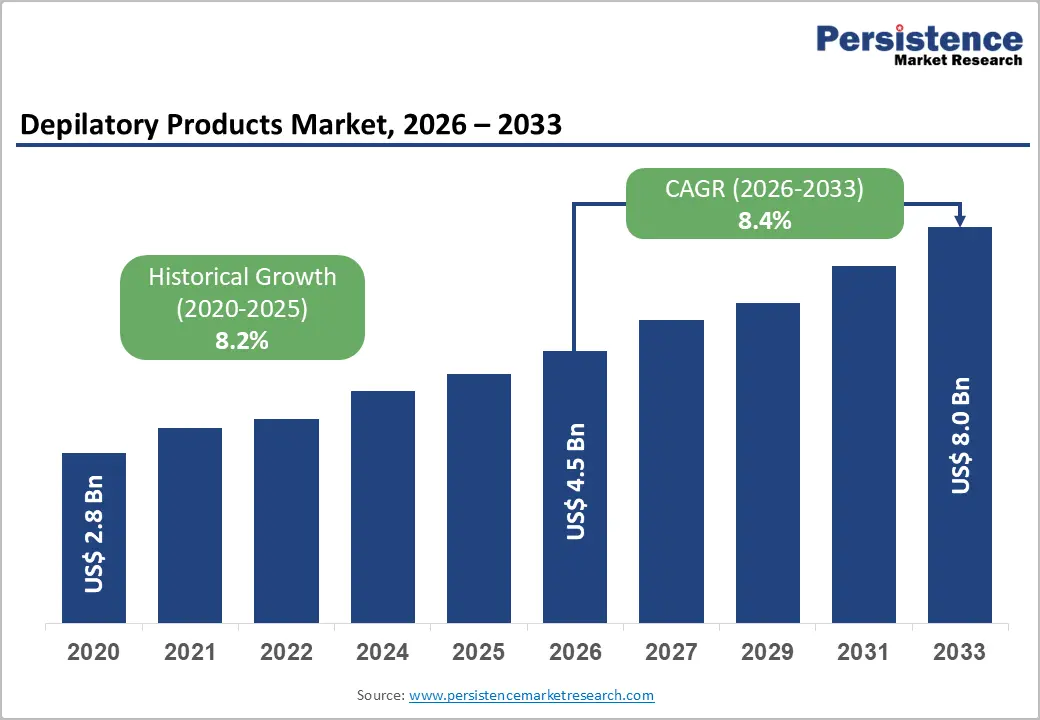
The global depilatory products market size is likely to be valued at US$4.5 billion in 2026 and is expected to reach US$8.0 billion by 2033, growing at a CAGR of 8.4% during the forecast period from 2026 to 2033, driven by shifting grooming habits, rising demand for convenient and cost-effective at-home hair removal solutions, and increasing awareness of personal hygiene.
Expanding urbanization, the influence of social media, and growing adoption among younger consumers and men are further supporting demand. Ongoing innovations in skin-friendly and natural formulations are enhancing product appeal and sustaining market growth.
Key Industry Highlights:
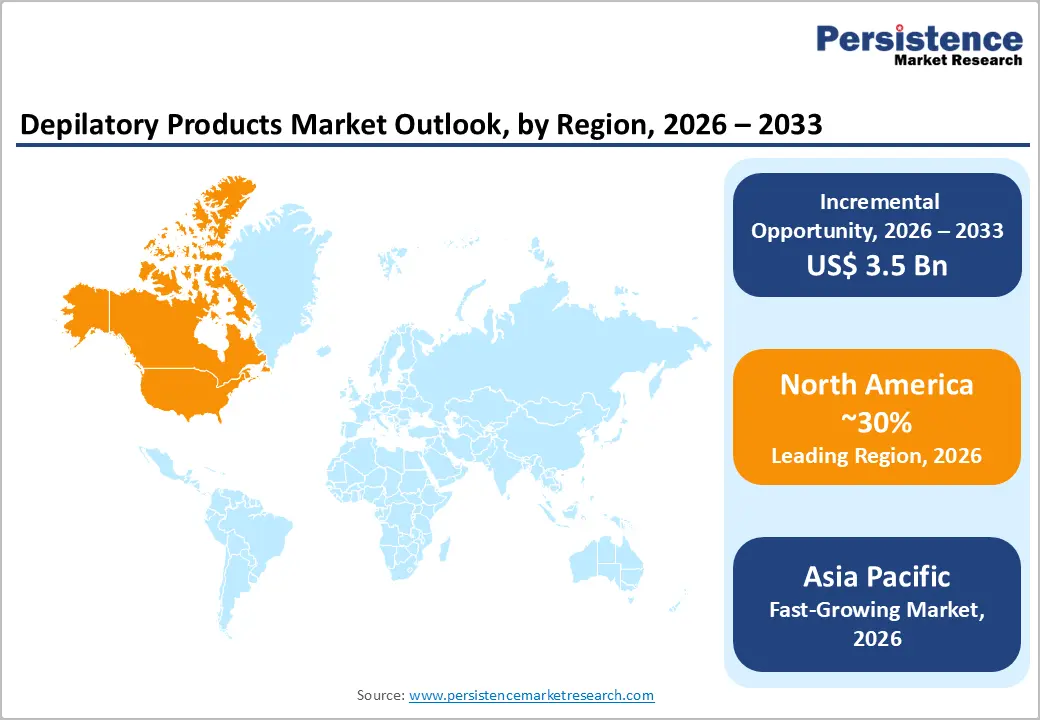
- Leading Region: North America is anticipated to be the leading region, accounting for a market share of 30% in 2026, driven by strong grooming culture, innovation, and premium product adoption led by the U.S.
- Fastest-growing Region: Asia Pacific is likely to be the fastest-growing region, supported by rapid urbanization, rising grooming awareness, and strong demand across countries.
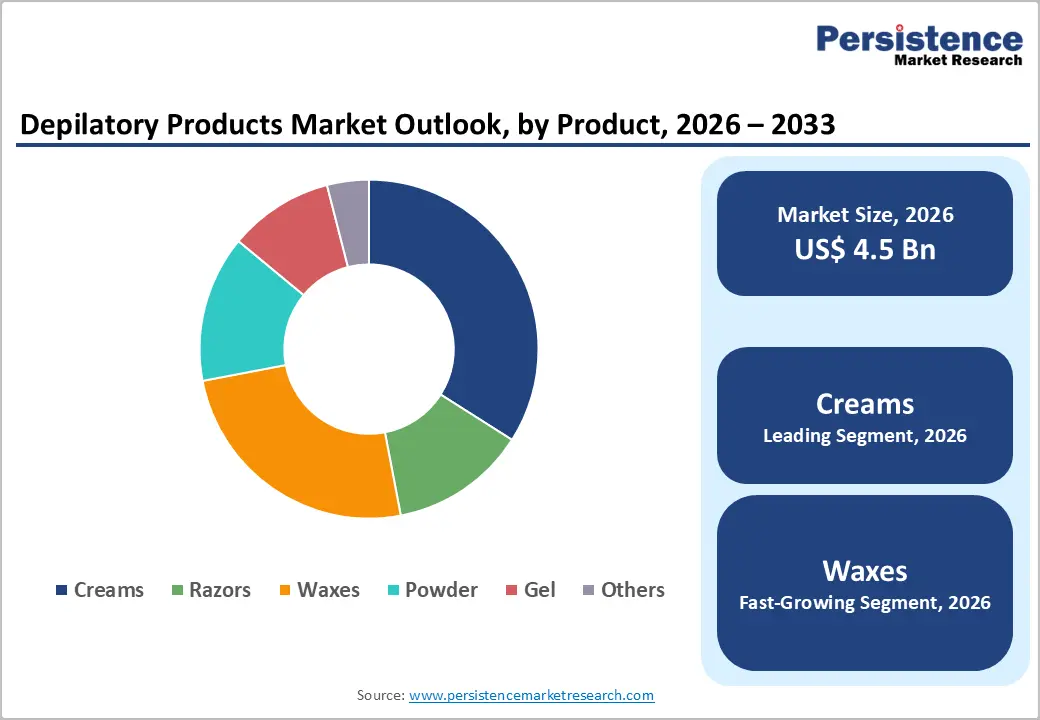
- Leading Product Type: Creams are projected to represent the leading product type in 2026, accounting for 45% of the revenue share, driven by ease of use and wide availability.
- Leading Application: The legs & body segment is anticipated to be the leading application, accounting for over 50% of the revenue share in 2026, supported by high-frequency grooming needs and broad consumer usage across demographics.
| Key Insights | Details |
|---|---|
|
Depilatory Products Market Size (2026E) |
US$4.5 Bn |
|
Market Value Forecast (2033F) |
US$8.0 Bn |
|
Projected Growth (CAGR 2026 to 2033) |
8.4% |
|
Historical Market Growth (CAGR 2020 to 2025) |
8.2% |
DRO Analysis
Driver - Increasing Consumer Focus on Personal Grooming and Hygiene
Rising awareness of personal grooming and hygiene continues to shape consumer behavior across markets, significantly influencing demand for depilatory products. Urban lifestyles, increasing disposable incomes, and evolving beauty standards have made regular hair removal an essential part of self-care routines. Social media and digital influence amplify this trend, encouraging consistent grooming habits among both women and men. Younger demographics are adopting grooming practices earlier, contributing to sustained demand.
The expansion of grooming culture beyond traditional gender boundaries is also strengthening market growth. Male consumers are increasingly investing in personal care, including hair removal, driven by professional appearance standards and lifestyle changes. Product accessibility through retail chains and e-commerce platforms enhances consumer reach, while targeted marketing strategies improve engagement. Brands are focusing on inclusive product lines catering to diverse skin types and preferences, increasing adoption.
Technological Advancements and Product Innovation
Technological advancements are playing a crucial role in enhancing the effectiveness and appeal of depilatory products. Continuous innovation in formulations has led to the development of faster-acting, low-odor, and skin-friendly products that reduce irritation while improving efficiency. Manufacturers are investing in research and development to incorporate soothing agents such as aloe vera and natural oils, which enhance user experience. Improvements in packaging, such as easy-to-use applicators and precision tools, are making products more convenient for consumers, supporting the shift toward at-home grooming solutions.
Innovation is also evident in the diversification of product offerings, including sprays, gels, and pre-coated wax strips designed for specific body areas. The integration of dermatologically tested and hypoallergenic formulations is addressing safety concerns and expanding the consumer base. Companies are leveraging digital platforms to launch new products and gather real-time feedback, accelerating innovation cycles. As competition intensifies, differentiation through advanced technology and product performance becomes critical, encouraging brands to continuously upgrade their offerings and align with evolving consumer expectations in the depilatory products market.
Restraint - Consumer Safety Concerns and Skin Sensitivity Issues
Concerns related to skin irritation, allergic reactions, and chemical exposure remain a significant challenge for the depilatory products market. Many formulations contain active ingredients that may cause redness, burns, or discomfort, particularly for individuals with sensitive skin. Negative consumer experiences can lead to reduced brand trust and hesitation in product usage. Increasing awareness regarding ingredient safety has made consumers more cautious, prompting them to carefully evaluate product labels and opt for safer alternatives, which can limit the adoption of certain depilatory products.
Regulatory bodies across regions are enforcing stricter guidelines on cosmetic ingredients to ensure consumer safety, which adds complexity to product development and approval processes. Compliance with these standards often increases costs for manufacturers, affecting pricing strategies. The rise of clean beauty trends is pushing consumers toward natural or organic alternatives, intensifying pressure on traditional formulations. To address these challenges, companies are investing in safer ingredients and dermatological testing, but overcoming consumer skepticism remains a key hurdle for sustained market growth.
Competitive Substitution from Alternative Grooming Methods
The availability of alternative hair removal methods presents a notable restraint for the depilatory products market. Options such as laser treatments, intense pulsed light (IPL) devices, shaving tools, and epilators offer varying benefits, including long-term results and precision, which attract consumers seeking more permanent or efficient solutions. These alternatives often reduce the frequency of depilatory product usage, impacting overall demand. Professional salon services continue to appeal to consumers who prioritize expertise and longer-lasting outcomes.
Technological advancements in alternative methods have made them more accessible and affordable, intensifying competition. At-home laser and IPL devices, in particular, are gaining traction among consumers looking for convenience and durability. This shift in preference challenges depilatory product manufacturers to differentiate their offerings through pricing, ease of use, and safety. While depilatory products remain popular for their affordability and simplicity, maintaining competitiveness against evolving alternatives requires continuous innovation and strong value propositions.
Opportunity - Technological Convergence with Natural and Sustainable Formulations
The growing demand for clean and sustainable beauty products is creating new opportunities within the depilatory products market. Consumers are increasingly seeking formulations that combine technological effectiveness with natural ingredients, minimizing the use of harsh chemicals. This convergence is driving innovation in plant-based depilatory creams and waxes that offer similar performance while enhancing skin compatibility. Sustainability trends also encourage the adoption of eco-friendly packaging and ethically sourced ingredients, aligning with consumer values and environmental concerns.
Manufacturers are leveraging this trend by developing biodegradable wax strips, recyclable packaging, and cruelty-free products. The integration of advanced formulation technologies with natural components allows brands to differentiate themselves in a competitive market. Regulatory support for safer and sustainable products accelerates this shift. As consumer awareness continues to grow, companies that successfully balance performance with sustainability are likely to gain a competitive edge and capture emerging demand in the depilatory products market.
Male Grooming and Broader Usage Expansion
The expansion of male grooming presents a significant growth opportunity for the depilatory products market. Changing social norms and increasing emphasis on personal appearance have encouraged men to adopt grooming routines that include hair removal. This shift is supported by targeted marketing campaigns and the introduction of products specifically designed for male skin and hair types. As awareness increases, men are becoming a key consumer segment, contributing to overall market expansion and diversification.
Beyond gender expansion, the market is also benefiting from broader usage across different body areas and age groups. Products tailored for specific applications, such as facial hair or sensitive zones, are gaining popularity, driving repeat purchases. E-commerce platforms and digital marketing strategies are enabling brands to reach untapped consumer segments. As grooming becomes more inclusive and personalized, the depilatory products market is well-positioned to capitalize on these evolving trends and expand its consumer base.
Category-wise Analysis
Product Type Insights
Creams are expected to lead the depilatory products market, accounting for approximately 45% of revenue in 2026, driven by their ease of application, painless process, and widespread availability across retail and online channels. These products are highly preferred for at-home use as they require minimal effort and deliver quick results, making them suitable for busy consumers. For example, Veet has strengthened its position by offering a wide range of cream-based depilatories designed for different skin sensitivities, reinforcing the segment’s dominance through product innovation and accessibility.
Waxes are likely to represent the fastest-growing segment in 2026, supported by increasing consumer preference for longer-lasting hair removal compared to creams and razors. Consumers are shifting toward wax-based solutions because they deliver smoother skin results that can last for weeks, reducing the frequency of grooming routines. For example, GiGi offers professional-grade waxing products and at-home kits designed for effective hair removal with improved skin comfort.
Application Insights
The legs & body segment is projected to lead the market, capturing around 50% of the revenue share in 2026, supported by high-frequency usage and a broad consumer base across different age groups and demographics. Hair removal for legs and body is a routine grooming practice, making it a consistent driver of demand. Consumers prioritize efficiency and ease when addressing these areas, which encourages repeat purchases. Marketing campaigns emphasizing smooth skin and hygiene contribute to sustained demand. For example, Sally Hansen offers body-focused wax strips and creams designed specifically for legs and larger areas.
Bikini is likely to be the fastest-growing application, driven by evolving beauty standards and increasing awareness of personal grooming in sensitive regions. Consumers are seeking specialized products that ensure safety, precision, and reduced irritation, leading to the development of targeted formulations. Social media influence and wellness trends are also encouraging individuals to adopt comprehensive grooming routines, including intimate care. For instance, Nad's offers sensitive-area wax strips specifically formulated for delicate skin, supporting the rapid expansion of this segment by addressing consumer safety concerns and demand for effective yet gentle solutions.
Regional Insights
North America Depilatory Products Market Trends
North America is anticipated to be the leading region, accounting for a market share of 30% in 2026, driven by high consumer awareness and strong purchasing power. Consumers increasingly prefer convenient, at-home hair removal solutions that combine efficiency with skin safety. There is a noticeable shift toward premium products featuring dermatologically tested formulations, hypoallergenic properties, and added skincare benefits such as moisturizing and soothing effects. The influence of social media and evolving beauty standards has also expanded demand among male consumers, diversifying the market.
Sustainability and clean beauty trends are gaining traction across the region, encouraging manufacturers to adopt eco-friendly packaging and natural ingredient-based formulations. Innovation in product design, including easy-to-use applicators and multi-functional products, is enhancing consumer convenience. For example, Church & Dwight Co., Inc. continues to expand its hair removal portfolio with advanced formulations under its personal care brands, focusing on sensitive skin solutions and improved product performance.
Europe Depilatory Products Market Trends
Europe is likely to be a significant market for depilatory products, due to strong consumer preference for high-quality, safe, and sustainable grooming solutions. Consumers in the region increasingly prioritize products that align with clean beauty standards, including organic, vegan, and cruelty-free formulations. This has encouraged manufacturers to innovate with plant-based ingredients and reduce reliance on harsh chemicals. The demand for precision grooming products, particularly for facial and sensitive areas, is also rising, driven by evolving beauty routines and increased attention to personal care. Retail channels remain diverse, with both physical stores and online platforms contributing significantly to market growth.
Regulatory standards in Europe are among the most stringent, ensuring high levels of product safety and transparency, which strengthens consumer confidence. The market is also witnessing a rise in gender-neutral and inclusive product offerings, catering to a broader audience. For example, Reckitt Benckiser Group PLC continues to innovate in depilatory formulations through its well-known brands, focusing on gentle, effective, and environmentally responsible products.
Asia Pacific Depilatory Products Market Trends
The Asia Pacific region is likely to be the fastest-growing region, driven by rapid urbanization, increasing disposable incomes, and expanding awareness of personal grooming. Younger populations and rising beauty consciousness are key factors influencing demand, particularly in countries such as India and China. Consumers are increasingly adopting at-home hair removal products due to affordability and convenience, while digital platforms are playing a significant role in product discovery and purchasing decisions. The growing influence of beauty trends is also encouraging consumers to explore a wider range of depilatory solutions.
Manufacturers are focusing on localized product development to cater to diverse skin types and cultural preferences across the region. Affordable pricing strategies and smaller packaging formats are helping brands penetrate both urban and semi-urban markets. For example, Helios Lifestyle Private Limited has expanded its grooming product offerings to meet the rising demand for accessible and effective depilatory solutions in the Indian market.
Competitive Landscape
The global depilatory products market exhibits a moderately fragmented structure, driven by the presence of several multinational consumer goods companies alongside regional and niche personal care brands competing across creams, waxes, razors, and electronic hair removal solutions.
Intense competition is shaped by continuous product innovation, branding strength, and expanding distribution networks across both offline retail and e-commerce platforms. Companies focus heavily on differentiating their offerings through dermatologically tested formulations, natural ingredient-based products, and improved user convenience to capture shifting consumer preferences toward safer and more effective grooming solutions.
With key leaders including Procter & Gamble, Reckitt Benckiser Group PLC, Church & Dwight Co., Inc., L’Oréal S.A., and Sally Hansen, the market demonstrates strong brand dominance supported by extensive R&D capabilities and established distribution channels. These players compete through aggressive marketing strategies, continuous product diversification, and expansion into emerging markets while also investing in sustainable and clean-label formulations.
Key Industry Developments:
- In January 2026, Gillette Venus announced the launch of its upgraded Pubic Hair & Skin Collection, designed specifically for intimate grooming needs. The new product line focuses on addressing common consumer concerns such as irritation, ingrown hairs, and discomfort during shaving, particularly in sensitive body areas.
- In March 2026, Gillette Venus announced the launch of its fourth design-driven, limited-edition shave collection in collaboration with lifestyle brand Rifle Paper Co. The collection combines Venus’s grooming performance with signature hand-painted floral designs, creating a visually distinctive range of razors and shave care products.
- In February 2026, Italy’s competition authority, the Autorità Garante della Concorrenza e del Mercato (AGCM), launched an investigation into Procter & Gamble regarding advertising claims for its Braun Skin i-Expert hair removal device. The regulator raised concerns that marketing messages suggesting users could remain hair-free for up to two years may be exaggerated and not sufficiently supported by evidence, potentially misleading consumers under unfair commercial practice rules.
- In October 2025, Philips introduced its OneBlade Intimate grooming device, a skin-safe and precision-focused solution designed specifically for sensitive body areas and intimate grooming needs. The product targets Gen Z consumers who are increasingly open about personal care and prefer convenient, at-home grooming solutions over traditional salon-based methods.
Companies Covered in Depilatory Products Market
- Reckitt Benckiser Group PLC
- Church & Dwight Co., Inc.
- Procter & Gamble
- Emjoi, Inc.
- Philips Personal Care B.V.
- Vijohnkart.com
- SI&D (Aust) Pty Ltd
- Revitol
- Sally Hansen
- Helios Lifestyle Private Limited
Frequently Asked Questions
The global depilatory products market is projected to reach US$4.5 billion in 2026.
The depilatory products market is driven by rising personal grooming awareness, increasing demand for convenient at-home hair removal solutions, and growing preference for safe, painless, and skin-friendly grooming products.
The depilatory products market is expected to grow at a CAGR of 8.4% from 2026 to 2033.
Key market opportunities in the depilatory products market include rising demand for natural and sustainable formulations, expansion of male grooming, and growing adoption of innovative at-home hair removal solutions in emerging markets.
Reckitt Benckiser Group PLC, Church & Dwight Co., Inc., Procter & Gamble, Emjoi, Inc., and Philips Personal Care B.V. are the leading players.


