




- Animal Feed & Additives
- Organic Feed Market
Organic Feed Market Size, Share, Growth, and Regional Forecast, 2026 - 2033
Organic Feed Market by Ingredient Type (Cereals & Grains, Oilseeds, Forage, and Others), by Form (Pellets, Crumbles, Mash, and Powder), by Livestock (Poultry, Ruminants, Swine, Aquaculture, and Others) End-user (Farmers, Feed Manufacturers, Livestock Producers, and Others), and Regional Analysis from 2026 - 2033

Organic Feed Market Share and Trend Analysis
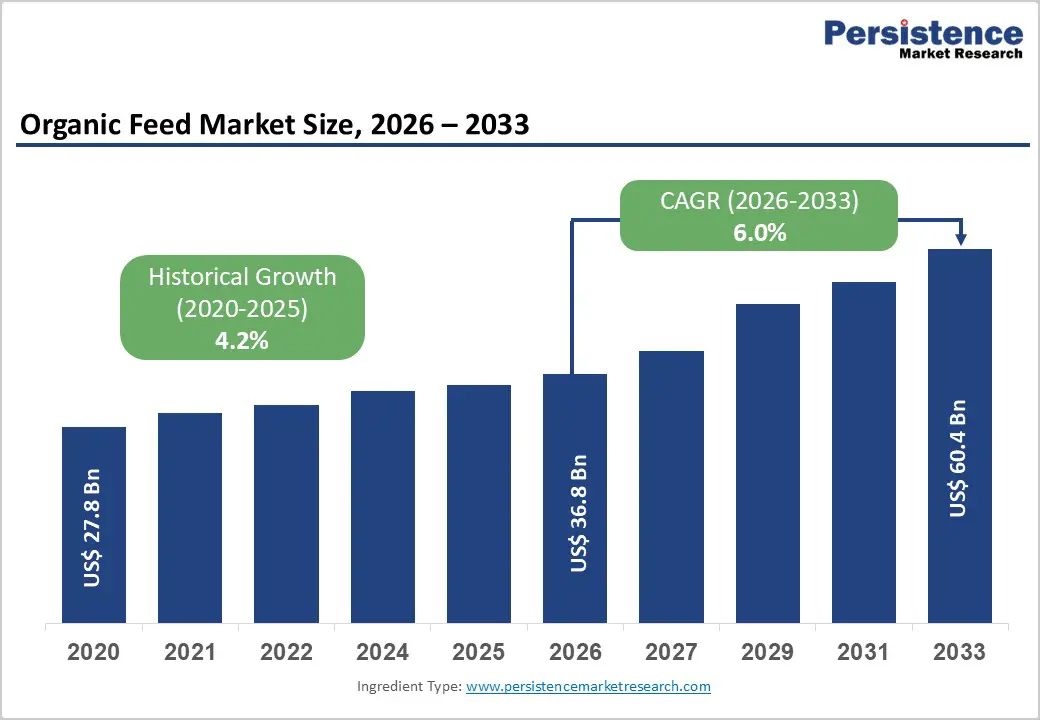
The global organic feed market size is estimated to grow from US$ 36.8 Bn in 2026 to US$ 60.4 Bn by 2033. The market is projected to record a CAGR of 6.0% during the forecast period from 2026 to 2033. The global inclination toward organically produced animal-based products is significantly accelerating the adoption of organic feed across livestock industries. Consumers are increasingly prioritizing food safety, chemical-free production, and ethical farming practices, driven by rising concerns over antibiotic residues, environmental sustainability, and long-term health impacts. This shift is encouraging farmers and producers to transition toward certified organic systems, where the use of organic feed is essential. Organic feed, composed of non-GMO crops and free from synthetic additives, supports improved animal health, enhances product quality, and aligns with premium market positioning.
Moreover, the advancements in feed formulation, including the integration of natural additives such as probiotics and plant-based compounds, are improving feed efficiency and livestock productivity. Strengthening supply chains, growing certification infrastructure, and increasing investments in sustainable agriculture are further supporting market expansion. As regulatory frameworks tighten and consumer awareness deepens, organic feed is becoming a critical component in the evolution of responsible and transparent food production systems.
Key Industry Highlights:
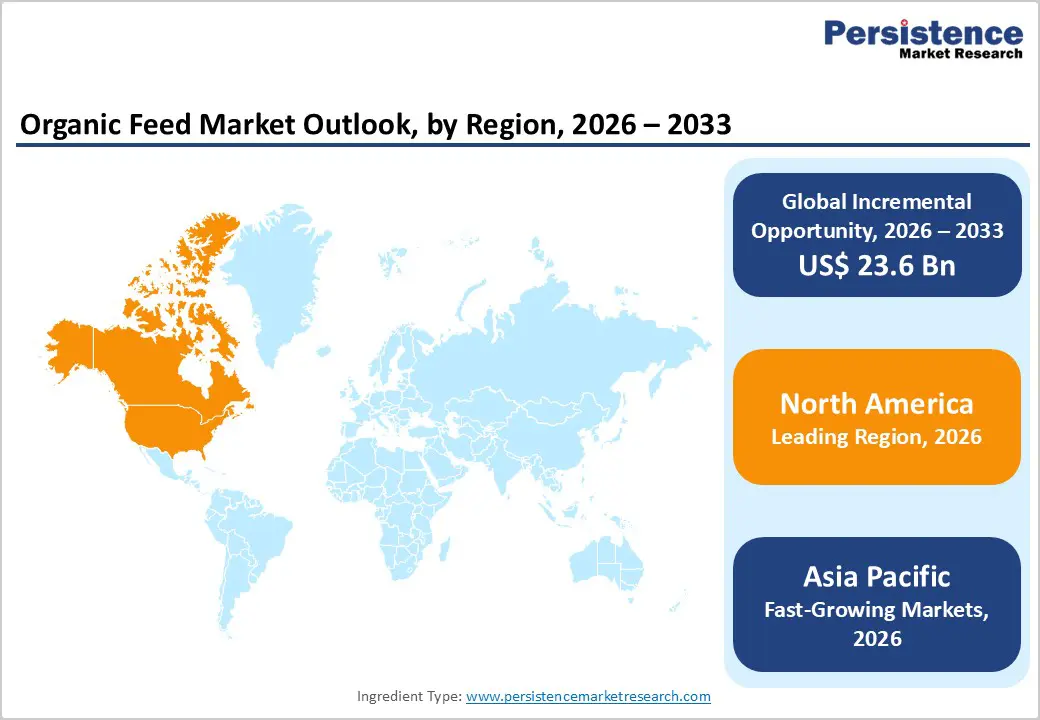
- Leading Region: North America dominates with a 46.7% share, supported by a well-established organic farming ecosystem, strong regulatory frameworks, advanced feed production capabilities, and high consumer demand for organic meat, dairy, and eggs.
- Fastest-Growing Region: Asia Pacific is emerging rapidly, driven by increasing awareness of organic farming benefits, rising disposable incomes, expanding livestock production, and supportive government initiatives promoting sustainable agriculture.
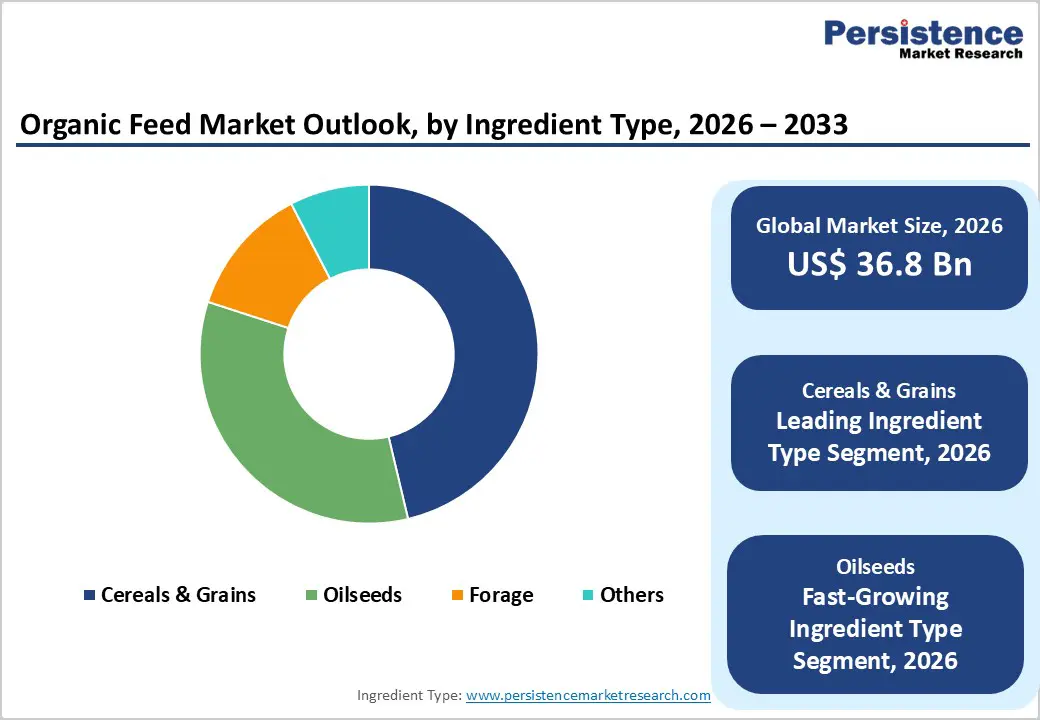
- Leading Ingredient Type Segment: Cereals & Grains hold the largest share at 46.3% attributed to their high energy content, digestibility, and widespread use as a primary component in livestock feed formulations.
- Fastest-Growing Ingredient Type Segment: Oilseeds are gaining momentum due to their rich protein profile and increasing demand for nutritionally balanced organic feed solutions.
- Leading Form Segment: Pellets account for 44.8% driven by advantages such as improved feed efficiency, ease of handling, reduced wastage, and suitability for large-scale livestock operations.
- Fastest-Growing Form Segment: Crumbles are witnessing notable growth as they are increasingly preferred in poultry farming for better intake, digestibility, and early-stage feeding efficiency.
| Key Insights | Details |
|---|---|
|
Organic Feed Market Size (2026E) |
US$ 36.8 Bn |
|
Market Value Forecast (2033F) |
US$ 60.4 Bn |
|
Projected Growth (CAGR 2026 to 2033) |
6.0% |
|
Historical Market Growth (CAGR 2020 to 2025) |
4.2 % |
DRO Analysis
Driver - Rising Demand for Organic Animal Products and Sustainable Livestock Practices
The growing global preference for organic and chemical-free food products is significantly driving the adoption of organic feed across the livestock sector. Consumers are becoming more conscious of food safety, animal welfare, and environmental sustainability, leading to higher demand for organic meat, dairy, and eggs. This shift is compelling farmers and livestock producers to transition to certified organic farming systems, where the use of organic feed is mandatory. Additionally, regulatory frameworks in regions such as North America and Europe are reinforcing organic standards, further accelerating feed demand.
Organic feed supports improved animal health by eliminating exposure to synthetic additives, antibiotics, and genetically modified ingredients, which aligns with evolving consumer expectations. Livestock producers are also recognizing long-term benefits such as better product quality, premium pricing opportunities, and enhanced brand positioning. Moreover, growing investments in sustainable agriculture and government-backed incentives are encouraging the adoption of organic farming practices. Advancements in feed formulation, including the use of plant-based additives and natural growth promoters, are further improving feed efficiency and productivity. As global food systems increasingly prioritize sustainability and transparency, the demand for organic feed continues to expand steadily.
Restraints - High Production Costs and Limited Availability of Certified Organic Raw Materials
One of the primary challenges affecting market expansion is the high cost associated with organic feed production compared to conventional alternatives. Organic feed requires certified raw materials that must be cultivated without synthetic fertilizers, pesticides, or genetically modified organisms, which often results in lower crop yields and higher input costs. This directly impacts pricing, making organic feed less accessible, particularly in price-sensitive markets. Additionally, the limited availability of organic ingredients such as grains and oilseeds creates supply-demand imbalances, further elevating costs.
Supply chain inefficiencies also contribute to market constraints, as sourcing, certification, storage, and transportation of organic feed require strict compliance with regulatory standards. Any contamination with non-organic materials can lead to product rejection, increasing operational risks for manufacturers. Furthermore, small-scale farmers may face difficulties in transitioning to organic practices due to the time-intensive certification process and lack of technical expertise. Variability in raw material supply caused by climatic conditions and agricultural limitations also affects production consistency. These factors collectively pose challenges to large-scale adoption, particularly in developing regions where cost competitiveness remains a critical factor influencing purchasing decisions.
Opportunity - Expansion of Organic Livestock Farming and Innovation in Nutritional Feed Solutions
The growing expansion of organic livestock farming presents substantial opportunities for feed manufacturers to scale operations and diversify product offerings. Increasing consumer willingness to pay premium prices for organic animal products is encouraging farmers to adopt organic practices, thereby creating consistent demand for high-quality feed. Emerging markets, particularly in Asia Pacific and Latin America, are witnessing a gradual shift toward organic agriculture, supported by rising incomes and improving awareness of food quality and safety.
Innovation in feed formulation is also unlocking new growth avenues. Manufacturers are increasingly incorporating natural additives such as probiotics, enzymes, and phytogenic compounds to enhance animal health, digestion, and productivity while maintaining organic compliance. These advancements are enabling the development of performance-oriented feed solutions that can compete with conventional alternatives. Additionally, digital agriculture and precision farming technologies are helping optimize feed usage and improve supply chain efficiency. Strategic partnerships between feed producers, farmers, and certification bodies are further strengthening market penetration. As sustainability becomes a core focus across the agricultural value chain, the organic feed sector is well-positioned to benefit from long-term structural growth opportunities.
Category-wise Analysis
By Ingredient Type Insights
Cereals & Grains are projected to remain the leading segment in the global organic feed market in 2026, accounting for 46.3% of total revenue. Their leadership is primarily driven by their high carbohydrate content, making them a key energy source for livestock across poultry, ruminants, and swine. Organic corn, wheat, barley, and oats are widely incorporated into feed formulations due to their digestibility and consistent availability within certified organic supply chains. These ingredients also support improved weight gain, feed conversion ratios, and overall animal productivity. In addition to their nutritional advantages, cereals and grains offer formulation flexibility, allowing manufacturers to create balanced feed blends tailored to specific livestock requirements. Increasing adoption of organic farming practices has further strengthened the supply base for organic grains globally. Moreover, advancements in organic cultivation techniques and storage infrastructure have enhanced yield stability and reduced contamination risks. As demand for organic meat, dairy, and eggs rises, cereals and grains continue to serve as the foundational component of organic feed formulations.
By Livestock Insights
The poultry segment is expected to hold the largest share in 2026, contributing 48.6% of total revenue. This dominance is attributed to the large-scale industrialization of poultry farming and the relatively shorter production cycle compared to other livestock. Organic poultry farming has gained significant traction, particularly in developed markets, driven by rising consumer demand for organic eggs and antibiotic-free chicken products. Feed requirements in poultry are frequent and high in volume, making it a key consumption segment for organic feed manufacturers. Additionally, poultry responds efficiently to nutritionally balanced feed, resulting in better growth rates and productivity, which further encourages adoption. The segment also benefits from standardized feeding practices and well-established supply chains. With increasing regulatory scrutiny on antibiotic usage and growing preference for clean-label animal products, organic poultry feed demand continues to expand. Emerging markets are also witnessing a gradual shift toward organic poultry farming, further reinforcing the segment’s leadership position globally.
By End-user Insights
The farmers segment is anticipated to account for 42.5% of total market revenue in 2026, making it the largest end-user category. This is largely due to the direct consumption of organic feed at the farm level, where livestock producers prioritize feed quality to ensure certification compliance and maintain product integrity. Farmers engaged in organic livestock production rely heavily on certified organic feed to meet stringent regulatory standards and consumer expectations. The increasing number of small and medium-scale organic farms globally has significantly contributed to the growth of this segment. Farmers often procure feed either directly from manufacturers or through local distributors, ensuring better control over feed quality and cost. Additionally, rising awareness regarding animal health, productivity, and long-term sustainability has encouraged farmers to adopt nutritionally optimized organic feed solutions. Government support programs and subsidies promoting organic agriculture in regions such as Europe and North America have further strengthened this segment. As organic livestock farming expands globally, farmers continue to remain the primary consumers of organic feed.
Regional Insights
North America Organic Feed Market Trends
North America is projected to account for 46.7% of the global organic feed market value in 2026, with the United States serving as the primary revenue contributor. The region’s dominance is supported by a highly structured organic agriculture ecosystem and strong consumer demand for organic animal-derived products, including meat, milk, and eggs. Increasing awareness around food safety, animal welfare, and environmental sustainability has significantly accelerated the adoption of organic livestock farming practices.
The presence of established feed manufacturers and robust distribution networks ensures consistent availability of certified organic feed across the region. Additionally, stringent regulatory frameworks governing organic certification enhance product quality and build consumer trust. Technological advancements in feed formulation, along with investments in improving feed efficiency and livestock nutrition, further support market expansion. The region also benefits from strong purchasing power and premium pricing for organic products, incentivizing farmers to shift toward organic feed usage. With continued innovation and regulatory backing, North America maintains its leading position in the global organic feed landscape.
Europe Organic Feed Market Trends
Europe represents a well-established and quality-driven market for organic feed, characterized by strong regulatory oversight and widespread adoption of sustainable agricultural practices. Countries such as Germany, France, the United Kingdom, Italy, and Spain play a significant role in driving regional demand. The market is largely influenced by stringent organic farming regulations, which mandate the use of certified organic feed for livestock production.
Consumer preference for ethically produced and environmentally sustainable food products has significantly contributed to the expansion of organic livestock farming across the region. In response, feed manufacturers are focusing on high-quality ingredient sourcing, traceability, and compliance with regulatory standards. The region also demonstrates a high level of awareness regarding animal health and welfare, further promoting the use of organic feed. Additionally, government initiatives and subsidies supporting organic agriculture have encouraged farmers to adopt organic practices. Continuous innovation in feed composition and sustainable sourcing strategies ensures steady market growth, positioning Europe as a mature yet evolving market within the global organic feed industry.
Asia Pacific Organic Feed Market Trends
Asia Pacific is expected to be the fastest-growing region, expanding at a CAGR of approximately 8.2% between 2026 and 2033. The region’s growth is driven by increasing urbanization, rising disposable incomes, and a gradual shift toward healthier and safer food consumption patterns. Countries such as China, India, Japan, and South Korea are witnessing growing demand for organic food products, which is directly influencing the adoption of organic feed in livestock farming.
China plays a crucial role as a major producer of organic feed ingredients, supported by large-scale agricultural activities and improving organic certification standards. Meanwhile, India and Southeast Asian countries are experiencing rising awareness among farmers regarding the benefits of organic farming, including improved soil health and premium pricing opportunities. Expanding livestock production and increasing exports of organic animal products further contribute to market growth. Additionally, supportive government policies promoting sustainable agriculture and organic practices are accelerating adoption. With a large population base and evolving dietary preferences, Asia Pacific continues to emerge as the most dynamic growth region in the global organic feed market.
Competitive Landscape
The global organic feed market is highly competitive, with strong participation from Aller Aqua A/S, B&W Feeds Ltd, Country Junction Feeds, Hi Peak Feeds Ltd, K-Much Feed Industry Co., Ltd., and Modesto Milling Inc. These companies leverage certified organic ingredient sourcing, non-GMO formulations, and advanced feed processing technologies to strengthen market presence while improving nutritional efficiency, digestibility, and livestock health outcomes. Rising demand for organic animal products is accelerating innovation. Manufacturers are expanding production capacity, ensuring compliance with organic standards, forming strategic partnerships, and increasing R&D investments to develop high-quality, sustainable, and performance-optimized organic feed solutions globally.
Key Industry Developments:
- In April 2026, AlphaPet Ventures acquired Tierliebhaber, the company continues to expand its premium pet food portfolio and strengthen its presence across Europe through a multi-channel model combining direct-to-consumer platforms and retail partnerships.
- In September 2025, Archer Daniels Midland and Alltech entered into a definitive agreement to establish a North American animal feed joint venture, combining their expertise to enhance innovation and deliver greater value to customers.
Companies Covered in Organic Feed Market
- Aller Aqua A/S
- B&W Feeds Ltd
- Country Junction Feeds
- Hi Peak Feeds Ltd
- K-Much Feed Industry Co., Ltd.
- Modesto Milling Inc.
- Ranch-Way Feeds
- The Organic Feed Company
- Yorktown Organics, LLC
- Country Heritage Feeds
- Feedex Companies
- Green Mountain Feeds
- Scratch and Peck Feeds
- Kreamer Feed, Inc.
- ForFarmers N.V.
- Others
Frequently Asked Questions
The global organic feed market is projected to be valued at US$ 36.8 Bn in 2026.
Rising consumer demand for organic animal products, increasing livestock health awareness, and stringent regulations on synthetic additives drive market growth.
The global organic feed market is poised to witness a CAGR of 6.0% between 2026 and 2033.
Expansion of organic livestock farming, innovation in plant-based feed additives, and growing demand in emerging markets create significant opportunities.
Aller Aqua A/S, B&W Feeds Ltd, Country Junction Feeds, Hi Peak Feeds Ltd, K-Much Feed Industry Co., Ltd., and Modesto Milling Inc. are some of the key players in the organic feed market.


