




- Processed Food
- Organic Eggs Market
Organic Eggs Market Size, Share, and Growth Forecast, 2026 - 2033
Organic Eggs Market by Product Type (Conventional, Pasture Raised, Others), Packaging Type (Carton, Tray, Bulk Packaging, Eco-Friendly Packaging), Distribution Channel (Supermarket, Online Retail, Specialty Store, Farmers Market), and Regional Analysis 2026 - 2033

Organic Eggs Market Size and Trends Analysis
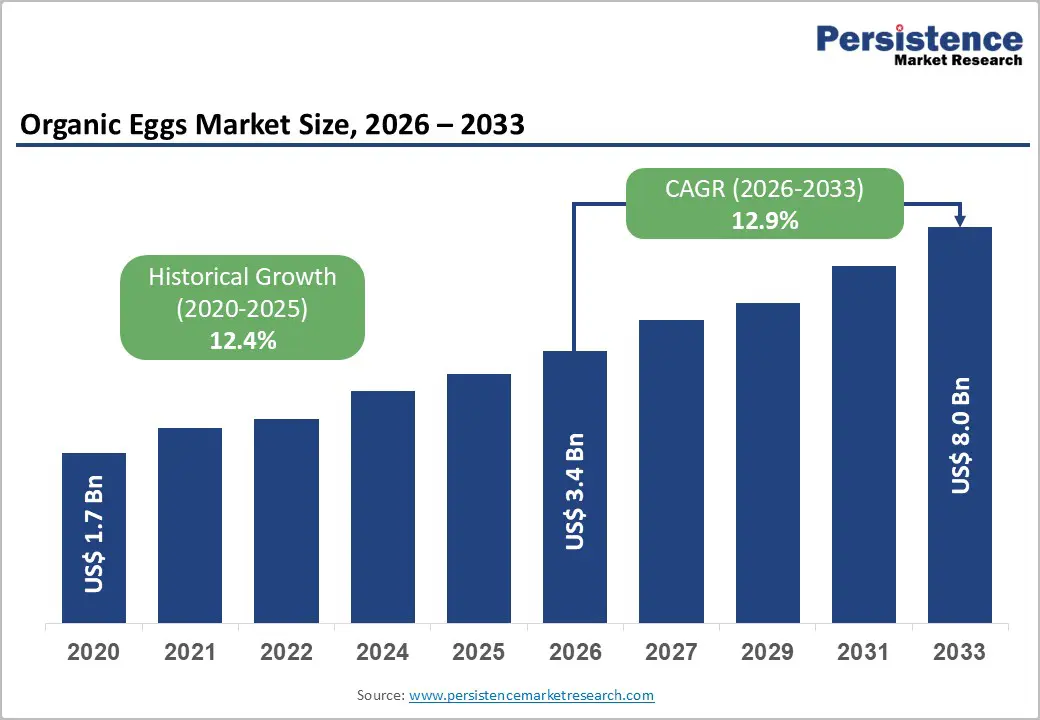
The global organic eggs market size is likely to be valued at US$3.4 billion in 2026 and is expected to reach US$8.0 billion by 2033, growing at a CAGR of 12.9% during the forecast period from 2026 to 2033, driven by increasing health consciousness across diverse consumer segments, leading to a shift toward clean-label and nutrient-rich food products.
Rising demand for healthier dietary options is accelerating consumption, while the expansion of online retail channels is improving accessibility, particularly in urban areas. Stringent certification standards are enhancing production quality across global supply chains, and the growing emphasis on sustainable packaging is further supporting market growth. As a result, premium pricing strategies continue to drive strong revenue growth worldwide.
Key Industry Highlights:
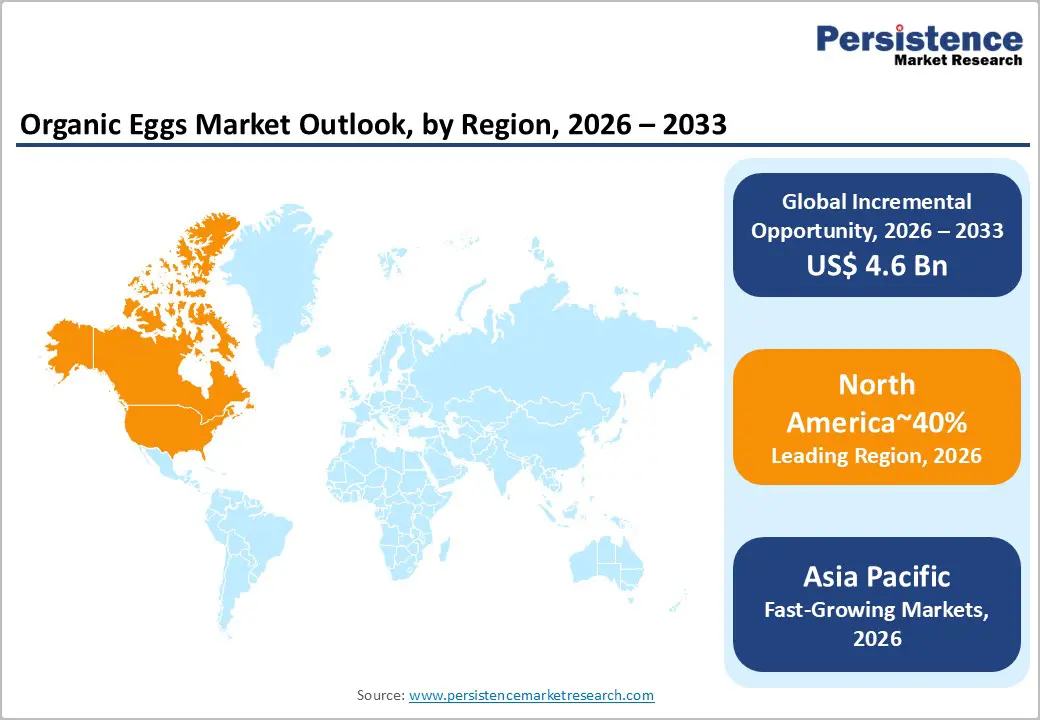
- Leading Region: North America is projected to lead, accounting for approximately 40% of the market in 2026, supported by established welfare standards, dense distribution networks, and premium household adoption.
- Fastest-growing Region: Asia Pacific is anticipated to grow fastest, driven by urbanization, rising disposable incomes, and e-commerce penetration.
- Leading Product Type: Conventional organic is anticipated to dominate, accounting for approximately 47% of the market in 2026, anchored by broad accessibility and foundational pricing structures.
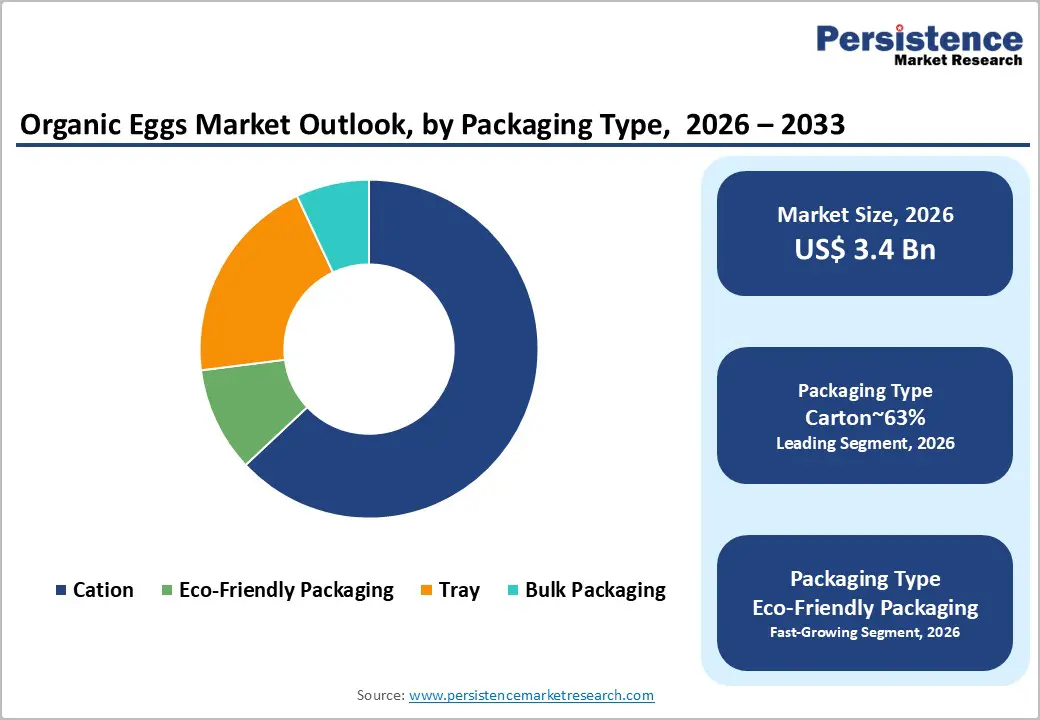
- Leading Packaging Type: Carton is projected to dominate, holding approximately 63% share in 2026, driven by universally standardized logistical dimensions and protective resilience.
| Key Insights | Details |
|---|---|
| Organic Eggs Market Size (2026E) | US$3.4 Bn |
| Market Value Forecast (2033F) | US$8.0 Bn |
| Projected Growth (CAGR 2026 to 2033) | 12.9% |
| Historical Market Growth (CAGR 2020 to 2025) | 12.4% |
Market Factors - Driver, Restraint, and Opportunity Analysis
Driver Analysis - Clean-Label Nutritional Adoption Driving Structural Demand for Certified Organic Protein Sources
Rising consumer interest in preventive healthcare is reshaping dietary consumption frameworks worldwide. This transition intensifies preference for organically cultivated food products free from synthetic inputs. Households increasingly emphasize nutrient-dense protein sources aligned with long-term wellness objectives. Such consumption patterns systematically elevate demand for certified natural agricultural outputs across regions. Regulatory endorsement of clean-label standards further legitimizes perceptions of product authenticity and safety. Consequently, sustained consumption reinforcement contributes to the stable expansion of premium organic food categories.
Producers are restructuring farming models to ensure traceability, transparency, and environmental sustainability. This transformation supports reliable supply continuity across high-value and quality-sensitive retail ecosystems. Certification protocols and compliance requirements increase operational costs while strengthening market entry barriers. Retail channels respond through curated product placement targeting health-conscious and quality-driven consumers. Enhanced visibility of authentic offerings improves conversion rates within premium merchandising environments. These integrated shifts collectively reinforce value chain alignment toward sustained clean-label market growth.
Pasture-Raised Egg Demand Intensification Driven by Ethical Sourcing and Transparency Standards
Rising awareness of animal welfare practices is reshaping consumer purchasing behavior across food categories. Households increasingly prefer pasture-raised eggs that align with ethical sourcing expectations. Verified free-range certifications strengthen trust by ensuring transparent and humane production conditions. This shift enhances perceived nutritional value and reinforces quality differentiation within premium segments. Distribution networks adapt by expanding procurement of welfare-compliant agricultural outputs across retail channels. Regulatory oversight and labeling standards further institutionalize transparency, supporting sustained global category expansion.
Producers are integrating certified welfare protocols to align with evolving consumer and regulatory expectations. These frameworks increase production complexity while significantly elevating compliance and operational cost structures. Strategic retail partnerships improve product accessibility within organized and premium-focused merchandising environments. Shelf positioning emphasizes authenticity and traceability, strengthening engagement among urban and value-conscious buyers. Supply chain coordination ensures the consistent availability of pasture-raised products across diverse consumption markets. These dynamics collectively reinforce premiumization trends and strengthen competitive positioning within ethical protein segments.
Restraint Analysis - Premium Pricing Elasticity Limiting Market Penetration across Income Segments
Elevated retail pricing structures restrict accessibility for cost-sensitive consumer groups across multiple regions. This affordability constraint concentrates demand within higher-income urban households and premium consumption clusters. Inflationary pressures intensify challenges with household budget allocation, reducing discretionary spending on premium food categories. Consumers increasingly substitute high-priced organic options for conventional alternatives during economic uncertainty. This behavioral shift reflects strong price elasticity that limits broader category penetration and adoption. Consequently, demand concentration narrows the effective consumer base within value-sensitive market environments globally.
Retailers face persistent challenges in sustaining sales volumes amid fluctuating macroeconomic conditions. Vendors often absorb cost pressures, leading to margin compression across production and distribution stages. Input cost volatility, including feed and certification expenses, further strains profitability within premium segments. Promotional pricing mechanisms stimulate short-term demand but risk diluting long-term brand value. Supply chain participants must balance pricing integrity with competitive positioning across organized retail channels. These structural constraints collectively moderate growth momentum and reinforce cautious expansion strategies within premium categories.
Shelf-Life Constraints Limiting Distribution Efficiency in Perishable Premium Egg Categories
The inherently perishable nature of pasture-raised eggs restricts viable distribution timelines across channels. Shorter shelf stability complicates inventory management within extended retail and e-commerce fulfillment networks. Dependence on temperature-controlled logistics increases operational complexity and significantly increases transportation costs. Inadequate preservation mechanisms heighten spoilage risk, particularly across geographically distant or fragmented markets. Bulk packaging formats remain vulnerable to quality degradation without advanced containment or stabilization technologies. These constraints collectively limit scalability and reduce effective penetration across wider distribution ecosystems.
Supply chain participants are investing in improved packaging designs to enhance product durability. Insulated cartons and optimized tray structures support marginal extensions in product freshness and handling resilience. Despite these advancements, cold-chain compliance requirements continue to impose significant logistical and financial burdens. Return rates increase when product integrity declines during long-distance transportation cycles. Retailers and distributors face additional quality assurance costs to maintain brand credibility within premium segments. These systemic inefficiencies reinforce structural limitations within perishability-sensitive product categories globally.
Opportunity Analysis - Digital Retail Integration Enabling Direct Access and Scalable Distribution for Perishable Protein Categories
Digital commerce platforms are redefining market access by connecting niche consumer segments directly with producers. This shift removes geographic limitations, enabling specialty food categories to penetrate previously inaccessible demand clusters. Subscription-based purchasing models stabilize demand by automating replenishment and recurring deliveries. Direct-to-consumer frameworks reduce reliance on traditional intermediaries, improving margin realization across the value chain. Platform-driven data insights enhance demand forecasting, enabling precise inventory planning and reducing waste risk. Consequently, digital integration strengthens structural efficiency while supporting scalable expansion across premium food segments.
Advancements in cold-chain logistics are enabling safe and reliable delivery of temperature-sensitive protein products. These systems align with rising consumer preference for convenience-oriented grocery procurement through digital interfaces. Protective packaging innovations improve product integrity during last-mile delivery and extended transit durations. Mobile-based ordering ecosystems further streamline purchase cycles, increasing frequency and customer retention levels. Compliance with food safety regulations remains critical, adding operational rigor to fulfillment processes. This convergence of logistics and digital infrastructure accelerates the adoption of modern retail channels across perishable categories.
Omega-3 Fortification Driving Functional Differentiation in Value-Added Egg Segments
Evolving health priorities are accelerating demand for nutrient-enriched eggs across aging consumer populations. Omega-3 fortification aligns with dietary focus on cardiovascular support and preventive nutrition frameworks. Functional food positioning strengthens product differentiation within increasingly competitive premium protein categories. Regulatory encouragement for fortified foods supports broader integration across processed and packaged applications. Consumer awareness campaigns reinforce perceived health benefits, influencing household purchase behavior. These dynamics collectively expand demand for value-added egg variants within health-focused consumption ecosystems.
Producers are innovating feed formulations to enhance nutrient profiles while maintaining compliance with certification standards. Wilcox Family Farms, with Wilcox Organic Omega-3 Eggs, expands enriched product lines targeting food processing segments. Farmers Hen House with Farmers Hen House Organic Eggs advances specialized feed blends to improve nutritional output consistency. These developments increase production costs while enabling premium pricing across fortified product categories. Retail and manufacturing channels integrate these offerings to address evolving demand for functional nutrition. This alignment reinforces sustained growth within specialized and value-added egg market segments.
Category-wise Analysis
Product Type Insights
Conventional organic is projected to lead the market, accounting for approximately 47% in 2026, supported by broad accessibility across mainstream consumption segments. Standardized certification frameworks ensure consistent quality, meeting everyday nutritional expectations within household consumption patterns. Economies of scale enable cost optimization, sustaining competitive pricing across organized retail environments. Cal-Maine Foods, with its Organic Brown Eggs, exemplifies volume-driven production that supports stable supply continuity. Wilcox Family Farms with Wilcox Organic Omega-3 Eggs complements core offerings through functional differentiation strategies. Established agricultural networks and simplified logistics reduce operational friction across regional distribution channels. This structural efficiency reinforces dominant positioning within conventional organic product categories across grocery ecosystems.
Pasture-raised is expected to be the fastest-growing segment of the organic eggs market, driven by rising emphasis on animal welfare and transparency in ethical sourcing. Consumers increasingly scrutinize production practices, favoring systems enabling unrestricted outdoor access for flocks. Trillium Farm Holdings, with Pasture-Raised Organic Eggs, aligns offerings with verified welfare protocols and traceability standards. Handsome Brook Farms, with Pasture-Raised Eggs, expands scalable production while maintaining compliance and credibility. Advanced verification technologies enhance transparency, strengthening trust across premium consumer segments. This convergence of ethics, nutrition, and traceability accelerates adoption within high-value and differentiated egg categories.
Packaging Type Insights
Carton is projected to lead, accounting for approximately 63% share, supported by standardized logistics compatibility across distribution networks in 2026. Molded fiber structures provide impact resistance, reducing breakage risks during complex transportation cycles. Rectangular configurations enable efficient stacking in retail refrigeration systems, optimizing space utilization. Consumer familiarity reinforces trust in secure handling and convenient household transport of eggs. Established production infrastructure supports cost-efficient manufacturing, ensuring sustained adoption within existing grocery ecosystems.
Eco-friendly packaging is projected to be the fastest-growing segment, driven by sustainability regulations and rising consumer environmental awareness. The use of compostable and biodegradable materials helps reduce landfill waste and aligns with evolving waste management standards. Companies such as Vital Farms are advancing recyclable packaging formats to strengthen their environmental positioning, while Pete and Gerry’s are adopting bio-based materials to enhance sustainability credentials. Ongoing innovations in material science are improving durability without compromising product protection during transportation. Additionally, the growth of online grocery channels is boosting demand for packaging solutions that are both resilient and environmentally responsible.
Regional Insights
Asia Pacific Organic Eggs Market Trends
Asia Pacific is expected to register the fastest growth trajectory, supported by urbanization and expanding digital commerce infrastructure across metropolitan consumption clusters. Rising income levels are enabling greater adoption of premium organic egg categories among urban households. E-commerce platforms are bridging distribution gaps, improving accessibility across fragmented and geographically dispersed markets. Heightened food safety awareness is shifting consumer preferences toward certified and traceable organic products. Regional agricultural systems are modernizing production practices to align with evolving quality expectations. This transformation strengthens demand foundations and accelerates structural expansion across premium protein segments.
India is expected to anchor regional momentum through regulatory strengthening and rapid digital retail adoption. National frameworks under food safety authorities are enhancing the credibility of organic certification and enforcement of traceability. Happy Egg Co., with Happy Egg Free Range Organic Eggs, targets online-first distribution to capture urban demand growth. Expanding cold-chain investments and digitizing logistics are improving product availability in high-density cities. China continues to contribute through large-scale agricultural modernization and infrastructure upgrades supporting domestic supply chains. This combined regional dynamic reinforces sustained growth momentum and evolving consumption patterns across Asia Pacific markets.
North America Organic Eggs Market Trends
North America is expected to remain the leading regional market, accounting for approximately 40% of the market share in 2026, supported by mature welfare frameworks and advanced distribution infrastructure. High disposable income levels enable sustained acceptance of premium organic egg pricing across households. Dense retail ecosystems facilitate efficient product availability across urban and suburban consumption clusters. Traceability technologies integrate deeply within supply chains, strengthening transparency and reinforcing consumer confidence. Policy alignment around nutritional labeling standardizes product positioning within regulated retail environments. This structural maturity sustains stable demand generation and reinforces regional dominance in premium egg categories.
The U.S. is expected to anchor regional momentum through evolving federal welfare standards and certification frameworks. Government-backed agricultural programs nationwide incentivize the adoption of organic and pasture-based production methodologies. Vital Farms with Vital Farms Pasture-Raised Eggs leverages localized capacity expansion and traceable sourcing systems. Investments in advanced farming practices improve productivity while maintaining compliance with stringent quality benchmarks. Retail procurement policies emphasizing cage-free sourcing further strengthen structured demand across major grocery chains. This regulatory and operational alignment reinforces long-term scalability and sustains North America’s leadership positioning.
Europe Organic Eggs Market Trends
Europe is expected to remain a mature and structurally stable regional market, supported by regulatory-driven premiumization and sustainability alignment. Stringent welfare and labeling frameworks standardize production practices across cross-border agricultural ecosystems. Consumers demonstrate a sustained willingness to pay premium prices for ethically certified organic products. Packaging directives accelerate transition toward recyclable and biodegradable materials across retail supply chains. Integration with food service channels reinforces consistent demand across institutional procurement environments. This regulatory and cultural alignment sustains steady consumption within established organic egg markets.
The U.K. is expected to anchor regional dynamics through evolving organic certification frameworks and policy tightening. National mandates encourage investment in compliant production systems and traceable sourcing infrastructures. Pete and Gerry's with Organic Pasture-Raised Eggs advances entry strategies aligned with premium retail expectations. Processors adapt operational models to meet strict sourcing and labeling compliance requirements. Retail and food service integration enhances product visibility across structured distribution channels. This alignment reinforces stability and supports the continued maturation of Europe’s organic egg ecosystem.
Competitive Landscape
The global organic eggs market is highly fragmented, with leadership dispersed among scaled global suppliers and regional certified producers. Leading participants exert a strong influence through extensive distribution networks and standardized welfare compliance frameworks. Their operational scale enables integration of traceability technologies, shaping procurement expectations across retail and food service channels. Cal-Maine Foods with Organic Brown Eggs establishes volume benchmarks supporting consistent supply reliability. Vital Farms, with Organic Pasture-Raised Eggs, defines premium transparency standards, influencing consumer trust and brand positioning. DQY Ecological with Organic Fresh Eggs demonstrates vertically integrated domestic capabilities, enhancing supply chain control. These leadership dynamics compel smaller producers to upgrade production methodologies and maintain competitive parity.
Competitive positioning is increasingly shaped by vertical differentiation across welfare tiers and nutritional enhancements. Premium brands emphasize pasture-raised and fortified variants, while value-focused suppliers prioritize scalable production efficiency. Nellie's Free Range with Nellie's Nester Box Eggs targets ethically conscious consumers through differentiated welfare positioning. Wilcox Family Farms, with Wilcox Organic Omega-3 Eggs, advances fortification-led product specialization strategies. Industry dynamics reflect consolidation through acquisitions of niche regional farms and eco-focused brands. Retailers expand private-label portfolios, intensifying pricing pressure and compressing margins across supplier tiers. Technology adoption in traceability and smart packaging continues to redefine competitive advantage within evolving organic egg ecosystems.
Key Industry Developments:
- In March 2026, Organic Valley introduced "Protein Plus" ultra-filtered milk line. Strategic focus on high-protein, nutrient-dense organic products aligns with the same consumer demographic purchasing organic eggs for health benefits.
- In October 2025, Organic Valley launched the New Organic Oat Beverage line. While a beverage, this brand extension leverages Organic Valley's existing organic network to diversify revenue streams into high-growth plant-based categories.
- In March 2025, Global Eggs acquired Hillandale Farms for US$1.1 billion. This massive consolidation strengthens Global Eggs’ North American supply chain and rapidly scales its capacity for both specialty and organic distribution.
Companies Covered in Organic Eggs Market
- Cal-Maine Foods
- Vital Farms
- Pete and Gerry's
- DQY Ecological
- Nellie's Free Range
- Happy Egg Co.
- Wilcox Family Farms
- Michael Foods
- Trillium Farm Holdings
- Handsome Brook Farms
- Farmer Focus
- Blue Sky Family Farms
- Egg Innovations
- Rembrandt Foods
- Sparboe Companies
- Daybreak Foods
Frequently Asked Questions
The global organic eggs market is likely to be valued at US$3.4 billion in 2026. It is expected to reach US$8.0 billion by the year 2033. This trajectory represents significant expansion across the entire forecast period.
Rising global health consciousness primarily drives demand for chemical-free nutritional products. Consumers actively prioritize clean-label proteins to support holistic personal wellness goals. This behavioral shift accelerates sustained procurement across major retail distribution channels.
The organic eggs market is projected to expand at a CAGR of 12.9%. This growth rate applies strictly to the forecast period from 2026 to 2033. It reflects accelerating momentum compared to historical industry performance metrics.
North America is anticipated to lead the global market landscape seamlessly. This advanced region is projected to account for approximately 40% share in 2026. Robust regulatory frameworks and high consumer spending strongly support this dominance.
Prominent industry participants include Cal-Maine Foods, Vital Farms, and DQY Ecological. These established vendors maintain significant influence over global supply chain dynamics. They continuously innovate packaging and farming methodologies to secure competitive advantages.


