




- Nutraceuticals & Functional Foods
- Red Yeast Rice Market
Red Yeast Rice Market Size, Share, and Growth Forecast 2026 - 2033
Red Yeast Rice Market by Form (Whole/Raw, Powder), by Nature (Conventional, Organic), End-user (Food & Beverages Industry, Dietary Supplements, Cosmetics & Personal Care, Household/Retail, Others), Distribution Channel, and Regional Analysis, 2026 - 2033

Red Yeast Rice Market Size and Trend Analysis
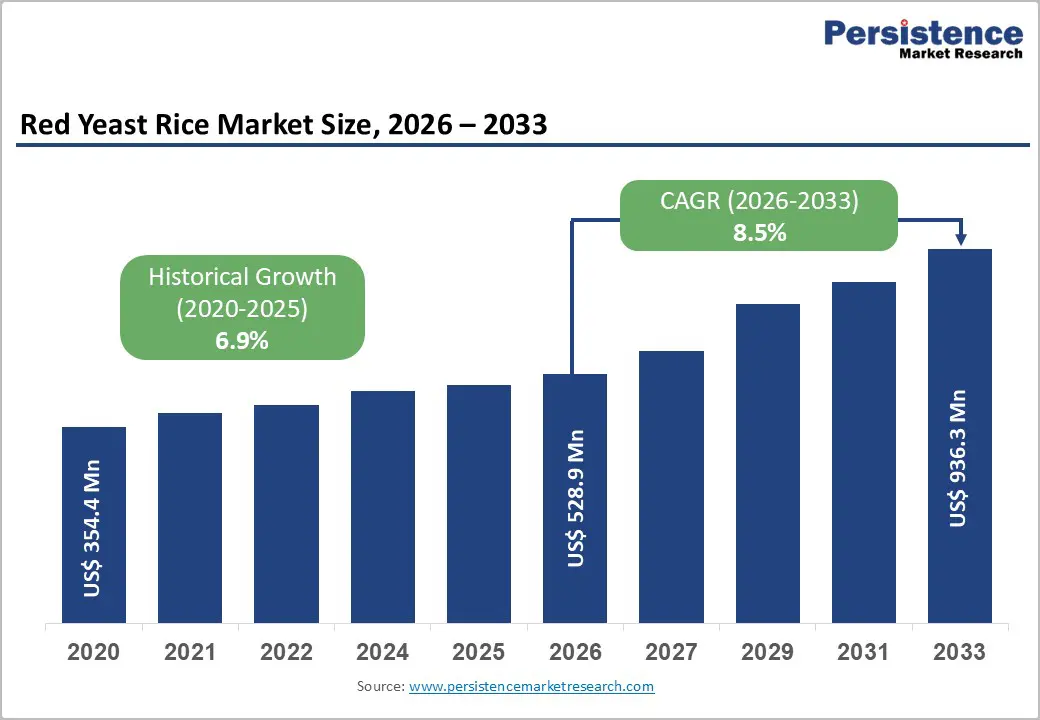
The global red yeast rice market size is expected to be valued at US$ 528.9 million in 2026 and projected to reach US$ 936.3 million by 2033, growing at a CAGR of 8.5% between 2026 and 2033. It is witnessing strong growth, driven by rising health consciousness and increasing demand for natural dietary supplements.
As consumers shift toward preventive healthcare, red yeast rice has gained attention for its natural cholesterol-lowering properties, primarily due to the presence of Monacolin K, a compound similar to statins. The growing prevalence of cardiovascular diseases and hyperlipidemia is further accelerating its adoption.
Additionally, modern lifestyles and poor dietary habits have increased reliance on supplements for overall well-being, including heart health and metabolic balance. Beyond nutraceuticals, its application is expanding into food, beverages, and personal care products due to clean-label trends. These factors collectively position red yeast rice as a key ingredient in the evolving global functional ingredients and supplements market.
Key Industry Highlights:
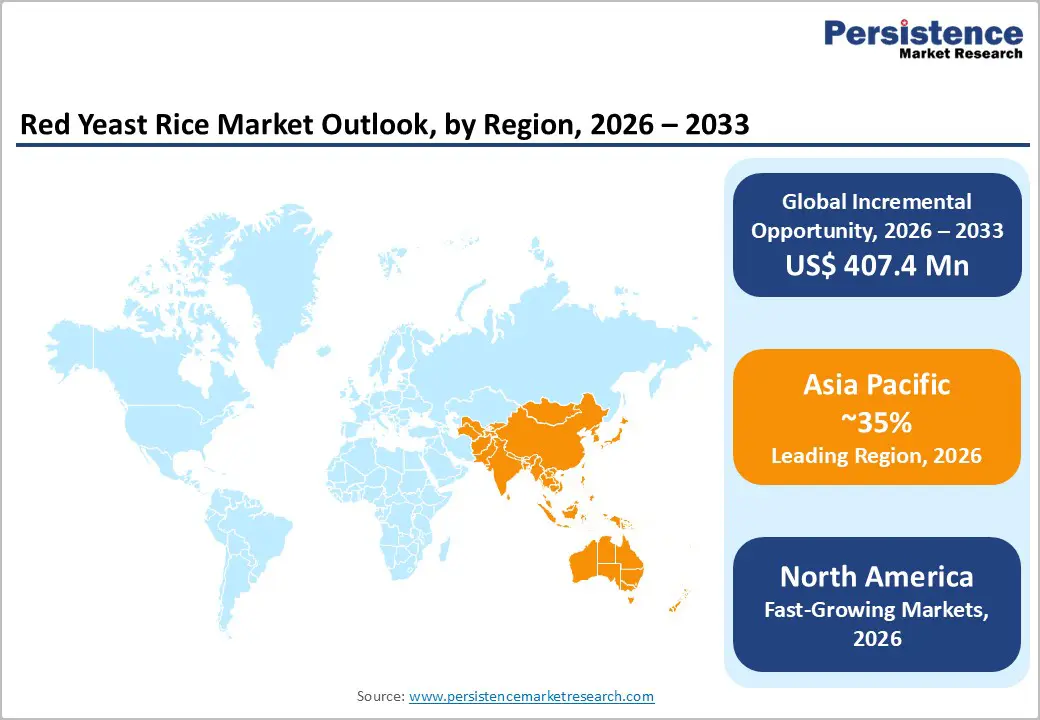
- Asia Pacific leads with a 35% share in 2025, driven by a long history of traditional medicinal use and a dominant manufacturing base in China and Japan.
- North America is the fastest-growing region, fueled by high consumer spending on preventive health and a rapid shift toward online nutraceutical shopping.
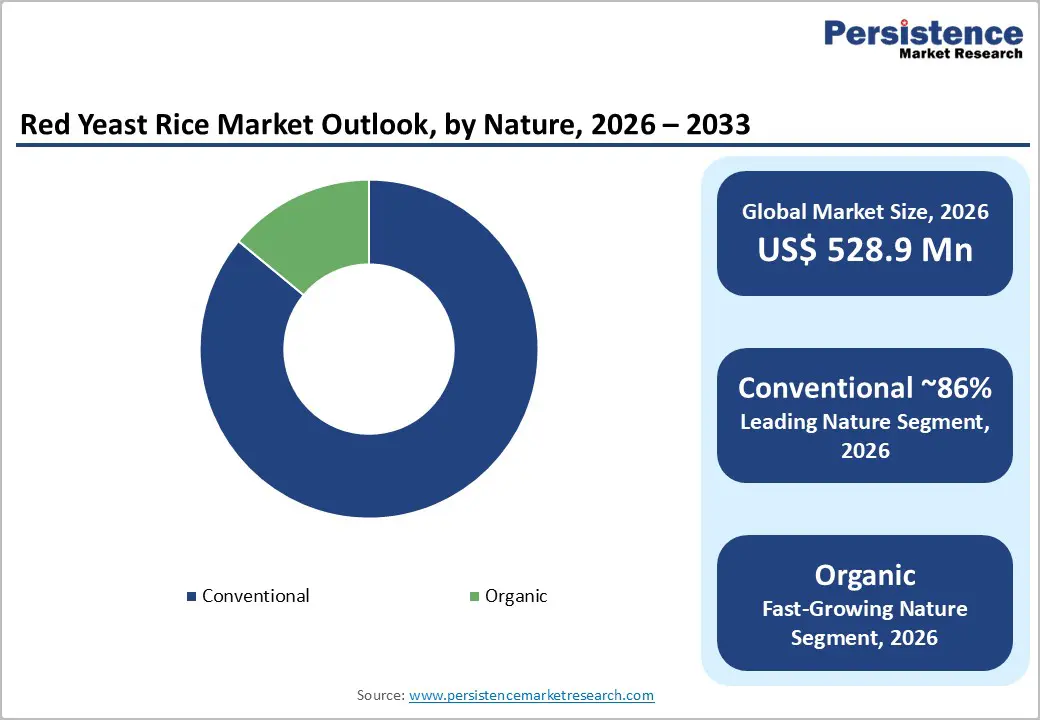
- Conventional nature products hold an 86% market share, due to their cost-effectiveness and widespread use in industrial food and feed applications globally.
- The cosmetics & personal care end-use category is fast-growing as brands seek natural fermented antioxidants for anti-aging and skin-brightening formulations.
- The development of Citrinin-free and standardized Monacolin K formulas is the most significant opportunity to gain market share in the highly regulated European and North American markets.
| Key Insights | Details |
|---|---|
| Red Yeast Rice Market Size (2026E) | US$ 528.9 million |
| Market Value Forecast (2033F) | US$ 936.3 million |
| Projected Growth CAGR (2026 - 2033) | 8.5% |
| Historical Market Growth (2020 - 2025) | 6.9% |
DRO Analysis
Drivers - Rising Prevalence of Cardiovascular Disorders and Hypercholesterolemia
A fundamental driver for the Red Yeast Rice Market is the global surge in lifestyle-related diseases, particularly high cholesterol levels. Data from the American Heart Association (AHA) indicates that nearly 38% of adults in the U.S. have high cholesterol, a trend mirrored in other developed and developing economies due to sedentary lifestyles and poor dietary habits. Red Yeast Rice, containing natural Monacolin K, has gained significant clinical traction as a functional food that can lower LDL cholesterol by 20% to 30%. The European Society of Cardiology (ESC) has also highlighted the role of nutraceuticals in managing mild-to-moderate lipid levels, encouraging consumers to seek non-pharmaceutical interventions. This medical validation, combined with increasing consumer health literacy, is substantially boosting the demand for Red Yeast Rice in the Dietary Supplements segment.
Restraints - Competition from Synthetic Statins and Alternative Lipid-Lowering Agents
Despite its natural appeal, Red Yeast Rice faces intense competition from low-cost, highly effective synthetic statins and other emerging natural supplements. Pharmaceutical drugs like Atorvastatin and Rosuvastatin are often covered by health insurance and have well-documented safety profiles, making them the primary choice for healthcare providers in treating high-risk patients. Furthermore, other natural alternatives such as Plant Sterols, Omega-3 Fatty Acids, and Bergamot extracts are competing for market share in the cholesterol-management space. The National Institutes of Health (NIH) notes that the variability in the chemical composition of Red Yeast Rice products where some brands contain no detectable monacolins while others contain significant amounts creates a lack of standardization that may lead consumers to choose more predictable pharmaceutical or alternative nutraceutical options.
Opportunities - Rising Demand for Plant-Based & Cholesterol-Lowering Supplements is Stimulating Market Growth
There is a growing demand for plant-based supplements due to various reasons. Nutritional and sustainable diets are being highly adopted by consumers across the world. Increased consumer awareness regarding the importance of a healthy lifestyle has compelled them to seek sustainable food products. Furthermore, because of the growing unfavorable opinion of animal-based food products, the population emphasizes an organic diet.
Since plant-based products offer relevant nutritional composition, they are evolving as ideal alternatives for animal-based products. Growing consumption of plant-based supplements has also led to a growth in the demand for red yeast rice. In developed countries, the consumption of animal products has a heavy burden on the environment. This has resulted in an exponential rise in the consumption of plant-based supplements. Specific species of mold are used to create red yeast rice through fermentation. It has been used in traditional Chinese medicine for centuries due to its powerful health-promoting properties.
Red yeast rice comprises the chemical compound monacolin, which is an active ingredient that can be found in prescribed cholesterol-lowering medications such as lovastatin. For this reason, red yeast rice usage is increasing as a cost-effective alternative to some overpriced medications to support heart health and aid in the reduction of cholesterol levels.
Category-wise Analysis
Nature Insights
In the red yeast rice market, the conventional segment currently dominates. This is largely due to its lower production costs, greater availability, and strong demand from dietary supplement manufacturers who prioritize cost-effectiveness and large-scale supply over organic certification. Conventional red yeast rice continues to meet the needs of mass-market health products, making it the leading segment globally. However, the organic segment is rapidly emerging as the fastest-growing category. Consumers are increasingly seeking clean-label, chemical-free, and non-GMO products, driving interest in organic alternatives.
Rising awareness of the health and environmental benefits associated with organic ingredients, particularly in premium markets such as North America and Europe is further accelerating its growth. While conventional red yeast rice maintains its market lead, the organic segment is expected to expand significantly, supported by growing demand from health-conscious and eco-conscious consumers.
End-user Insights
The dietary supplements is a dominant end-use segment accounting for a large share of global consumption. As consumers increasingly prioritize preventive healthcare and natural wellness solutions, red yeast rice has gained significant traction for its proven ability to lower cholesterol levels naturally. Supplement manufacturers capitalize on this demand by incorporating red yeast rice into capsules, tablets, and powder blends targeted at heart health and metabolic wellness. Its multifunctional benefits, such as reducing inflammation, supporting blood sugar control, and aiding in the management of metabolic syndrome have further solidified its position in the dietary supplement space.
The convenience of supplements, coupled with a growing preference for plant-based and non-pharmaceutical alternatives has led to the rising adoption among health-conscious individuals. Moreover, the segment is supported by expanding retail channels and e-commerce platforms, making red yeast rice supplements more accessible than ever. As a result, dietary supplements remain the leading driver of red yeast rice market growth.
Regional Insights
Asia Pacific Red Yeast Rice Market Trends and Insights
Asia Pacific holds a dominant position in the global market, accounting for 35% of the share in 2025. This leadership is rooted in the region's deep cultural history with fermented foods; Red Yeast Rice has been used as a food preservative and medicinal agent in China, Japan, and Korea for centuries. The region benefits from a robust manufacturing infrastructure and is a global hub for production, with China alone contributing significantly to the global supply of fermented rice substrates.
In Japan, the market is highly mature, with a strong focus on "FOSHU" (Foods for Specified Health Uses) certifications. However, recent regulatory shifts in Japan and Taiwan emphasize stricter safety monitoring of fermented products to ensure the absence of harmful mycotoxins. The ASEAN countries are also emerging as key growth pockets, driven by rapid urbanization and a rising middle class that is increasingly adopting western-style diets, leading to higher rates of cardiovascular issues. The presence of specialized firms such as SunWay Biotech Co., Ltd. in Taiwan and Xi’an Sost Biotech Co. Ltd. in China ensures that the region remains at the forefront of innovation in high-purity fermentation technologies.
North America Red Yeast Rice Market Trends and Insights
North America is identified as the fastest-growing region, supported by a highly developed Dietary Supplements ecosystem and a proactive consumer base. The U.S. leads the regional market, where the high cost of pharmaceutical healthcare often drives consumers toward natural self-care solutions. The U.S. FDA's complex regulatory stance on Monacolin K levels has fostered an environment where manufacturers compete on quality and testing transparency, leading to a highly sophisticated market.
The region is characterized by a strong innovation ecosystem where startups and established giants like NOW Health Group, Inc. and Nature's Bounty are investing in "Citrinin-free" certifications and synergistic formulations (e.g., combining Red Yeast Rice with CoQ10). The growth of Online Retail and specialty health chains like Whole Foods Market has made these supplements highly accessible. Furthermore, the rising awareness of the "gut-heart axis" among North American consumers is expected to drive the demand for fermented grain-based products beyond simple lipid management, into the broader functional food space.
Europe Red Yeast Rice Market Trends and Insights
The Europe market is shaped by some of the world's most stringent regulatory frameworks, particularly regarding the harmonization of health claims and contaminant limits. Germany, the U.K., and France are the key performance drivers in this region. The EFSA's 2022 update on monacolins has forced many manufacturers to reformulate their products to lower concentrations, which has paradoxically increased the market's credibility by standardizing safety expectations.
In Germany, there is a strong preference for Organic and sustainably sourced ingredients, which aligns with the country's robust "Apotheke" (pharmacy) culture where high-quality nutraceuticals are sold. France and Italy are seeing growth in the Cosmetics & Personal Care sector, with companies like Alesco S.r.l. and Giellepi SpA leading the way in integrating red rice extracts into high-end dermatological products. The regional emphasis on Non-GMO and "Clean Label" products ensures that the demand for natural pigments and functional ingredients remains high across the Food & Beverages Industry.
Competitive Landscape
Increasing demand for food color has pushed manufacturers to produce colors naturally through plant-extracted solutions. Artificial colors used by manufacturers have certain chemical compositions that are not suitable for human health. Thus, growing consumer awareness regarding the ill effects of synthetic colors has prompted manufacturers to minimize their use and prefer naturally made colors.
Key Developments:
- In March 2024, SunWay Biotech partnered with Gnosis by Lesaffre to launch a new product combining vitamin K2 with statin-free red yeast rice fermentate. This innovative complex is designed to support both heart and bone health.
- In April 2024, Swanson introduced a new heart health supplement featuring red yeast rice combined with Karallief, a clinically studied blend of six Ayurvedic herbal extracts.
Companies Covered in Red Yeast Rice Market
- Alesco S.r.l.
- Amazing Nutrition
- Giellepi SpA
- Jarrow Formulas, Inc.
- Sylvan Wellness
- Natures Plus
- Plamed Green Science Group
- SunWay Biotech Co., Ltd.
- Purelife Bioscience Co., Ltd.
- NOW Health Group, Inc.
- Swanson
- Nature's Bounty
- Xi’an Sost Biotech Co. Ltd.
- The Bountiful Company
- Others
Frequently Asked Questions
The global red yeast rice market size is expected to be valued at approximately US$ 528.9 million in 2026.
The market is primarily driven by the rising global prevalence of cardiovascular diseases and the increasing consumer shift toward plant-based, natural alternatives to synthetic cholesterol-lowering drugs like statins.
Asia Pacific is the leading region, holding a 35% market share in 2025, supported by its traditional use in Asian medicine and a strong manufacturing presence in China and Japan.
The most critical opportunity lies in developing standardized, Citrinin-free formulations that comply with stringent EFSA and FDA safety guidelines, ensuring consumer safety and regulatory approval.
Major players include Nature's Bounty, NOW Health Group, Inc., SunWay Biotech Co., Ltd., Jarrow Formulas, Inc., and Alesco S.r.l., among other specialized biotechnology and nutraceutical firms.


