




- Food Ingredients & Additives
- Caramel Ingredients Market
Caramel Ingredients Market Size, Share, Growth, and Regional Forecast, 2026 to 2033
Caramel Ingredients Market by Product (Caramel Color, Caramel Flavor, Caramel Fillings, Caramel Toppings, Caramel Inclusions, and Others), by Form (Powder, Liquid, Solid Caramel, and Paste), by Application (Bakery & Confectionery, Beverages, Dairy & Frozen Desserts, Snacks, Ready-to-Eat Foods, Sauces & Spreads, and Others) End-user (Food Processing Industry, Beverage Industry, Dairy and Frozen Desserts, and Others), and Regional Analysis from 2026 to 2033

Caramel Ingredients Market Share and Trend Analysis
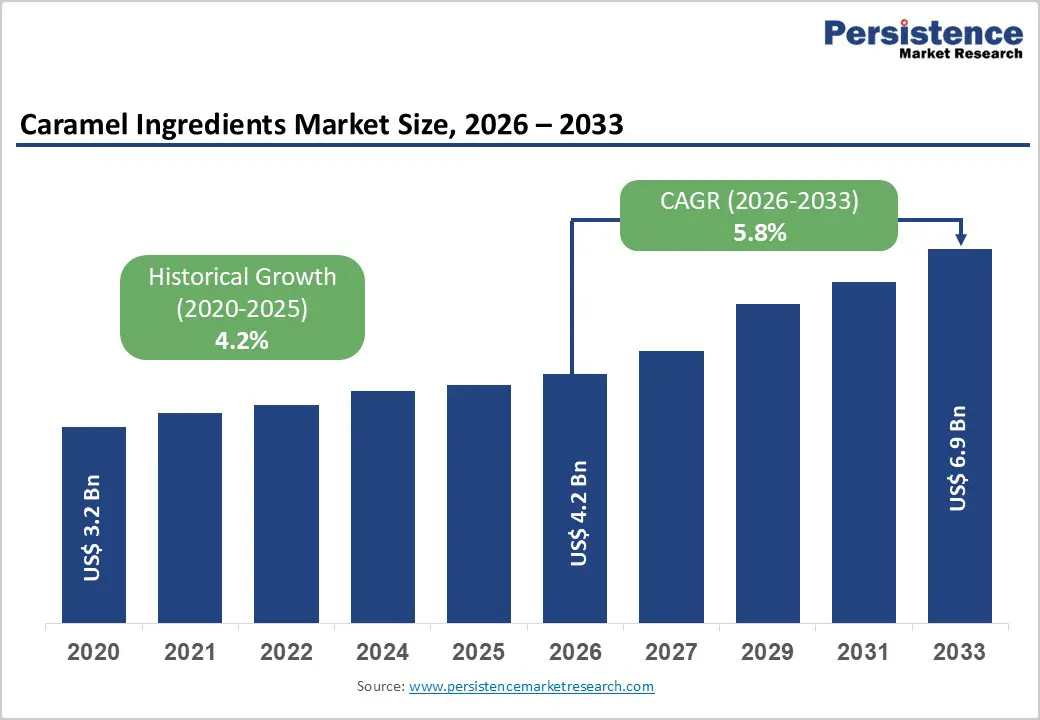
The global caramel ingredients market size is estimated to grow from US$ 4.2 Bn in 2026 to US$ 6.9 Bn by 2033. The market is projected to record a CAGR of 5.8% during the forecast period from 2026 to 2033.
Growing global consumption of flavored foods and visually appealing beverages is steadily increasing the use of caramel-based ingredients across multiple food manufacturing sectors. Caramel color, flavor systems, fillings, and toppings play an essential role in delivering sweetness, rich aroma, and the characteristic brown shades widely associated with confectionery, bakery products, dairy desserts, and beverages. Manufacturers rely on these ingredients to create distinctive taste profiles and improve product presentation while maintaining formulation consistency during large-scale production.
Rising demand for indulgent snacks, premium desserts, and specialty beverages is encouraging food companies to incorporate caramel components into innovative product offerings such as layered desserts, flavored coffees, snack bars, and gourmet chocolates. Continuous improvements in ingredient processing technologies have enabled producers to achieve more consistent flavor intensity, improved texture performance, and longer shelf stability. At the same time, global expansion of packaged food consumption and modern retail distribution channels is supporting higher production volumes for caramel-based ingredients. Collaboration between food manufacturers and ingredient suppliers is also accelerating the development of customized caramel solutions tailored to specific product formulations. As consumer interest in indulgent yet visually appealing food products continues rising worldwide, caramel ingredients are expected to remain an important component of modern food innovation.
Key Industry Highlights
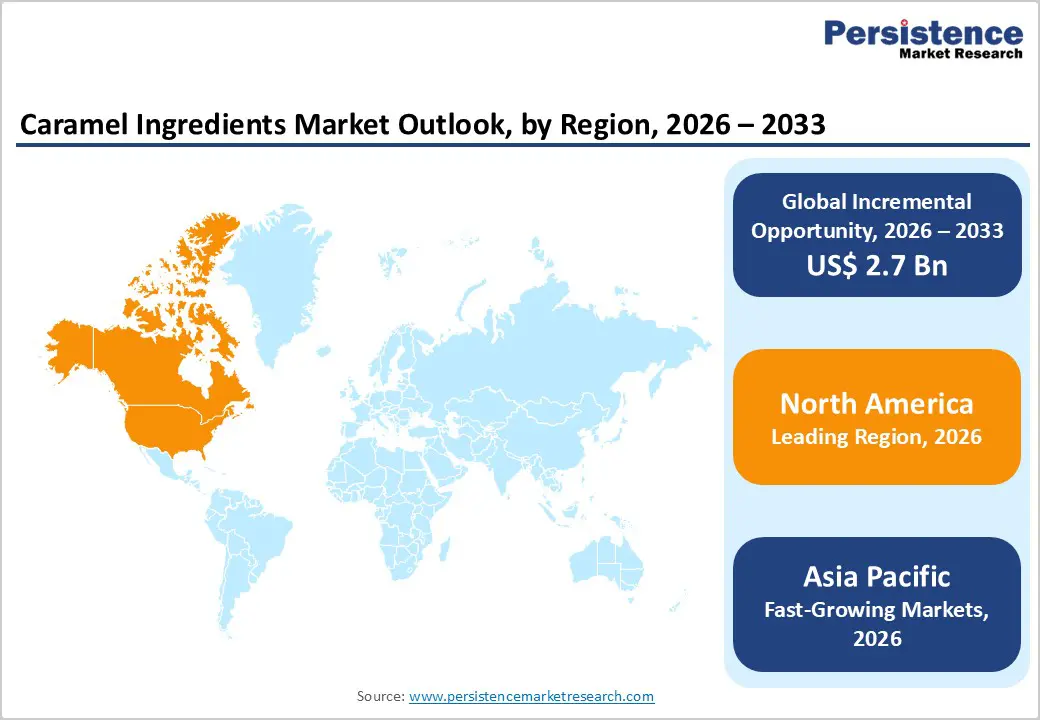
- Leading Region: North America holds the largest share at 46.7%, supported by a well-established food and beverage industry, strong demand for caramel-colored beverages, extensive bakery and confectionery production, and the presence of major ingredient manufacturers investing in product innovation.
- Fastest-Growing Region: Asia Pacific is expanding fastest due to rising consumption of packaged desserts, rapid growth of café culture, increasing demand for flavored beverages, and expanding food processing capacity across emerging economies.
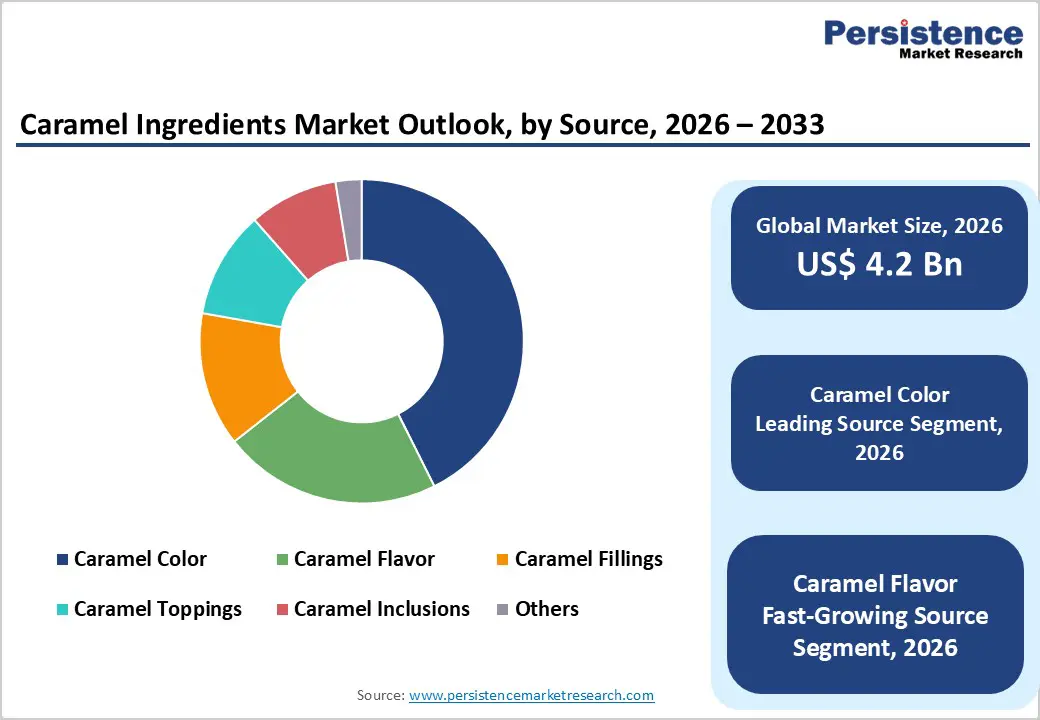
- Leading Type Segment: Caramel color dominate the market with a 56.8% share, driven by its extensive application in carbonated beverages, sauces, bakery products, and processed foods where stable color consistency is essential.
- Fastest-Growing Type Segment: Caramel flavor are experiencing accelerated growth as food companies increasingly develop premium desserts, flavored drinks, and confectionery products that rely on rich caramel taste profiles to attract consumers.
- Leading Application Segment: Bakery & confectionery lead with a 38.7% share, supported by strong global demand for caramel-filled chocolates, pastries, biscuits, cakes, and other sweet snack products.
- Fastest-Growing Application Segment: Beverages is growing rapidly as beverage producers increasingly incorporate caramel syrups and color systems in coffee drinks, milkshakes, soft drinks, and specialty flavored beverages to enhance taste and visual appeal.
| Key Insights | Details |
|---|---|
| Caramel Ingredients Market Size (2026E) | US$ 4.2 Bn |
| Market Value Forecast (2033F) | US$ 6.9 Bn |
| Projected Growth (CAGR 2026 to 2033) | 5.8% |
| Historical Market Growth (CAGR 2020 to 2025) | 4.2 % |
Market Dynamics
Driver - Rising Demand for Indulgent Flavors and Natural Food Coloring in Processed Foods
Increasing consumer preference for visually appealing and flavor-rich food products is significantly strengthening demand for caramel-based ingredients across global food and beverage industries. Caramel components are widely used to deliver distinctive sweetness, rich flavor complexity, and characteristic brown color in numerous packaged food products. Bakery goods, confectionery items, flavored beverages, dairy desserts, and snack products increasingly incorporate caramel syrups, fillings, toppings, and colors to enhance sensory appeal and product differentiation. Food manufacturers are continuously introducing premium dessert products, caramel-flavored beverages, and indulgent snack formulations to attract consumers seeking unique taste experiences.
Additionally, caramel color is extensively utilized in carbonated beverages, malt drinks, sauces, and syrups because it provides stable coloring without altering the core flavor profile of the final product. Growing global consumption of convenience foods and ready-to-eat products further supports ingredient demand as producers focus on maintaining consistent flavor and appearance in mass-produced foods. Advances in controlled heating processes and ingredient refinement have also improved the stability, viscosity, and shelf life of caramel ingredients, making them easier to integrate into complex formulations. In addition, expanding café culture and dessert-oriented foodservice menus are increasing the use of caramel syrups and toppings in beverages and bakery products. As food brands continue focusing on flavor innovation and product aesthetics, caramel ingredients remain essential in delivering consistent taste, color, and indulgent sensory experiences across a wide range of food categories.
Restraints - Raw Material Price Fluctuations and Processing Complexity in Caramel Production
Production of caramel ingredients is influenced by fluctuations in the availability and pricing of key raw materials such as sugar, glucose syrups, and other carbohydrate substrates used in caramelization processes. These raw materials are closely tied to agricultural production cycles, global commodity markets, and climatic conditions affecting sugar crop yields.
Variations in sugar prices can directly impact manufacturing costs for ingredient producers, making cost management a persistent challenge for companies operating in this sector. Caramel production also involves carefully controlled heating and chemical reactions to achieve specific color intensity, flavor characteristics, and viscosity levels. Maintaining consistency across large production batches requires advanced processing equipment, precise temperature control systems, and strict quality monitoring procedures. This level of operational precision increases manufacturing complexity and can raise energy consumption during production
Another challenge involves compliance with evolving food safety and labeling regulations in different regions. Caramel colors and flavor ingredients used in beverages and packaged foods must meet regulatory standards related to purity, permissible additives, and product labeling requirements. Differences in regulatory frameworks across global markets can complicate product approvals and increase administrative costs for manufacturers seeking international expansion. Additionally, some food companies remain cautious when adjusting established formulations, since altering caramel ingredient ratios may affect flavor balance, product appearance, and overall consumer acceptance. These operational and cost factors collectively create barriers that may limit faster market expansion.
Opportunity - Expanding Use of Caramel Ingredients in Premium Desserts, Specialty Beverages, and Innovative Food Products
The growing diversification of food products worldwide is creating significant opportunities for caramel ingredient manufacturers. Rising consumer interest in indulgent desserts, gourmet bakery products, and specialty beverages is encouraging food companies to incorporate more sophisticated flavor combinations and premium toppings in their offerings. Caramel syrups, inclusions, and fillings are increasingly used in cakes, pastries, chocolates, ice creams, and layered desserts to create distinctive textures and flavor experiences that appeal to modern consumers. The rapid growth of café culture and specialty beverage chains is also contributing to increasing demand for caramel flavor systems. Coffee-based drinks, milkshakes, dessert beverages, and flavored lattes frequently include caramel syrups or sauces to enhance sweetness and provide signature taste profiles. Beverage companies are experimenting with new caramel flavor variants, including salted caramel, caramel vanilla, and caramel chocolate combinations to attract younger consumer groups seeking novel taste experiences.
Food manufacturers are also integrating caramel ingredients into snack bars, breakfast cereals, and ready-to-eat desserts to add visual appeal and flavor intensity. Improvements in ingredient formulation technologies are enabling producers to develop caramel inclusions with enhanced heat stability, texture retention, and shelf life suitable for large-scale industrial processing. Furthermore, emerging markets with rapidly expanding food processing industries are presenting strong opportunities for ingredient suppliers to establish new production facilities and distribution networks. As global food companies continue exploring innovative flavor concepts and premium product positioning, caramel ingredients are expected to play a growing role in shaping next-generation dessert, beverage, and snack formulations.
Category-wise Analysis
By Product
Caramel color is projected to remain the dominant product category in the global caramel ingredients market in 2026, representing 42.6% of total revenue. Its strong market presence is primarily driven by its widespread use as a natural-looking coloring solution across beverages, bakery items, sauces, confectionery, and processed foods. The ingredient is valued for its ability to deliver stable brown shades, improve visual appeal, and maintain consistency under varying pH and temperature conditions. Food and beverage manufacturers prefer caramel color because it integrates easily into different formulations without altering flavor profiles.
Carbonated drinks, malt beverages, ready-to-drink coffees, and syrups are among the major product categories utilizing caramel color. Additionally, increasing regulatory scrutiny on artificial colors has encouraged food producers to adopt reliable alternatives that maintain product appearance while aligning with evolving consumer expectations. Technological advancements in controlled heating processes and ingredient refinement have further improved color stability, uniformity, and shelf life. As global demand for visually appealing packaged foods continues to grow, caramel color maintains a strong position as an essential ingredient for large-scale food manufacturing operations.
By Application Insights
The bakery & confectionery segment is expected to account for the largest share of the caramel ingredients market in 2026, contributing 38.4% of overall revenue. Caramel ingredients are extensively incorporated into cakes, pastries, chocolates, candies, cookies, and dessert products to enhance sweetness, texture, and flavor depth. Food manufacturers increasingly use caramel fillings, syrups, and inclusions to create premium bakery offerings and indulgent confectionery products. These ingredients provide rich flavor complexity and attractive color characteristics that improve product differentiation in competitive retail markets. Rising consumer demand for gourmet desserts, snack bars, and artisanal bakery products has further strengthened the role of caramel components in modern food formulations. Additionally, manufacturers are integrating caramel ingredients into innovative hybrid products such as caramel-filled biscuits, layered desserts, and chocolate-coated snacks. Advances in ingredient processing and formulation technologies allow producers to maintain consistent viscosity, flavor intensity, and shelf stability in large-scale production environments. As global consumption of packaged sweets and bakery items continues expanding, caramel ingredients remain critical to delivering premium taste experiences and visual appeal across a wide range of confectionery applications.
By End-user Insights
The food processing industry is expected to represent the largest end-user group in 2026, capturing 56.2% of total market revenue. Large food manufacturers rely heavily on caramel ingredients to enhance flavor, appearance, and product consistency across numerous packaged food categories. Caramel colors, syrups, and flavor systems are widely integrated into sauces, ready-to-eat meals, snack foods, dairy desserts, and baked goods produced at industrial scale. These ingredients offer manufacturers formulation flexibility while maintaining stable taste and color profiles during processing and storage. In addition, caramel components help food companies develop distinctive flavor profiles that support brand differentiation in crowded retail markets. Major food producers maintain sophisticated product development pipelines focused on improving texture, taste balance, and product aesthetics, where caramel ingredients play a central role. Established manufacturing infrastructure allows companies to incorporate new caramel-based solutions rapidly once validated for safety and quality standards. With global demand for packaged and convenience foods continuing to rise, the food processing industry remains the primary driver of caramel ingredient consumption worldwide.
Regional Insights
North America Caramel Ingredients Market Trends
North America is anticipated to hold the largest share of the global caramel ingredients market in 2026, accounting for 46.7% of total market value, with the United States serving as the primary contributor to regional growth. The region benefits from a highly developed food and beverage industry where caramel ingredients are widely utilized in soft drinks, baked goods, confectionery items, and dairy desserts. Beverage manufacturers particularly rely on caramel color to provide the characteristic dark tone found in colas, flavored beers, and ready-to-drink coffees. In addition, bakery and dessert producers extensively incorporate caramel fillings, toppings, and syrups to enhance product taste and visual appeal.
North American consumers demonstrate strong demand for indulgent snacks and premium desserts, which encourages manufacturers to innovate with new caramel-based flavors and textures. Advanced ingredient processing technologies and well-established supply chains further support consistent production and distribution across the region. Major food ingredient companies also maintain significant research facilities in the United States and Canada focused on developing improved caramel formulations with enhanced stability and flavor complexity. Combined with high purchasing power and rapid product innovation cycles, these factors continue to reinforce North America’s leadership position in the global caramel ingredients market.
Europe Caramel Ingredients Market Trends
Europe represents a well-established yet steadily evolving market for caramel ingredients, supported by a strong bakery tradition, sophisticated confectionery sector, and high consumer preference for premium desserts. Countries such as Germany, France, the United Kingdom, Italy, and Belgium serve as major consumption hubs due to their extensive chocolate, pastry, and dairy dessert industries. Caramel components are widely incorporated into chocolates, biscuits, pastries, and specialty desserts, where they contribute distinctive sweetness, color depth, and flavor complexity. European manufacturers are increasingly focusing on ingredient transparency and quality assurance, leading to the adoption of carefully controlled caramel production processes that ensure consistent flavor and appearance. Regional food producers also emphasize product innovation, frequently introducing new caramel-infused snack bars, gourmet desserts, and flavored dairy products.
Additionally, strong regulatory frameworks governing food safety and labeling encourage companies to maintain high standards in ingredient sourcing and processing. Research institutions and ingredient suppliers across Europe continue investing in improved caramel processing technologies that enhance stability, viscosity control, and sensory performance. These developments, combined with strong demand for premium bakery and confectionery products, position Europe as a stable and innovation-driven market for caramel ingredients.
Asia Pacific Caramel Ingredients Market Trends
Asia Pacific is projected to be the fastest-growing regional market, expected to expand at a CAGR of approximately 7.9% between 2026 and 2033. Rapid urbanization, population growth, and changing dietary habits are significantly increasing demand for packaged foods, desserts, and flavored beverages throughout the region. Countries such as China, India, Japan, and South Korea are experiencing rapid expansion in bakery chains, café culture, and convenience food consumption, all of which utilize caramel ingredients in various product formulations. Beverage manufacturers across the region are incorporating caramel color in carbonated drinks, flavored teas, and ready-to-drink coffee products to enhance visual appearance and brand identity.
Moreover, bakery producers are integrating caramel syrups, fillings, and inclusions into cakes, pastries, and snack products designed for urban consumers. Expanding retail infrastructure and e-commerce channels are further accelerating the availability of premium dessert and confectionery items. Governments and private companies are also investing in food processing technologies and ingredient manufacturing capabilities to support growing domestic demand. With its large consumer base, rapidly developing food industry, and increasing appetite for indulgent flavors, Asia Pacific continues to emerge as the most dynamic growth region for caramel ingredients worldwide.
Competitive Landscape
The global caramel ingredients market is highly competitive, with strong participation from Kerry Group plc., Puratos Group, Givaudan SA, Martin Braun-Gruppe, and Metarom Group. These companies leverage advanced flavor formulation technologies, large-scale ingredient manufacturing capabilities, and global food ingredient distribution networks to strengthen their market presence while enhancing taste profiles, color consistency, and functional performance of caramel-based ingredients.
Growing demand for clean-label products, premium bakery and confectionery items, and indulgent flavored beverages is accelerating product innovation. Manufacturers are focusing on expanding production capacity, improving caramel processing techniques, ensuring regulatory compliance, and forming strategic collaborations while increasing R&D investments to develop specialty caramel flavors, fillings, toppings, and inclusions.
Key Industry Developments:
- In October 2025, Mars introduced M&M’s POP’d Caramel, the brand’s first freeze-dried confectionery product, offering a light and crispy texture paired with its signature caramel flavor. The innovation reflects the company’s strategy to introduce novel textures and flavor experiences to attract evolving consumer preferences in the confectionery market.
- In February 2025, Nestlé expanded into the fast-growing chocolate tablet segment by launching new KitKat tablets in Europe, featuring flavors such as double chocolate, hazelnut, and salted caramel. The launch aims to strengthen the brand’s presence in the premium confectionery segment while responding to rising consumer demand for innovative chocolate flavors.
- In April 2023, Nactarome announced the completion of its acquisition of Royal Buisman, a well-established producer of natural, clean-label caramel ingredients used across various food and beverage applications, with more than 150 years of industry heritage. Rothschild & Co served as the sole financial advisor to Nactarome, while EY acted as financial and tax advisor, Van Campen Liem provided legal advisory services, and WSP supported the transaction as environmental advisor.
Companies Covered in Caramel Ingredients Market
- Angel Yeast Co., Ltd.
- Lallemand Inc.
- Associated British Foods plc.
- Lesaffre et Compagnie
- Kerry Group plc.
- Alltech, Inc.
- Leiber GmbH
- Oriental Yeast Co., Ltd.
- Bioven Ingredients
- dsm-firmenich AG
- Novonesis A/S
- Biorigin
- Sensient Technologies Corporation
- Cargill, Incorporated
- Synergy Flavors, Inc.
- Others Kerry Group plc.
- Puratos Group
- Givaudan SA
- Martin Braun-Gruppe
- Metarom Group
- Sensient Technologies Corporation
- DDW, The Color House (formerly D.D. Williamson & Co., Inc.)
- Cargill, Incorporated
- Nigay SAS
- Sethness Roquette
- Archer-Daniels-Midland Company (ADM)
- Ingredion Incorporated
- Bakels Worldwide
- Tate & Lyle PLC
- Barry Callebaut AG
- Others
Frequently Asked Questions
The global caramel ingredients market is projected to be valued at US$ 4.2 Bn in 2026.
Rising consumption of processed foods, confectionery products, and caramel-flavored beverages is driving demand for caramel ingredients in bakery, beverage, and dairy applications.
The global caramel ingredients market is poised to witness a CAGR of 5.8% between 2026 and 2033.
Growing demand for plant-based foods, clean-label ingredients, and functional nutrition products is creating major opportunities for yeast ingredient manufacturers.
Kerry Group plc., Puratos Group, Givaudan SA, Martin Braun-Gruppe, and Metarom Group. are some of the key players in the caramel ingredients market.


