Europe Egg Replacement Ingredients Market Size, Share, Growth, and Regional Forecast, 2025 to 2032

Europe Egg Replacement Ingredients Market by Product Type (Plant-Based Proteins, Dairy Proteins, Starches & Flours, Hydrocolloids & Gums, Yeast extracts, Others), by Form, by Application, by Distribution Channel, and Country Analysis from 2025 to 2032

ID: PMRREP35643
Calendar

September 2025

178 Pages

Author : Abhijeet Surwase

Market Dynamics

Driver - Rapid Growth of Vegan/Plant-Based Diets & Flexitarianism

Europe market for egg replacement ingredients is strongly driven by the rapid rise of vegan, vegetarian, and flexitarian lifestyles, which are reshaping consumer food preferences. Growing awareness of animal welfare, environmental sustainability, and personal health has led more consumers to reduce or eliminate animal-based products, creating a surge in demand for plant-based alternatives.

Flexitarian diets, in particular, are gaining traction as consumer’s balance meat and dairy reduction with occasional animal product consumption, fueling steady demand for versatile egg replacers. Food manufacturers are responding with innovative plant-derived formulations that replicate the binding, emulsifying, and foaming functions of eggs without compromising on taste or texture.

This trend is further reinforced by the increasing availability of plant-based bakery, confectionery, and ready-to-eat products across Europe.

Restraint- Complex EU Labelling & Allergen Rules Increase Compliance Cost and Time to Market

Europe egg replacement ingredients market faces a significant hurdle due to complex EU labelling and allergen regulations, which directly increase compliance costs and prolong time to market.

Under EU law, manufacturers must provide highly detailed ingredient disclosures, allergen declarations, and nutritional information, especially when products involve novel proteins such as pea, soy, or chickpea. Even trace allergen risks require rigorous documentation and testing, which adds financial strain and delays product launches.

Furthermore, labelling requirements differ slightly across member states, complicating harmonization for pan-European distribution. Companies aiming for “vegan,” “organic,” or “clean-label” claims must undergo additional certification processes, adding another regulatory layer.

For small and mid-sized producers, these overlapping frameworks create barriers to innovation and scalability, reducing competitive advantage against conventional eggs with simpler compliance pathways.

Opportunity - Pea-protein + Starch Functional Blends

Pea-protein combined with starch-based functional blends is emerging as a promising innovation in Europe’s egg replacement ingredients market. These blends are specifically engineered to replicate the key properties of eggs, binding, aeration, and structure making them highly suitable for bakery applications such as breads, cakes, and muffins.

Pea protein delivers high-quality plant-based protein with excellent amino acid content, while starches (from sources like corn, tapioca, or potato) provide elasticity and moisture retention. Together, they create a synergistic effect, ensuring volume, softness, and stability without compromising taste or texture.

This approach also aligns with Europe’s rising demand for clean-label, allergen-free, and vegan-friendly ingredients. With growing consumer preference for sustainable plant proteins and reduced allergen risks, pea-protein and starch blends present manufacturers with both functionality and market differentiation opportunities.

Category-wise Analysis

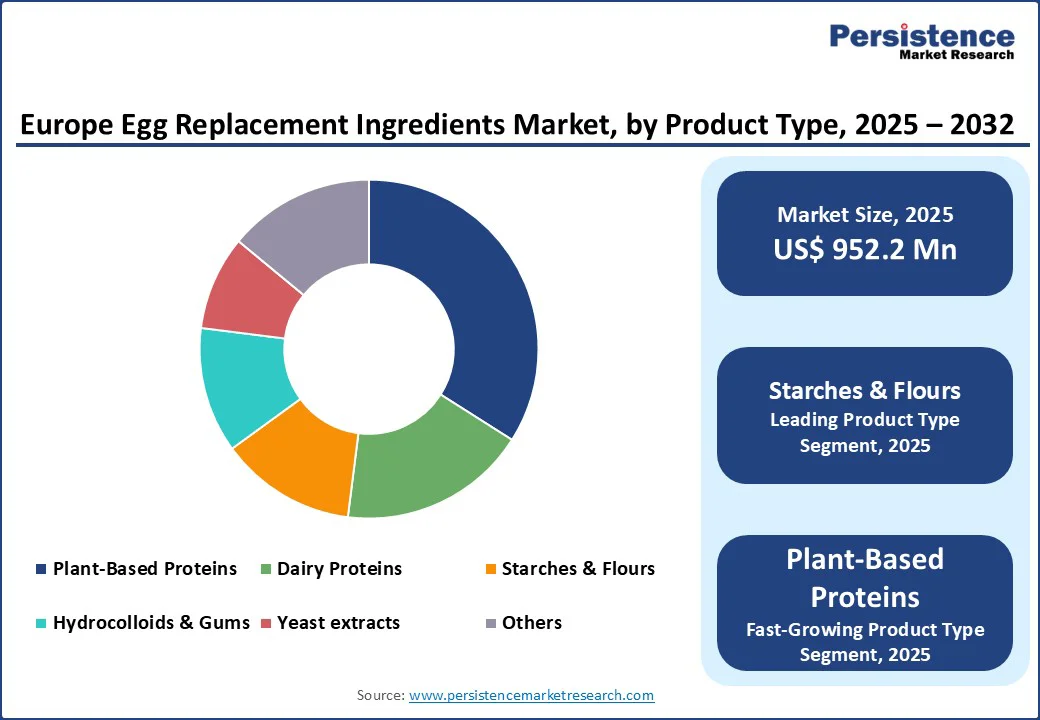
By Product Type, Starches & Flours Driving the Dominance

Starches and flours hold a dominant position in the egg replacement ingredients market due to their versatility, affordability, and widespread acceptance in the food industry. They are extensively used in bakery, confectionery, and processed foods to provide structure, texture, and binding properties, effectively mimicking eggs in a variety of applications.

Compared to protein-based alternatives, starches and flours are cost-effective, allowing large-scale manufacturers to maintain profitability while meeting product quality standards. Additionally, they are readily available across global markets and integrate seamlessly into existing production processes without requiring specialized equipment or formulations.

Their neutral taste and high consumer acceptance further enhance their appeal. Combined, these factors make starches and flours the preferred choice for mainstream egg replacement, ensuring they continue to dominate the market despite emerging plant-based protein alternatives.

By Formulation, Bakery & Confectionery Remain the Dominant Application in Europe

Bakery & confectionery leads Europe egg replacement ingredients market due to its high reliance on eggs for structure, texture, and moisture retention. Egg replacers, particularly plant-based proteins, starches, and functional blends, effectively mimic these properties, enabling consistent quality in cakes, muffins, breads, and pastries.

Growing consumer demand for vegan, allergen-free, and clean-label bakery products has accelerated adoption, as manufacturers seek alternatives that maintain product taste and appearance.

Additionally, the bakery sector’s large-scale industrial production favors versatile, cost-effective egg replacements that improve shelf life and processing efficiency. Innovations in functional blends and protein-starch formulations further enhance aeration, binding, and browning, solidifying bakery and confectionery as the primary driver of growth in Europe’s egg replacement ingredients market.
europe-egg-replacement-ingredients-market-by-product-type-2025–2032

Country Insights

Germany Leads Europe’s Egg Replacement Ingredients Market

Germany leads the egg replacement ingredients market in Europe due to its advanced food industry, high consumer awareness, and strong vegan and plant-based product adoption. The country has a well-established bakery and confectionery sector, which actively incorporates egg replacers to meet growing demand for vegan, allergen-free, and clean-label products.

German consumers increasingly prefer sustainable, plant-based diets, driving manufacturers to innovate with pea proteins, starches, and functional blends.

Additionally, Germany benefits from robust R&D infrastructure, advanced processing technologies, and supportive regulatory frameworks, enabling large-scale production of high-quality egg alternatives. Leading food companies and startups alike focus on product differentiation and export opportunities, reinforcing Germany’s position as the primary hub for egg replacement innovation in Europe.

Competitive Landscape

Europe egg replacement ingredients market is highly competitive, characterized by a mix of global food ingredient suppliers, regional specialists, and innovative startups. Key players, including Puratos, Döhler, Cargill, and Kerry Group, focus on developing plant-based proteins, starches, and functional blends that replicate egg functionality in bakery, confectionery, and processed foods.

Companies compete through product innovation, clean-label formulations, sustainability initiatives, and customized solutions for industrial and retail applications. Startups specializing in algae, fermentation-derived proteins, and aquafaba further intensify competition by offering niche, high-value alternatives.

Key Industry Developments:

  • In April 2025, Loryma, a brand of the Crespel & Deiters Group, launched a stabilising compound designed to replace eggs and dairy in baked goods. Called Lory® Stab, the ingredient was described as a “compound of natural, technically treated raw materials that ensured excellent dough stability and optimal baking results.”

Companies Covered in Europe Egg Replacement Ingredients Market

  • Cargill, Incorporated
  • Archer Daniels Midland Company
  • Ingredion Incorporated
  • Kerry Group plc
  • Roquette Frères S.A.
  • Puratos Group
  • Corbion NV
  • Glanbia plc
  • Tate & Lyle plc
  • Loryma
  • MEGGLE Ingredients
  • Revyve
  • Crespel & Deiters Group
  • Others
Frequently Asked Questions

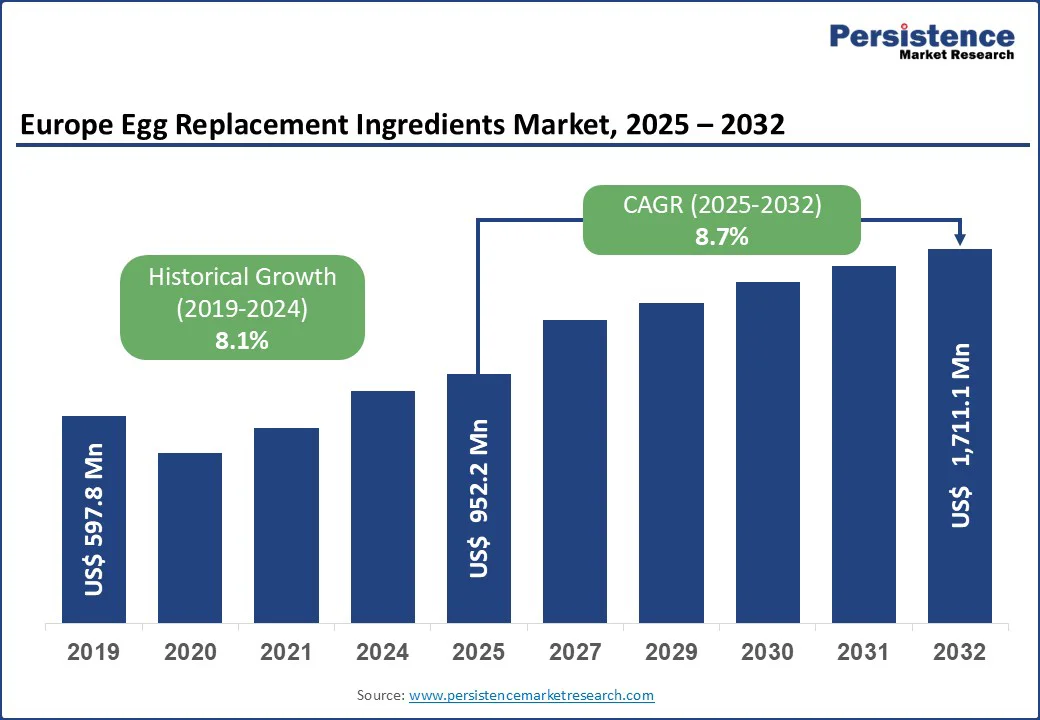
The European market is projected to be valued at US$952.2 Mn in 2025.

Growing adoption of veganism and flexitarian lifestyles increases demand for egg-free alternatives.

The market is poised to witness a CAGR of 8.7% between 2025 and 2032.

Developing pea, soy, chickpea, and fava protein blends that replicate egg functionality in bakery and confectionery.

Germany accounts for a major share.

Europe Egg Replacement Ingredients Market Report Scope
Report Attribute Details
Historical Data/Actuals 2019 - 2024
Forecast Period 2025 - 2032
Market Analysis Value: US$ Mn
Geographical Coverage
  • Germany
  • UK
  • France
  • Italy
  • Spain
  • Rest of Europe
Segmental Coverage
  • Product Type
  • Form
  • Application
  • Distribution Channel
  • Country
Competitive Analysis
  • Cargill, Incorporated
  • Archer Daniels Midland Company
  • Ingredion Incorporated
  • Kerry Group plc
  • Roquette Frères S.A.
  • Puratos Group
  • Corbion NV
  • Glanbia plc
  • Tate & Lyle plc
  • Loryma
  • MEGGLE Ingredients
  • Revyve
  • Crespel & Deiters Group
  • Others
Report Highlights
  • Market Forecast and Trends
  • Growth Factors and Challenges
  • Strategic Growth Initiatives
  • Future Opportunities and Revenue Pockets
  • Industry Market Analysis Tools
Market Segmentation

By Product Type

  • Plant-Based Proteins
  • Dairy Proteins
  • Starches & Flours
  • Hydrocolloids & Gums
  • Yeast extracts
  • Others

By Form

  • Powder
  • Liquid

By Application

  • Bakery & Confectionery
  • Dairy Products
  • Processed Foods
  • Sauces and Salad Dressings
  • Others

By Distribution Channel

  • B2B
  • B2C
    • Hypermarkets/Supermarkets
    • Specialty Stores
    • Online retail
    • Others

By Country

  • Germany
  • UK
  • France
  • Italy
  • Spain
  • Rest of Europe

Related Reports

  1. Executive Summary
    1. Europe Egg Replacement ingredients Market Snapshot, 2025 and 2032
    2. Market Opportunity Assessment, 2025 - 2032, US$ Mn
    3. Key Market Trends
    4. Future Market Projections
    5. Premium Market Insights
    6. Industry Developments and Key Market Events
    7. PMR Analysis and Recommendations
  2. Market Overview
    1. Market Scope and Definition
    2. Market Dynamics
      1. Drivers
      2. Restraints
      3. Opportunity
      4. Challenges
      5. Key Trends
    3. COVID-19 Impact Analysis
    4. Forecast Factors - Relevance and Impact
  3. Value Added Insights
    1. Value Chain Analysis
    2. Product Adoption / Usage Analysis
    3. Key Market Players
    4. Key Promotional Strategies, By Key Players
    5. Regulatory Landscape
    6. PESTLE Analysis
    7. Porter’s Five Force Analysis
  4. Europe Egg Replacement Product Types Market Outlook
    1. Key Highlights
      1. Market Size (US$ Mn) and Y-o-Y Growth
      2. Absolute $ Opportunity
    2. Market Size (US$ Mn) Analysis and Forecast
      1. Historical Market Size (US$ Mn) Analysis, 2019-2024
      2. Market Size (US$ Mn) Analysis and Forecast, 2025-2032
    3. Europe Egg Replacement Product Types Market Outlook: Product Type
      1. Historical Market Size (US$ Mn) Analysis, By Product Type, 2019-2024
      2. Market Size (US$ Mn) and Forecast Analysis, By Product Type, 2025-2032
        1. Plant-Based Proteins
        2. Dairy Proteins
        3. Starches & Flours
        4. Hydrocolloids & Gums
        5. Yeast extracts
        6. Others
      3. Market Attractiveness Analysis: Product Type
    4. Europe Egg Replacement Product Types Market Outlook: Form
      1. Historical Market Size (US$ Mn) Analysis, By Form, 2019-2024
      2. Market Size (US$ Mn) and Forecast Analysis, By Form, 2025-2032
        1. Powder
        2. Liquid
      3. Market Attractiveness Analysis: Form
    5. Europe Egg Replacement Product Types Market Outlook: Application
      1. Historical Market Size (US$ Mn) Analysis, By Application, 2019-2024
      2. Market Size (US$ Mn) and Forecast Analysis, By Application, 2025-2032
        1. Bakery & Confectionery
        2. Dairy Products
        3. Processed Foods
        4. Sauces and Salad Dressings
        5. Others
      3. Market Attractiveness Analysis: Application
    6. Europe Egg Replacement Product Types Market Outlook: Distribution Channel
      1. Historical Market Size (US$ Mn) Analysis, By Distribution Channel, 2019-2024
      2. Market Size (US$ Mn) and Forecast Analysis, By Distribution Channel, 2025-2032
        1. B2B
        2. B2C
          1. Hypermarkets/Supermarkets
          2. Specialty Stores
          3. Online retail
          4. Others
      3. Market Attractiveness Analysis: Distribution Channel
  5. Europe Egg Replacement Product Types Market Outlook: Country
    1. Historical Market Size (US$ Mn) Analysis, By Country, 2019-2024
    2. Market Size (US$ Mn) and Forecast Analysis, by Country, 2025-2032
      1. Germany
      2. U.K.
      3. France
      4. Italy
      5. Spain
      6. Rest of Europe
    3. Market Attractiveness Analysis: Country
  6. Germany Egg Replacement Product Types Market Outlook
    1. Historical Market Size (US$ Mn) Analysis, By Market, 2019-2024
      1. By Product Type
      2. By Form
      3. By Application
    2. Market Size (US$ Mn) and Forecast Analysis, by Product Type, 2025-2032
      1. Plant-Based Proteins
      2. Dairy Proteins
      3. Starches & Flours
      4. Hydrocolloids & Gums
      5. Yeast extracts
      6. Others
    3. Market Size (US$ Mn) Analysis and Forecast, By Form, 2025-2032
      1. Powder
      2. Liquid
    4. Market Size (US$ Mn) Analysis and Forecast, By Application, 2025-2032
      1. Bakery & Confectionery
      2. Dairy Products
      3. Processed Foods
      4. Sauces and Salad Dressings
      5. Others
    5. Market Size (US$ Mn) Analysis and Forecast, By Distribution Channel, 2025-2032
      1. B2B
      2. B2C
        1. Hypermarkets/Supermarkets
        2. Specialty Stores
        3. Online retail
        4. Others
    6. Market Attractiveness Analysis
  7. U.K. Egg Replacement Product Types Market Outlook
    1. Historical Market Size (US$ Mn) Analysis, By Market, 2019-2024
      1. By Product Type
      2. By Form
      3. By Application
    2. Market Size (US$ Mn) and Forecast Analysis, by Product Type, 2025-2032
      1. Plant-Based Proteins
      2. Dairy Proteins
      3. Starches & Flours
      4. Hydrocolloids & Gums
      5. Yeast extracts
      6. Others
    3. Market Size (US$ Mn) Analysis and Forecast, By Form, 2025-2032
      1. Powder
      2. Liquid
    4. Market Size (US$ Mn) Analysis and Forecast, By Application, 2025-2032
      1. Bakery & Confectionery
      2. Dairy Products
      3. Processed Foods
      4. Sauces and Salad Dressings
      5. Others
    5. Market Size (US$ Mn) Analysis and Forecast, By Distribution Channel, 2025-2032
      1. B2B
      2. B2C
        1. Hypermarkets/Supermarkets
        2. Specialty Stores
        3. Online retail
        4. Others
    6. Market Attractiveness Analysis
  8. France Egg Replacement Product Types Market Outlook
    1. Historical Market Size (US$ Mn) Analysis, By Market, 2019-2024
      1. By Product Type
      2. By Form
      3. By Application
    2. Market Size (US$ Mn) and Forecast Analysis, by Product Type, 2025-2032
      1. Plant-Based Proteins
      2. Dairy Proteins
      3. Starches & Flours
      4. Hydrocolloids & Gums
      5. Yeast extracts
      6. Others
    3. Market Size (US$ Mn) Analysis and Forecast, By Form, 2025-2032
      1. Powder
      2. Liquid
    4. Market Size (US$ Mn) Analysis and Forecast, By Application, 2025-2032
      1. Bakery & Confectionery
      2. Dairy Products
      3. Processed Foods
      4. Sauces and Salad Dressings
      5. Others
    5. Market Size (US$ Mn) Analysis and Forecast, By Distribution Channel, 2025-2032
      1. B2B
      2. B2C
        1. Hypermarkets/Supermarkets
        2. Specialty Stores
        3. Online retail
        4. Others
    6. Market Attractiveness Analysis
  9. Italy Egg Replacement Product Types Market Outlook
    1. Historical Market Size (US$ Mn) Analysis, By Market, 2019-2024
      1. By Product Type
      2. By Form
      3. By Application
    2. Market Size (US$ Mn) and Forecast Analysis, by Product Type, 2025-2032
      1. Plant-Based Proteins
      2. Dairy Proteins
      3. Starches & Flours
      4. Hydrocolloids & Gums
      5. Yeast extracts
      6. Others
    3. Market Size (US$ Mn) Analysis and Forecast, By Form, 2025-2032
      1. Powder
      2. Liquid
    4. Market Size (US$ Mn) Analysis and Forecast, By Application, 2025-2032
      1. Bakery & Confectionery
      2. Dairy Products
      3. Processed Foods
      4. Sauces and Salad Dressings
      5. Others
    5. Market Size (US$ Mn) Analysis and Forecast, By Distribution Channel, 2025-2032
      1. B2B
      2. B2C
        1. Hypermarkets/Supermarkets
        2. Specialty Stores
        3. Online retail
        4. Others
    6. Market Attractiveness Analysis
  10. Spain Egg Replacement Product Types Market Outlook
    1. Historical Market Size (US$ Mn) Analysis, By Market, 2019-2024
      1. By Product Type
      2. By Form
      3. By Application
    2. Market Size (US$ Mn) and Forecast Analysis, by Product Type, 2025-2032
      1. Plant-Based Proteins
      2. Dairy Proteins
      3. Starches & Flours
      4. Hydrocolloids & Gums
      5. Yeast extracts
      6. Others
    3. Market Size (US$ Mn) Analysis and Forecast, By Form, 2025-2032
      1. Powder
      2. Liquid
    4. Market Size (US$ Mn) Analysis and Forecast, By Application, 2025-2032
      1. Bakery & Confectionery
      2. Dairy Products
      3. Processed Foods
      4. Sauces and Salad Dressings
      5. Others
    5. Market Size (US$ Mn) Analysis and Forecast, By Distribution Channel, 2025-2032
      1. B2B
      2. B2C
        1. Hypermarkets/Supermarkets
        2. Specialty Stores
        3. Online retail
        4. Others
    6. Market Attractiveness Analysis
  11. Rest of Europe Egg Replacement Product Types Market Outlook
    1. Historical Market Size (US$ Mn) Analysis, By Market, 2019-2024
      1. By Product Type
      2. By Form
      3. By Application
    2. Market Size (US$ Mn) and Forecast Analysis, by Product Type, 2025-2032
      1. Plant-Based Proteins
      2. Dairy Proteins
      3. Starches & Flours
      4. Hydrocolloids & Gums
      5. Yeast extracts
      6. Others
    3. Market Size (US$ Mn) Analysis and Forecast, By Form, 2025-2032
      1. Powder
      2. Liquid
    4. Market Size (US$ Mn) Analysis and Forecast, By Application, 2025-2032
      1. Bakery & Confectionery
      2. Dairy Products
      3. Processed Foods
      4. Sauces and Salad Dressings
      5. Others
    5. Market Size (US$ Mn) Analysis and Forecast, By Distribution Channel, 2025-2032
      1. B2B
      2. B2C
        1. Hypermarkets/Supermarkets
        2. Specialty Stores
        3. Online retail
        4. Others
    6. Market Attractiveness Analysis
  12. Competition Landscape
    1. Market Share Analysis, 2024
    2. Market Structure
      1. Competition Intensity Mapping by Market
      2. Competition Dashboard
    3. Company Profiles (Details - Overview, Financials, Strategy, Recent Developments)
      1. Cargill, Incorporated
        1. Overview
        2. Segments and Applications
        3. Key Financials
        4. Market Developments
        5. Market Strategy
      2. Archer Daniels Midland Company
      3. Ingredion Incorporated
      4. Kerry Group plc
      5. Roquette Frères S.A.
      6. Puratos Group
      7. Corbion NV
      8. Glanbia plc
      9. Tate & Lyle plc
      10. Loryma
      11. MEGGLE Ingredients
      12. Revyve
      13. Crespel & Deiters Group
      14. Others
  13. Appendix
    1. Research Methodology
    2. Research Assumptions
    3. Acronyms and Abbreviations

Research Methodology Framework for Market Research Excellence

At Persistence Market Research, we implement a comprehensive, validated, and multi-dimensional approachto market analysis that delivers actionable insights across complex market landscapes. Our methodology combines the analytical rigor of leading consulting firms with innovative research techniques, ensuring robust market assessments that guide strategic decision-making with confidence.

Core Research Philosophy

Our methodology is built on four foundational pillars:

Research Philosophy Image

At Persistence Market Research, our methodology is designed to transcend conventional market studies by combining analytical rigor, multi-source validation, and future-focused insights.

We integrate advanced research frameworks, robust data collection strategies, cutting-edge analytics, and innovative technologies to deliver a 360-degree view of complex markets.

We integrate advanced research frameworks, robust data collection strategies, cutting-edge analytics, and innovative technologies to deliver a 360-degree view of complex markets.

Each stage spanning from strategic scoping and hypothesis-building to competitive intelligence, quality validation, and actionable recommendations is engineered to provide clients with unmatched clarity, precision, and confidence in decision-making.

By embedding innovation and technology at the core, our approach ensures that insights are not only comprehensive but also predictive, empowering businesses to seize opportunities, mitigate risks, and achieve sustainable growth

Research Philosophy Image

Capturing Key Information and Events

During this phase, key research objectives focus on essential information and data points for assessing the market, including:

Research Philosophy Image

TAM-SAM-SOM Framework Implementation

We employ both top-down and bottom-up approaches to ensure accurate market sizing.

Top-Down Market SizingBottom-Up Market Sizing
Universe Definition: Total global/regional market identificationUnit Economics: Average transaction values, purchase frequencies, customer lifecycle
Segmentation Filters: Geographic, demographic, and behavioral constraintsCustomer Segmentation: Detailed buyer persona development and sizing
Market Share Analysis: Competitive landscape assessment and share allocationPenetration Analysis: Market penetration rates by segment and geography
Growth Rate Application: Historical trends and forward-looking growth assumptionsScaling Methodology: Extrapolation techniques with confidence intervals

Validation & Cross-Verification

  • Triangulation: Comparing top-down and bottom-up results for consistency
  • Sensitivity Analysis: Testing key assumptions and parameter variations
  • Peer Benchmarking: Comparison with analogous markets and industry benchmarks
  • Expert Review: External validation through industry specialist consultation

Research Philosophy Image

Forecasting & Projection Modeling

Our proprietary forecasting models incorporate multiple variables and scenarios.

Forecasting Components

  • Historical Trend Analysis: 10-year historical growth patterns and cyclical variations
  • Driver-Based Modeling: Economic indicators, demographic shifts, technology adoption
  • Scenario Planning: Base case, optimistic, and conservative projections
  • Monte Carlo Simulations: Probability-weighted outcomes and risk assessments

Model Validation

  • Back-Testing: Historical accuracy assessment over 3–5-year periods
  • Cross-Validation: Multiple modeling approaches for result comparison
  • External Benchmarking: Comparison with established market forecasts
  • Continuous Calibration: Quarterly model updates based on new data

Comprehensive Data Collection Strategy

Our secondary research phase establishes a robust knowledge base utilizing diverse, credible sources.

Secondary Data Sourcess

  • Industry Publications & Reports
  • Government & Regulatory Data
  • Financial Intelligence (filings & reports)
  • Academic Research & Digital Intelligence

Quality Assurance Protocol

  • Source credibility assessment and publication date validation
  • Data consistency checks across multiple sources
  • Bias identification and neutralization techniques
  • Information gap tracking for primary research prioritization

Research Philosophy Image

Primary Research Excellence

Our primary research methodology employs best-in-class techniques to capture unique market insights.

Quantitative Research Methods

  • Large-Scale Surveys: Statistically representative samples with 95% confidence intervals
  • Survey Methodology: Multi-channel deployment (online, telephone, in-person)
  • Question Architecture and Response Optimization

Qualitative Research Methods

  • Executive Interviews
  • Focus Groups
  • Expert Consultations

Quality Assurance & Validation Framework

Multi-Stage Validation Process

  • Source Verification and Consistency Testing
  • Outlier Detection and Bias Assessment
  • Peer Review Process and External Validation
  • Sensitivity Analysis and Confidence Intervals

Research Philosophy Image

Methodology Validation & Credibility

Our research methodology has been extensively validated through:

  • Academic Partnerships: Collaborations with top-tier business schools and research institutions
  • Client Success Stories: Documented case studies demonstrating research impact and ROI
  • Continuous Benchmarking: Performance comparison with leading global research firms

This comprehensive methodology framework positions Persistence Market Research at the forefront of market intelligence, combining the analytical sophistication of top-tier consulting firms with innovative research techniques. Our approach ensures that every market assessment delivers precise, actionable, and strategically valuable insights that drive business success in competitive market environments.

Ready to unlock your market potential? Contact our research experts to discuss how our validated methodology can transform your strategic decision-making with data-driven market intelligence.

Copyright © 2026 Persistence Market Research. All Rights Reserved

Connect With Us -