




- Home Appliances
- Cleaning Appliances Market
Cleaning Appliances Market Size, Trends, Share, and Growth Forecast 2026 - 2033
Cleaning Appliances Market by Product Type (Vacuum Cleaners, Steam Carpet Cleaners, Upholstery Cleaners, Others), Application (Residential, Industrial, Commercial), Sales Channel (Departmental Stores, Specialty Stores, Online Retail, Others), Regional Analysis, 2026 - 2033

Cleaning Appliances Market Size and Trend Analysis
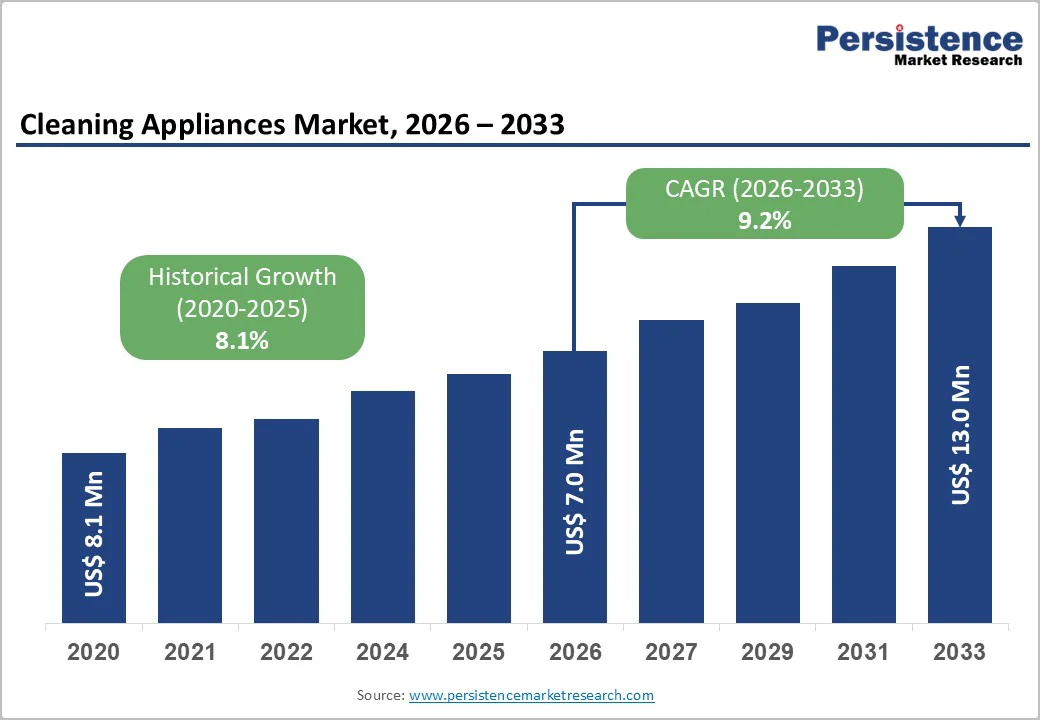
The global cleaning appliances market size is expected to value at US$ 7.0 billion in 2026 and is projected to reach US$ 13.0 billion by 2033, growing at a CAGR of 9.2% between 2026 and 2033.
The market’s rapid expansion is propelled by heightened hygiene awareness, consumer preference for time-saving and automated cleaning solutions, and surging adoption of advanced technologies such as AI-driven and robotic cleaning appliances. Innovations across product categories and the rise of e-commerce platforms have further broadened consumer access, contributing to the robust market growth trajectory.
Key Market Highlights
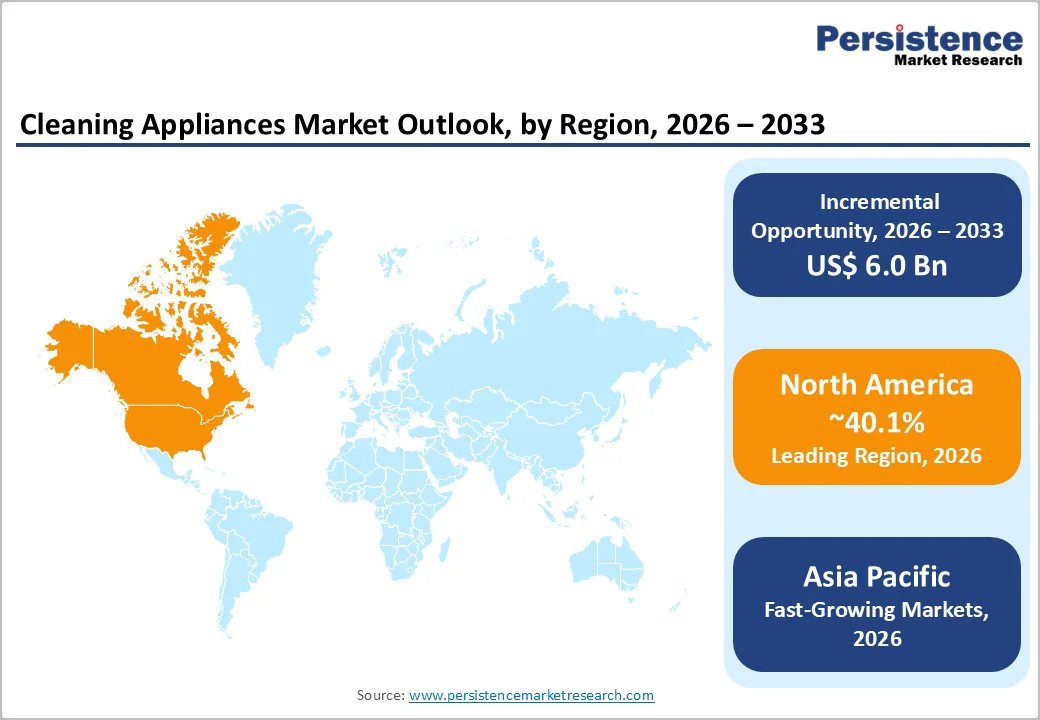
- Leading Region: North America leads the market with 40.1% share, driven by innovation, advanced technology, and strong regulatory standards.
- Fastest-Growing Region: Asia Pacific holds 35% share and is the fastest-growing region, fueled by urbanization, rising disposable incomes, and expanding adoption in China, India, and ASEAN markets.
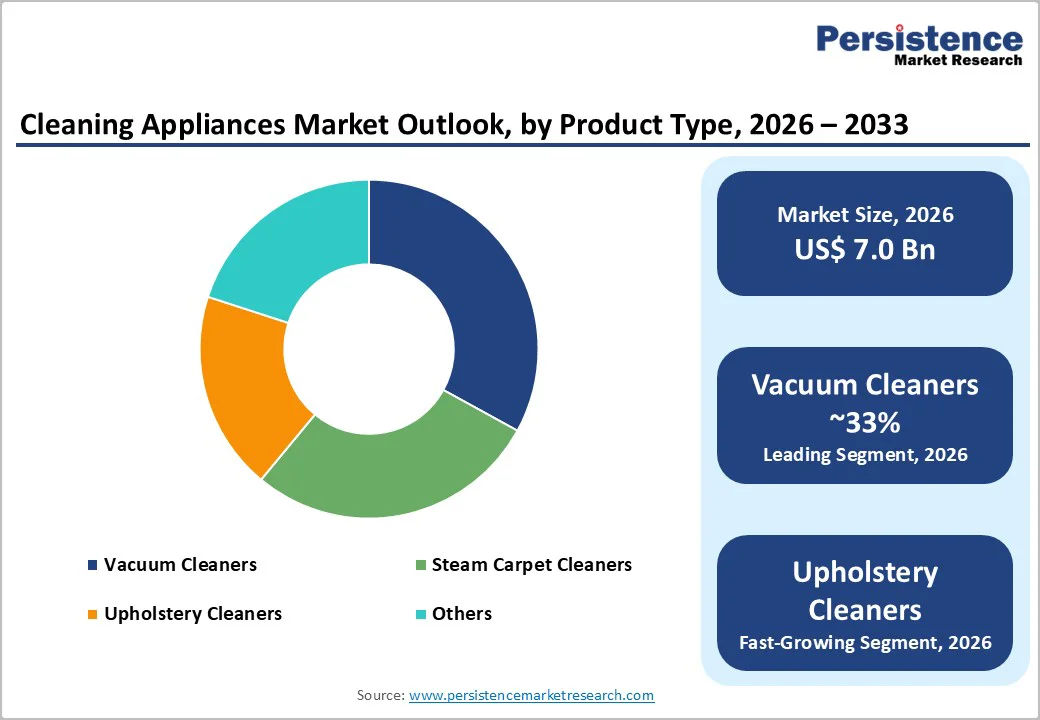
- Leading Category: Vacuum Cleaners dominate the product segment, capturing ~33% of global share, supported by home automation and smart technology upgrades.
- Fastest-Growing Sales Channel: E-commerce is rapidly transforming access and distribution, offering convenience and broader reach in both emerging and developed markets.
- Key Market Opportunity: Innovation in AI-driven and sustainable solutions offers growth potential, appealing to environmentally conscious and tech-savvy consumers.
| Key Insights | Details |
|---|---|
| Cleaning Appliances Market Size (2026E) | US$ 7.0 billion |
| Market Value Forecast (2033F) | US$ 13.0 billion |
| Projected Growth CAGR (2026 - 2033) | 9.2% |
| Historical Market Growth (2020 - 2025) | 8.1% |
Market Dynamics
Drivers - Rising Urbanization, Changing Lifestyles and Surge in Hygiene Awareness
Rapid urbanization, rising disposable incomes, and increasing numbers of dual-working households are significantly driving the adoption of advanced cleaning appliances. The modern consumer lifestyle demands convenience, hygiene, and time efficiency, which boosts the usage of devices like vacuum cleaners, steam carpet cleaners, and robotic cleaning systems.
Post-pandemic awareness has further elevated the importance of sanitization, pushing both residential and commercial sectors to invest more in automated and contactless cleaning technologies as part of everyday living.
Growing health consciousness has also influenced purchasing decisions, with users leaning toward solutions that ensure allergen removal, deep cleaning, and indoor air improvement. A shift toward healthier living environments is encouraging consumers to replace traditional cleaning methods with machine-operated alternatives. As urbanization continues globally, penetration levels for cleaning appliances will rise, strengthening long-term market growth.
Rapid Technological Advancements, AI Automation, and Smart Home Integration
The Cleaning Appliances market is also strengthened by continuous technological innovation, especially in robotics, IoT connectivity, and AI-based automation. Modern devices now feature intelligent navigation, virtual mapping, voice-assistant pairing, adaptive suction control, and automated scheduling, making them more intuitive and nearly maintenance-free.
Global manufacturers such as Samsung, Dyson, LG, and Miele are actively developing AI-equipped cleaning systems to enhance user convenience and improve operational efficiency, energy savings, and cleaning precision. This drive toward smart automation aligns strongly with rising consumer preference for non-manual, self-operating home solutions.
The increasing adoption of connected smart home ecosystems is enabling better device integration and real-time control through mobile apps. These innovations are reducing labour intensity while scaling cleaning effectiveness across both household and commercial environments. As smart appliances become more affordable, accessible, and feature-rich, their acceptance is expected to accelerate further, making technology a key catalyst for future market growth.
Restraints - Raw Material Cost Instability, Geopolitical Supply Disruptions & Margin Compression Risks
Volatility in the prices of plastics, metals, semiconductor components, and lithium-based batteries has emerged as a critical restraint for the Cleaning Appliances market. Frequent cost spikes driven by energy shortages, trade disputes, and freight challenges affect manufacturing economics, forcing companies to absorb losses or raise retail pricing, both commercially unfavourable.
Small and mid-sized OEMs are particularly exposed, as they lack the scale advantages to negotiate long-term contracts or hedge against fluctuations. This instability increases production planning complexity and delays output cycles, especially during high-demand phases.
Sustainability pressure further compounds this challenge. Manufacturers aiming for recyclable and biodegradable materials face higher procurement costs and limited supplier availability, affecting margins and scalability. Fluctuating currency values, import dependencies, and disruptions in sourcing hubs like China and Southeast Asia amplify uncertainty.
Until material flow becomes more regulated and circular recycling systems mature, cost unpredictability will remain a barrier to consistent pricing, profitability, and global competitiveness.
Regulatory Pressures, Eco-Design Standards & Increasing Sustainability Compliance Load
Stringent environmental norms governing energy consumption, packaging waste, noise levels, and chemical usage are tightening across global markets. Compliance with directives such as Extended Producer Responsibility (EPR), RoHS, and eco-efficiency labelling increases documentation, certification, and testing cycles, slowing down product launches.
This makes innovation more costly and time-intensive, particularly for companies operating across multiple regulatory zones. Manufacturers must invest heavily in R&D to meet efficiency thresholds, integrate recyclable materials, and ensure reduced power consumption, elevating upfront development expenditure.
While these mandates drive long-term environmental benefit, they limit operational flexibility and raise barriers to entry for new players. Premium technology development also becomes riskier under compliance uncertainty, discouraging aggressive scaling or diversification.
Emerging economies in Asia-Pacific and Latin America, though high-growth, often pose additional compliance fragmentation, complicating cross-border product standardization. Balancing innovation speed with regulatory alignment will continue to challenge profit structures and strategic expansion timelines.
Market Opportunities
Rapid Growth of E-Commerce, Digital Shelf Expansion & Deep Market Penetration in Emerging Economies
E-commerce is rapidly strengthening the reach and accessibility of cleaning appliances, especially in emerging markets where offline penetration is limited. Digital platforms allow wider product variety, transparent pricing, and comparison-based decision making, making them the fastest-growing sales channel globally.
Flexible EMIs, influencer marketing, and online product discovery now drive high first-time purchase conversions among urban and semi-urban consumers. Countries like India exemplify this shift, where online cleaning appliance sales reached nearly 5% recently and continue accelerating with strong logistics and smartphone adoption.
For manufacturers, e-commerce reduces dependence on physical stores while enabling direct-to-consumer models with lower overheads. Online exclusives, subscription-based consumables, and targeted ads further boost retention and upselling potential. As doorstep delivery and return convenience improve, digital retail is expected to capture a major share incrementally, solidifying itself as a long-term growth engine for global cleaning appliance brands.
Sustainability-Driven Product Innovation, Recycled Material Adoption & Smart Cleaning System Development
Rising environmental awareness is pushing the market toward energy-efficient, water-saving, and recyclable cleaning appliances, opening strong innovation opportunities. Manufacturers introducing biodegradable components, low-power systems, and modular repair-friendly designs are gaining traction across both residential and commercial environments.
Examples such as Nilfisk, incorporating 30% post-consumer recycled plastic, and Tennant introducing advanced robotic scrubbers highlight this shift. These developments align with global climate goals and appeal to eco-focused consumers and corporates aiming to reduce operational impact.
Sustainability is increasingly tied to product value perception, making green upgrades a revenue-building pathway rather than a compliance burden. Brands that scale circular economy models, refurbishment programs, spare-part recovery, and recyclable packaging are positioned to capture future market share.
As awareness deepens, sustainable and smart cleaning systems are expected to transition into mainstream demand, reshaping innovation priorities in the coming years.
Category-wise Insights
Product Type Analysis
Vacuum cleaners hold the leading position in the product category, contributing around 33% of global market share in 2025. Growth is strengthened by cordless models, HEPA filtration, and AI-enabled navigation, making them the preferred choice for homes and offices.
Major brands like Dyson, Shark, and Bosch continue to push performance upgrades, longer battery runtime, and multi-surface cleaning efficiency, ensuring strong consumer preference over traditional tools. Rising allergy cases and indoor dust pollution further elevate adoption, especially in high-density cities.
With convenience and hygiene becoming central to purchase decisions, robotic and smart vacuums are accelerating replacement cycles. The segment’s CAGR of over 9% reflects shifting behaviour toward automated cleaning, reduced manual effort, and premium product demand. Continued innovation in mapping technology and suction precision is expected to cement vacuum cleaners as the most dominant and future-resilient category.
Application Analysis
Residential use remains the largest application segment, approaching 50% share in 2025 and driven by urban living, smaller homes, and heightened hygiene awareness. The post-COVID shift to frequent home sanitization has made cleaning appliances everyday essentials rather than luxury purchases.
Dual-income households, rising pet ownership, and elderly demographics further enable strong home-based adoption, particularly in developed markets. Smart appliances offering multiple functions and app control are becoming household upgrades rather than first-time buys.
The rise of compact and silent models has made cleaning more efficient for modern lifestyles, supporting sustained penetration across apartments and mid-income residences. As consumers prioritize comfort, health, and convenience, residential demand is expected to remain the backbone of global revenue. Continuous innovation and affordability improvements will maintain dominance in the long term.
Sales Channel Analysis
Specialty stores contributed nearly 45% to revenue in 2025, supported by in-store demonstrations, expert guidance, and stronger buying confidence for high-value appliances. Consumers still prefer to physically assess suction power, build quality, and noise levels before purchase, making stores important for conversion.
Loyalty offers and festive promotions further sustain traffic and repeat sales for premium brands. Hands-on comparison remains a crucial advantage of the format.
However, online retail is the fastest-expanding channel, offering ease, a wider assortment, and review-driven decision making. Digital marketplaces are steadily capturing share, particularly in India, Europe, and the U.S. Despite this growth, specialty stores will retain relevance as experiential hubs while omnichannel formats, click-and-collect, and virtual demos redefine future retail structure.
Regional Insights
North America Cleaning Appliances Market Trends
North America remains the global leader in cleaning appliances, capturing approximately 40.1% of the market in 2025, with the United States as the largest single market.
The region’s growth is driven by strong consumer spending, advanced R&D in smart and automated devices, and stringent hygiene regulations in commercial and public spaces. AI-enabled and IoT-integrated appliances are transforming usage patterns, with brands such as Tennant, Whirlpool, and Dyson leading innovation in robotics, energy efficiency, and sustainability.
Demand is further strengthened by the healthcare, hospitality, and facility management sectors, which increasingly rely on automated, compliant cleaning solutions. Continued investment in premium and connected appliances ensures that North America will maintain its leading position, while the adoption of smart home technologies supports steady growth across residential and commercial segments.
Europe Cleaning Appliances Market Trends
Europe emphasizes sustainability, regulatory compliance, and smart technology integration, making it a mature and highly competitive market. Leading countries, including Germany, the UK, France, and Spain, impose strict energy efficiency and eco-friendly standards for household and industrial appliances. Bosch, Electrolux, Miele, and Whirlpool dominate the market, with product launches focusing on energy labels, green certifications, and smart home compatibility.
Online retail is steadily gaining traction alongside traditional department and specialty stores, catering to consumers’ demand for convenience and variety. Despite slower growth than Asia Pacific, Europe’s focus on high-quality, eco-certified appliances, combined with strong R&D investment, continues to sustain market stability and moderate expansion across both residential and commercial segments.
Asia Pacific Cleaning Appliances Market Trends
Asia Pacific is the fastest-growing region, holding around 35% of the market in 2025, driven by rapid urbanization, rising disposable incomes, and strong manufacturing capabilities.
China, Japan, and India lead demand for labor-saving, smart, and energy-efficient appliances, while government initiatives promoting energy efficiency and smart home adoption accelerate uptake. Both local and Western manufacturers are aggressively expanding product portfolios to capture residential and commercial opportunities.
The region is also a leader in AI-powered and robotic cleaning solutions, with ASEAN markets following China’s and India’s trends. Cost advantages, rising urban middle-class populations, and growing awareness of hygiene and convenience are expected to sustain high growth, positioning the Asia Pacific as the key engine for global market expansion in the coming years.
Competitive Landscape
The Cleaning Appliances market is moderately consolidated, with a mix of global leaders and regional players driving innovation. Strategic priorities focus on AI integration, robotics, energy efficiency, and sustainability, with firms investing heavily in R&D to enhance product performance, connectivity, and user experience. Advanced features like smart navigation, ergonomic design, and app-enabled control are key differentiators in the premium segment.
Emerging players and niche manufacturers target specialized applications, cost-effective solutions, and regional consumer preferences. New business models, including subscription services, circular lifecycle programs, and hybrid retail channels, are gaining traction, reshaping market dynamics and creating growth opportunities across residential and commercial segments.
Key Market Developments
- In September 2026, Dyson unveiled its latest innovations, including the ultra-slim PencilVac™, the AI-enabled Spot+Scrub™ robotic cleaner, and the Clean+Wash Hygiene wet & dry cleaner. These launches emphasize advanced automation, AI integration, and multifunctionality, reinforcing Dyson’s focus on premium, efficient, and hygienic cleaning solutions for both residential and commercial users.
- In August 2024, Samsung India introduced 10 new AI-powered washing machines, signaling its strong push toward smart appliances. The company aims for 70% of its home appliance sales to come from AI-enabled products by 2026. These launches highlight the growing demand for connected, automated, and energy-efficient cleaning and laundry solutions in the Indian market.
- In October 2024, Bissell re-entered the Indian market with a focus on portable wet-and-dry vacuum systems. Available through major e-commerce platforms, the move targets urban households seeking convenient, versatile, and time-saving cleaning solutions. The strategy leverages online retail growth and emphasizes Bissell’s emphasis on accessibility, efficiency, and localized market penetration.
Companies Covered in Cleaning Appliances Market
- Dyson
- Electrolux
- Whirlpool
- Samsung
- LG
- Panasonic
- Haier
- Miele
- iRobot
- Bissell
- SharkNinja
- Kärcher
- Nilfisk
- Tennant Company
- Bosch
Frequently Asked Questions
The cleaning appliances market is valued at US$ 7.0 billion in 2026 and projected to reach US$ 13.0 billion by 2033, growing at a CAGR of 9.2%.
Key drivers include rising urbanization, growing health consciousness, and technological advancements such as AI integration, robotic automation, and sustainable innovation in cleaning appliances.
Vacuum Cleaners are the leading segment, accounting for approximately 33% of global market share in 2024, owing to advanced filtration and home automation features.
North America holds the largest share, driven by robust regulatory standards, consumer spending, and rapid adoption of innovative cleaning technologies.
Major growth opportunities lie in e-commerce expansion and sustainable innovation, including AI-driven automation and eco-friendly product lines.
Dyson, Electrolux, Whirlpool Corporation, Samsung Electronics, LG Electronics, Panasonic, Haier Group, Miele, iRobot, Bissell, SharkNinja, Kärcher, Nilfisk, Tennant Company, and Bosch are prominent players shaping the market through innovation, global reach, and strategic partnerships.


