




- Food Ingredients & Additives
- Organic Grains Market
Organic Grains Market Size, Share, and Growth Forecast, 2026 - 2033
Organic Grains Market by Grain Type (Wheat, Corn, Others), Application (Food & Beverage, Retail, Others), Farming Type, and Regional Analysis for 2026 - 2033

Organic Grains Market Size and Trends Analysis
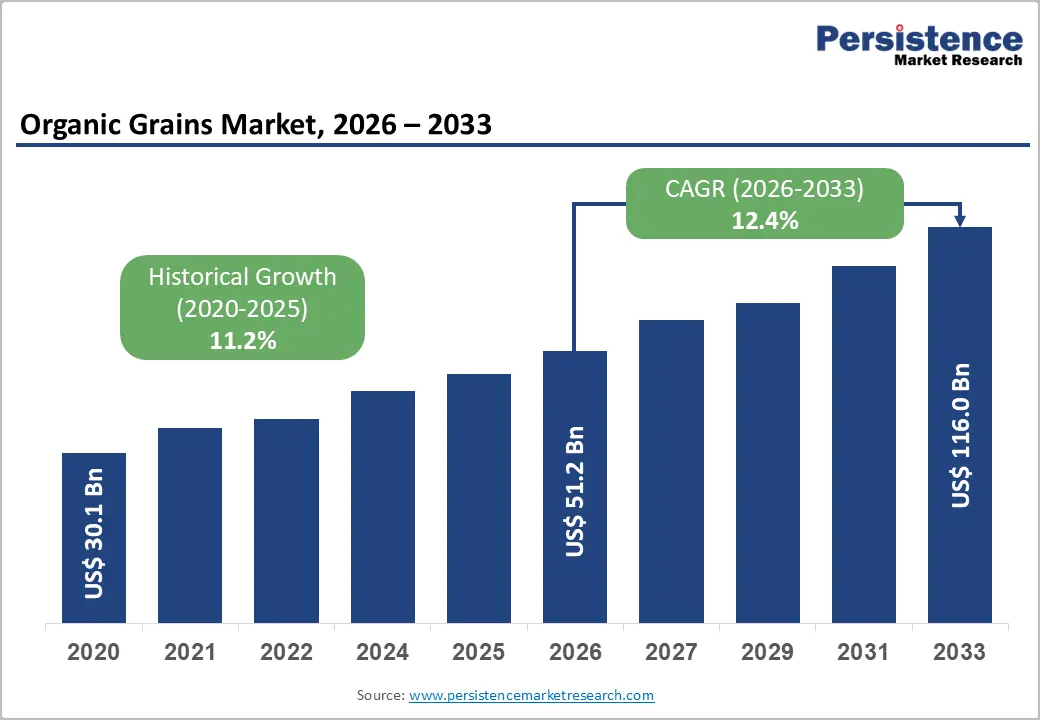
The global organic grains market size is likely to be valued at US$51.2 billion in 2026 and is expected to reach US$116.0 billion by 2033, growing at a CAGR of 12.4% between 2026 and 2033, driven by increasing consumer preference for certified organic foods, expanding organic farmland, and strengthening regulatory oversight across major agricultural economies.
Growing awareness regarding food safety, environmental sustainability, and clean-label nutrition is accelerating demand for organic grain products across food, feed, and retail applications. Rising investments in traceable supply chains and certified farming systems are further enhancing market transparency and supporting long-term industry expansion.
Key Industry Highlights:
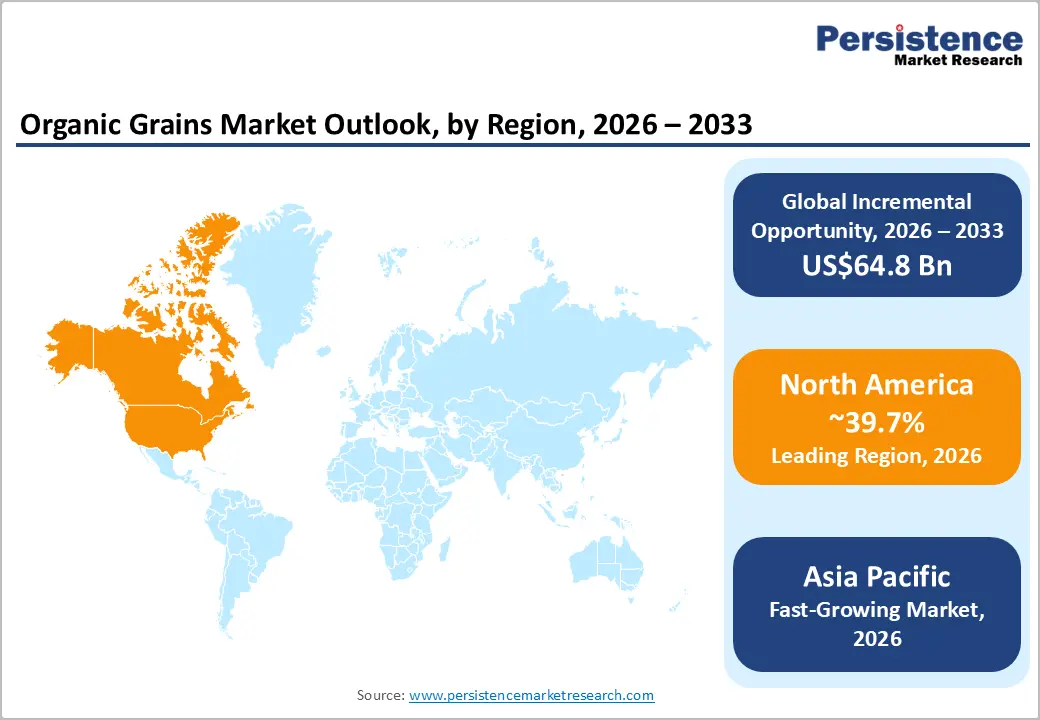
- Leading Region: North America is anticipated to account for approximately 39.7% of the market share in 2026, supported by strong consumer demand, advanced certification systems, and a mature organic food industry.
- Fastest-growing Region: Asia Pacific is projected to register the highest growth rate through 2033, driven by expanding organic farmland, rising health awareness, increasing disposable incomes, and growing exports from countries such as India and China.
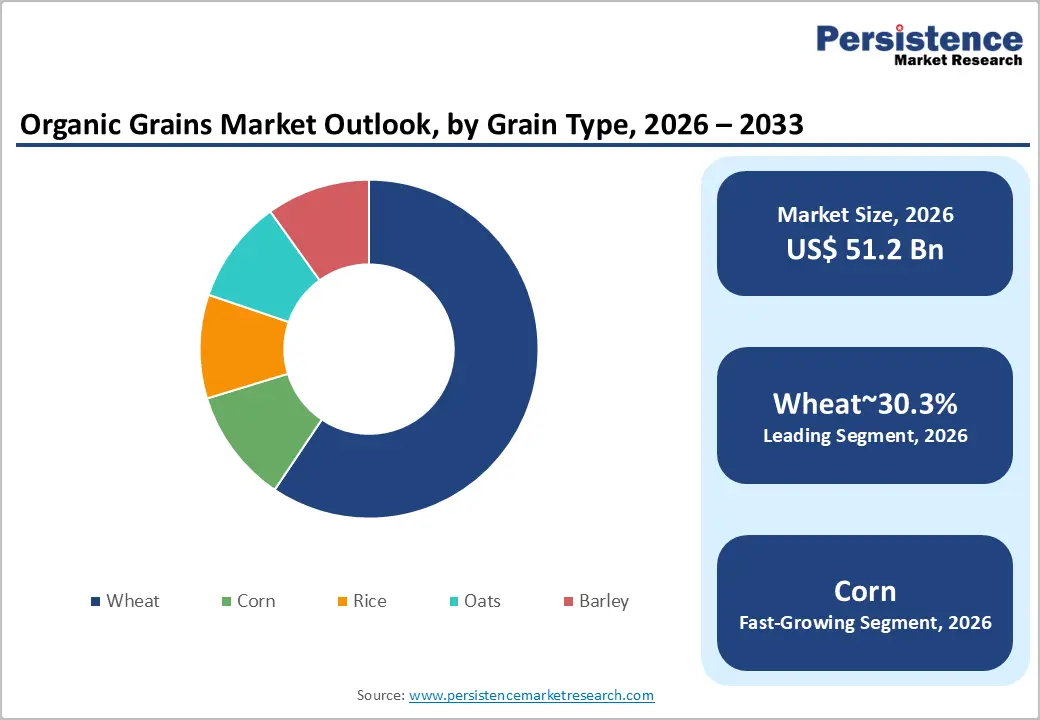
- Dominant Grain Type: Wheat is anticipated to hold approximately 30.3% market share in 2026, driven by its extensive use in organic bread, pasta, bakery products, cereals, and flour manufacturing.
- Leading Application: The food & beverage segment is anticipated to account for approximately 60.5% of market revenue in 2026, supported by strong demand for organic cereals, bakery products, snacks, beverages, and processed food applications.
DRO Analysis
Driver - Strengthening Organic Regulations and Traceability Standards Drive Market Expansion
The implementation of stricter organic certification and traceability requirements across major agricultural markets is significantly improving confidence in organic grain supply chains. Regulatory authorities in North America and Europe have strengthened inspection procedures, import controls, certification protocols, and supply chain verification mechanisms to reduce fraud risks and improve transparency.
These regulatory improvements are particularly important for organic grains because grain supply chains often involve multiple intermediaries, storage facilities, processors, and international trading networks. Enhanced traceability increases buyer confidence and supports premium pricing for certified products. As compliance standards become more robust, food manufacturers, retailers, and institutional buyers are increasingly prioritizing certified organic grain suppliers, creating favorable conditions for market growth and long-term investment.
Supply-Demand Imbalances Continue to Support Premium Organic Grain Markets
Demand for certified organic grains is growing faster than available supply in several key markets. Expanding consumption of organic cereals, bakery products, snacks, and livestock feed has increased pressure on existing production systems. Although global organic farmland and producer participation continue to rise, certified grain production remains uneven across regions.
The supply gap has encouraged long-term purchasing agreements, acreage conversion initiatives, and investments in domestic sourcing programs. Food manufacturers increasingly seek stable organic grain supplies to reduce procurement risks and maintain product consistency. These market conditions support premium pricing structures and encourage additional investment in organic farming infrastructure, grain storage, processing facilities, and supply chain development.
Restraint - High Transition Costs and Certification Challenges Limit Producer Adoption
Despite favorable demand conditions, transitioning from conventional to organic grain production remains a significant challenge for many farmers. Organic farming requires a multi-year conversion process, specialized agronomic practices, increased labor requirements, and strict compliance with certification standards before producers can access premium organic markets.
Farmers often face reduced yields during the transition period while simultaneously incurring higher production costs. Uncertainty regarding market access, certification expenses, and price realization further complicates investment decisions. Limited technical support and inadequate market opportunities for rotation crops can also reduce profitability. These structural barriers continue to slow the pace of certified acreage expansion, particularly in regions where conventional grain farming already operates under narrow profit margins.
Opportunity - Domestic Supply Chain Development Creates Significant Growth Potential
Many countries continue to rely on imported organic grains to satisfy growing consumer and industrial demand. This dependency creates opportunities for domestic producers, processors, and grain handlers to expand local supply capabilities and reduce import exposure.
Investments in certified farming operations, grain storage infrastructure, identity-preserved logistics, and processing facilities can improve supply security while supporting regional food manufacturing industries. Domestic sourcing also enhances traceability, shortens transportation distances, and aligns with sustainability objectives increasingly prioritized by consumers and regulators. As a result, local organic grain ecosystems are expected to attract substantial investment throughout the forecast period.
Expansion of Value-Added Organic Grain Products Supports Market Diversification
Consumer demand is evolving beyond raw organic grains toward premium packaged products, including breakfast cereals, wholegrain snacks, baking mixes, gluten-free formulations, and functional foods. This shift creates opportunities for manufacturers to capture higher margins through product differentiation and brand development.
Emerging markets in Asia Pacific, Latin America, and the Middle East are witnessing increased adoption of packaged organic foods as disposable incomes rise and health awareness improves. Companies that invest in product innovation, premium branding, and convenient consumer formats are expected to benefit from expanding demand across retail and foodservice channels.
Category-wise Analysis
Grain Type Insights
Wheat is anticipated to account for approximately 30.3% of the market share in 2026, making it the leading grain type segment. Its dominance is driven by extensive use in organic bread, pasta, bakery products, cereals, and flour. Major organic food manufacturers and bakeries rely on organic wheat due to its consistent quality, processing efficiency, and broad consumer acceptance. Strong demand across North America and Europe, particularly for wholegrain and clean-label bakery products, continues to support the segment's leadership.
Corn is anticipated to be the fastest-growing segment. Growth is supported by rising applications in organic livestock feed, breakfast cereals, corn flour, sweeteners, and bio-based products. Increasing demand for organic dairy and meat products is boosting the need for certified organic feed corn. Expanding organic corn cultivation in the U.S., India, and parts of Europe is expected to further strengthen market growth.
Application Insights
The food & beverage industry is anticipated to account for approximately 60.5% of the market share in 2026, making it the dominant application segment. Organic grains are widely used in cereals, bakery products, snacks, pasta, beverages, and plant-based foods. Growing consumer preference for clean-label, minimally processed, and organic products has encouraged manufacturers to expand organic product portfolios. The increasing popularity of organic breakfast cereals, wholegrain breads, and functional foods continues to drive segment growth.
Retail is anticipated to be the fastest-growing segment. Growth is being driven by rising consumer purchases of packaged organic grains, flour, oats, and ready-to-cook products through supermarkets, specialty stores, and e-commerce platforms. For example, brands offering organic oats, breakfast cereals, and grain-based snacks have experienced increasing demand as consumers seek convenient and healthier food options. Improved product availability and stronger organic branding are further accelerating retail sales.
Regional Insights
North America Organic Grains Market Trends
North America is anticipated to account for approximately 39.7% of the market share in 2026, making it the largest regional market. Growth is supported by strong consumer demand for organic foods, advanced certification frameworks, and a well-established food processing industry. The region benefits from mature retail networks, high organic product penetration, and increasing investments in traceable supply chains.
U.S. Organic Grains Market Trends
The U.S. dominates the North American market and serves as the primary growth engine for regional demand. Rising consumption of organic cereals, bakery products, plant-based foods, and packaged grain products continues to support market expansion. Strong regulatory oversight and certification standards enhance consumer confidence while encouraging investments in domestic grain sourcing, storage facilities, and processing infrastructure.
Canada Organic Grains Market Trends
Canada represents a significant market for organic grains, driven by increasing consumer preference for sustainable and clean-label food products. Demand for organic oats, wheat, and barley remains strong, particularly within the breakfast cereal and bakery sectors. Growing organic farmland acreage and export opportunities further support market development.
Overall, investments across North America remain concentrated in grain processing facilities, storage infrastructure, and identity-preserved logistics networks, helping strengthen local supply chains and reduce import dependency.
Europe Organic Grains Market Trends
Europe remains one of the world's most important organic grain markets due to its extensive organic farmland, supportive policy environment, and high consumer adoption rates. Strong regulatory harmonization and sustainability initiatives continue to encourage organic farming and food production throughout the region.
Germany Organic Grains Market Trends
Germany is the largest organic food market in Europe and a major consumer of organic wheat, oats, and grain-based products. Demand is particularly strong for organic bakery products, breakfast cereals, and functional foods. The country's advanced retail sector and strong consumer awareness continue to support market growth.
U.K. Organic Grains Market Trends
The U.K. has witnessed increasing demand for organic grains driven by growing health consciousness and interest in sustainable food choices. Organic cereals, flour products, and packaged grain-based foods continue to gain shelf space across supermarkets and specialty retailers.
France Organic Grains Market Trends
France remains one of Europe's leading organic agricultural producers. Strong government support for organic farming and increasing consumer spending on premium food products are driving demand for organic grains across bakery, retail, and foodservice applications.
Spain Organic Grains Market Trends
Spain plays an important role as both a producer and exporter of organic agricultural products. Expanding organic farmland and growing investments in processing infrastructure are supporting increased production of organic grains for domestic and international markets.
Demand growth across Europe is being fueled by rising consumption of organic bakery products, breakfast cereals, plant-based foods, and private-label organic offerings. The region's sophisticated retail infrastructure and strong regulatory framework continue to support long-term market expansion.
Asia Pacific Organic Grains Market Trends
Asia Pacific is anticipated to be the fastest-growing regional market during the forecast period. Expansion is being driven by increasing consumer awareness, rising disposable incomes, growing organic farmland, and strengthening export capabilities. The region is also benefiting from rapid urbanization and greater demand for healthier food products.
China Organic Grains Market Trends
China represents one of the largest growth opportunities within the region. Rising middle-class incomes, increasing food safety concerns, and government support for sustainable agriculture are driving demand for organic grains. Organic rice, wheat, and grain-based packaged foods are experiencing strong adoption among urban consumers.
India Organic Grains Market Trends
India serves as a major production hub for organic grains due to its large organic farming base and growing international recognition of organic certification standards. Organic wheat, rice, millets, and other grains are increasingly being exported to global markets. Government initiatives supporting organic farming and expanding export opportunities continue to strengthen India's market position.
Japan Organic Grains Market Trends
Japan's organic grains market is driven by strong demand for premium-quality food products and growing interest in health-focused diets. Organic rice, breakfast cereals, and specialty grain products are witnessing increased adoption among consumers seeking higher-quality food alternatives.
Competitive Landscape
The global organic grains market is moderately fragmented, characterized by the presence of multinational agribusiness companies, grain processors, milling specialists, and organic food manufacturers. Leading participants maintain competitive advantages through integrated sourcing networks, long-term grower relationships, processing capabilities, and established distribution channels.
Market leaders are prioritizing supply chain transparency, domestic sourcing expansion, product innovation, and processing capacity growth. Companies increasingly focus on vertically integrated operations, premium branding, certification excellence, and sustainable sourcing practices to differentiate themselves in a competitive marketplace.
Key Industry Developments:
- In August 2025, SunOpta announced an investment in a new fruit snack manufacturing line at its Omak, Washington facility, which is expected to come online in 2026 to support rising demand for better-for-you and organic ingredient-based snack products.
Companies Covered in Organic Grains Market
- Archer Daniels Midland (ADM)
- Cargill, Incorporated
- SunOpta Inc.
- Grain Millers, Inc.
- Bay State Milling Company
- Bob's Red Mill Natural Foods, Inc.
- Nature's Path Foods, Inc.
- The Hain Celestial Group, Inc.
- Cascade Milling, Inc.
- ORGANIC INDIA Pvt. Ltd.
- Farmer Direct Organic Foods Inc.
- Healthy Food Ingredients (HFI)
- Pipeline Foods LLC
- Ardent Mills LLC
- Clarkson Grain Company, Inc.
- Briess Malt & Ingredients Co.
- General Mills
Frequently Asked Questions
The global organic grains market is anticipated to be valued at US$51.2 billion in 2026.
The organic grains market is expected to reach US$116.0 billion by 2033.
The organic grains market is projected to grow at a CAGR of 12.4% between 2026 and 2033.
Key trends include increasing demand for clean-label and minimally processed foods, expansion of organic farming acreage, growth in packaged organic grain products, rising adoption of organic livestock feed, stronger supply-chain traceability, and increasing investments in domestic organic grain production and processing infrastructure.
Wheat is the leading grain type segment, accounting for approximately 30.3% of the market share, owing to its extensive use in organic bread, pasta, bakery products, cereals, and flour manufacturing.
Major companies include Archer Daniels Midland (ADM), Cargill, General Mills, SunOpta, and Grain Millers.


