




- Telecommunications
- Mobile Payment Transaction Market
Mobile Payment Transaction Market Size, Trends, Share, and Growth Forecast 2025 - 2032
Mobile Payment Transaction Market by Technology (Near Field Communication, Direct Mobile Billing, Mobile Web Payment, USSD, QR Codes, Other), Application (Merchandise, Money Transfer, Bill Payment, Ticketing, Other), and Regional Analysis for 2025 - 2032

Mobile Payment Transaction Market Size and Trend Analysis
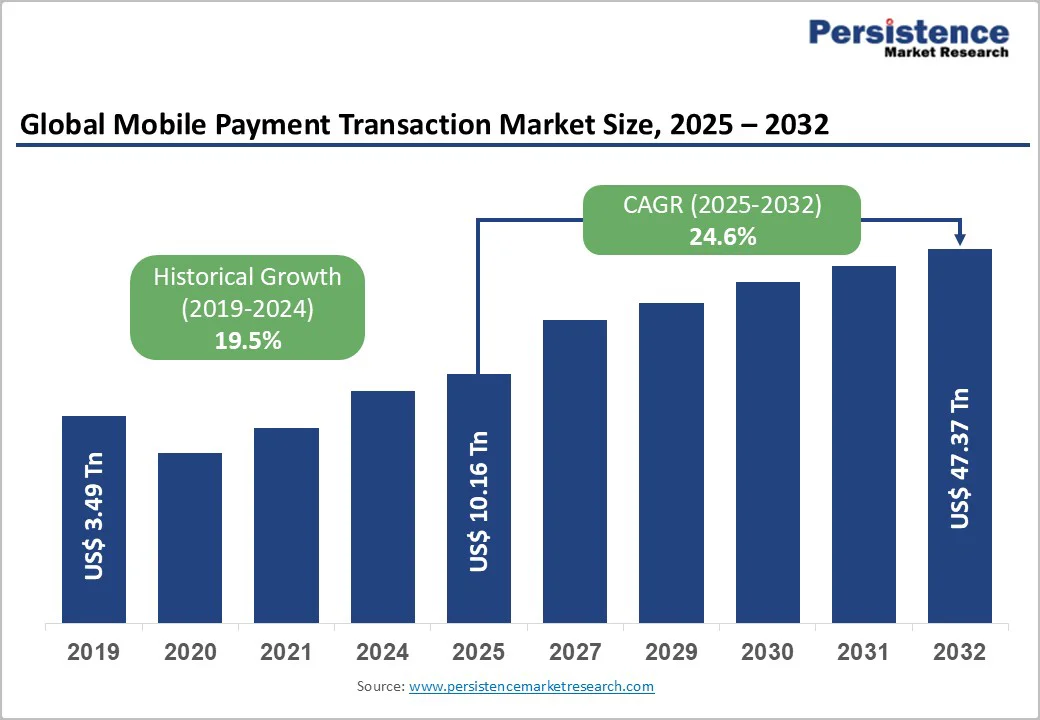
The global mobile payment transaction market size is valued at US$10.16 trillion in 2025 and is projected to reach US$47.37 trillion, growing at a CAGR of 24.6% between 2025 and 2032.
The primary drivers of this robust expansion include surging smartphone penetration and the rapid proliferation of e-commerce platforms, which facilitate seamless digital transactions worldwide.
The exponential expansion is driven by widespread smartphone penetration exceeding 7 billion devices globally, accelerated digital wallet adoption accounting for 50% of global e-commerce transactions in 2025, and government-backed instant payment infrastructures such as India's Unified Payments Interface (UPI), processing 16.58 billion transactions monthly, and Brazil's PIX handling 6 billion monthly transactions.
Key Market Highlights
- Regional Leader: Asia Pacific leads the Mobile Payment Transaction Market with over 50% global share, driven by super apps and government digital initiatives in China and India.
- Fastest Growing Region: North America emerges as the fastest-growing region, fueled by QR adoption and manufacturing hubs enabling affordable devices.
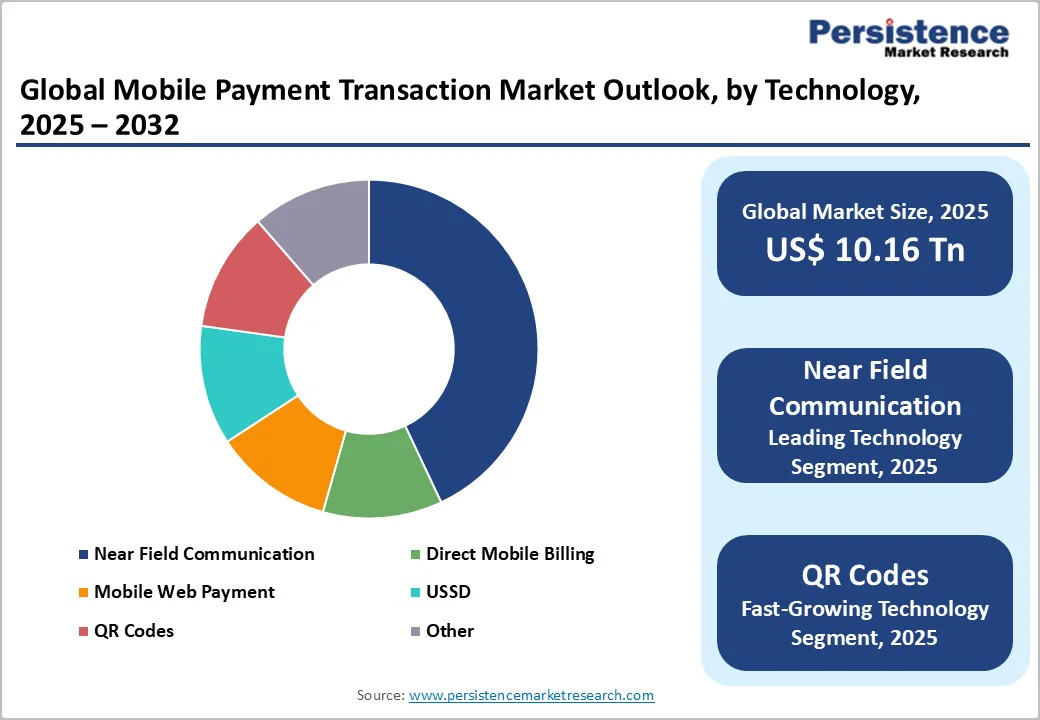
- Leading Segment: Near Field Communication (NFC) dominates the technology segment with a 43% share, thanks to its contactless convenience in retail and transit.
- Fastest Growing Segment: QR Codes represent the fastest-growing technology segment at 30% growth, popular in emerging markets for low-cost implementations.
- Growth Opportunities: Integration of AI and blockchain offers key opportunities, enhancing security and unlocking US$5 trillion in emerging market transactions.
| Key Insights | Details |
|---|---|
| Mobile Payment Transaction Market Size (2025E) | US$10.16 Tn |
| Market Value Forecast (2032F) | US$47.37 Tn |
| Projected Growth CAGR (2025 - 2032) | 24.6% |
| Historical Market Growth (2019 - 2024) | 19.5% |
Market Dynamics
Drivers - Surging Smartphone Penetration and Internet Connectivity
The escalating adoption of smartphones and high-speed internet connectivity stands as a cornerstone driver for the Mobile Payment Transaction Market, fundamentally transforming consumer behavior towards digital transactions. According to Worldpay's Global Payments Report 2025, digital wallets have surpassed traditional payment methods, with consumers now preferring seamless, contactless transactions across retail, hospitality, and transportation sectors.
With global smartphone penetration reaching 85% by 2025, users increasingly favor quick, app-based payments over physical cash, evidenced by a 37% year-over-year increase in transaction volumes in regions like the Asia Pacific. This shift is amplified by enhanced 5G networks, which reduce latency and enable real-time processing, supporting over 1.5 trillion non-cash transactions projected by 2028.
Proliferation of E-Commerce and Contactless Payment Preferences
The explosive growth of e-commerce, coupled with strong consumer preference for contactless solutions, is significantly driving the Mobile Payment Transaction Market by expanding transaction opportunities across retail and services. E-commerce sales are forecasted to surpass US$8 trillion globally in 2025, with mobile payments accounting for 60% of these, driven by platforms like Amazon and Alipay that offer one-tap purchases.
The National Payments Corporation of India (NPCI) reported that UPI transactions in October 2024 reached US$280 Bn across 16.58 billion transactions, representing 45% year-on-year growth and processing over 75% of India's retail digital payments.
QR code payment methods have demonstrated particular traction in Asian markets, with over 83% of mobile payments in China using QR code infrastructure, according to 2024 Alipay reports, and 75% of India's UPI transactions involving QR code scanning, according to NPCI data from June 2024.
This synergy not only accelerates transaction speeds but also integrates with loyalty programs, incentivizing repeat usage and solidifying mobile payments as the preferred method in the evolving Financial Cards and Payments Market.
Restraints - Cybersecurity Threats and Data Privacy Concerns
Persistent cybersecurity vulnerabilities and data privacy issues pose substantial restraints to the Mobile Payment Transaction Market, eroding consumer trust and slowing adoption rates. High-profile breaches affected over 300 million users in 2024, leading 42% of non-adopters to cite security fears as a primary barrier, particularly in cross-border transactions.
The European Payments Council's 2024 Payment Threats and Fraud Trends Report documented increasingly sophisticated fraud techniques, including reverse engineering of mobile applications, overlay attacks that mimic legitimate interfaces, and exploitation of mobile device vulnerabilities.
Starting in October 2024, the United Kingdom implemented transformative regulations mandating enhanced protections against APP scams and strengthened reimbursement policies for fraud victims, reflecting regulatory responses to escalating threat landscapes.
High Transaction Fees and Infrastructure Limitations
Elevated transaction fees and inadequate infrastructure represent key barriers in the Mobile Payment Transaction Market, particularly affecting small merchants and rural areas. Fees averaging 1.4% per transaction in 2025 burden cost-sensitive users, with 27% of seniors reporting discomfort due to perceived complexity and charges.
In regions with poor connectivity, 22% of merchants lack acceptance capabilities, forcing them to rely on cash and stalling digital shifts. These limitations, combined with interoperability issues across platforms, result in 28% transaction abandonments, undermining efficiency gains. Overall, they constrain scalability, especially in underserved segments.
Market Opportunities
Expansion in Emerging Markets via Financial Inclusion Initiatives
The burgeoning opportunities in emerging markets through targeted financial inclusion programs offer substantial growth potential for participants in the Mobile Payment Transaction Market, particularly in unbanked regions. With over 1.7 billion adults globally lacking bank accounts, initiatives like India's UPI and Brazil's PIX have processed 6 billion monthly transactions by 2025, enabling low-cost remittances and bill payments.
Government-backed policies, including subsidies for digital wallets, are projected to boost adoption by 50% in ASEAN countries, where smartphone ownership has hit 80%. Companies can capitalize by partnering with local telcos for USSD-based solutions, reaching feature phone users and generating US$5 trillion in new transaction value by 2032.
This aligns with the Online Payment Fraud Detection Market's evolution, where AI enhancements reduce risks, fostering trust and expanding revenue streams in high-growth areas like peer-to-peer transfers.
Integration of AI and Blockchain for Enhanced Security and Efficiency
Leveraging AI and blockchain technologies presents transformative opportunities for Mobile Payment Transaction Market players to innovate in security and operational efficiency, targeting the fastest-growing segments, such as real-time payments. AI-driven fraud detection is expected to prevent 90% of threats, with systems analyzing billions of transactions daily, as seen in Visa's pilots reducing false positives by 40%.
Blockchain enables decentralized ledgers for cross-border transfers, cutting costs by 70% compared to traditional wires, appealing to B2B users in the Retail Vending Machine Market for automated restocking payments.
Developments in quantum-encrypted wallets and biometric integrations could capture 35% of the APAC market share by 2030, driven by regulatory initiatives to promote open banking. These advancements not only address privacy concerns but also unlock new end-user applications, positioning early adopters for significant demand surges in contactless ecosystems.
Category-wise Analysis
Technology Insights
In the mobile payment transaction market, Near Field Communication (NFC) emerges as the leading technology segment, commanding approximately 43% market share in 2025. This dominance stems from its seamless contactless capabilities, allowing users to tap devices for instant transactions, which has driven adoption in retail and transit with over 90% NFC-enabled POS terminals in developed regions.
Security features like tokenization minimize fraud, supporting 70% of in-store payments in North America and aligning with global shifts toward hygiene-focused methods post-2024. NFC's compatibility with major wallets such as Apple Pay and Google Pay further solidifies its position, evidenced by a 25% annual growth in transaction volumes. This technology's versatility across devices ensures it outpaces alternatives like QR codes in high-frequency use cases.
Application Insights
Within the Mobile Payment Transaction Market applications, Merchandise leads with around 55% market share, fueled by the surge in omnichannel shopping experiences. This segment's prominence is justified by e-commerce's expansion, where mobile checkouts via wallets like PayPal and Venmo reduced processing times by 50%, boosting conversion rates in stores and online.
The significant shift toward Merchandise transactions is driven by merchant adoption of contactless payment infrastructure and consumer preference for quick, hygienic transaction methods. Retail Vending Machine Market operators have increasingly integrated NFC and QR code capabilities to enable mobile payments, expanding payment accessibility in previously cash-dependent environments.
Regional Insights
North America Mobile Payment Transaction Trends
North America is rapidly growing the Mobile Payment Transaction Market, due to the U.S.'s dominant fintech ecosystem and robust regulatory framework under the Federal Reserve, fostering innovation in secure digital payments.
The region saw 70% adoption of contactless methods in 2025, propelled by Apple Pay and Google Wallet integrations in retail, with transaction values exceeding US$2 trillion amid e-commerce growth. Regulatory support via PCI DSS compliance ensures data protection, while the innovation hub in Silicon Valley accelerates biometric advancements, reducing fraud by 40%.
Key trends include the rise of peer-to-peer platforms like Venmo, which processed 42% of P2P transfers, and partnerships between banks and tech firms for real-time settlements. Government initiatives promoting financial inclusion, such as FDIC programs, further embed mobile payments in underserved communities, aligning with broader Financial Cards and Payments Market dynamics.
Europe Mobile Payment Transaction Trends
Europe's Mobile Payment Transaction Market exhibits strong performance, led by Germany, the U.K., France, and Spain, where digital wallets captured 20% of weekly usage in 2025, driven by NFC and open banking regulations such as PSD3.
Harmonized EU directives ensure interoperability, boosting cross-border transactions by 28%, with the U.K.'s contactless cap at £100, facilitating everyday retail use. Germany's fintech scene, including N26 and Revolut, emphasizes sustainability in payments, reducing plastic waste through app-based solutions.
Performance varies: France leads QR adoption in hospitality at 68% penetration, while Spain's Bizum handles 32% of P2P volume. Regulatory harmonization via the EuroPA framework mitigates fragmentation, supporting AI fraud tools that cut losses by 35%, and integrates with the Online Payment Fraud Detection Market for enhanced security.
Asia Pacific Mobile Payment Transaction Trends
Asia Pacific drives explosive growth in the Mobile Payment Transaction Market, with around 50% of the market share, driven by China, India, Japan, and ASEAN nations leveraging manufacturing advantages and QR/super app ecosystems to achieve 82% adoption rates.
China's Alipay and WeChat Pay dominate, processing 1 trillion transactions annually via real-time rails like PromptPay linkages, fueled by 35% YoY growth. India's UPI hit 130 billion transactions in 2025, promoting inclusion in rural manufacturing hubs.
Growth dynamics highlight ASEAN's shift to A2A payments, with Visa's palm recognition pilots in Singapore enhancing unattended retail. Japan's card loyalty systems blend with mobile, while manufacturing edges enable low-cost device production, supporting 66% wallet share by 2027 and tying into the Retail Vending Machine Market automation.
Competitive Landscape
The global mobile payment transaction market displays a moderately consolidated structure, with top players controlling about 45% share through strategic acquisitions and tech integrations yet remaining fragmented by regional incumbents. Companies pursue expansion via partnerships, such as Visa's QR connector alliances, and R&D in AI for fraud prevention, differentiating via biometric security and low-fee models.
Emerging trends include embedded finance in super apps and blockchain for cross-border efficiency, enabling leaders to capture growth in P2P segments while smaller fintechs innovate in niche markets like unattended payments. This balance fosters competition, driving service enhancements without full oligopoly.
Key Market Developments:
- January 2025: Visa pilots palm recognition payments in Singapore with Tencent, enabling biometric transactions at cafes for enhanced contactless security.
- May 2025: Worldline expands SoftPOS solutions across Europe, allowing smartphones to serve as payment terminals for small merchants.
- September 2025: PayPal integrates AI-driven fraud detection in Venmo, reducing false declines by 40% and supporting real-time P2P transfers.
Top Companies in the Mobile Payment Transaction Market
- Visa Inc. (Foster City, California, USA): As a global payments giant, Visa leads with its vast network processing over 200 billion transactions yearly, emphasizing NFC and tokenization innovations for secure mobile integrations. Its strategic partnerships, like QR expansions in Asia, enhance cross-border capabilities, solidifying market influence through revenue exceeding US$30 billion in 2024.
- PayPal Holdings, Inc. (San Jose, California, USA): PayPal dominates digital wallets with Venmo and Braintree, facilitating P2P and e-commerce payments across 200 countries, boasting 400 million active users. Its focus on AI analytics and buy-now-pay-later features drives growth, with transaction volumes up 20% in 2025, leveraging portfolio strength for merchant adoption.
- Alipay (Ant Group) (Hangzhou, China): Alipay commands Asia's market with a super app ecosystem, handling trillions in transactions via QR and facial recognition, serving 1 billion users. Backed by Tencent synergies, its maturity in real-time payments and financial inclusion initiatives positions it as a leader, with influence spanning remittances and retail.
Companies Covered in Mobile Payment Transaction Market
- Paypal
- MasterCard
- Google Wallet
- Apple, Inc.
- Braintree
- Visa
- Samsung
- WorldPay
- Tencent Holdings Ltd.
- SinglePoint
- Venmo
- Alipay
- Amazon
- Stripe
- Square
Frequently Asked Questions
The market is valued at US$10.16 Tn in 2025 and expected to reach US$47.37 Tn by 2032, reflecting strong digital adoption.
Key drivers include rising smartphone penetration exceeding 6.8 billion users and e-commerce growth surpassing US$8 8 Tn, promoting contactless transactions.
Near Field Communication (NFC) leads with 43% share, due to its secure, tap-based convenience in retail settings.
Asia Pacific leads with over 50% share, powered by QR codes and super apps in China and India.
AI and blockchain integration offer opportunities to enhance security, potentially unlocking US$5 Tn in emerging market volumes.
Leading players include Visa, PayPal, and Alipay, dominating through networks and wallet innovations.


