




- Food Ingredients & Additives
- Egg and Egg Products Market
Egg and Egg Products Market Size, Share, and Growth Forecast 2026 - 2033
Egg and Egg Products Market by Product Type (Fresh Shell Eggs, Liquid Egg Products, Dried / Powdered Eggs, Frozen Egg Products), by Form (Liquid, Powder, Frozen), Application (Bakery & Confectionery, Food Processing, Household Consumption, Foodservice, Others), Distribution Channel (Supermarkets & Hypermarkets, Convenience Stores, Online Retail, Others), and Regional Analysis, 2026 - 2033

Egg and Egg Products Market Share and Trends Analysis
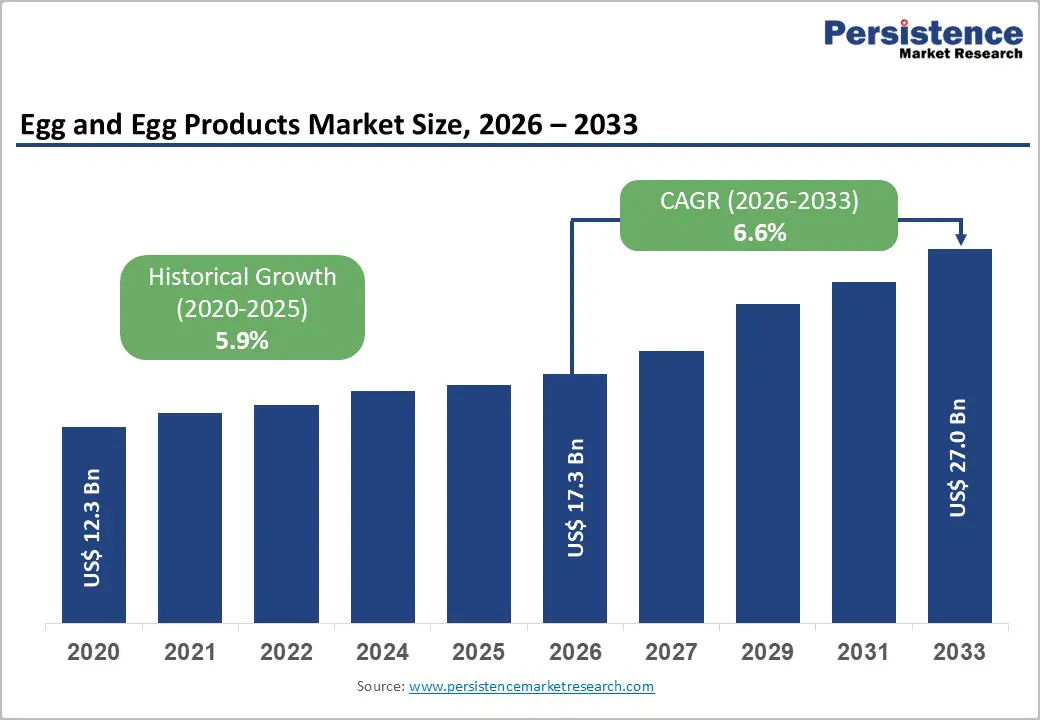
The global egg and egg products market size is expected to be valued at US$ 17.3 billion in 2026 and projected to reach US$ 27.0 billion by 2033, growing at a CAGR of 6.6% between 2026 and 2033.
Robust growth is underpinned by rising consumption of affordable animal protein, the expansion of the processed food and bakery industries, and the rapid shift from shell eggs to value-added egg products across foodservice and industrial applications. Structural factors such as urbanization, busier lifestyles, and demand for convenient, ready-to-use ingredients are accelerating the transition toward liquid, powdered, and frozen egg formats that offer safety, consistency, and longer shelf life.
Key Industry Highlights:
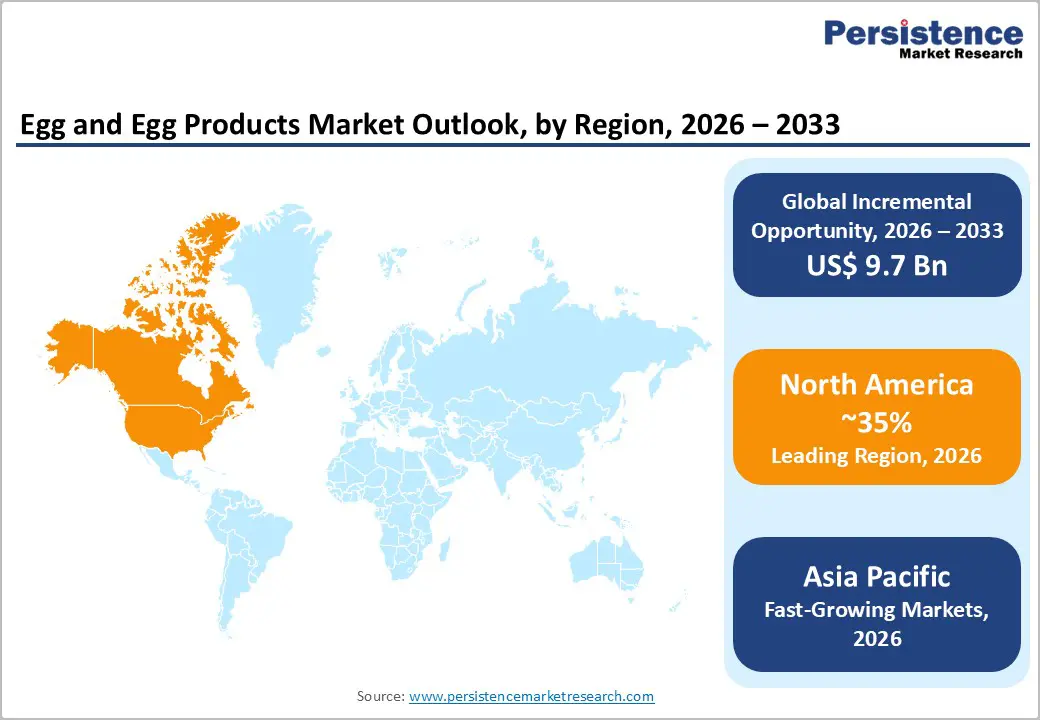
- North America remains the leading regional market, with the U.S. and Canada benefiting from high per capita egg consumption, advanced processing infrastructure, and strong foodservice and retail networks that support diversified egg and egg product portfolios across fresh, liquid, frozen, and powdered formats.
- Asia Pacific is the fastest-growing region in the egg and egg products market, driven by rapid expansion in egg production, rising protein intake in China, India, Japan, and ASEAN, and accelerating adoption of processed egg ingredients in bakery, instant foods, and convenience-oriented foodservice channels.
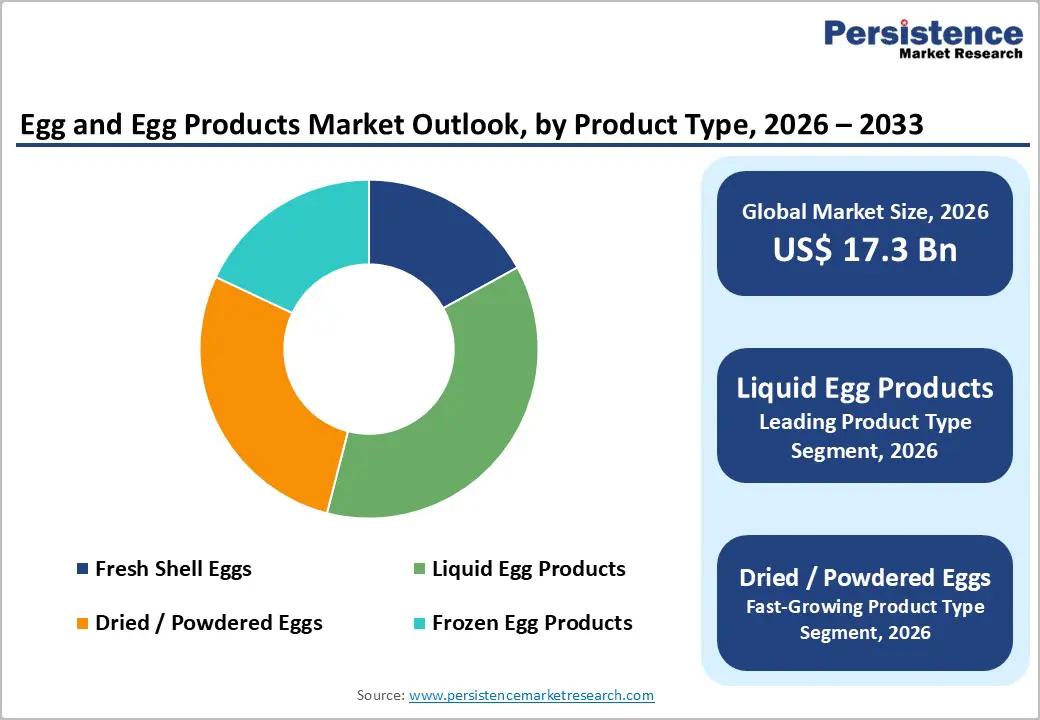
- Among product types, liquid egg products hold a leading share, supported by their extensive use in industrial baking and large-scale foodservice operations, where pasteurized, ready-to-use eggs enhance food safety, labor efficiency, and consistency compared with shell eggs.
- Dried and powdered eggs are the fastest-growing product segment, benefiting from long shelf life, ambient storage, and suitability for global trade. Approximately 70% of powder volume is directed to bakery and confectionery applications that demand reliable foaming and emulsification performance.
| Key Insights | Details |
|---|---|
| Egg and Egg Products Market Size (2026E) | US$ 17.3 billion |
| Market Value Forecast (2033F) | US$ 27.0 billion |
| Projected Growth CAGR (2026 - 2033) | 6.6% |
| Historical Market Growth (2020 - 2025) | 5.9% |
Market Dynamics
Drivers - Rising global egg production and per capita consumption
Rising global egg production and increasing per capita consumption are major drivers of the Egg and Egg Products market, as eggs remain one of the most affordable and versatile sources of high-quality protein worldwide. Expanding poultry farming capacity, improved feed efficiency, and better disease management have enabled producers to scale output and meet growing dietary demand across both developed and emerging economies. At the same time, urbanization, population growth, and changing eating habits-such as higher intake of protein-rich breakfasts, ready-to-eat meals, and bakery products—are steadily lifting egg consumption per person. Health awareness around eggs’ nutritional value, including their amino acid profile, vitamins, and minerals, is further supporting demand. Together, higher production volumes and broader everyday usage are strengthening supply chains, encouraging investment in processing facilities, and accelerating adoption of liquid, dried, and frozen egg formats across foodservice and industrial applications.
Expansion of foodservice, bakery, and processed food industries
The rapid expansion of foodservice, bakery, and processed food industries is a major driver for the Egg and Egg Products Market, as eggs remain a core ingredient across multiple prepared food categories. Quick-service restaurants, cafés, hotels, and catering chains increasingly rely on liquid, frozen, and powdered egg products for menu consistency, food safety, and operational efficiency. In bakeries and confectionery manufacturing, eggs are essential for texture, emulsification, aeration, and flavor, supporting steady bulk demand from industrial producers. Growth in ready-to-eat meals, packaged snacks, sauces, and breakfast items has further accelerated the use of processed egg formats that offer longer shelf life and easier storage than shell eggs. Urbanization, rising disposable incomes, and busier lifestyles are increasing global consumption of convenience foods, prompting manufacturers to scale production and diversify egg-based ingredients for commercial kitchens and large-scale food processors.
Restraint - Volatility in feed costs, disease outbreaks, and price instability
The egg and egg products market is exposed to volatility in feed costs, disease outbreaks, and resulting price instability, which can disrupt supply and margins. Feed typically accounts for more than half of egg production costs, so spikes in corn and soybean prices can quickly compress profitability for layer farms and processors. Outbreaks of highly pathogenic avian influenza (HPAI) in North America and Europe have periodically reduced flock sizes, constrained supply, and triggered sharp increases in retail prices. For example, industry analysis of Cal-Maine Foods, Inc., the largest egg producer in the U.S., shows that egg prices surged by more than 50% during recent HPAI episodes, significantly lifting revenues but also highlighting the sector’s vulnerability to biosecurity shocks. Such volatility complicates long-term planning and investment decisions for both producers and downstream users of egg products.
Opportunity - Growth in Value-Added Liquid and Powdered Egg Products
Growth in value-added liquid and powdered egg products represents a major opportunity in the Egg and Egg Products Market, as food manufacturers and foodservice operators increasingly seek ingredients that deliver convenience, safety, and functional performance. These products are gaining traction because they reduce labor costs, minimize shell waste, and provide consistent quality for large-scale baking, sauces, and ready-to-eat meals. Fortified and specialty variants, such as high-protein egg whites, omega-enriched formulations, allergen-controlled blends, and customized functional mixes, command premium prices in health-focused and sports-nutrition segments. Powdered eggs with extended shelf life and improved solubility are also opening export opportunities in regions with limited cold-chain infrastructure. Rising demand from industrial food processors, airline catering, institutional kitchens, and packaged food brands is encouraging suppliers to invest in advanced pasteurization, spray-drying, and formulation technologies, enabling differentiation and stronger margins in a competitive global market.
Category-wise Analysis
Product Type Insights
Within product types, liquid egg products are the leading segment, accounting for an estimated 37% share of the global egg and egg products market in 2025. Their dominance stems from the operational efficiency they offer to bakeries, quick-service restaurants, and institutional caterers, where speed, consistency, and food safety are critical. Pasteurized liquid whole egg, yolk, and white products eliminate shell handling, reduce microbial risks, and support automation on high-speed production lines. The growth of liquid egg mixtures and customized blends tailored for specific applications, such as mayonnaise, sauces, desserts, and ready-to-eat breakfast items, further entrenches liquid egg products as the preferred format in industrial applications.
Form Insights
By form, liquid egg products hold the largest share of the market, estimated at roughly 45-50% of value in 2025. This reflects the combined demand for pasteurized liquid whole eggs, yolks, and whites across industrial baking, sauces, dressings, ready meals, and foodservice breakfast items. Liquid forms are particularly attractive where hygiene, labor savings, and dosing precision matter; they can be pumped, metered, and blended directly into automated systems. The scaling up of quick-service restaurant chains and institutional catering, especially in North America, Europe, and urban centers in Asia Pacific, is reinforcing liquid’s leadership. The strong growth trajectory highlighted for the liquid eggs segment underscores how this form has become central to modern food manufacturing and high-volume kitchen operations.
Powder form is the fastest-growing, supported by global trade and storage advantages
Powder form is projected to be the fastest-growing form segment, leveraging its logistical advantages and suitability for international trade. Egg powders can be stored at ambient temperatures, have shelf lives extending up to 12-18 months depending on specification, and dramatically reduce transport weight and volume compared with shell or liquid products. Specialist producers such as IGRECA in France and Eurovo Group in Europe have invested in advanced dehydration technologies and dedicated egg powder plants to serve demanding bakery, confectionery, and food ingredient customers. In regions where cold-chain infrastructure is limited or expensive, powdered eggs offer a practical way to incorporate high-quality animal protein into packaged foods, driving above-average growth rates relative to other forms.
Application Insights
Bakery and confectionery constitute the leading application segment in the egg and egg products market, accounting for an estimated 40-45% share of global demand in 2025. Eggs deliver irreplaceable functionality in cakes, biscuits, pastries, custards, and dessert fillings, providing structure, aeration, color, flavor, and moistness. Industry data indicate that roughly 70% of global dried egg output is directed to bakery and confectionery applications, underlining the centrality of this end use for powdered eggs. Major European processors such as Interovo Egg Group, Eurovo Group, and IGRECA supply a wide spectrum of liquid and powdered egg ingredients to industrial bakeries and patisserie manufacturers across Europe and beyond. As consumption of packaged baked goods rises in emerging markets and premium artisanal bakery offerings expand in mature economies, this application segment is set to retain its dominance.
Regional Insights
North America Egg and Egg Products Market Trends and Insights
North America continues to lead in 2026 driven by strong consumer demand for high-protein foods and a highly developed food processing and foodservice ecosystem. High egg consumption levels, particularly in the United States, support steady retail sales as well as large-volume industrial use in bakeries, ready-to-eat meals, and restaurant chains. The region benefits from advanced processing capabilities for liquid, frozen, and powdered egg products, which ensure food safety, consistency, and longer shelf life for commercial customers. Growing consumer interest in cage-free and organic eggs is shaping production strategies, while sustainability and animal-welfare commitments are influencing sourcing practices. Expansion of quick-service restaurants, packaged food lines, and institutional catering continues to reinforce North America’s dominant position in the global market.
Asia Pacific Egg and Egg Products Market Trends and Insights
Asia Pacific is emerging as a high-growth region in the Egg and Egg Products Market, supported by rising population, urbanization, and increasing protein consumption across major economies such as China, India, and Southeast Asia. Expanding middle-class incomes and changing dietary habits are driving higher demand for eggs in both household and foodservice channels. Rapid growth of bakery chains, quick-service restaurants, and packaged food manufacturing is accelerating adoption of liquid and powdered egg products that offer convenience and consistent quality. Improvements in cold-chain logistics, food safety standards, and local processing capacity are further strengthening regional supply. At the same time, export-oriented production hubs are gaining importance as global demand for shelf-stable egg ingredients rises. Government initiatives to modernize poultry farming and processing infrastructure are also contributing to Asia Pacific’s increasing role in the global market.
Competitive Landscape
The competition landscape in the egg and egg products market is characterized by a mix of large integrated producers and specialized processors striving for scale, efficiency, and product differentiation. Competitive dynamics are driven by investments in advanced processing technologies, quality assurance, and supply chain optimization to meet stringent food safety standards. Market players focus on expanding product portfolios with value-added and fortified egg products to capture diverse applications in foodservice and industrial segments. Price competitiveness, branding, and distribution reach are key factors, while sustainability practices and traceability are gaining importance as consumers increasingly favor ethically produced egg offerings.
Key Developments:
- In January 2026, the American Egg Board (AEB) announced the launch of its first-ever Founders Cohort, a six-month, virtual, business-school-style program created to support food and beverage entrepreneurs developing innovative, emerging brands using eggs. In partnership with innovation industry leader JPG Resources, the cohort reflected AEB’s continued commitment to fostering innovation and entrepreneurship across the food industry.
Companies Covered in Egg and Egg Products Market
- Cal-Maine Foods, Inc.
- Michael Foods, Inc.
- Rose Acre Farms
- Rembrandt Enterprises
- Hillandale Farms
- Eggland’s Best, Inc.
- Daybreak Foods
- Interovo Egg Group B.V.
- Eurovo Group S.r.l.
- SKM Egg Products Export (India) Ltd.
- OVOBEL
- IGRECA S.A.
- Charoen Pokphand Group
- Post Holdings, Inc.
- Nipponham Group
- Proteina Animal SA (PROAN)
Frequently Asked Questions
The global egg and egg products market size is expected to reach approximately US$ 17.3 billion in 2026, supported by rising egg production, growing per capita consumption, and increased use of processed egg ingredients in bakery, confectionery, and foodservice applications across developed and emerging economies.
Key demand drivers include the steady expansion of global egg production, strong consumer preference for affordable, high-quality animal protein, and rapid growth in bakery, confectionery, and foodservice sectors. The shift toward convenience and ready-to-use ingredients is boosting demand for pasteurized liquid, frozen, and powdered egg products that improve safety, efficiency, and consistency in industrial and commercial kitchens.
North America, led by the United States, currently leads the global egg and egg products market in value terms, supported by high per capita egg consumption, advanced processing infrastructure, widespread adoption of cage-free and specialty eggs, and a sophisticated foodservice and retail ecosystem that uses large volumes of liquid, frozen, and precooked egg products.
One of the most attractive opportunities lies in premium, value-added egg products that combine sustainability credentials and functional innovation, such as cage-free and organic eggs, carbon-reduced offerings, egg-based ready meals, and specialized liquid and powdered formulations for bakery, sports nutrition, and convenience foods, allowing producers to secure higher margins and long-term partnerships with global food brands.
Key players include Cal-Maine Foods, Inc., Michael Foods, Inc., Rose Acre Farms, Rembrandt Enterprises, etc.


