




- Processed Food
- Cage Free Eggs Market
Cage Free Eggs Market Size, Trends, Share, Growth, and Regional Forecast, 2025 to 2032
Cage Free Eggs Market by Product Type (White Eggs, Brown Eggs), Size (Small, Medium, Large, Extra Large/Jumbo), Distribution Channel (B2B, B2C), and Regional Analysis from 2025 - 2032

Cage Free Eggs Market Share and Trends Analysis
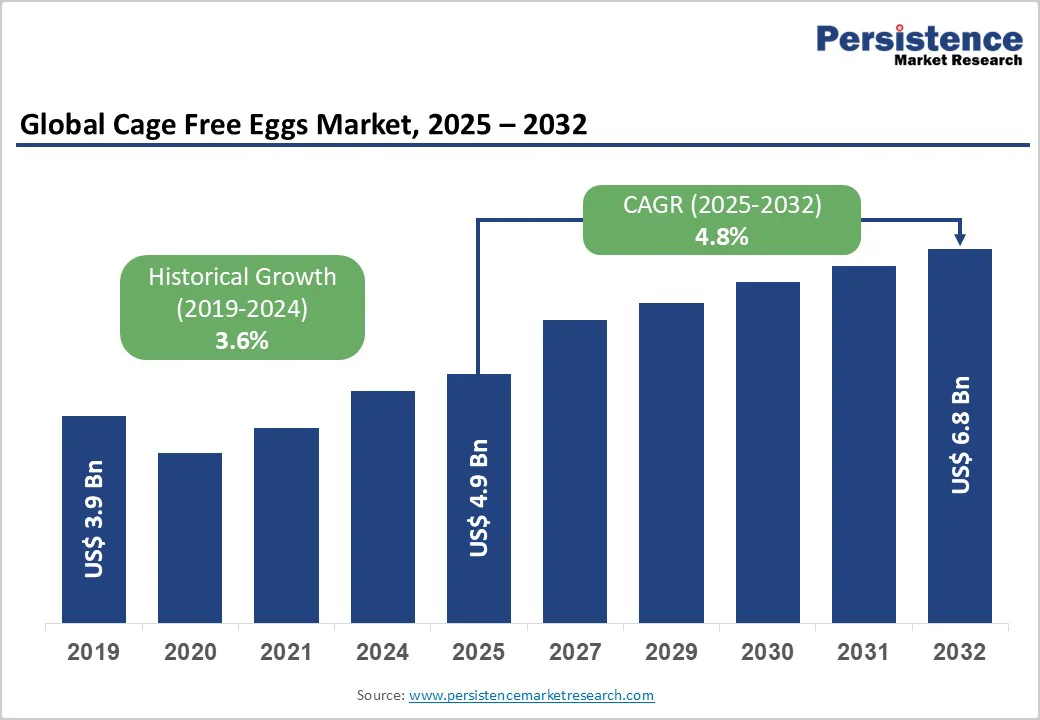
The global cage-free eggs market is valued at US$4.9 billion in 2025 and is projected to reach US$6.8 billion by 2032, growing at a CAGR of 4.8% from 2025 to 2032. A global shift toward humane production is rapidly redefining how eggs move through retail, foodservice, and manufacturing supply chains. Rise in health & welfare, advancing barn technologies, and stringent corporate commitments are collectively pushing the cage-free category into a more mature, future-focused growth phase.
Key Industry Highlights
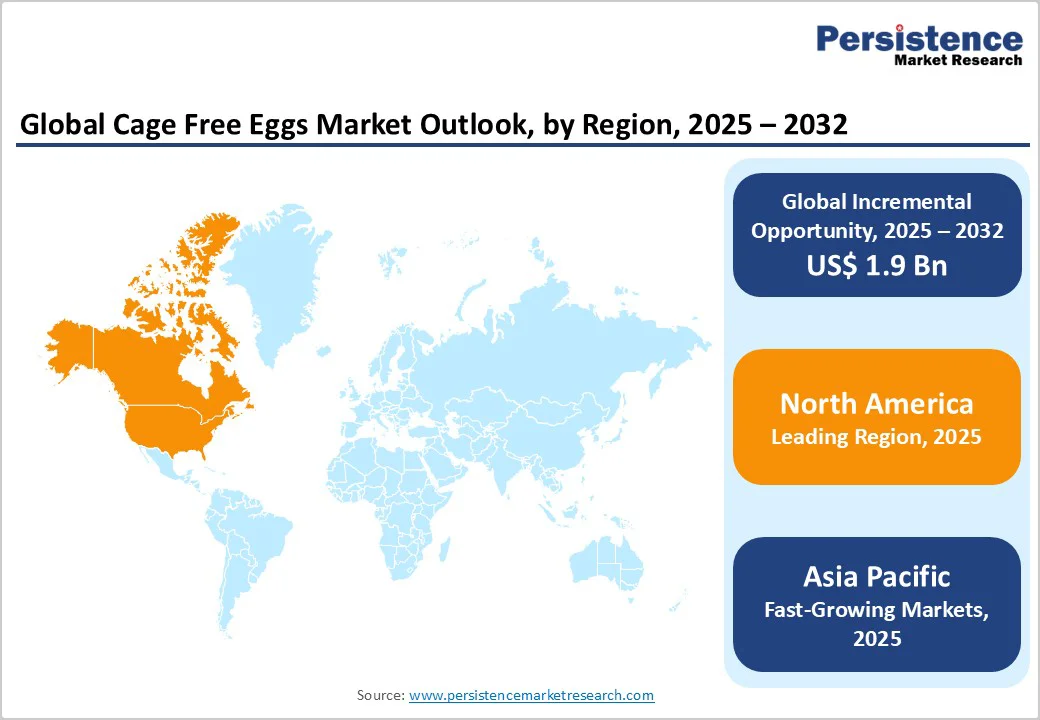
- Leading Region: North America emerges as the strongest regional force, driven by expanding welfare-certified retail assortments, rising traceability expectations, and accelerated commitments from major U.S. and Canadian foodservice chains.
- Fastest-Growing Region: Asia Pacific advances rapidly as modern retail formats, QSR expansions, and welfare-aligned branding in India, China, Japan, South Korea, and Indonesia stimulate widespread transitions toward cage-free sourcing.
- Dominant Product Type: White eggs retain a commanding lead due to efficient commercial-scale production, consistent grading, and strong acceptance among retailers, bakeries, and QSR operators seeking predictable volume and ease of handling.
- Growth Indicators: Quick-service restaurant policies centered on humane sourcing are generating high-volume procurement cycles that incentivize producers to scale aviary systems, strengthen supply consistency, and upgrade welfare-audited logistics.
- Opportunities: Agri-tech partnerships are unlocking major gains through AI-guided feeding, precision mortality tracking, and environmental automation, helping farms improve flock performance, reduce input waste, and support profitable cage-free expansion.
- Key Developments: In November 2025, PepsiCo advanced its global transition by reaching 100% cage-free sourcing across the U.S., Europe, and Canada. In October 2025, the Open Wing Alliance released its Fair and Fowl 2025 Report, accelerating accountability and transparency across global corporate supply chains.
| Key Insights | Details |
|---|---|
|
Cage Free Eggs Market Size (2025E) |
US$4.9 Bn |
|
Market Value Forecast (2032F) |
US$6.8 Bn |
|
Projected Growth (CAGR 2025 to 2032) |
4.8% |
|
Historical Market Growth (CAGR 2019 to 2024) |
3.6% |
Market Dynamics
Driver - Quick-service restaurants adopting cage-free policies boost large-volume procurement
A wave of rapid menu modernization is reshaping the foodservice sector, and this shift is pushing quick-service chains to elevate their sourcing standards, directly influencing cage-free egg demand. As global QSR operators lean into welfare-aligned procurement to strengthen brand trust, their transition decisions create sudden, high-volume purchasing cycles that accelerate market growth. A clear example is Noble Restaurant Co., Ltd., which has completed its move to 100% cage-free eggs across all restaurant brands in Thailand.
The company applied its welfare protocol across 39 outlets, spanning the Mo-Mo-Paradise chain and three additional concepts. Such commitments signal long-term structural demand, encouraging producers to scale infrastructure, upgrade traceability, and invest in consistent year-round cage-free supply.
Restraints - Higher production costs from increased space, labor, and feed inputs
A sharp rise in input costs is reshaping the economics of cage-free egg production, placing meaningful pressure on producers scaling up. Higher space allowances demand larger barns, enhanced ventilation, and stronger biosecurity investments, increasing both capital intensity and ongoing maintenance costs. Labor needs escalate as flock management becomes more complex, requiring trained staff to monitor bird movement, welfare indicators, and behavioral patterns.
Feed consumption rises because birds expend more energy in open environments, thereby increasing operational expenses during periods of volatile grain prices. These combined cost burdens tighten margins for mid-sized farms, delay expansion plans, and make price-sensitive buyers cautious, creating a structural restraint that continues to influence the global cage-free eggs market trajectory.
Opportunity - Agri-tech Partnerships Help Optimize Feed Efficiency and Reduce Mortality, Improving Profitability for Cage-Free Farms
A new wave of precision agriculture is reshaping how cage-free farms strengthen efficiency, and agri-tech collaborations are emerging as one of the most strategic levers for long-term profitability. Sensor-enabled feeding systems, computer-vision mortality trackers, and AI-driven environmental controls allow farms to fine-tune nutrition, reduce stress, and stabilize flock performance. Partnerships with tech innovators give producers access to real-time data on feed conversion, behavior patterns, and micro-climate deviations, helping them cut wastage and maintain consistent egg output.
Startups supplying automated weighing stations, predictive health analytics, and smart barn controllers are becoming high-value allies for large and mid-scale producers. As demand rises for traceable, welfare-aligned production, agri-tech solutions are positioning cage-free farms for stronger margins and scalable growth.
Category-wise Analysis
By Product Type Insights
White eggs hold approx. 83% market share as of 2025, and their dominance is rooted in large-scale commercial production systems that consistently deliver high volumes with predictable grading standards. Their lighter shells, uniform sizing, and efficient laying performance make them the preferred choice for retailers, quick-service restaurants, and food processors aiming for a stable supply and easier handling. Consumers in many regions also associate white eggs with freshness and everyday affordability, reinforcing their strong retail presence. Brown eggs maintain a steady niche, supported by perceptions of being more natural and farm-fresh, which strengthens their appeal in premium and organic segments. Their growth remains linked to rising interest in animal welfare, local sourcing, and specialty cage-free production models.
By Distribution Channel Insights
Specialty stores are projected to achieve a robust CAGR during the forecast period. This surge stems from their ability to curate premium cage-free egg assortments that mainstream retail often overlooks. These stores are becoming trusted destinations for consumers who prioritize transparency, animal welfare, and freshness, enabling brands to showcase differentiated grades, pasture-raised variants, and region-specific offerings. Strong in-store education, chef partnerships, and sampling programs further elevate shopper confidence. Specialty retailers are also embracing QR-enabled traceability, cold-chain upgrades, and partnerships with local cage-free farms to ensure consistency and quality. With rising preference for ethically sourced proteins and expanding urban wellness-driven shoppers, specialty stores are evolving into high-value gateways for cage-free egg producers aiming for margin-rich visibility and loyal consumer bases.

Regional Insights
North America Cage Free Eggs Market Trends
North America accounts for approximately a 36% share in the global cage-free eggs market, and a powerful shift toward ethical sourcing, transparent farming, and premium-quality protein choices is shaping the region’s trajectory. In the U.S., major retailers and foodservice chains are widening cage-free commitments, prompting rapid upgrades in housing systems, automated monitoring, and welfare-audited supply chains.
Consumers are pushing toward cartons carrying humane certifications and QR-enabled traceability, strengthening demand for regional producers using pasture-inspired systems. Canada is experiencing momentum through the expansion of free-range acreage, farm clustering models, and government-backed welfare standards that raise baseline production quality. With culinary brands, meal kits, and bakery manufacturers reformulating around cage-free inputs, the region is emerging as a benchmark for scalable, welfare-forward egg production.
Asia Pacific Cage Free Eggs Market Trends
The Asia Pacific cage-free eggs market is expected to achieve a CAGR of 8.3%, and this rise reflects a decisive shift toward welfare-certified protein choices across rapidly modernizing economies. India is witnessing stronger traction as quick-service chains and premium grocers introduce cage-free labeling to appeal to urban families seeking cleaner sourcing. China’s demand is being shaped by retail transparency campaigns, higher-income households, and expanding domestic suppliers upgrading housing systems. Japan is emphasizing safety, traceability, and compact, automated cage-free barns suited for limited land availability. South Korea’s beauty-nutrition and functional food trends are accelerating interest in high-quality eggs with welfare guarantees. Indonesia’s young population is increasingly responding to social media–driven awareness, strengthening adoption across modern trade and foodservice.
Competitive Landscape
The global cage-free eggs market reflects a moderately consolidated landscape, shaped by strategic expansion, welfare-driven branding, and rapid modernization of layer farming systems. Leading producers are scaling aviary barns, improving ventilation designs, and adopting climate-smart housing to stabilize yields in heat-stress regions. Companies are strengthening retail partnerships as supermarkets tighten welfare procurement standards and governments expand cage-free guidelines across foodservice, bakery, and QSR chains.
Collaborations among farmers, equipment makers, and nutrition specialists are accelerating the shift toward better flock health and higher productivity. Certifications such as Certified Humane, American Humane, and European welfare labels are enhancing trust, while R&D investments in enriched feed formulas, automated egg collection, and advanced monitoring tools are elevating output consistency and long-term competitiveness.
Key Industry Developments:
- In November 2025, PepsiCo announced strong progress toward its global commitment to transition entirely to cage-free eggs by the end of 2025. The company has already achieved 100% cage-free sourcing across the U.S., Europe, and Canada, reinforcing its broader animal welfare and responsible sourcing goals.
- In October 2025, the Open Wing Alliance (OWA) unveiled its Fair and Fowl 2025 Cage-Free Egg Report, which spotlighted global corporate progress in humane sourcing. The release strengthens accountability across foodservice, retail, and manufacturing sectors as brands accelerate shifts toward fully cage-free supply chains.
- In January 2025, Vietnam marked a major move toward humane egg production as Global Food Partners partnered with Nguyen Gia Livestock Production Cooperative to accelerate its transition to fully certified cage-free systems.
Companies Covered in Cage Free Eggs Market
- Cal-Maine Foods, Inc.
- Rose Acre Farms
- Versova
- Vital Farms
- EUROVO S.r.l.
- LDC
- Stonegate Farmers Ltd
- Yorkshire
- St. Ewe Free Range Eggs Ltd
- The Lakes Free Range Egg Company Limited
- FREEGGS
- Happy Egg Co.
- Van Zetten
- Others
Frequently Asked Questions
The global cage free eggs market is projected to be valued at US$ 4.9 Bn in 2025.
Rising commitments from quick-service restaurants to fully shift toward cage-free sourcing are accelerating global demand for cage-free eggs.
The global Cage Free Eggs market is poised to witness a CAGR of 4.8% between 2025 and 2032.
Collaborations between farms and agri-tech innovators that enhance feed efficiency and reduce mortality are unlocking strong profitability prospects for cage-free producers.
Major players in the global Cage Free Eggs market include Cal-Maine Foods, Inc., Rose Acre Farms, Versova, Vital Farms, EUROVO S.r.l., LDC, Stonegate Farmers Ltd, Happy Egg Co., and others


