




- Medical Devices
- Thermal Ablation Devices Market
Thermal Ablation Devices Market Size, Share, Growth, and Regional Forecast, 2026 - 2033
Thermal Ablation Devices Market by Product (Systems, Probes), Technology (Radiofrequency Ablation, Hydrothermal Ablation, Microwave Ablation, Laser Ablation, Ultrasound Ablation), End-user, and Regional Analysis from 2026 - 2033

Thermal Ablation Devices Market Share and Trends Analysis
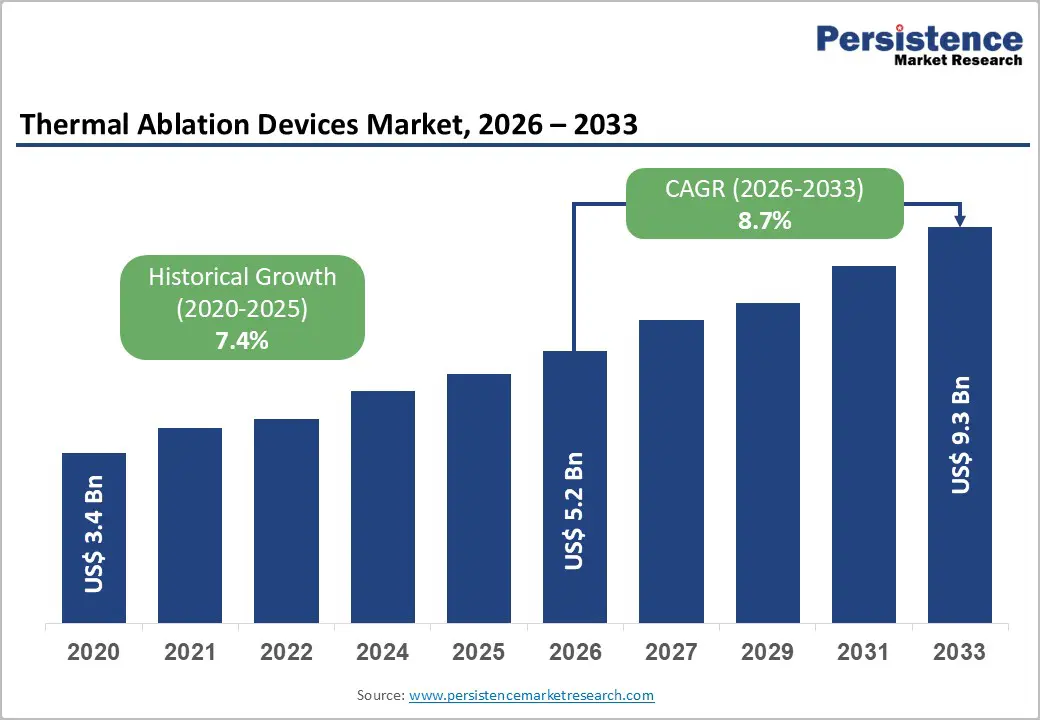
The global thermal ablation devices market size is likely to be valued at US$ 5.2 billion in 2026 and is projected to reach US$ 9.3 billion by 2033, growing at a CAGR of 8.7% between 2026 and 2033. The global market is expanding steadily as hospitals and specialty centers increasingly adopt minimally invasive therapies for cancer, cardiovascular disorders, and other chronic conditions. Thermal ablation offers a precise, tissue-targeted approach using heat or cold to destroy abnormal cells and minimizes surgical risks and recovery time.
The market continues to benefit from wider availability of image-guided systems, rising procedural volumes, and strong clinician preference for cost-effective alternatives to open surgery. Ongoing innovation in radiofrequency, microwave, cryoablation, and laser technologies is further strengthening adoption across both developed and emerging healthcare markets.
Key Industry Highlights
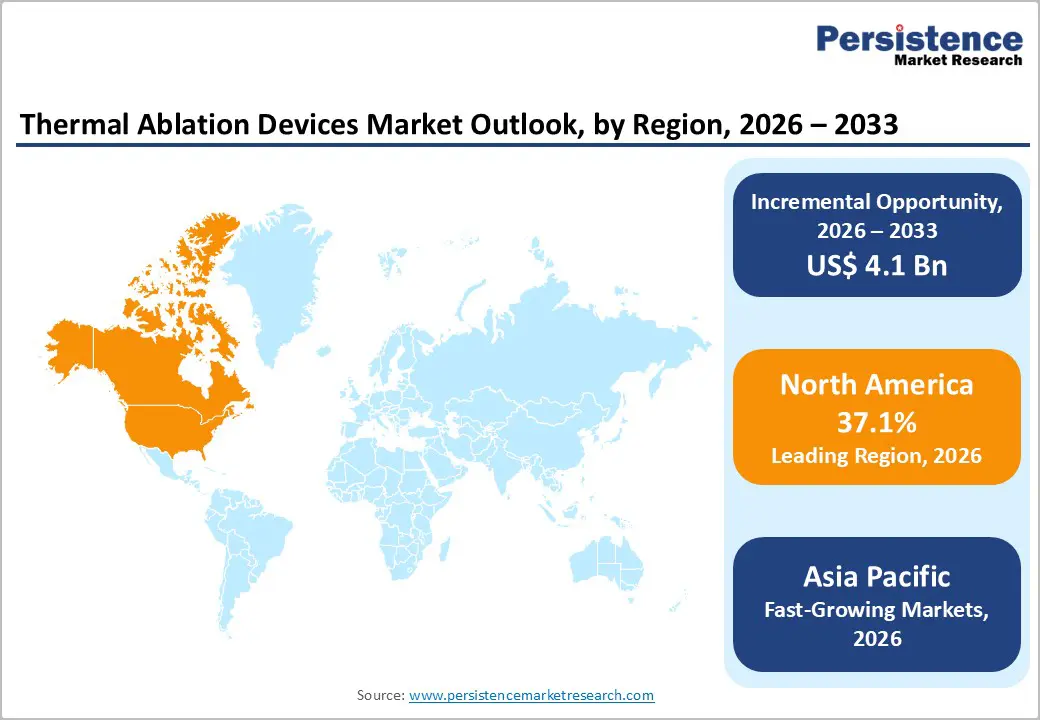
- Leading Region: North America dominates the global market with 37.1%, driven by high procedural adoption, strong reimbursement systems, and widespread availability of advanced image-guided ablation technologies.
- Fastest-Growing Region: Asia Pacific market is expected to grow rapidly with a CAGR of 10.9% in the forecast period, fueled by expanding cancer burden, improving healthcare infrastructure, and rising preference for minimally invasive procedures across developing economies.
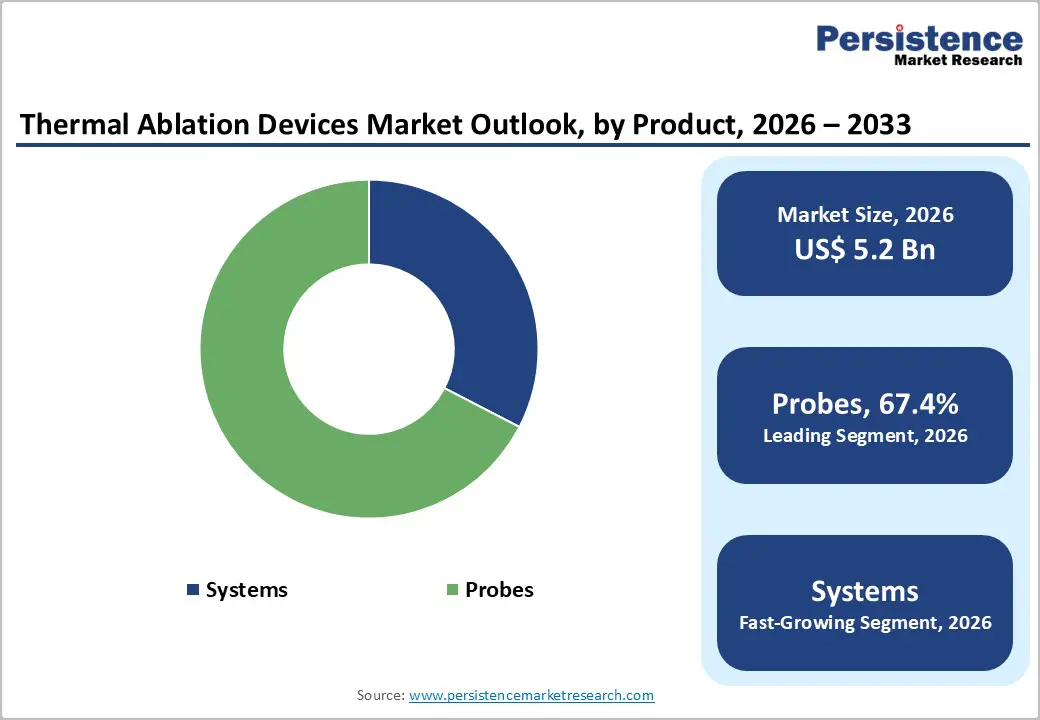
- Leading Product: Probes lead with 67.4% share, supported by their essential role in all thermal ablation modalities, consistent replacement demand, and increasing use in CT- and ultrasound-guided interventions.
- Leading Technology: Radiofrequency Ablation to remain dominant with 39.2%, driven by its clinical familiarity, cost-effectiveness, broad oncology applications, and strong evidence base supporting safety and procedural efficacy.
- Leading End-user: Hospitals lead with 72.8% share, due to higher patient inflow, advanced imaging facilities, skilled specialists, and greater adoption of multidisciplinary treatment pathways requiring ablation technologies.
- Rising preference for same-day ablation procedures that reduce hospitalization costs and improve patient throughput in busy clinical settings.
- Thermal ablation adoption rises with private hospital investments in advanced interventional suites, enabling broader access to high-precision ablation technologies in emerging markets.
| Key Insights | Details |
|---|---|
|
Global Thermal Ablation Devices Market Size (2026E) |
US$ 5.2 Billion |
|
Market Value Forecast (2033F) |
US$ 9.3 Billion |
|
Projected Growth (CAGR 2026 to 2033) |
8.7% |
|
Historical Market Growth (CAGR 2020 to 2025) |
7.4% |
Market Dynamics
Driver - Rising Minimally Invasive Oncology Adoption Accelerates Market Expansion
The global thermal ablation devices market is gaining strong momentum as ultrasound-guided modalities—such as microwave ablation, radiofrequency ablation, and laser ablation—become widely recognized as effective, minimally invasive options for treating cancers, including cervical and thyroid tumors. Their adoption is rising particularly in low- and middle-income countries (LMICs), where cervical cancer remains a major cause of mortality. In 2022 alone, more than 350,000 cervical cancer deaths were reported, with over 90% occurring in LMICs.
To support the World Health Organization’s (WHO) 2030 elimination strategy, countries are increasingly replacing cryotherapy—often expensive and operationally restrictive—with thermal ablation (TA), a portable, safe, and cost-efficient alternative endorsed by WHO. Large-scale initiatives funded by Unitaid and implemented with CHAI, national governments, and the SUCCESS group have accelerated this transition. By mid-2024, over 6,000 thermal ablation (TA) devices had been deployed across 28 countries, and more than 11,000 healthcare providers trained. Multiple deployment models—tiered, universal, and demand-driven—help integrate TA into local screening programs while reducing treatment costs by nearly 75%, to about $4.10 per patient.
With Ministries of Health in ten Unitaid–CHAI countries incorporating TA into national guidelines and extending access to primary and secondary care, thermal ablation is becoming central to expanding affordable cancer treatment globally.
Restraints - Device Performance Variability and Procedural Limitations Continue to Restrict Broader Adoption
Despite significant progress, reliability and durability concerns continue to limit the full-scale adoption of thermal ablation devices in global health systems. Data collected between 2020 and 2022 from nearly 3,000 deployed Liger HTU-110 and Wisap C3 units across public facilities in nine countries reported a device-incident rate of under 1%, indicating generally strong performance.
However, the nature of the incidents highlights persistent technical challenges. Approximately 34% of recorded issues were linked to battery or charger failures—critical components for portable devices operating in remote or resource-limited environments. Another 34% of incidents involved probe-related defects, including cracking or inadequate heating, which directly affects treatment consistency.
Additionally, around 17% of malfunctions resulted from devices failing to heat properly due to causes outside the probe or battery systems. While no adverse clinical events were reported, such recurring operational challenges can undermine provider confidence, increase maintenance demands, and create interruptions in service delivery. For many LMICs where supply-chain delays and limited biomedical engineering capacity already constrain healthcare delivery, even low incident rates can slow adoption. These technical reliability issues remain an important restraint on broader thermal ablation scale-up.
Opportunity - Advances in Portable, Image-Guided, and AI-Enhanced Ablation Systems Unlock New Growth Opportunities Worldwide
The global thermal ablation devices market is positioned for major expansion as innovations, clinical evidence, and cross-border collaborations reshape the field. A key milestone came in June 2024, when a publication reported that a portable, low-cost, battery-powered thermal ablator—co-developed by the International Agency for Research on Cancer (IARC) and engineering partners—matched the safety and efficacy of standard-of-care cervical precancer treatments in the largest randomized trial conducted to date. This strengthens the case for broader global adoption.
Additionally, momentum is growing in oncology communities worldwide. At the ISMIO 2025 Annual Conference held in Suzhou in June 2025, experts from China, Russia, Turkey, Kazakhstan, Pakistan, and other countries shared advances in cryo-thermal and microwave ablation techniques for solid tumors, highlighting rising academic and clinical interest.
Technology partnerships are also opening new avenues; in October 2025, Techsomed Ltd. began a pilot collaboration with Medtronic, integrating its BioTraceIO360 AI-powered imaging software with the Emprint microwave ablation system. This aims to improve real-time visualization, predictive margin control, and intraprocedural planning—addressing persistent challenges such as inadequate margin assessment and fragmented imaging workflows. Together, these developments create strong opportunities for innovation, adoption, and market growth in thermal ablation technologies.
Category-wise Analysis
By Product Insights
Probes are expected to capture a 67.4% share of the global thermal ablation devices market by 2026, supported by their versatility across multiple ablation modalities, including microwave, radiofrequency, and laser systems. Their compatibility with image-guided platforms and ability to deliver controlled energy to targeted tissues make them essential in oncology, hepatology, cardiology, and gynecology. Continuous advancements in probe design—such as enhanced heat resistance, flexible shaft architecture, and improved temperature feedback—further strengthen adoption. As minimally invasive procedures expand, clinicians increasingly prefer high-precision probes for safe, predictable, and reproducible treatment outcomes across diverse clinical settings.
By Technology Insights
Radiofrequency ablation is projected to hold nearly 39.2% of the global thermal ablation devices market in 2026, driven by its long-established clinical validation and broad therapeutic use across liver, kidney, lung, and bone tumors. Its extensive safety profile, predictable thermal behavior, and cost-effectiveness make it a preferred modality in both developed and emerging regions. RFA also benefits from widespread availability, streamlined workflows, and compatibility with standard imaging systems. Ongoing refinements in electrode design and energy-delivery algorithms continue to improve precision, further reinforcing its position as a cornerstone technology in interventional oncology and pain management.
By End-user Insights
Hospitals are projected to account for nearly 72.8% of the global market in 2026, supported by their advanced imaging infrastructure, availability of trained interventional specialists, and ability to perform complex ablation procedures safely. High patient inflows, multidisciplinary oncology teams, and better reimbursement alignment further drive adoption. Hospitals also serve as primary hubs for microwave, radiofrequency, cryoablation, and laser procedures requiring real-time monitoring and postoperative care. With expanding interventional oncology suites and rising preference for minimally invasive treatments, hospitals continue to perform the majority of ablation interventions globally, sustaining their dominant market position.
Regional Insights
North America Thermal Ablation Devices Market Trends
North America is projected to remain the largest regional contributor, capturing nearly 37.1% of the global thermal ablation devices market by 2026, supported by rapid regulatory progress and expanding clinical adoption. Francis Medical, Inc. received U.S. Food and Drug Administration (FDA) 510(k) clearance for its Vanquish® Water Vapor Ablation System for prostate tissue ablation. The approval was based on promising 12-month follow-up results from the first 110 patients enrolled in the ongoing VAPOR 2 clinical study, a prospective, multicenter, single-arm trial designed to treat 235 individuals with intermediate-risk, localized prostate cancer across 26 U.S. sites.
The Vanquish System, a transurethral, ultrasound- and electromagnetically guided water-vapor device, enables thermal ablation in an outpatient setting, reflecting North America’s strong inclination toward minimally invasive, patient-friendly therapies. With initial procedures completed in February 2025 and longer-term data being collected to support future premarket approval (PMA) submissions, the region continues to advance next-generation ablation technologies. These developments reinforce North America’s leadership in commercialization, clinical evidence generation, and accelerated innovation pipelines.
Europe Thermal Ablation Devices Market Trends
Europe, expected to account for 29.6% of the global thermal ablation devices market by 2026, is benefitting from continuous technological upgrades and widening access to minimally invasive oncology solutions.
A defining milestone occurred in July 2025 when Varian, a Siemens Healthineers company, launched IntelliBlate, its next-generation microwave ablation platform, across Europe following CE-mark approval. Designed to enhance precision, control, and predictability in tumor treatment, IntelliBlate strengthens Europe’s focus on integrated and clinician-friendly ablation ecosystems. Its introduction supports the region’s shift toward advanced interventional oncology techniques that reduce hospital stays, improve procedural accuracy, and expand therapeutic options for soft-tissue tumors.
By offering a more intuitive and comprehensive platform, IntelliBlate accelerates the adoption of image-guided microwave ablation across European centers. This aligns with the region’s strong infrastructure for medical innovation, robust regulatory frameworks, and emphasis on expanding minimally invasive care. As providers increasingly seek technologies that blend automation, accuracy, and workflow integration, Europe continues to drive momentum for high-performance thermal ablation devices.
Asia Pacific Thermal Ablation Devices Market Trends
The Asia Pacific region is emerging as the fastest-growing market for thermal ablation devices, projected to expand at a CAGR of 10.9% during the forecast period. Much of this momentum comes from rapid regulatory approvals, rising cancer incidence, and strong domestic innovation.
A key driver was the March 2024 announcement by Baird Medical Devices, Inc., which received a new Class III certification from the National Medical Products Administration (NMPA) in China for its next-generation Ceramic Thyroid Ablation Needle. This device, developed for the management of thyroid nodules, incorporates rare-earth ceramic materials that provide exceptional heat resistance, chemical stability, and electrical insulation.
These properties enable highly controlled thermal delivery, minimize procedural complications, and ensure uniform energy distribution—an improvement over conventional MWA designs where edge-heating is a concern. With a 30% increase in mechanical strength, the needle enhances flexibility and reduces breakage risk during delicate procedures. As regional manufacturers continue introducing advanced, cost-effective solutions tailored to high-volume clinical needs, Asia Pacific strengthens its position as a dynamic growth engine for thermal ablation innovation and adoption.
Competitive Landscape
The global thermal ablation device market is highly competitive, driven by rapid innovation in energy delivery, imaging integration, and minimally invasive platforms. Manufacturers compete aggressively on device precision, safety, procedural versatility, and cost-effectiveness. Market players strive to differentiate through cutting-edge technologies, regulatory approvals, and expanding use across oncology, cardiology, and ambulatory care settings.
Key Industry Developments:
- In October 2025, Monteris Medical and Symphony Robotics today revealed a strategic alliance to launch an AI-driven micro-robotic platform for MRI-guided brain laser ablation. The system features a flexible, engine-less micro-robotic arm that navigates through a 5 mm entry to reach complex or irregular lesions and enables non-linear laser probe trajectories for enhanced precision during treatment of brain tumours, epilepsy foci, and challenging anatomical targets.
- In September 2024, The Quad Cancer Moonshot was launched by the United States, Australia, India, and Japan to strengthen cancer care across the Indo-Pacific - expanding prevention, detection, treatment and care infrastructure. The initiative promotes wider access to screening and treatment options (including thermal ablation) for cervical and other cancers. With coordinated research funding, bulk procurement of diagnostics, improved imaging and radiotherapy access, and support for vaccination and early detection programmes, Quad aims to reduce cancer burden and improve equitable care across underserved regions
Companies Covered in Thermal Ablation Devices Market
- Medtronic
- Boston Scientific Corp.
- Smith+Nephew
- AngioDynamics
- Abbott
- Johnson & Johnson
- Olympus
- STARmed America Inc.
- Thermedical, Inc.
- ECO Medical
- Kardium
- Terumo
- Vantage Medtech
- Francis Medical, Inc.
- Seimens Healthineers AG
- Baird Medical Devices, Inc
- Arthrex, Inc.
- Cambridge Interventional
Frequently Asked Questions
The global thermal ablation devices market is projected to be valued at US$ 5.2 Billion in 2026.
Rising cancer prevalence, growing adoption of minimally invasive procedures, and expanding use of image-guided interventions drive market growth.
The global market is poised to witness a CAGR of 8.7% between 2026 and 2033.
Advances in navigation/robotic guidance, expansion into outpatient settings, and increasing adoption in emerging markets present major growth opportunities.
Major players in the thermal ablation devices market are Medtronic, Boston Scientific Corp., Smith+Nephew, AngioDynamics, Abbott, Johnson & Johnson, and others.


