




- Semiconductor Materials & Components
- Test Socket Thermal Solutions Market
Test Socket Thermal Solutions Market Size, Share, and Growth Forecast, 2026 - 2033
Test Socket Thermal Solutions Market by Product Type (Air Cooling, Liquid Cooling, Thermoelectric Cooling, Others), Application (Semiconductor Testing, Electronics Testing, Others), End-User (Automotive, Consumer Electronics, IT & Telecommunications, Industrial, Others), and Regional Analysis for 2026 - 2033

Test Socket Thermal Solutions Market Share and Trends Analysis
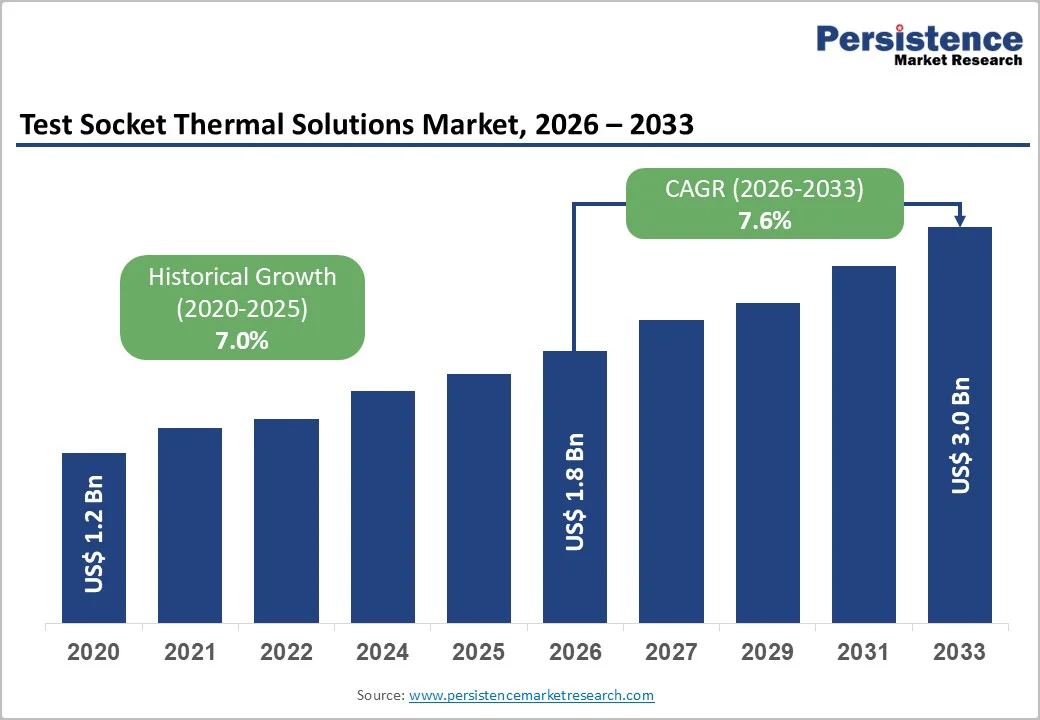
The global test socket thermal solutions market size is likely to be valued at US$ 1.8 billion in 2026, and is projected to reach US$ 3.0 billion by 2033, growing at a CAGR of 7.6% during the forecast period 2026−2033. Rising demand for advanced semiconductor testing solutions is driving the expansion of the market, as increasing device complexity results in higher heat loads during testing and requires efficient cooling and thermal management to ensure reliability and performance in production environments.
The rapid adoption of 5G networks, artificial intelligence (AI), and Internet of Things (IoT) technologies is intensifying the need for sophisticated test systems capable of precisely controlling thermal profiles during quality assurance processes. The growing use of electronics in automotive and electric vehicle (EV) applications is accelerating demand for robust thermal solutions in test sockets to meet stringent durability and safety standards.
Key Industry Highlights
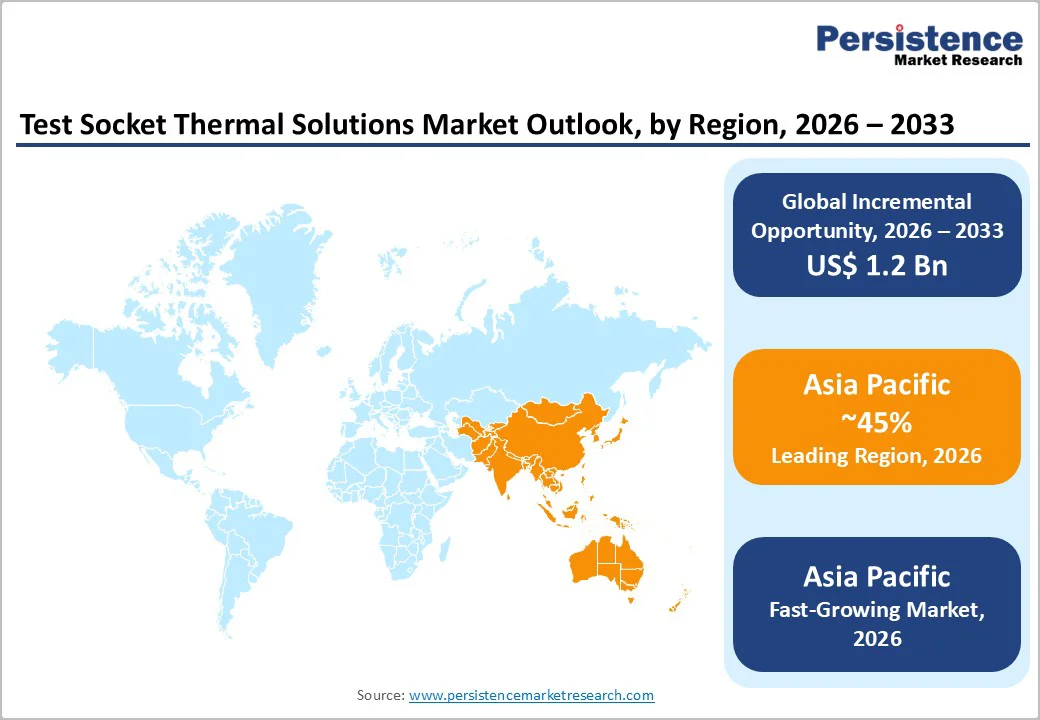
- Dominant Region: Asia Pacific is projected to capture around 45% market share by 2026, fueled by concentrated semiconductor manufacturing and integrated fabrication and testing ecosystems.
- Fastest-growing Regional Market: Asia Pacific is positioned to be the fastest-growing market through 2033, supported by semiconductor self-reliance initiatives and expanding power-dense electronics production.
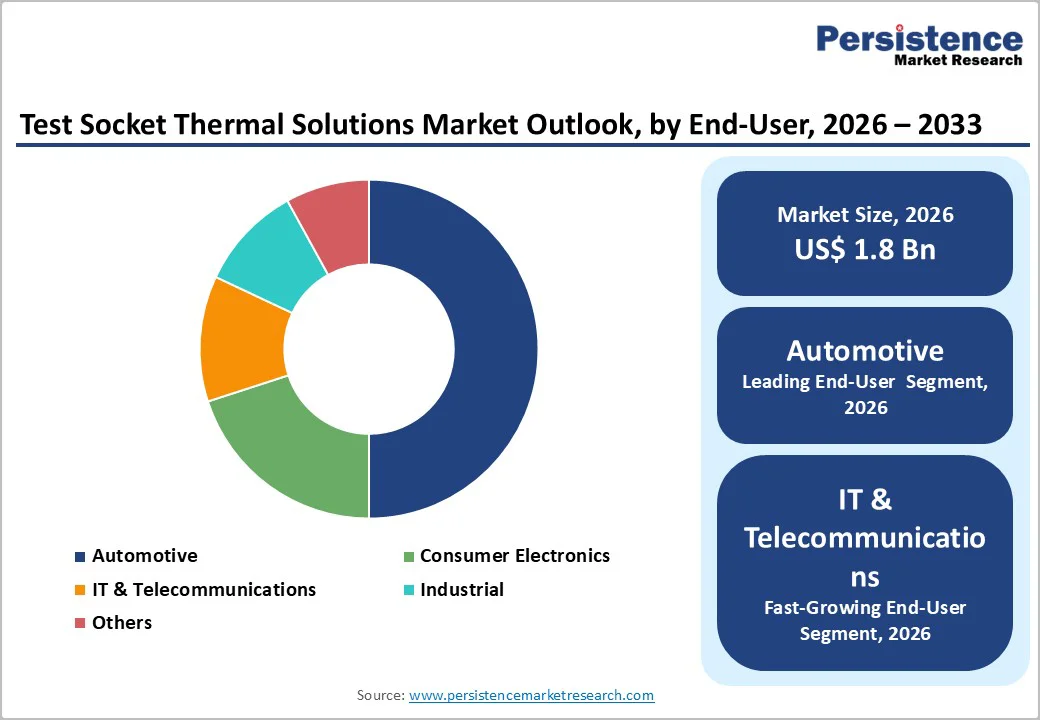
- Leading End-User: Automotive is likely to hold around 50% market share by 2026, driven by rapid integration of advanced computing, power electronics, and EV technologies.
- Fastest-growing End-User: IT and telecommunications are expected to grow the fastest through 2033, owing to extensive 5G deployment and data center expansion worldwide.
| Key Insights | Details |
|---|---|
|
Test Socket Thermal Solutions Market Size (2026E) |
US$ 1.8 Bn |
|
Market Value Forecast (2033F) |
US$ 3.0 Bn |
|
Projected Growth (CAGR 2026 to 2033) |
7.6% |
|
Historical Market Growth (CAGR 2020 to 2025) |
7% |
Market Factors - Growth, Barriers, and Opportunity Analysis
Increasing Complexity and Power Density in Semiconductors
Rising device complexity has reshaped validation requirements across advanced chip architectures. Higher transistor counts, heterogeneous integration, and dense interconnects elevate thermal loads at the contact interface during electrical verification. These conditions stress signal integrity, timing accuracy, and mechanical stability, raising the risk of yield loss during qualification cycles. Thermal control at the interface becomes a commercial necessity to sustain throughput and protect high value devices. Precision heat extraction aligned with contact geometry supports repeatable measurements, stable contact resistance, and predictable test windows under elevated power draw typical of leading nodes.
Escalating power density concentrates heat within smaller footprints, accelerating temperature gradients during rapid test sequences. Unmanaged heat skews electrical characteristics, extends test time, and increases retest rates, pressuring operating margins. Advanced thermal designs integrated into sockets enable localized cooling, faster thermal equilibrium, and consistent results across volumes. This capability aligns testing with aggressive launch schedules and quality targets demanded by premium applications such as artificial intelligence accelerators, automotive electronics, and high performance computing.
Complexity in Integration and Customization
The complexities associated with integration and customization processes act as a major growth restraint for the market, as thermal solutions require precise alignment with device architecture, test socket design, and production workflows. Each semiconductor generation introduces varied pin layouts, materials, and power profiles, driving demand for tailored thermal configurations. Standardized solutions struggle to align with these requirements, leading to extended engineering cycles and repeated validation stages. Design teams face pressure to balance thermal performance with mechanical stability and signal integrity, which raises development effort and technical risk.
Customization demands close coordination among socket suppliers, thermal component providers, and device manufacturers. Variations in testing conditions, load cycles, and temperature targets increase dependency on specialized expertise and iterative prototyping. This environment elevates integration costs and reduces operational flexibility for high mix production lines. Engineering resources shift toward adaptation and troubleshooting instead of process optimization. Procurement decisions face delays as stakeholders assess long term compatibility and upgrade paths.
Promising Progress in AI, 5G, and EV Technologies
Emerging deployments of AI drive rapid escalation in chip performance requirements across data centers, edge computing, and specialized accelerators. These workloads demand extreme processing density, higher input output counts, and prolonged test cycles under real operating conditions. Such trends elevate thermal stress during validation and burn in stages, creating strong demand for advanced heat dissipation interfaces. Precise thermal control enables consistent signal integrity, stable power delivery, and higher test throughput, aligning with cost efficiency targets set by semiconductor manufacturers and outsourced testing providers. This environment positions advanced thermal interfaces as a strategic enabler rather than a support component.
Expansion of 5G infrastructure and the meteoric rise in the adoption of EVs globally have accelerated the use of high power radio frequency devices, automotive grade processors, and wide bandgap semiconductors. These components operate under elevated temperatures and strict reliability standards, intensifying focus on thermal performance during device qualification. Testing platforms require solutions that sustain accuracy across wide temperature ranges while supporting rapid design changes and shorter product cycles. Investment in advanced thermal interfaces supports faster time to qualification, reduced failure rates, and compliance with automotive and telecom performance benchmarks, strengthening long term value creation across the semiconductor ecosystem.
Category-wise Analysis
Product Type Insights
Air cooling is likely to be the leading segment with a projected 55% of the test socket thermal solutions market revenue share in 2026 due to its cost efficiency, operational simplicity, and proven reliability for moderate power applications. Its compatibility with existing test infrastructure reduces integration complexity, enabling widespread adoption across semiconductor fabrication and testing facilities. The low maintenance requirement and scalability for varying package sizes reinforce its preference among testing engineers. Air cooling effectively balances performance and expenditure, supporting consistent throughput and predictable thermal management.
Liquid cooling is anticipated to be the fastest-growing segment from 2026 to 2033, fueled by superior heat dissipation for high-power semiconductors where air cooling reaches physical limits. Its adoption in testing high-performance integrated circuits (ICs), power devices, and automotive semiconductors addresses thermal constraints, enabling accurate performance validation under extreme operating conditions. Investments in data centers, AI accelerators, and EV-related electronics further support this growth. The efficiency in temperature control and scalability for compact, high-density packages positions liquid cooling as the preferred solution for advanced testing scenarios.
Application Insights
Semiconductor testing is poised to dominate with a forecasted market share of 60% in 2026, powered by the critical requirement for precise thermal management during IC and chip validation. Ensuring device reliability before mass production drives manufacturers to invest in advanced test socket thermal solutions. These systems support accurate temperature control, maintain signal integrity, and reduce failure rates, making them essential for high-volume semiconductor fabrication. The segment benefits from established infrastructure, industry standards, and the growing complexity of modern integrated circuits.
Digital assessment tools and software are estimated to be the fastest-growing segment from 2026 to 2033, fueled by rising volumes of consumer and industrial devices requiring validation across diverse environments. Rapid product lifecycles, higher integration of electronics, and the need for reliable performance under variable thermal conditions drive demand for modular and adaptable test socket thermal solutions. These systems enable flexible deployment across different device types while supporting throughput efficiency and accurate thermal profiling, critical for ensuring device functionality and safety across electronics markets.
End-User Insights
Automotive is anticipated to secure around 50% of the test socket thermal solutions market revenue share in 2026, reflecting strong demand from the rapid integration of advanced computing, power electronics, and electric vehicle systems within modern vehicles. Thermal testing ensures device reliability under extreme temperature variations and operational stress, supporting safety, performance, and regulatory compliance. Manufacturers prioritize test socket thermal solutions to validate sensors, battery management systems, and infotainment processors. The segment’s leadership is reinforced by high-value applications, established infrastructure, and continuous investment in automotive electronics innovation across global markets.
IT and telecommunications are expected to be the fastest-growing segment during the 2026–2033 forecast period, propelled by widespread 5G network deployment, data center expansion, and edge computing adoption. High-frequency devices, server SOCs, and network equipment require precise thermal management during testing to maintain performance, reliability, and operational efficiency. Advanced test socket thermal solutions enable scalable validation of high-power, high-density electronics while supporting accelerated product development cycles and minimizing risk in complex IT and telecommunications systems.
Regional Insights
North America Test Socket Thermal Solutions Market Trends
North America is set to occupy a prominent position in the market, supported by dense clusters of semiconductor design and testing facilities and the early adoption of advanced computing and AI technologies. Global chip design houses, hyperscale data centers, and high-performance computing (HPC) operators create steady demand for accurate and repeatable thermal characterization across the product lifecycle. Strict reliability expectations in aerospace, defense, automotive electronics, and AI accelerator applications require sophisticated temperature control that can maintain stable performance under extreme operating conditions. For engineering leaders, this environment makes it essential to standardize on test platforms that combine high thermal accuracy with robust data logging, so that design, quality, and reliability teams can work from a single source of truth.
Several reinforcing factors, including high-value end-user applications, regulatory requirements, and targeted investment in next-generation electronics, further strengthen North America’s position. Manufacturers seek to reduce device failure rates, improve yield, and compress time-to-market, which increases reliance on advanced thermal solutions during both prototype qualification and high-volume production testing. The expansion of electric vehicles, 5G networks, AI-enabled systems, and high-performance servers introduces more complex heat loads that demand scalable, precise, and modular test architectures.
Europe Test Socket Thermal Solutions Market Trends
Europe maintains a strong presence in the thermal validation solutions market, supported by its advanced semiconductor, automotive electronics, and high-performance computing sectors. The widespread adoption of electric and autonomous vehicles, along with industrial automation and AI deployment, drives steady demand for precise temperature management. Strict environmental and regulatory requirements compel manufacturers to use reliable air and liquid cooling systems during IC and power electronics testing. Operators should prioritize solutions that meet compliance standards and offer robust thermal control to minimize product failures and ensure consistent test results.
New trends show increased integration of high-density, power-intensive chips in automotive, consumer electronics, and industrial settings, which intensifies the need for efficient thermal management during testing. Modular, scalable, and automated thermal solutions are gaining traction as companies aim to shorten development cycles and reduce defect rates. Investment in green manufacturing and energy-efficient testing systems is also shaping the design and deployment of these solutions. Procurement teams should focus on suppliers that offer modular systems, proven energy savings, and strong support for regulatory compliance to maintain competitiveness and sustainability in this evolving market.
Asia Pacific Test Socket Thermal Solutions Market Trends
Asia Pacific is expected to dominate with an estimated 45% of the test socket thermal solutions market share in 2026, reflecting unparalleled concentration of semiconductor manufacturing and electronics production. Leading fabrication hubs in South Korea and Japan drive consistent demand for advanced thermal management during high-volume IC and power electronics testing. Vertically integrated supply chains, where semiconductor foundries, assembly and testing facilities, and electronics OEMs operate in close proximity, reduce lead times and encourage adoption of specialized thermal solutions. Rapid deployment of 5G infrastructure, AI accelerators, and electric vehicle systems increases thermal stress on devices during validation, elevating the need for precise and scalable test socket solutions.
Asia Pacific is also poised to be the fastest-growing market for test socket thermal solutions during the 2026-2033 forecast period, supported by government incentives for domestic semiconductor self-reliance and technology modernization. High integration of complex ICs and power-dense modules in smartphones, laptops, servers, and EV controllers amplifies thermal testing requirements, prompting adoption of modular and liquid-cooling solutions alongside traditional air cooling. Increasing industrial automation, smart device penetration, and next-generation network rollouts create continuous demand for faster, reliable, and scalable thermal validation.
Competitive Landscape
The global test socket thermal solutions market structure is moderately consolidated, with a limited number of leading thermal solution providers capturing significant share while several specialized firms focus on application-specific requirements. Key participants such as Ironwood Electronics, Yamaichi Electronics Co., Ltd., 3M, Sensata Technologies, Inc., Aries Electronics, and WinWay Tech. Co., Ltd. play a central role in shaping competitive dynamics through strong engineering capabilities and diversified product portfolios. These companies support demand from automotive, telecom, industrial, and high-performance computing segments by delivering precise thermal management solutions for complex IC and system-on-chip testing environments.
These established players collectively account for a substantial portion of overall revenues, supported by global customer relationships and continuous product innovation. Emphasis on reliability, customization, and scalability enables penetration across advanced testing applications. Smaller participants address specialized and application-focused requirements, strengthening overall market depth. This balance between large, established suppliers and focused solution providers sustains competition while supporting steady technology advancement and adoption across evolving semiconductor testing landscapes.
Key Industry Developments
- In October 2025, Ironwood Electronics introduced a 94 GHz elastomer socket for BGA1440 packages that delivered approximately –1 dB insertion loss and integrated thermal management features to support high-frequency, high-power device testing.
- In September 2025, Advantest expanded its 7038 system-level test platform with a new right-sized single test rack solution offering up to 1.4 kW liquid-cooled thermal management per test site, enabling robust testing of complex, high-power devices such as AI, HPC, and automotive processors.
- In July 2025, WinWay Technology became the world’s largest supplier of semiconductor test sockets, strengthening its position in advanced thermal and high-frequency testing solutions amid rising demand from AI and high-performance computing applications.
Companies Covered in Test Socket Thermal Solutions Market
- Ironwood Electronics.
- Yamaichi Electronics Co., Ltd.
- 3M
- Sensata Technologies, Inc.
- Aries Electronics
- WinWay Tech. Co., Ltd.
- Smiths Interconnect
- Mikros Technologies
- Enplas Semiconductor Peripheral Corporation
- Tark Thermal Solutions.
Frequently Asked Questions
The global test socket thermal solutions market is projected to reach US$ 1.8 billion in 2026.
Rising semiconductor power density, increasing device complexity, and strict reliability requirements during IC and system-level testing drive the demand for advanced thermal validation solutions.
The market is poised to witness a CAGR of 7.6% from 2026 to 2033.
Expansion of AI, 5G, electric vehicles, and high-performance computing testing has created lucrative opportunities for advanced, scalable, and high-efficiency thermal testing solutions.
Ironwood Electronics, Yamaichi Electronics Co., Ltd., 3M, Sensata Technologies, Inc., and Aries Electronics are few of the key players in the market.


