




- Home Appliances
- Thermal Printer Market
Thermal Printer Market Size, Share, and Growth Forecast 2026 - 2033
Thermal Printer Market by Printing Technology (Direct Thermal (DT), Thermal Transfer (TT), Dye-Diffusion Thermal Transfer (D2T2)), by Format Type (Industrial, Desktop, Mobile), by Application (Retail, Logistics & Warehousing, Healthcare, Manufacturing & Industrial, Hospitality & Ticketing, Government & Public Services, Others), by Regional Analysis, 2026-2033

Thermal Printer Market Size and Trend Analysis
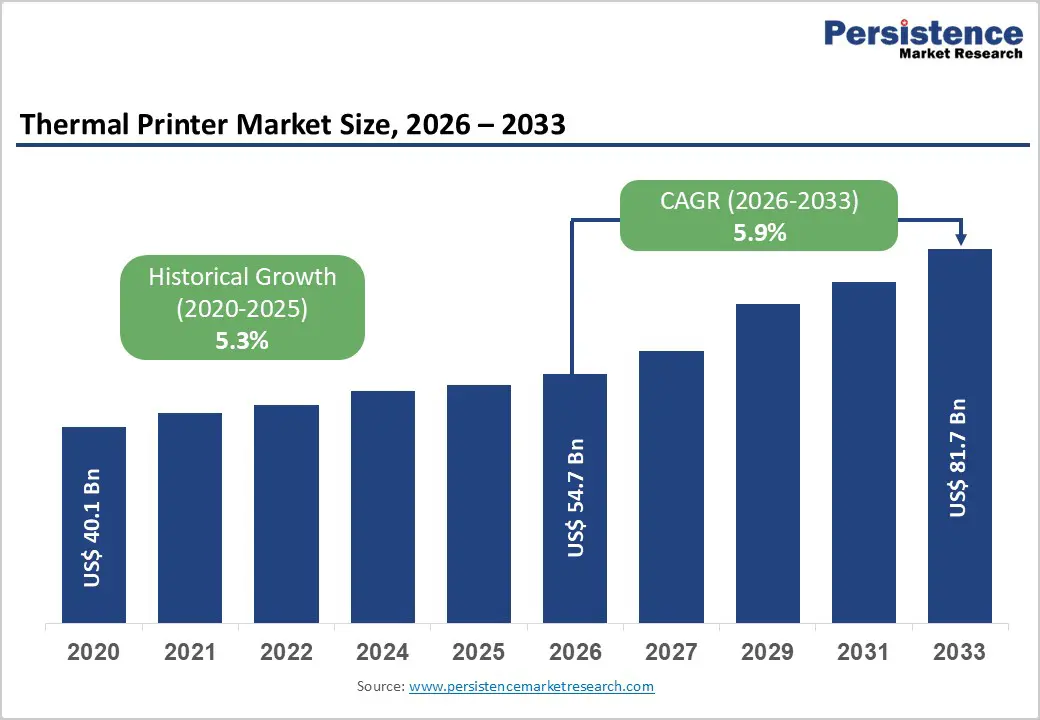
The global Thermal Printer market size is expected to be valued at US$ 54.7 billion in 2026 and projected to reach US$ 81.7 billion by 2033, growing at a CAGR of 5.9% between 2026 and 2033. This growth is primarily driven by the rapid expansion of e-commerce and increasing automation in logistics, as businesses demand fast, reliable, and durable label printing solutions for shipping and inventory management. In addition, retail point-of-sale systems contribute significantly, with high-volume receipt printing requirements. The ongoing digitization of supply chains further supports market expansion, making thermal printers essential for efficiency and operational accuracy across industries worldwide.
Key Market Highlights
- Leading Region: North America leads the Thermal Printer market with 38.1% share, driven by U.S. regulations, technological innovation, and high adoption across retail, healthcare, and logistics sectors.
- Leading Category: Direct Thermal (DT) dominates printing technology with 48% share, widely used for cost-effective retail, logistics, and short-life labels due to ribbon-free operation and low maintenance.
- Leading Format Type: Desktop printers hold the largest format share at 45%, preferred by offices, SMBs, and small retail outlets for medium-volume, reliable label printing.
- Fastest-Growing Region: Asia Pacific holds 30.8% share and is the fastest-growing region, fueled by China’s manufacturing hub, India’s e-commerce expansion, and rapid logistics modernization.
- Key Market Opportunity: IoT and RFID integration presents high growth potential, reducing logistics errors by up to 50% and enabling real-time inventory management, mobile printing, and automated warehouse operations.
| Report Attribute | Details |
|---|---|
|
Thermal Printer Size (2026E) |
US$ 54.7 billion |
|
Market Value Forecast (2033F) |
US$ 81.7 billion |
|
Projected Growth CAGR(2026-2033) |
5.9% |
|
Historical Market Growth (2020-2025) |
5.3% |
Market Dynamics
Market Drivers
Rapid Growth in E-commerce and Logistics Automation Driving Thermal Printer Adoption
The rapid expansion of global e-commerce has significantly increased the volume of parcels, labels, and barcodes that must be generated every day, making thermal printers a core technology in logistics operations. Warehouses, fulfillment centers, and courier companies depend on thermal printing for producing shipping labels, inventory tags, and tracking barcodes that are clear, durable, and scannable at high speed.
As logistics networks become more automated, thermal printers play a critical role in reducing manual handling and minimizing labeling errors across sorting and distribution processes. Their ability to deliver fast, high-volume printing with minimal downtime improves throughput and supports real-time inventory tracking, enabling companies to manage growing order volumes efficiently while maintaining accuracy and delivery reliability.
Retail Digital Transformation and Demand for High-Efficiency POS Printing
Retailers worldwide are undergoing digital transformation, driven by the shift toward contactless payments, omnichannel retailing, and faster checkout experiences. Thermal printers have become essential in modern point-of-sale environments for printing receipts, price labels, and barcode tags quickly and reliably, supporting smooth customer transactions even during peak store traffic.
Their ink-free operation ensures consistent print quality while significantly reducing maintenance requirements and operating costs compared with traditional printing technologies. This makes thermal printers especially attractive for supermarkets, convenience stores, and large retail chains that require continuous, high-volume printing. As retailers continue upgrading their digital infrastructure, demand for dependable and cost-efficient thermal printing solutions continues to rise.
Market Restraints
High Initial Investment and Ongoing Operating Costs Limiting Wider Adoption
Thermal printers, particularly industrial and high-speed models, require a higher upfront investment compared with conventional inkjet and impact printers, which can discourage cost-sensitive buyers. For small and mid-sized businesses, this price premium creates a barrier when upgrading or expanding printing infrastructure, especially in environments where multiple printers are needed across operations.
In addition, thermal printing relies on specialized media such as coated thermal paper and ribbons, which increases recurring operating expenses. Rising component and logistics costs further add to procurement and maintenance burdens. Under tight budget conditions, these combined financial pressures can slow purchasing decisions and limit the pace at which organizations adopt thermal printing technology.
Limited Print Longevity and Durability Constraints in Certain Applications
A key limitation of direct thermal printing is the relatively short lifespan of printed images, which can fade when exposed to heat, light, or environmental stress. This makes such prints less suitable for applications that require long-term record keeping, legal documentation, or archival storage, where legibility over extended periods is essential.
While thermal transfer printing improves durability, it adds complexity through the need for ribbons, calibration, and additional consumables. These requirements increase operational effort and cost, reducing the attractiveness of thermal solutions for document-heavy industries. As a result, concerns over print permanence and handling requirements restrict broader penetration beyond logistics and retail labeling uses.
Market Opportunity
Integration of Thermal Printers with IoT and RFID for Smart Logistics
The convergence of thermal printing with IoT and RFID technologies is creating strong growth opportunities, particularly in smart warehouses and automated logistics networks. Connected thermal printers can exchange real-time data with inventory management and tracking systems, enabling seamless label generation, asset identification, and shipment verification across digital platforms.
When combined with RFID, thermal printers eliminate much of the manual scanning required in traditional barcode-based workflows, improving accuracy and accelerating order processing. This is especially valuable in high-throughput logistics hubs and mobile printing environments, where speed and connectivity are critical. As supply chains become more digitized, IoT- and RFID-enabled thermal printers are positioned as key enablers of next-generation logistics efficiency.
Rising Demand for Compliance and Safety Printing in the Healthcare Sector
Healthcare is emerging as a major growth avenue for thermal printers due to stricter regulatory requirements and the need for accurate patient and pharmaceutical identification. Hospitals, clinics, and laboratories increasingly rely on thermal printers for producing wristbands, specimen labels, and medication tags that must remain legible and scannable throughout patient care workflows.
Durable and high-resolution thermal prints help reduce medical errors and improve traceability, making them essential for compliance with pharmaceutical and medical device regulations. As healthcare systems adopt more digital and automated processes, the need for reliable, compliant labeling continues to expand, creating sustained demand for advanced thermal printing technologies.
Category-wise Insights
Printing Technology Analysis
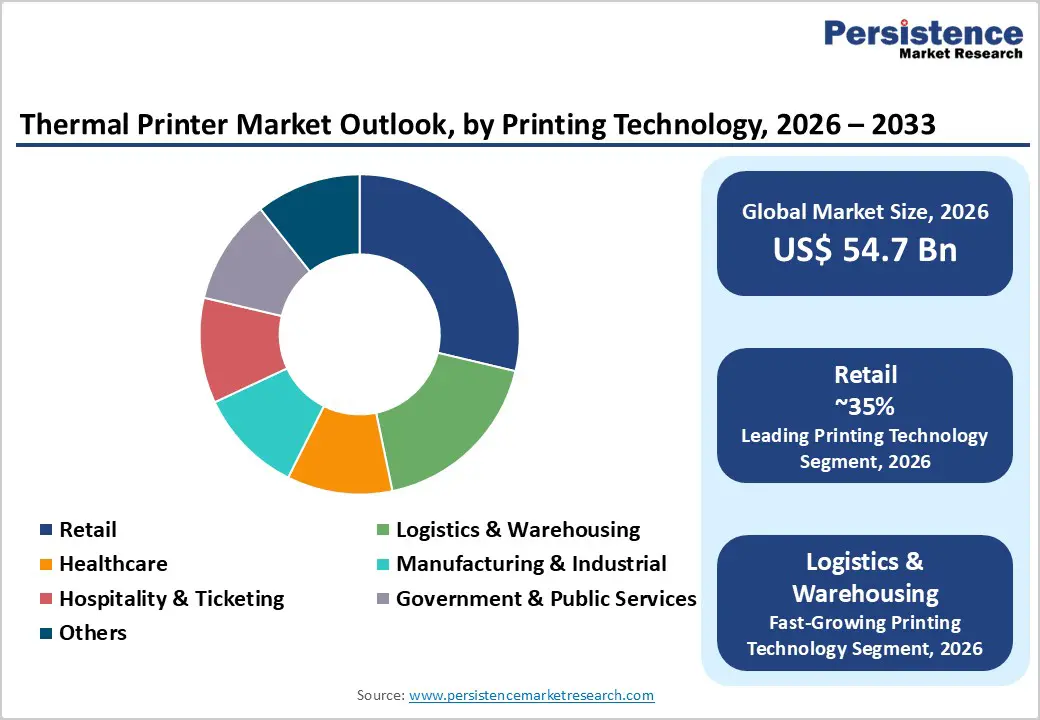
Direct Thermal (DT) dominates the thermal printer market, accounting for 48% share in 2025, reflecting its strong adoption in retail, logistics, and e-commerce applications. Its leadership is driven by the absence of ribbons, which reduces operating costs by around 40% compared with thermal transfer technology. DT is especially preferred for short-life labels and shipping tags where speed, simplicity, and low maintenance are more important than long-term print durability.
Thermal Transfer and hybrid technologies are the fastest-growing printing formats as industries shift toward traceability, compliance, and longer-lasting labels. Manufacturing, pharmaceuticals, and export logistics increasingly require prints that resist heat, moisture, and abrasion, accelerating adoption of higher-durability thermal solutions across regulated and industrial environments.
Format Type Analysis
Desktop thermal printers held the largest share at 45% in 2025, driven by their compact size, affordability, and suitability for offices, retail counters, and small warehouses. These printers typically handle 5,000 to 30,000 labels per month with print speeds of up to 8 inches per second, making them the preferred format for SMBs needing consistent, medium-volume output without investing in industrial systems.
Mobile and industrial printers represent the fastest-growing formats as logistics, field services, and omnichannel fulfillment demand on-site and high-volume printing. The rise of last-mile delivery, warehouse automation, and mobile workforces is pushing demand for rugged, portable, and high-throughput thermal printers.
Application Analysis
Retail leads thermal printer usage with a 35% share in 2025, supported by POS receipts, barcode labels, and shelf tagging that account for nearly 60% of total printing volume. Supermarkets and chain stores rely heavily on GS1-compliant barcode printing to support fast checkouts, accurate pricing, and inventory tracking across thousands of SKUs in high-transaction environments.
E-commerce and logistics are the fastest-growing application areas as global parcel volumes surge and fulfillment networks become more automated. Thermal printers are increasingly deployed for shipping labels, sorting tags, and real-time tracking, making them essential to digital, high-speed supply chains.
Regional Insights
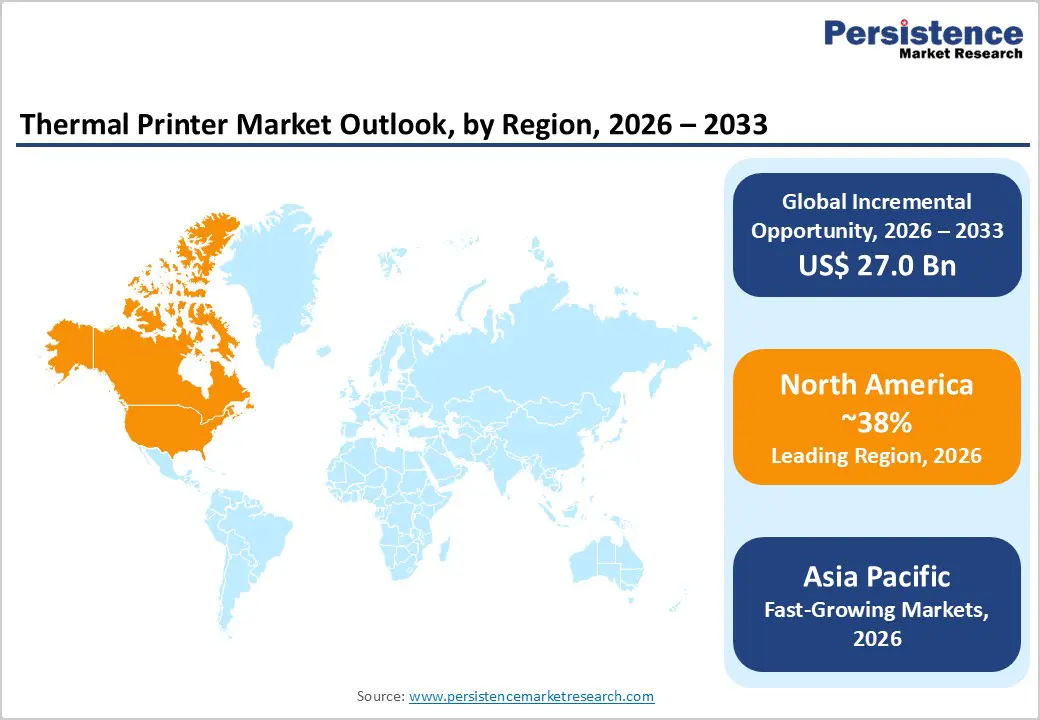
North America leads the global thermal printer market with 38.1% share in 2025, driven largely by strong adoption across the United States in retail, healthcare, and logistics. Regulatory requirements for food labeling, pharmaceutical traceability, and shipping documentation have made rugged and high-precision thermal printers a standard across regulated industries, reinforcing the region’s leadership.
The region is also seeing rapid innovation through IoT-enabled and mobile thermal printers, particularly in technology hubs and large retail chains. Retailers and logistics operators are increasingly integrating thermal printers into digital inventory systems, supporting faster order fulfillment, improved tracking, and real-time supply chain visibility across omnichannel operations.
Europe Thermal Printer Market Trends and Insights
Europe represents a steadily expanding thermal printer market, supported by strong industrial automation and digital retail ecosystems. Germany leads adoption through Industry 4.0-driven manufacturing, while the UK and France contribute through expanding e-commerce, retail automation, and RFID-based labeling systems across distribution networks.
The European thermal printer market is projected to grow at around 6% CAGR, supported by regulatory harmonization on product labeling, sustainability, and traceability. Demand for eco-friendly thermal paper and energy-efficient printers is rising, while logistics hubs in countries such as Spain and the Netherlands are accelerating printer deployments to support cross-border trade and warehouse modernization.
Asia Pacific Thermal Printer Market Trends and Insights
Asia Pacific holds approximately 30.8% share in 2025, making it the largest regional market, driven by manufacturing strength, export activity, and fast-growing e-commerce platforms across China, India, and Southeast Asia. China remains a major hub for both production and deployment of thermal printers, while India’s expanding digital commerce and logistics networks continue to boost installations.
The region is also the fastest-growing as retailers, courier firms, and factories modernize operations with barcode, label, and receipt printing. Government programs supporting digital payments, smart manufacturing, and logistics digitization are accelerating adoption of thermal printers across both urban and emerging markets.
Competitive Landscape
The thermal printer market remains highly fragmented, with the leading suppliers together controlling less than one-fifth of total industry revenues. This structure reflects the presence of numerous global, regional, and local manufacturers serving diverse end-use sectors. Competition is driven by continuous product innovation, customization, and the ability to support varied printing environments ranging from retail counters to industrial logistics hubs.
Market participants are increasingly investing in research and development focused on RFID, IoT connectivity, and cloud-based printing platforms. Sustainability initiatives, including eco-friendly consumables and energy-efficient hardware, are also gaining importance. Subscription-based service models and software-driven solutions are emerging as key differentiators.
Key Market Developments
- In January 2025, Zebra Technologies launched a new industrial thermal printer series featuring eco-friendly ribbons designed for enhanced durability in logistics environments, supporting high-volume labeling while reducing environmental impact and improving long-term operational efficiency.
- In March 2022, TSC Printronix introduced its TX series desktop thermal printers offering print speeds of 6–8 inches per second, specifically engineered to meet healthcare labeling requirements for accuracy, reliability, and compliance in clinical and laboratory settings.
- In September 2019, Epson debuted advanced color label printers for thermal transfer applications, enabling high-resolution, full-color product and compliance labels while improving branding, traceability, and print quality across industrial and commercial labeling operations.
Companies Covered in Thermal Printer Market
- Zebra Technologies
- Seiko Epson Corporation
- Honeywell
- Brother Industries
- Toshiba TEC
- SATO Holdings
- TSC Auto ID Technology
- Star Micronics
- Bixolon
- Citizen Systems
- Printronix Auto ID
- Fujitsu
- Godex International
- Dascom
- Posiflex Technology
Frequently Asked Questions
The global Thermal Printer market is expected to reach US$ 54.7 billion in 2026.
E-commerce growth and logistics automation drive demand, with retail POS adding high-volume needs.
Direct Thermal (DT) leads with 48% share, favored for cost-efficient, short-life labels in retail and logistics.
North America leads with 38.1% share, powered by U.S. regulations and innovation in logistics, healthcare, and retail.
IoT and RFID integration in mobile printers reduces logistics errors by up to 50% and enables real-time inventory tracking.
Thermal Printer market leaders include Zebra Technologies, Seiko Epson, and Honeywell.


