




- Home Care & Utilities
- Tissue Towel Market
Tissue Towel Market Size, Share, and Growth Forecast, 2026 - 2033
Tissue towel market by Product Type (Roll Towel, Folded Towel, Boxed Towel), Application (Personal Care, Home Care, Others), Distribution Channel (Hypermarkets/Supermarkets, Convenience Stores, Pharmacies/Drug Stores, Others), and Regional Analysis for 2026 - 2033

Tissue Towel Market Size and Trends Analysis
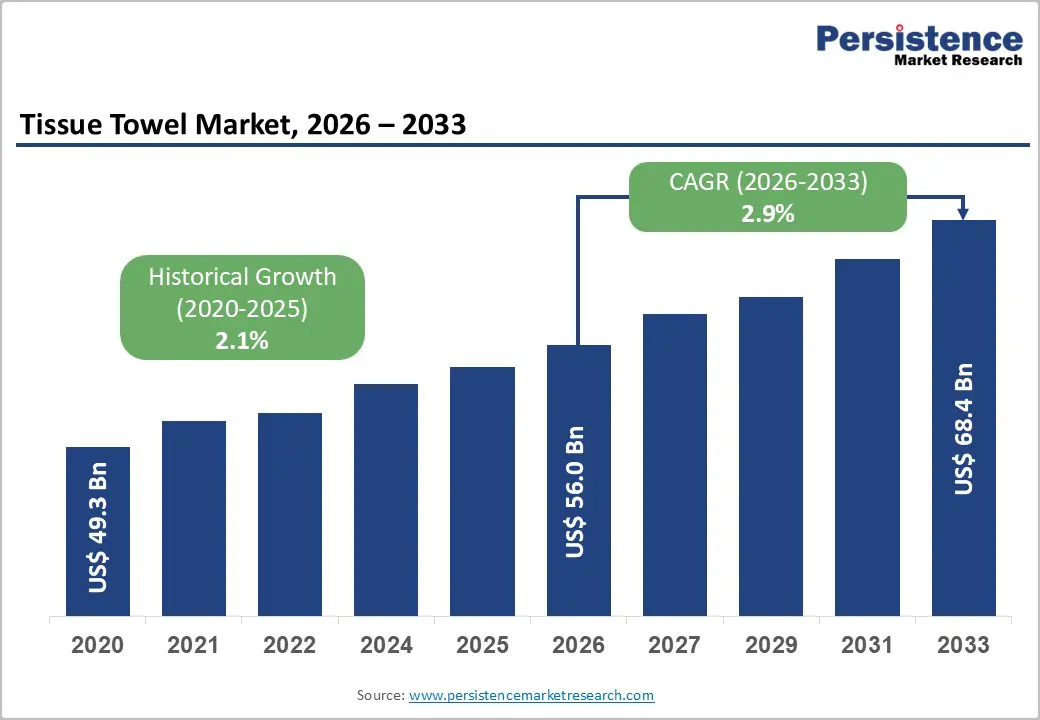
The global tissue towel market size is likely to be valued at US$56.0 billion in 2026, and is expected to reach US$68.4 billion by 2033, growing at a CAGR of 2.9% during the forecast period from 2026 to 2033, driven by the increasing prevalence of hygiene awareness, rising demand for convenient disposable paper products in households and commercial spaces, and growing preference for premium and eco-friendly tissue towels.
Rising demand for high-quality tissue towels, particularly roll towels, is driven by home and healthcare use. Innovations in sustainable pulp, recycled content, and embossed designs enhance absorbency and eco-friendliness, while growing awareness of hygiene and infection control boosts adoption.
Key Industry Highlights:
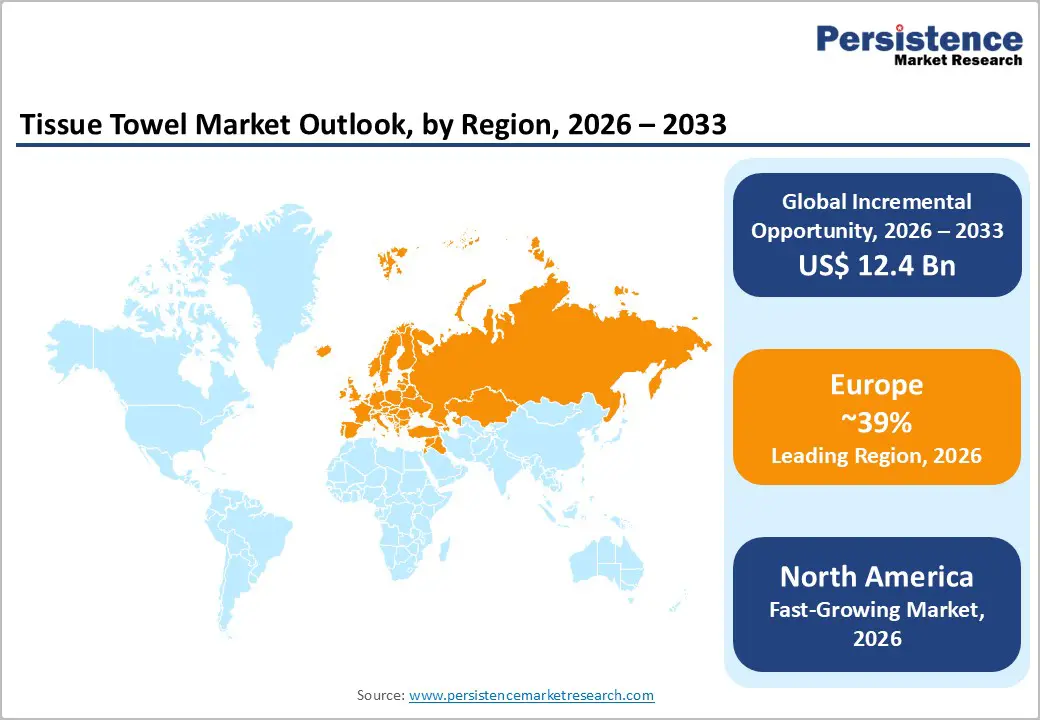
- Leading Region: Europe with a 39% share, driven by rising awareness of hygiene and sustainability, robust regulatory frameworks, and government initiatives promoting circular economy programs.
- Fastest-growing Region: North America, supported by stringent hygiene standards, strong demand for premium products, and widespread public awareness of the convenience offered by disposable items.
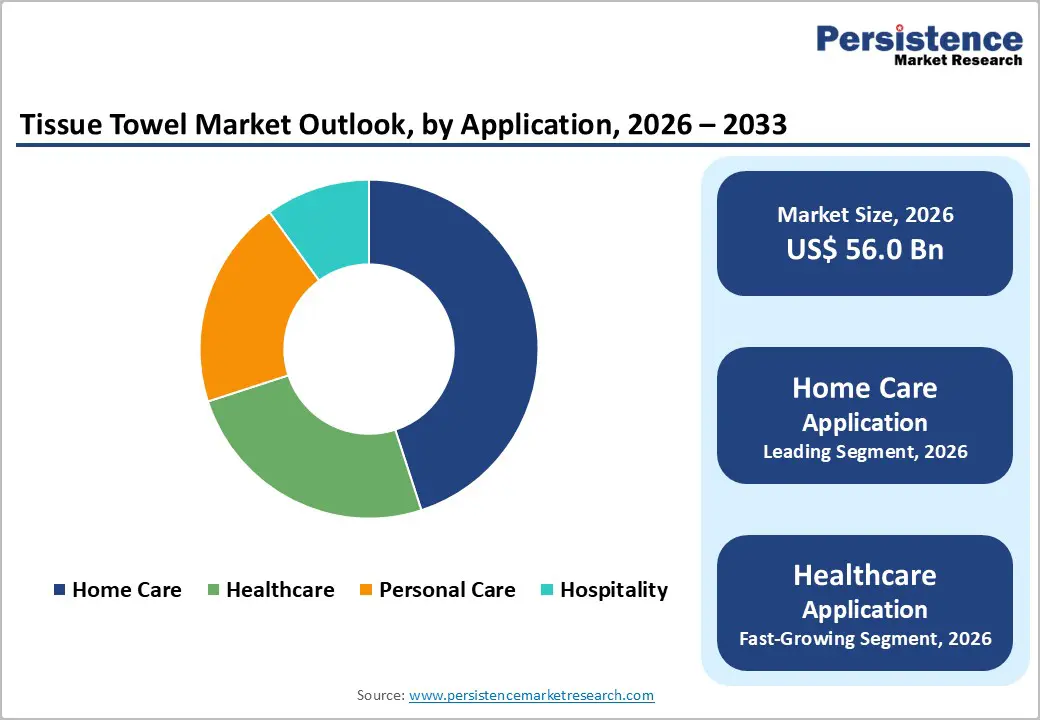
- Dominant Product Type: Roll towel, to hold approximately 55% of the market share, as it remains the most widely used format in households and commercial settings.
- Leading Application: Home care, contributing nearly 48% of the market revenue, due to the highest everyday consumption volume.
| Key Insights | Details |
|---|---|
|
Tissue Towel Market Size (2026E) |
US$56.0 Bn |
|
Market Value Forecast (2033F) |
US$68.4 Bn |
|
Projected Growth CAGR (2026-2033) |
2.9% |
|
Historical Market Growth (2020-2025) |
2.1% |
Market Factors - Growth, Barriers, and Opportunity Analysis
Growth Analysis - Rising Hygiene Awareness and Urbanization
Growing attention to personal and household cleanliness has shaped everyday purchasing habits in cities, where exposure to public transport, shared workplaces, and dense living spaces has normalized the use of disposable hygiene products. Paper towels and facial tissues are increasingly preferred for hand drying, surface wiping, and food-contact hygiene in urban homes, offices, schools, and food outlets. Public messaging on infection prevention has reinforced routine hand hygiene and surface sanitation, lifting demand for convenient, single-use paper products. In India, handwashing with soap after contact with contaminants was reported by 85% of urban residents in the National Family Health Survey (NFHS-5, 2019–21) published by the Ministry of Health and Family Welfare, Government of India. This sustained practice pattern translates into higher consumption of tissue towels across daily touchpoints.
Urbanization has expanded the addressable consumer base for tissue towels through higher household incomes, compact living spaces, and organized retail access. City lifestyles favor quick-clean solutions for kitchens, bathrooms, and on-the-go use, supporting steady volume growth in disposable paper formats. Urban growth also brings more commercial demand from restaurants, clinics, offices, and transport hubs that standardize paper towels for hygiene compliance and waste management. India’s urban population share reached 35.4% in 2023 as reported by the Office of the Registrar General & Census Commissioner, Government of India, reflecting a larger concentration of consumers with frequent exposure to shared surfaces and services.
Commercial and Institutional Demand
Restaurants, cafés, hospitals, clinics, offices, and educational campuses have standardized disposable paper products to meet hygiene protocols in food handling, patient care, and shared restrooms. Tissue towels are favored for hand drying and surface wipe-downs where rapid turnover and contamination control are required. Routine sanitation schedules in commercial kitchens and healthcare wards increase daily consumption volumes, while compliance audits encourage consistent replenishment. In India, food safety rules mandate hygienic handwashing and cleanable food-contact surfaces in licensed food establishments, reinforcing the use of disposable paper for drying and wiping tasks, as documented by the Food Safety and Standards Authority of India. In healthcare settings, infection-prevention guidance promotes single-use drying materials for hand hygiene to limit cross-contamination, sustaining recurring institutional demand.
Urban service expansion has widened the institutional footprint that depends on tissue towels for operations, including transport terminals, malls, and coworking spaces. High footfall drives frequent restocking cycles and bulk procurement through organized supply chains, locking in predictable baseline demand. Government data show the scale of institutional use: the Ministry of Health and Family Welfare reported 1.94 million hospital beds in India in 2022, indicating extensive daily hand hygiene events across care facilities. Education infrastructure also adds volume; the Ministry of Education recorded over 1.48 million schools nationwide in 2021–22, each requiring routine restroom and classroom cleaning supplies. This breadth of public-serving facilities sustains steady tissue towel consumption without reliance on discretionary household spending.
Barrier Analysis - Waste Management and Landfill Burden
Disposal pressure from municipal solid waste systems constrains growth for disposable paper products in dense cities. Tissue towels add to mixed waste streams that require collection, transport, and landfilling or controlled processing, raising service costs for local bodies and commercial facilities. India’s Central Pollution Control Board reported 160,038 tonnes per day of municipal solid waste generated in 2020–21, a volume that stretches landfill capacity and drives tighter procurement rules for consumables in offices, malls, hospitals, and transit hubs. Procurement teams respond by rationing paper use, promoting air dryers, or shifting to cloth options to reduce waste loads and disposal fees.
Landfill capacity constraints in developed waste systems also shape purchasing policies for institutions with sustainability targets. Paper towels contribute to bulk waste that occupies landfill space and raises hauling costs, prompting facility managers to limit dispensers and set usage controls. The U.S. Environmental Protection Agency reported 17.2 million tons of paper and paperboard were landfilled in 2018, signaling ongoing pressure on disposal infrastructure and landfill management programs. Such data underpin waste-reduction mandates and green procurement standards across public buildings, airports, and universities, where single-use paper faces tighter scrutiny. These constraints temper volume growth and favor investments in waste-minimizing hygiene solutions.
Sustainability Pressure and Plastic Substitution
Public policy and corporate ESG commitments are reshaping material choices in hygiene products. Cities are tightening rules on waste reduction, recycling targets, and procurement standards for public buildings, transport hubs, and hospitals. These measures elevate scrutiny on single-use items, pushing buyers to evaluate lifecycle impacts such as fiber sourcing, water use, and post-use disposal. Brands face pressure to certify sustainable forestry, cut basis weight, and redesign packaging for recyclability. Retailers and institutions adopt supplier scorecards tied to emissions and waste metrics, which filter shelf space and contracts toward products with verifiable sustainability claims. This climate raises compliance costs and lengthens product qualification cycles for tissue towel suppliers.
Plastic substitution trends also reshape demand patterns. As plastic cutlery, wipes, and packaging face restrictions, paper formats gain attention as alternatives for food service and cleaning. The shift expands opportunities for tissue towels in spill control and hand drying, yet it also invites stricter performance expectations and environmental claims. Buyers seek compostable grades, lower linting, and certified sourcing to justify switching materials. Operational teams pilot air dryers and reusable cloths to curb waste streams, placing price and performance pressure on paper options. Net growth depends on meeting sustainability criteria at scale while holding cost competitiveness across institutional channels.
Opportunity Analysis - Growth in Sustainable and Premium Tissue Towels
The shift toward environmentally responsible and premium tissue towels presents a strong opportunity in the market as consumers and institutions increasingly prioritize sustainable consumption and product performance. Certified eco-friendly products help brands differentiate offerings by appealing to buyers who factor environmental impact into purchase decisions. Government-endorsed labelling frameworks such as India’s Eco-mark scheme for environment-friendly products provide a recognized benchmark for sustainability, encouraging manufacturers to innovate and promote lower-impact products to discerning consumers.
Institutional and municipal policies that emphasize recycling and resource conservation amplify this opportunity for sustainable tissue towels. According to the U.S. Environmental Protection Agency, approximately 46 million tons of paper and paperboard were recycled in 2018, achieving a recycling rate of about 68.2 percent, illustrating structural support for circular materials and waste diversion efforts. Premium tissue towels that incorporate recycled content, enhanced absorbency, or compostable design can benefit from such frameworks by aligning with broader sustainability goals while commanding higher price points. Market uptake is also supported by institutional buyers seeking certified, high-performance supplies for green buildings, healthcare, and hospitality sectors, where sustainability and quality criteria are integral to procurement decisions.
Expansion in E-commerce and Modern Retail Channels
Growth of e-commerce and modern retail channels is creating a meaningful opportunity for tissue towel manufacturers to reach a wider set of buyers with convenience and choice. Online marketplaces provide 24/7 access to a broad assortment of paper products, enabling consumers to compare brands, grades, and pack sizes before purchase. Digital platforms support subscription-based buying and auto-replenishment options that reduce the friction of repeat orders for household tissue towels. This ease of purchase drives higher purchase frequency and encourages trial of premium and value-added variants such as multi-layer or scented paper towels. E-commerce also enables smaller brands to scale quickly by tapping into national logistics networks without large upfront investments in physical stores.
Modern retail outlets such as supermarkets, hypermarkets, and organized grocery chains contribute to volume growth through prominent shelf space and in-store promotions. These formats allow for bulk buying, combo packs, and visibility that traditional mom-and-pop channels cannot easily replicate. Retailers increasingly use data insights to tailor assortments to local demand patterns, improving sell-through rates for tissue towel categories. Modern outlets also facilitate coordinated marketing campaigns across cities, which boosts brand awareness and trial. For institutional and commercial buyers, modern retail chains simplify procurement with defined SKUs and consistent supply, reducing lead times.
Category-wise Analysis
Product Type Insights
Roll towel is anticipated to dominate the market, accounting for approximately 55% of the market share in 2026. Its dominance is driven by its fit in high-traffic environments that prioritize hygiene, speed, and cost control. Continuous rolls enable controlled dispensing, reduce hand contact with shared surfaces, and cut wastage through portioned sheets. Facilities such as offices, hospitals, restaurants, and transit hubs favor roll formats for rapid turnover and easier maintenance of dispensers. Bulk procurement lowers unit costs, supporting large-scale deployment across washrooms and kitchens. Compact storage and longer replacement cycles reduce labor time for housekeeping teams. Kimberley Clark Professional India’s Scott Rolled Towel System boosts hygiene without compromising on efficiency. It is designed to work in perfect harmony with the trusted Scott® branded hand towels. These washroom dispensers are designed to support hygiene standards and deliver a consistent washroom solution suited to your workplace hygiene needs. The system pairs innovation and style with exceptional performance.
Folded towel represents the fastest-growing product type, due to their suitability for premium and controlled usage environments. Their pre-cut format simplifies dispensing, reduces over-use, and enhances user experience in settings such as upscale offices, boutique hotels, and medical clinics. Folding allows for compact storage and easy placement in countertop or wall-mounted dispensers, supporting neat presentation and efficient restocking. Kleenex Multi-Fold Paper Towels and Tork Xpress® Soft Multifold Hand Towel are widely supplied folded paper towels designed for use with dispensers in office washrooms, hotels, restaurants, and clinics. Their multifold format allows controlled one-at-a-time dispensing, which helps reduce waste and improve hygiene by limiting contact with unused sheets, a key requirement in premium and high-traffic environments such as corporate buildings and hospitality facilities.
Application Insights
Home care is expected to dominate the market, contributing nearly 48% of revenue in 2026, supported by daily household routines that drive steady, high-frequency consumption of tissue towels. Kitchens, dining areas, and bathrooms generate repeated needs for spill control, surface wiping, and hand drying, creating consistent replenishment cycles. Smaller pack sizes and multipacks suit pantry storage and routine grocery purchases, lifting basket value and repeat buys. Rising preference for convenient, disposable cleaning aids supports penetration across apartments and nuclear families. Product innovations such as higher absorbency, softer textures, and recyclable packaging strengthen brand loyalty in home settings. Beco Eco-Friendly Bamboo Kitchen Towel Pack of 2, which targets eco-aware households looking for sustainable, reusable towel alternatives for daily cleaning. These products appeal to families who want effective absorbency for kitchen spills while reducing environmental impact, reinforcing routine tissue towel purchases at home.
Healthcare represents the fastest-growing application, stimulated by strict hygiene and infection-prevention protocols in medical facilities. Clinics, hospitals, diagnostic centers, and care homes use disposable paper towels for hand drying, surface cleaning, patient contact points, and ancillary areas to limit cross-contamination. Single-use towels reduce the risk of pathogen transfer compared with reusable cloths, aligning with sanitation standards in patient care zones and procedural areas. Rising healthcare infrastructure and increased outpatient visits amplify daily consumption rates. Centers for Disease Control and Prevention guidance on clinical hand hygiene specifically instructs that after washing hands with soap and water in healthcare settings, staff should use disposable towels to dry hands and then use those towels to turn off the faucet, reinforcing single-use paper towels’ role in clinical sanitation practice.
Regional Insights
North America Tissue Towel Market Trends
North America is likely to be the fastest-growing region in 2026, powered by the region’s high hygiene standards, strong premium consumption, and high public awareness of disposable convenience benefits. Distribution systems in the U.S. and Canada provide extensive support for tissue towel programs, ensuring wide accessibility across roll towel, home care, and hypermarkets/supermarkets populations. Increasing demand for premium, convenient, and easy-to-use forms is further accelerating adoption, as these formats improve daily hygiene and reduce barriers associated with cloth towels.
Innovation in tissue towel technology, including stable recycled-content, improved embossed delivery, and targeted healthcare enhancement, is attracting significant investment from both public and private sectors. Government initiatives and CDC campaigns continue to promote use against hygiene risks, sustainability concerns, and emerging premium threats, creating sustained market demand. The growing focus on folded towel grades and specialty uses, particularly for home care and others, is expanding the target applications for tissue towels.
Europe Tissue Towel Market Trends
Europe is projected to lead with a market share of 39% in 2026, fueled by increasing awareness of hygiene and sustainability benefits, strong regulatory systems, and government-led circular economy programs. Countries such as Germany, France, the United Kingdom, and Italy have well-established retail and tissue frameworks that support routine tissue towel use and encourage adoption of innovative recycled-content delivery methods. These high-quality formulations are particularly appealing for home care populations, regulation-conscious retailers, and healthcare users, improving absorbency and coverage rates.
Technological advancements in tissue towel development, such as enhanced recycled pulp, application-targeted delivery, and improved premium grades, are further boosting market potential. European authorities are increasingly supporting research and trials for towels against both routine and specialized needs, strengthening market confidence. The growing emphasis on convenient, eco-friendly options is aligned with the region’s focus on preventive waste reduction and hygiene compliance. Public awareness campaigns and promotion drives are expanding reach in both hypermarkets/supermarkets and online stores segments, while suppliers are investing in sustainable fibers and novel variants to increase efficacy.
Asia Pacific Tissue Towel Market Trends
Asia Pacific is witnessing rising hygiene awareness, increasing government initiatives, and expanding application programs across the region. Countries such as China, India, Indonesia, and Thailand are actively promoting tissue towel campaigns to address urban growth and emerging hygiene needs. Tissue towels are particularly attractive in these regions due to their cost-effective administration, ease of adoption, and suitability for large-scale home care and modern trade drives in both urban and semi-urban populations.
Technological advancements are supporting the development of stable, effective, and easy-to-use tissue towels, which can withstand challenging climatic conditions and minimize irritation dependence. These innovations are critical for reaching domestic retailers and improving overall hygiene coverage. Growing demand for roll towels, home care, and hypermarkets/supermarkets applications is contributing to market expansion. Public-private partnerships, increased consumer expenditure, and rising investment in tissue towel research and production capacity are further accelerating growth. The convenience of tissue towel delivery, combined with improved absorbency and reduced risk of infection, positions it as a preferred choice.
Competitive Landscape
The global tissue towel market shows intense competition between established multinational leaders and fast-growing sustainable challengers. In North America and Europe, Essity and Kimberly-Clark Worldwide maintain leadership through strong R&D capabilities, deep distribution networks, and long-standing brand relationships with retailers and institutions. Their portfolios are strengthened by continuous innovation in roll towel systems and premium, high-absorbency grades tailored for households, offices, healthcare facilities, and foodservice outlets. These offerings improve everyday convenience, reduce wastage through controlled dispensing, and support large-scale integration across modern retail and commercial washrooms.
In Asia Pacific, regional manufacturers gain traction with cost-competitive products that expand access across price-sensitive households and small businesses, widening category penetration. Strategic partnerships, collaborations, and acquisitions help global and regional players combine technical expertise, expand product portfolios, and accelerate market entry in new geographies. Investment in recycled fiber formulations and certified sourcing addresses sustainability expectations, supporting adoption in eco-conscious consumer segments and institutional procurement programs.
Key Industry Developments:
- In October 2025, Kimberly-Clark Professional launched the ReNew™ program, building on RightCycle™ to enhance waste recovery and advance circular practices across its products.
- In September 2025, Essity expanded its coreless technology into new markets, eliminating cardboard tubes, extending roll life, reducing waste and CO2, and improving recyclability for products like Lotus Just-1 in France.
Companies Covered in Tissue Towel Market
- Kruger Inc.
- Wepa
- Cascades Inc.
- Georgia-Pacific
- Metsä Group
- Procter & Gamble
- KCWW
- Essity Aktiebolag
- Celtex S.p.A.
- Lucart S.p.A.
- Sofidel
- APP (Asia Pulp & Paper)
- MP Hygiene
- Vinda International Holdings Limited
- Softys
Frequently Asked Questions
The global tissue towel market is projected to reach US$56.0 billion in 2026.
Routine handwashing, surface sanitation, and food-contact hygiene in homes, healthcare, offices, and foodservice settings drive steady, repeat demand for disposable tissue towels.
The tissue towel market is poised to witness a CAGR of 2.9% from 2026 to 2033.
Rising preference for recycled fiber, certified sourcing, and higher-absorbency products opens premium pricing and differentiation opportunities across households and institutional buyers.
Essity Aktiebolag, KCWW, Procter & Gamble, Georgia-Pacific, and Sofidel are the key players.


