




- Healthcare Services
- Tissue and Organ Transplantation Services Market
Tissue and Organ Transplantation Services Market Size, Share, and Growth Forecast, 2026 - 2033
Tissue and Organ Transplantation Services Market By Transplant Type (Kidney Transplantation, Lung Transplantation, Others), Donor Source (Deceased Donor, Living Donor, Others), Service, End User and Regional Analysis for 2026 - 2033

Tissue and Organ Transplantation Services Market Size and Trends Analysis
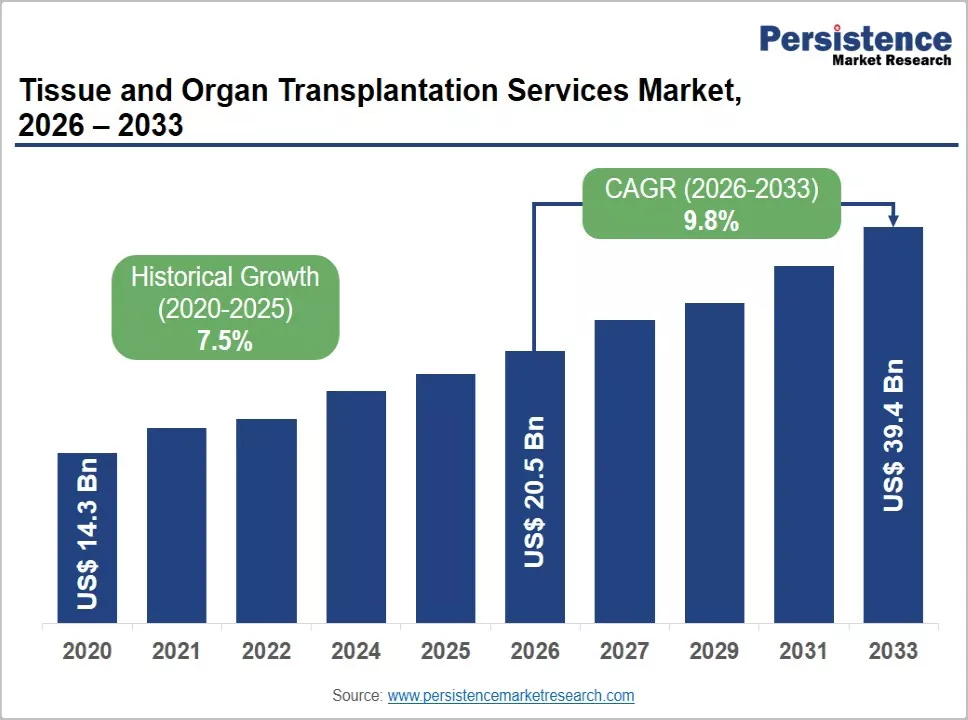
The global tissue and organ transplantation services market size is likely to be valued at US$20.5 billion in 2026 and is expected to reach US$39.4 billion by 2033, growing at a CAGR of 9.8% between 2026 and 2033, driven by the rising burden of end-stage organ failure, record transplant volumes in major health systems, and wider use of organ preservation technologies.
Health systems are increasingly investing in transplant programs, donor management, and lifelong patient follow-up to narrow the gap between the number of patients awaiting organs and the number of organs available.
Key Industry Highlights
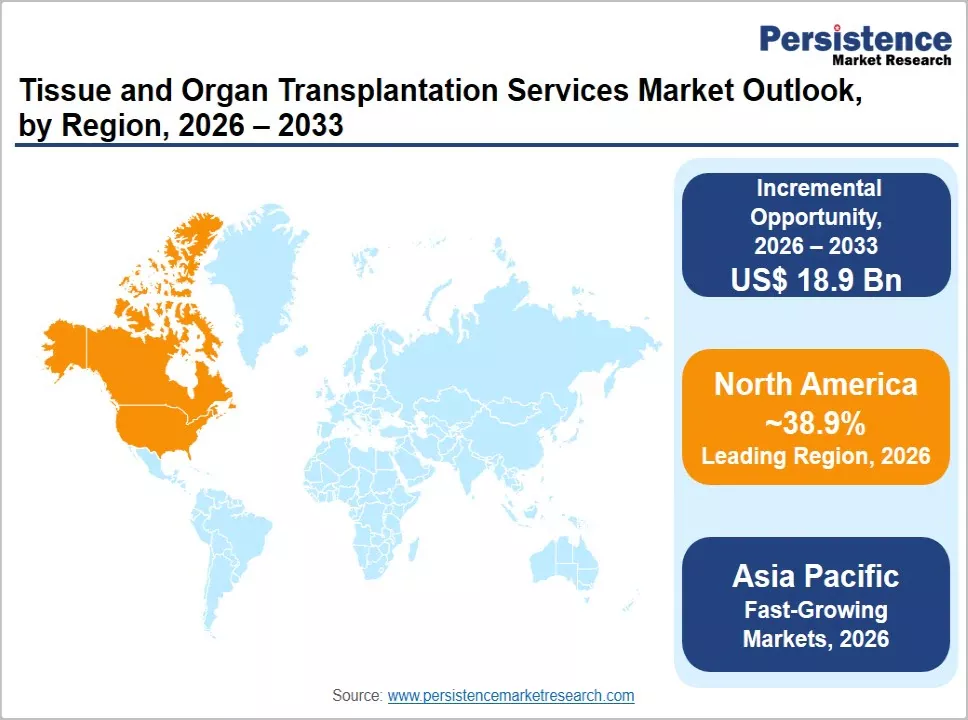
- Leading Region: North America, anticipated to account for 38.9% of the market share, supported by high transplant volumes, established organ allocation networks, and strong investment in organ preservation technologies.
- Fastest-growing Region: Asia Pacific, driven by expanding transplant programs in India and China, high living-donor activity, and government-led efforts to build deceased-donor networks.
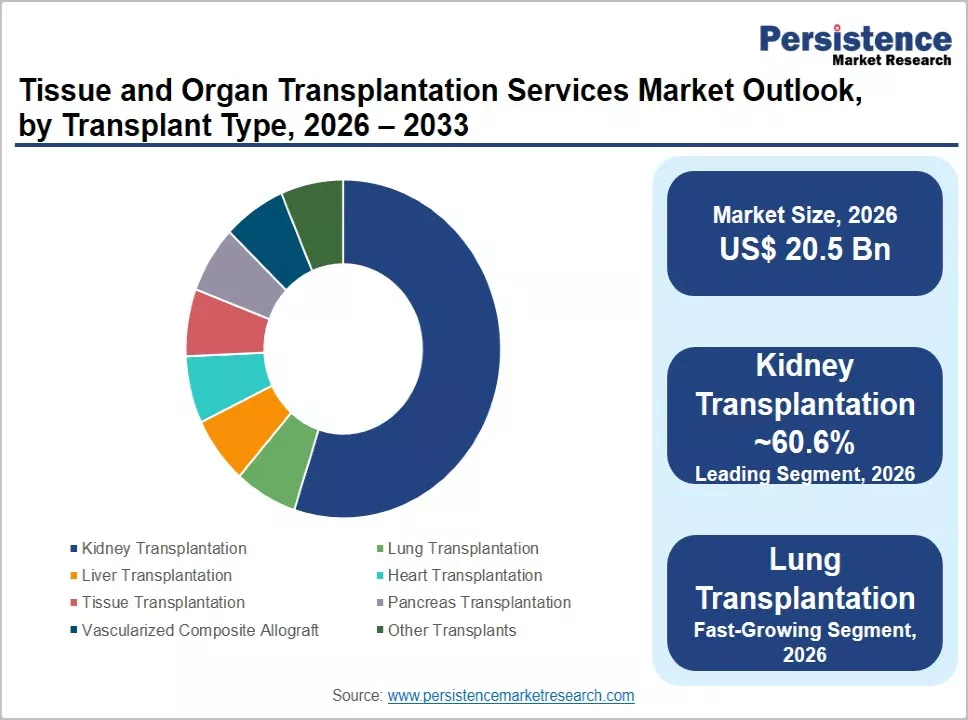
- Dominant Transplant Type: Kidney transplantation, anticipated to hold 60.6% of the market revenue, driven by the large population with end-stage kidney disease and the higher number of kidney procedures compared with other organs.
- Leading Donor Source: Deceased donors, anticipated to account for 68.3% of the market share, supported by national allocation systems and the expansion of donation after circulatory death.
DRO Analysis
Drivers - Growing Organ Failure Burden and Record Transplant Activity Are Expanding Service Demand
Demand for transplantation services is rising as chronic kidney, liver, heart, and lung diseases increase the number of patients who need organ replacement. According to the Global Observatory on Donation and Transplantation (GODT), approximately 173,727 solid organ transplants were performed worldwide in 2024, the highest number reported to date, yet this meets 10% or less of global needs. In the United States, the Organ Procurement and Transplantation Network (OPTN) recorded more than 49,000 transplants in 2025, the fifth consecutive annual record.
Government programs are also supporting volume growth. The U.S. Centers for Medicare & Medicaid Services (CMS) began the mandatory Increasing Organ Transplant Access (IOTA) Model in July 2025, linking hospital payments to kidney transplant volume, organ offer acceptance, and quality. Such reforms convert unmet clinical need into funded demand for surgery, donor management, and post-transplant care across transplant hospitals.
Organ Preservation and Perfusion Technologies Are Expanding the Usable Donor Pool
Machine perfusion and portable organ care systems keep donor organs viable for longer periods and allow clinicians to assess organ function before transplantation. TransMedics reported 5,139 U.S. cases using its Organ Care System in 2025, representing 26% of total U.S. heart, liver, and lung transplants. OrganOx reports that its normothermic perfusion technology has been involved in more than 7,500 transplants.
These technologies are supporting the growth of donation after circulatory death, which accounted for 28% of deceased donation activity worldwide in 2024, according to GODT. Higher organ utilization increases the number of procedures performed per donor and raises demand for preservation, logistics, and procurement services.
Restraint - Donor Organ Shortage and Organ Discard Limit Transplant Volumes
The gap between organ supply and demand remains the main structural constraint for the market. In the United Kingdom, family consent for organ donation fell from 69% in 2020/21 to 57% in 2025/26, while the active waiting list reached a record of approximately 8,300 patients in March 2026, according to NHS Blood and Transplant (NHSBT). In Germany, relatives made the donation decision in 64.5% of cases in 2025 because the deceased had not documented a personal decision, according to Deutsche Stiftung Organtransplantation (DSO).
Organ discard adds to this constraint. An evaluation of the CMS IOTA Model by the American Institutes for Research notes that approximately one-third of transplantable kidneys recovered each year in the United States are discarded. Lifelong immunosuppression, high procedure costs, and uneven access to transplant centers in lower-income regions further restrict the number of patients who reach transplantation, limiting revenue growth even where clinical need is high.
Opportunities - Xenotransplantation and Next-generation Preservation Create New Organ Supply Pathways
One of the most significant opportunities in the market is the development of new organ supply sources. By September 2025, the U.S. Food and Drug Administration (FDA) had approved eGenesis to begin a clinical study of gene-edited pig kidney transplants in 30 patients aged 50 or older who are on dialysis and on the transplant list, while United Therapeutics prepared to enroll patients in a similar FDA-approved study.
Preservation technology is advancing in parallel. TransMedics is developing OCS Kidney on its Gen 3.0 platform, with a U.S. trial targeted by early 2027, and OrganOx has a kidney perfusion device under development with commercialization targeted around 2030. Kidney transplantation represents 60.6% of market revenue, so progress in this segment expands the procedure base for surgical, logistics, and follow-up services.
Category-wise Analysis
Transplant Type Insights
Kidney transplantation is anticipated to account for 60.6% of the market revenue. The segment includes surgery, donor matching, and follow-up care for patients with end-stage kidney disease. According to GODT, kidney procedures made up 110,467 of the 173,727 solid organ transplants performed worldwide in 2024, approximately 64%. For example, the United States performed 27,573 kidney transplants in 2025, of which 21,052 used deceased donors and 6,521 used living donors. The CMS IOTA Model, which covered 103 kidney transplant hospitals in its first performance year, is further supporting volume and care coordination.
Lung transplantation is anticipated to be the fastest-growing transplant type at a CAGR of 9.11%, driven by wider use of ex vivo lung perfusion and donation after circulatory death. For example, TransMedics received FDA approval for its OCS DENOVO Lung trial, and Cedars-Sinai performed a record 93 lung transplants in 2025, compared with 88 in 2024. Liver, heart, tissue, pancreas, and vascularized composite allograft procedures account for the remaining demand, with U.S. liver transplants reaching a record 12,344 in 2025.
Donor Source Insights
Deceased donors are anticipated to account for 68.3% of the market share. National allocation networks such as OPTN in the United States, Eurotransplant in Europe, and NHSBT in the United Kingdom route organs from deceased donors to listed patients. GODT recorded 47,180 deceased donors worldwide in 2024, of which 33,814 were donation after brain death and 13,366 were donation after circulatory death. In the United States, deceased donors supplied 21,052 of the 27,573 kidney transplants performed in 2025.
Living donors are anticipated to be the fastest-growing donor source at a CAGR of 9.2%, supported by scheduled surgery, shorter waiting times, and the adoption of robotic donor surgery. The United States recorded 7,237 living organ donors in 2025, a 3% increase over 2024, and living-donor liver transplants rose 17% to 709. Cedars-Sinai performed a record 80 robotically assisted living-donor kidney transplants in 2025. In India, living donors account for approximately 82% of transplants, according to NOTTO data.
Service Insights
Transplant surgery is the leading service component, covering recipient surgery, donor surgery, and the inpatient care around the procedure. Revenue is concentrated in high-volume transplant programs. For example, Mayo Clinic performed 2,065 solid organ transplants across its Arizona, Florida, and Minnesota campuses in 2025, compared with 2,006 in 2024, while Cedars-Sinai completed 677 solid organ transplants in the same year.
Post-transplant care and immunosuppression management is anticipated to be the fastest-growing service category because recipients require lifelong monitoring, medication management, and rejection surveillance. Each additional transplant adds to the number of patients under long-term follow-up. For example, the CMS IOTA Model scores participating hospitals on post-transplant outcomes and allows support such as transportation and in-home care during the post-transplant period. Organ preservation and perfusion, donor matching and procurement, and transplant diagnostics and compatibility testing complete the service mix.
End User Insights
Hospitals are anticipated to account for 55.8% of the market revenue, as solid organ transplantation requires intensive care units, multidisciplinary surgical teams, blood bank services, and laboratory support. For example, 43 transplant centers in Germany performed 3,256 transplants in 2025, and Mayo Clinic recorded 2,065 transplants across three campuses in the United States.
Ambulatory clinics and surgical centers are anticipated to be the fastest-growing end user at a CAGR of 12%, as pre-transplant evaluation, living donor screening, post-transplant monitoring, laboratory testing, and medication management move to outpatient settings. Specialized transplant centers, organ procurement organizations, and organ and tissue banks account for the remaining demand, supporting organ recovery, tissue processing, storage, and distribution.
Regional Insights
North America Tissue and Organ Transplantation Services Market Trends
North America is anticipated to account for approximately 38.9% of the market share, supported by the highest transplant rate per population among reporting countries. GODT data show that the United States recorded 139.68 transplanted organs per million population in 2023, the highest globally, while Canada recorded 89.02. Transplant hospitals, organ procurement organizations, and preservation companies are investing in logistics and perfusion technology to increase organ utilization.
U.S. Tissue and Organ Transplantation Services Market Trends
The United States remains the dominant market in North America due to its large transplant network and high donation activity. According to the United Network for Organ Sharing (UNOS), 49,064 organ transplants were performed in 2025, a record for the fifth consecutive year, although deceased organ donations dipped. Kidney transplants totaled 27,573, which is 102 fewer than in 2024, while liver transplants reached a record 12,344. More than 109,000 people remain on the national waiting list, according to OPTN data.
Policy and technology developments are reshaping service delivery. In July 2025, CMS began the six-year IOTA Model with 103 kidney transplant hospitals in its first performance year. In the second quarter of 2026, TransMedics reported revenue of US$189.9 million, up 21% year over year, and raised its full-year 2026 revenue guidance to US$737 million - US$757 million, reflecting the commercial scale of organ preservation and aviation logistics services.
Canada Tissue and Organ Transplantation Services Market Trends
Canada represents an important secondary market, supported by publicly funded transplant programs and provincial donation organizations. The Canadian Institute for Health Information (CIHI) reported 3,203 transplants performed in 2024, while 4,044 patients were on the waiting list at the end of that year. In 2023, 83% of transplants used deceased donor organs and 17% used living donor organs. Health Canada, CIHI, and Canada Health Infoway are building a pan-Canadian data and performance reporting system intended to reduce manual data entry and support interprovincial organ transfers.
Europe Tissue and Organ Transplantation Services Market Trends
Europe is a mature market characterized by established national transplant organizations, cross-border organ exchange, and a growing shift toward opt-out consent. Data compiled from GODT show that Europe reported approximately 28,000 kidney transplants in 2024. Spain recorded 123.43 transplanted organs per million population in 2023, the second-highest rate globally after the United States.
Germany Tissue and Organ Transplantation Services Market Trends
Germany represents a major European market because of its large hospital base and participation in the Eurotransplant network of eight countries. According to DSO, 985 people donated organs after death in 2025, a 3.4% increase and the highest number since 2012, equal to 11.8 donors per million inhabitants. The 43 transplant centers performed 3,256 transplants in 2025, compared with 3,013 in 2024, including 2,266 kidney transplants, of which approximately 30% came from living donors.
At the end of 2025, 8,199 patients were on the active waiting list. Germany applies an explicit consent system, and DSO has welcomed renewed political discussion on an opt-out model. The gap between donation and demand supports investment in donor identification, hospital coordination, and perfusion technologies that raise the number of usable organs.
United Kingdom Tissue and Organ Transplantation Services Market Trends
The United Kingdom remains an important market for transplant services and organ preservation innovation. NHSBT reported 4,666 organ transplants in 2025/26, a 2% increase over the previous year, including 2,294 kidney transplants. Deceased organ donors totaled 1,428, up 2%, and living donors accounted for more than 40% of organ donations in 2024/25. Opt-out consent is now law in all four nations, yet family consent has fallen to 57%, and approximately 8,300 patients are on the active waiting list.
A notable industry development occurred in October 2025 when Terumo Corporation completed its acquisition of OrganOx, an Oxford University spinout, for approximately US$1.5 billion. The transaction is the largest acquisition of an Oxford spinout to date and highlights the role of the United Kingdom as a source of organ perfusion technology.
Asia Pacific Tissue and Organ Transplantation Services Market Trends
Asia Pacific is anticipated to be the fastest-growing regional market due to expanding transplant programs, large patient populations, and government-led donation frameworks. According to GODT data, the Western Pacific region reported approximately 21,000 kidney transplants in 2024, while India alone performed 14,477 kidney transplants in 2025. Growth in deceased-donor programs, living-donor activity, and hospital capacity is increasing demand for transplant surgery, preservation, and follow-up services.
India Tissue and Organ Transplantation Services Market Trends
India is emerging as a major growth market because of rising transplant volumes and strong living-donor activity. NOTTO reported a record 20,138 organ transplants in 2025, up from 18,911 in 2024, including 14,477 kidney and 5,154 liver transplants. Deceased-donor transplants rose from 837 in 2013 to 3,526 in 2025, supported by 1,235 deceased donors. India remains the world leader in living-donor transplants, with 16,614 living donors in 2025, of whom 68% were women.
Delhi-NCR recorded the highest number of transplants at 4,564, followed by Tamil Nadu with 2,796, while Tamil Nadu led deceased donation with 266 donors. Organ donation pledges verified through Aadhaar crossed five lakh, and the Transplantation of Human Organs and Tissues Act, 1994, together with NOTTO, provides the regulatory and coordination framework. The deceased donation rate remains below one per million population, which keeps the market concentrated in living-donor procedures.
China Tissue and Organ Transplantation Services Market Trends
China continues to build a regulated, citizen-driven donation system. Voluntary donation has been the only legal source of deceased-donor organs since 2015, and allocation runs through the China Organ Transplant Response System (COTRS) under the oversight of the National Health Commission and the Red Cross Society of China. In 2025, 187 hospitals were qualified for transplantation, including 117 for liver and 158 for kidney procedures.
The National Health Commission reported more than 6.7 million registered donation volunteers in May 2024. Government focus on organ procurement organizations, data oversight, and transplant center accreditation is supporting demand for perfusion devices, diagnostics, and post-transplant care, while the large patient population sustains long-term procedure growth.
Competitive Landscape
The global tissue and organ transplantation services market is fragmented, with competition occurring among academic medical centers, multi-specialty hospital groups, organ preservation technology companies, transplant diagnostics providers, and logistics specialists. Transplant surgery is delivered through many individual programs.
Hospitals compete on clinical outcomes, program volume, living-donor access, and the use of hard-to-place organs, while technology companies compete on organ viability time, clinical evidence, and logistics reach. Recent consolidation reflects this focus, including Getinge's acquisition of Paragonix for US$477 million and Terumo's acquisition of OrganOx for approximately US$1.5 billion. Companies are also adding aviation logistics, remote case support, and post-transplant monitoring to move from device sales toward integrated service models.
Key Industry Developments
- In October 2025, Terumo Corporation completed its acquisition of OrganOx for approximately US$1.5 billion, marking Terumo's entry into organ transplantation and adding the OrganOx metra liver perfusion platform to its portfolio.
- In July 2026, TransMedics completed its strategic investment in PAD Aviation, a Germany-based private aviation operator, supporting its plan to build National OCS Program logistics in Europe, starting with Italy.
Companies Covered in Tissue and Organ Transplantation Services Market
- Mayo Clinic
- Cleveland Clinic
- UPMC
- NYU Langone Health
- Johns Hopkins Medicine
- Cedars-Sinai Medical Center
- Apollo Hospitals Enterprise Ltd.
- TransMedics Group, Inc.
- Terumo Corporation (OrganOx)
- Getinge AB (Paragonix)
- XVIVO Perfusion AB
- CareDx, Inc.
- Organ Recovery Systems
- Bridge to Life Ltd.
Frequently Asked Questions
The global tissue and organ transplantation services market is projected to be valued at US$ 20.5 billion in 2026.
The market is expected to reach US$ 39.4 billion by 2033.
The market is expected to grow at a CAGR of 9.8% between 2026 and 2033.
Key trends include the adoption of machine perfusion and advanced organ preservation systems, growth in donation after circulatory death, expansion of living-donor transplantation, development of xenotransplantation, and increasing demand for long-term post-transplant care.
Major companies include TransMedics, XVIVO Perfusion, Terumo Corporation, Getinge, Organ Recovery Systems.


