




- Semiconductor Materials & Components
- Surface Mount Reed Relays Market
Surface Mount Reed Relays Market Size, Share, and Growth Forecast 2026 - 2033
Surface Mount Reed Relays Market by Configuration (Normally Open (Form A), Normally Closed (Form B), Changeover (Form C)), by Load Type (Signal Switching, Power Switching), by End-Use Industry (Automotive, Aerospace & Defense, Healthcare, IT and Telecommunications, Consumer Electronics, Industrial Automation, Others), by Regional Analysis, 2026-2033

Surface Mount Reed Relays Market Size and Trend Analysis
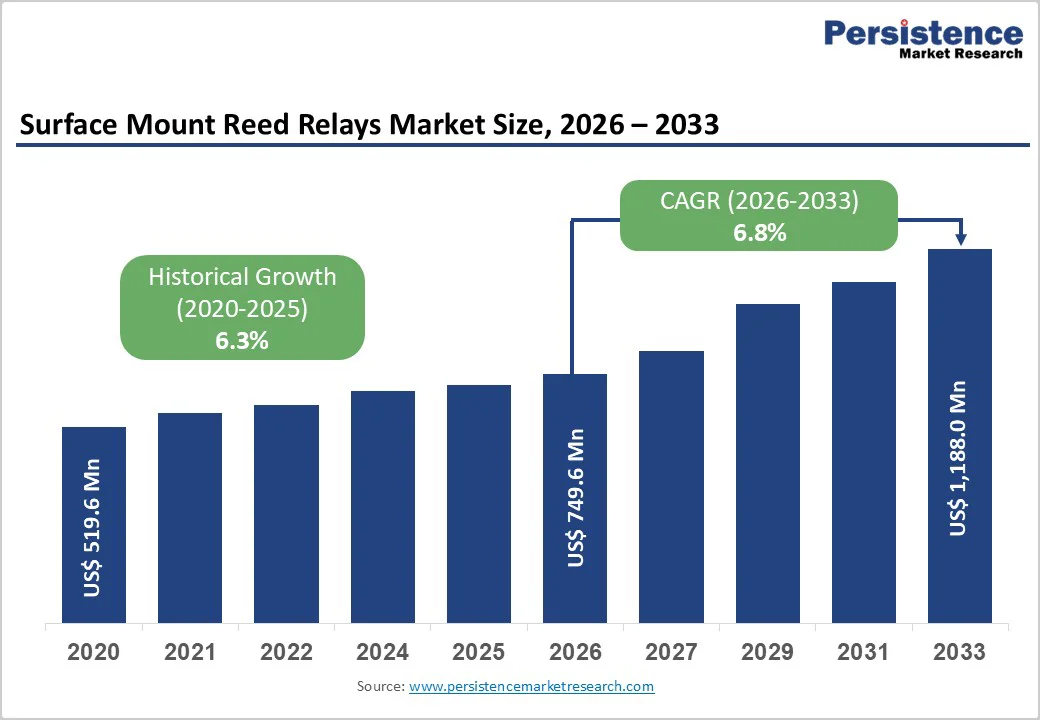
The global surface-mount reed relays market is expected to be valued at US$ 749.6 million in 2026 and is projected to reach US$ 1,188.0 million by 2033, growing at a CAGR of 6.8% between 2026 and 2033.
Growth is driven by escalating demand for highly reliable signal-switching components in test and measurement, telecommunications, automotive electronics, and medical devices, where miniaturization and high isolation are critical. Increasing deployment of 5G infrastructure, proliferation of advanced driver-assistance systems (ADAS), and expansion of automated test equipment (ATE) for complex semiconductors are driving OEMs and system designers toward compact, surface-mount reed solutions that offer long life, low contact resistance, and hermetic sealing. Historically, the broader reed relay and sensor ecosystem has delivered steady mid-single- to high-single-digit growth in line with electronics production, supporting a robust outlook.
Key Market Highlights
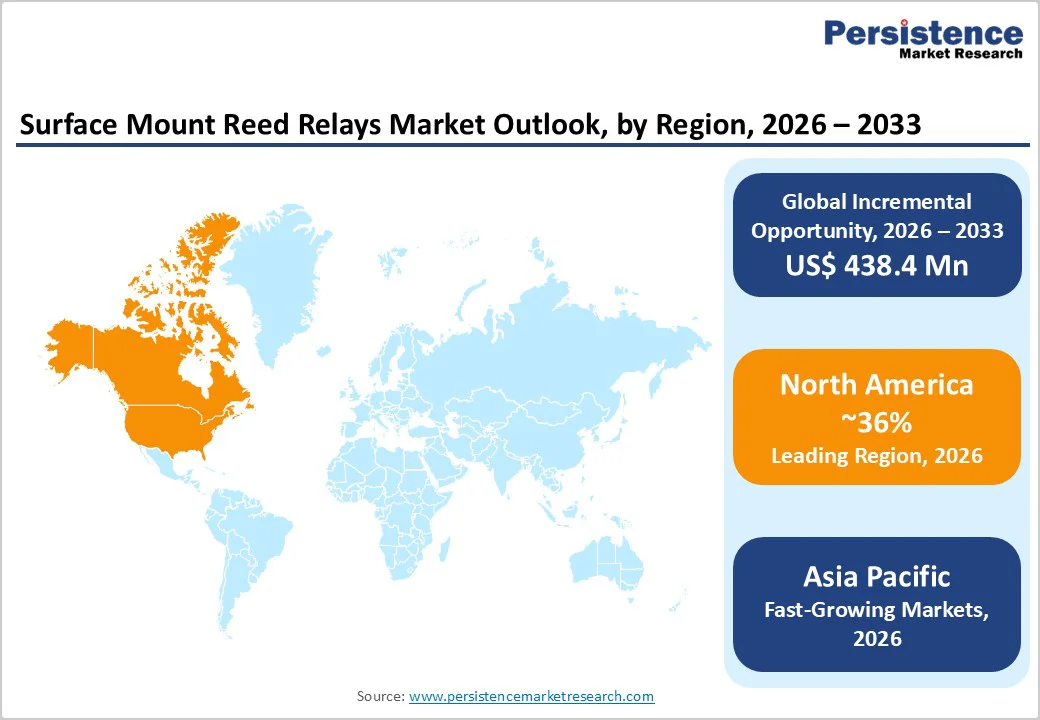
- Leading Region: North America leads the Surface Mount Reed Relays Market with around 36% share in 2025, supported by strong telecom, aerospace, semiconductor, and EV ecosystems, stringent safety standards, and high penetration of advanced test and measurement platforms.
- Fastest Growing Region: Asia Pacific is the fastest-growing region, expected to post about 7.4% a CAGR through 2033, driven by large electronics manufacturing bases, 5G rollout, and accelerating EV production in China, Japan, India, and ASEAN economies.
- Dominant Segment: Signal Switching is the dominant load-type segment, with a roughly 71% share in 2025, as precision test, telecom, medical, and instrumentation applications rely heavily on low-leakage, high-isolation surface-mount reed relays for critical signal paths.
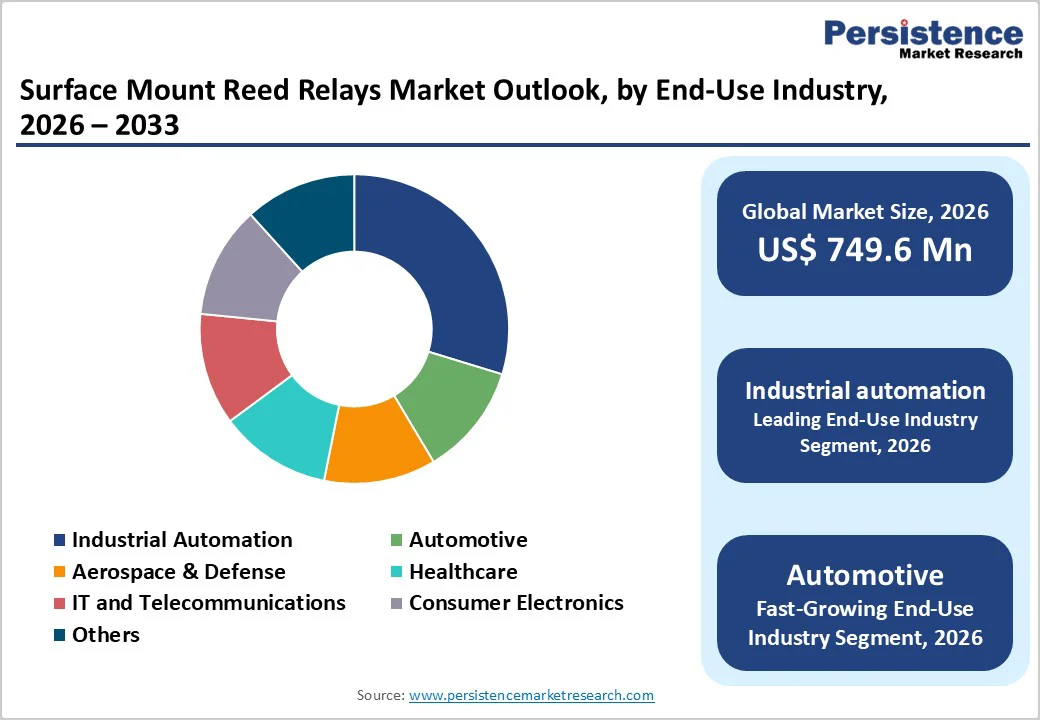
- Fastest Growing Segment: Automotive end use is the fastest-growing segment, with an estimated 8.1% CAGR through 2033, fueled by EV battery management, pre-charge, isolation monitoring, and ADAS electronics needing compact, high-voltage, and reliable relay solutions.
- Key Market Opportunity: High-density, miniaturized surface mount reed relays for ATE, RF test, and medical instrumentation offer a major opportunity as OEMs pursue more channels per board, higher isolation, and lower parasitics in compact, thermally efficient system designs.
| Global Market Attributes | Key Insights |
|---|---|
| Surface Mount Reed Relays Market Size (2026E) | US$ 749.6 million |
| Market Value Forecast (2033F) | US$ 1,188.0 million |
| Projected Growth CAGR (2026-2033) | 6.8% |
| Historical Market Growth (2020-2025) | 6.3% |
Market Dynamics
Market Growth Drivers
Proliferation of 5G, High-Speed Networking, and Test & Measurement
Rising investments in 5G and high-speed fiber networks are a key growth catalyst for surface-mount reed relays, which are widely used in RF switching, signal routing, and sophisticated test and measurement systems. In telecom infrastructure and semiconductor ATE, Reed relays provide fast switching in the hundreds of microseconds, high insulation resistance, and extremely low leakage, enabling precise characterization of high-speed ICs and RF front-ends.
With global 5G subscriptions projected to reach well over 1.9 billion users by 2025, test system density and reliability requirements are rising sharply, favoring miniaturized, surface-mount packages that save PCB area while maintaining performance. Vendors such as Pickering Electronics and Standex Electronics highlight surface-mount reed relays capable of switching up to 12.5 kV and operating to several GHz in compact footprints, making them indispensable in modern RF, broadband, and network test platforms.
Electrification of Automotive and Growth in Safety-Critical Systems
Rapid electrification of vehicles and broader adoption of ADAS, battery management, and safety-critical control architectures are driving strong demand for reed-based switching components in automotive electronics. High-voltage reed relays are increasingly deployed in pre-charge circuits for EV traction inverters and energy storage systems, safely managing inrush currents from 400 V up to 1,500 V DC while offering fast switching (< 1 ms) and high isolation. Their hermetically sealed construction and high insulation resistance support stable performance over millions of operations, making them attractive for isolation monitoring and diagnostic circuits in battery management systems.
Surface-mount variants enable designers to integrate these capabilities into dense automotive PCBs, aligning with the industry shift toward compact, power-dense electronics modules. The continued growth of global EV sales beyond 17 million units in 2024 and the emphasis on functional safety standards (such as ISO 26262) underpin strong long-term adoption of surface mount reed relays in power electronics, charging, and on-board diagnostic applications.
Market Restraints
Competition from Solid-State Relays and MEMS-Based Switching
Surface-mount reed relays face structural competition from solid-state relays (SSRs) and emerging MEMS-based switches that promise longer lifetimes in some applications and easier integration in purely semiconductor-based systems. SSRs offer silent operation and can handle high switching frequencies, while MEMS switches target RF front ends where ultra-low insertion loss and high linearity are required. However, these technologies also introduce higher leakage, non-linear resistance, and parasitic capacitance, which can distort precision measurements. In many test and measurement and low-leakage signal routing applications, reed relays still provide superior insulation resistance and near-ideal switch behavior, but pricing pressure and technological marketing from SSR and MEMS vendors can slow adoption where reed performance advantages are not fully appreciated by system designers.
Mechanical Nature and Perception of Limited Lifetime
Despite their long operational life relative to traditional electromechanical relays, reed relays are still mechanical devices and are sometimes perceived as less robust than fully solid-state alternatives. In high-cycle, harsh-environment scenarios, concerns about contact wear, shock, and vibration can lead some OEMs to favor non-mechanical switching. Although manufacturers demonstrate that reed relays can withstand billions of operations under low-level signal conditions and operate over wide temperature ranges, the need for careful contact protection and proper circuit design remains. This perception challenge can restrain growth where design teams prioritize perceived maintenance-free operation over absolute signal integrity and isolation performance, particularly in cost-sensitive consumer or industrial designs.
Market Opportunities
Miniaturization, High-Density Packaging, and Advanced ATE Architectures
Ongoing miniaturization of test, measurement, and communication equipment provides a strong opportunity for surface-mount reed relay suppliers to deliver ultra-compact, high-density solutions. Pickering Electronics reports surface-mount relays that are “five times smaller than industry standard relays” while still withstanding up to 20 kV standoff and switching up to 12.5 kV and 200 W in Form A, Form B, and Form C configurations.
As semiconductor nodes advance and device pin counts rise, ATE vendors seek higher channel densities and lower thermal footprints; surface mount reed relays with soft-center construction, mu-metal magnetic shielding, and formerless coil technology allow tight packing without magnetic interaction and maintain stable contact resistance over the lifetime. This opens opportunities for relay vendors to collaborate closely with leading ATE manufacturers and instrumentation companies, embedding custom relay modules optimized for low thermal EMF, low capacitance (< 0.5 pF), and fast switching in next-generation mixed-signal, RF, and high-voltage testers.
Expansion in Medical, Healthcare, and Smart Electronics
Growing adoption of precise, low-leakage switching in medical diagnostics, imaging, patient monitoring, and smart healthcare devices presents another high-value opportunity. Reed relays are used for high-voltage isolation and signal routing in medical imaging systems, defibrillator charging circuits, and patient-connected measurement equipment, where leakage currents must remain in the picoampere range and isolation levels can reach several kV. Healthcare and laboratory instruments increasingly require compact surface-mount components to enable portable, battery-powered designs without compromising safety.
At the same time, smart home and security applications use reed relays and sensors for tamper detection, door/window monitoring, and low-power fail-safe switching in alarm systems. Vendors such as TE Connectivity and Honeywell International are expanding their reed-based sensor and switching portfolios tailored to these domains, leveraging reed technology’s low power, high reliability, and hermetic sealing to address long-life, mission-critical use cases in the medical and building automation markets.
Category-wise Insights
Configuration Analysis
Normally Open (Form A) surface mount reed relays lead the configuration segment, accounting for approximately 58% of market share in 2025. Their default open-state design provides inherent fail-safe behavior, making them highly suitable for applications requiring simple, reliable isolation. Form A relays are widely used in automated test equipment, telecommunications switching, and electric vehicle battery isolation circuits, where single-path switching is sufficient. Their straightforward operation reduces circuit complexity while maintaining high insulation resistance and stable electrical performance. Designers prefer Form A configurations for safety-critical and high-voltage environments, as they ensure predictable behavior during power loss. This strong alignment with reliability-driven applications continues to support the dominance of Normally Open reed relays.
Load Type Analysis
Signal switching represents the largest load type segment, holding an estimated 71% share of the Surface Mount Reed Relays Market in 2025. Reed relays are particularly well-suited for low-level signal applications due to their extremely high insulation resistance, low contact resistance, and minimal leakage current. These characteristics are essential for maintaining signal integrity in test and measurement systems, telecommunications equipment, and medical instrumentation. Surface-mount reed relays are extensively deployed in semiconductor testers, data acquisition systems, and RF measurement setups, where precision and repeatability are critical. The continued expansion of high-frequency, high-density electronic systems ensures sustained demand for reed-based signal switching solutions.
End-Use Industry Analysis
Industrial automation remains the leading end-use industry, accounting for approximately 27% of market value in 2025. Applications such as automated test equipment, semiconductor testing, industrial controls, and inspection systems rely on surface-mount reed relays for accurate and reliable signal routing. Their long operational life, fast switching speeds, and low maintenance requirements make them ideal for high-duty-cycle industrial environments. Ongoing investments in factory automation, robotics, and advanced quality assurance systems are increasing the density of relays within control and test platforms. As manufacturing processes become more automated and digitally monitored, demand for compact, high-reliability switching components in industrial automation continues to strengthen.
Regional Insights
North America Surface Mount Reed Relays Market Trends and Insights
North America is estimated to lead the global surface-mount reed relays market with around 36% share in 2025, underpinned by mature telecommunications, aerospace & defense, and semiconductor industries. The United States hosts a dense cluster of ATE manufacturers, RF instrumentation companies, and EV innovators that rely on high-performance signal switching for design validation, production test, and field diagnostics. Regulatory emphasis on safety and reliability, exemplified by standards from bodies such as UL and IEEE, encourages the adoption of components with proven isolation and long-term stability, further reinforcing demand for surface-mount reed relays in mission-critical systems.
North America also benefits from a strong innovation ecosystem, with companies like Standex Electronics, Pickering Interfaces, TE Connectivity, and Honeywell International continuously advancing reed relay performance for test & measurement, automotive, and medical applications. Rapid rollout of 5G and ongoing upgrades to data centers, cloud infrastructure, and high-speed broadband drive incremental demand for reed-based switching in RF test, network monitoring, and protection circuits. Additionally, the region’s leadership in EV and energy storage research supports the growing deployment of high-voltage surface-mount reed relays for battery pre-charge, isolation monitoring, and safety circuits for mobility and stationary storage platforms.
Europe Surface Mount Reed Relays Market Trends and Insights
Europe represents a significant share of the Surface Mount Reed Relays Market, estimated at about 29% in 2025, supported by strong industrial automation, automotive, and telecom ecosystems in Germany, the U.K., France, and Spain. European OEMs place high emphasis on energy efficiency, environmental compliance, and robust safety standards, which favor hermetically sealed, low-leakage switching technologies such as reed relays in both industrial and vehicle applications. Automotive leaders in Germany and France are accelerating electrification and ADAS deployment, driving demand for compact, high-voltage capable relays in EV power electronics and test environments.
Regulatory harmonization across the European Union, including directives on low voltage, EMC, and safety, encourages standardized component usage and quality levels that align well with reed relay capabilities. European test and measurement firms and ATE manufacturers are long-standing adopters of surface mount reed relays for RF, high-voltage, and precision analog switching, a trend reinforced by new product launches such as Pickering’s miniature multi-pole reed relays introduced at electronica 2024. As 5G rollout, smart grid modernization, and industrial digitalization progress across Europe, demand for high-reliability, surface-mount switching in telecom, energy, and factory automation is expected to remain strong, with Eastern Europe delivering faster growth from expanding manufacturing bases and electronics assembly operations.
Asia Pacific Surface Mount Reed Relays Market Trends and Insights
Asia Pacific is the fastest-growing regional market, projected to grow at approximately 7.4% CAGR through 2033, driven by large-scale electronics manufacturing, telecom infrastructure expansion, and rapid automotive electrification. China, Japan, South Korea, and Taiwan host substantial semiconductor fabrication and EMS capacity, where surface mount reed relays are used in in-circuit testers, burn-in systems, and reliability evaluation equipment. In China and India, growth in 5G base stations, fiber networks, and consumer electronics production is supporting increased deployment of reed-based switching for RF and signal routing applications.
Automotive growth in Asia Pacific, especially EV and hybrid production, is amplifying demand for high-voltage reed relays in BMS, on-board chargers, and isolation monitoring circuits, with local and global suppliers targeting AEC-Q-qualified components for these platforms. ASEAN countries offer cost-effective manufacturing hubs for both consumer electronics and industrial equipment, encouraging adoption of surface-mount reed relays in smart home, security, and automation devices. Regional governments’ support for digitalization, smart manufacturing, and renewable energy further bolsters long-term demand for reliable, compact switching devices throughout energy, industrial, and communications infrastructure.
Competitive Landscape
The surface-mount reed relays market exhibits a moderately consolidated structure, particularly in high-performance and mission-critical applications, where technical expertise and reliability standards create natural barriers to entry. Large, globally diversified component suppliers hold strong positions due to their advanced engineering capabilities, broad product portfolios, and established relationships with OEMs across telecommunications, test and measurement, medical, and automotive electronics. Competitive differentiation increasingly centers on miniaturization, higher voltage and isolation ratings, automotive-grade qualification, and long-term reliability.
Smaller and specialized manufacturers compete by focusing on custom designs, application-specific packaging, and rapid prototyping, addressing niche requirements that larger suppliers may not prioritize. Across the market, business strategies emphasize early-stage design collaboration, design-in support, and long product lifecycle commitments, which are critical for industrial, aerospace, and medical applications. Overall, competitive advantage is driven by technical performance, application knowledge, supply chain stability, and the ability to support evolving OEM requirements in increasingly compact and high-density electronic systems.
Key Market Developments
- March, 2024: Pickering Electronics announced new high-power surface mount reed relays (Series 144) capable of switching higher voltages and power densities, showcased at Productronica India to address demanding industrial and ATE applications.
- November 2024: Coto Technology unveiled innovative relays and sensors at Electronica 2024, including the 9853 SMD Reed Relay for ATE, the CotoMOS® high-current series for AI, the S117X for EVs, and the RedRock® TMR sensor for medical devices.
Companies Covered in Surface Mount Reed Relays Market
- Standex Electronics Inc.
- Pickering Interfaces Ltd.
- Reed Relays and Electronics India Limited
- Coto Technology
- Hamilton Electronics Pvt. Ltd.
- Comus International
- Misensor Tech Co., Ltd.
- Omron Technology
- Hasco Relays and Electronics International Corp.
- Cynergy3
- KEMET Corporation
- TE Connectivity
- Schneider Electric
- Honeywell International
- Mitsubishi Electric Corporation
- Cynergy3 Components
- NEC Electronics
- Eaton Corporation
Frequently Asked Questions
The market is projected to reach US$ 749.6 million in 2026.
Growth is driven by 5G expansion, EV adoption, increasing test and measurement complexity, and electronics miniaturization.
North America leads the market with an estimated 36% share.
Miniaturized, high-density relays for ATE, RF switching, EV control, and medical diagnostics offer the strongest opportunity.
Major players include Standex Electronics, Pickering Interfaces, Coto Technology, Omron, TE Connectivity, and Mitsubishi Electric.


