




- Plastics, Polymers & Resins
- Rubber Granules Market
Rubber Granules Market Size, Share, and Growth Forecast, 2025 - 2032
Rubber Granules Market by Product Type (Natural Rubber Granules, Synthetic Rubber Granules, Others), Construction (Playground Surfaces, Sports and Athletic Surfaces, Others), Automotive, Industrial and Regional Analysis for 2025 - 2032

Rubber Granules Market Size and Trends Analysis
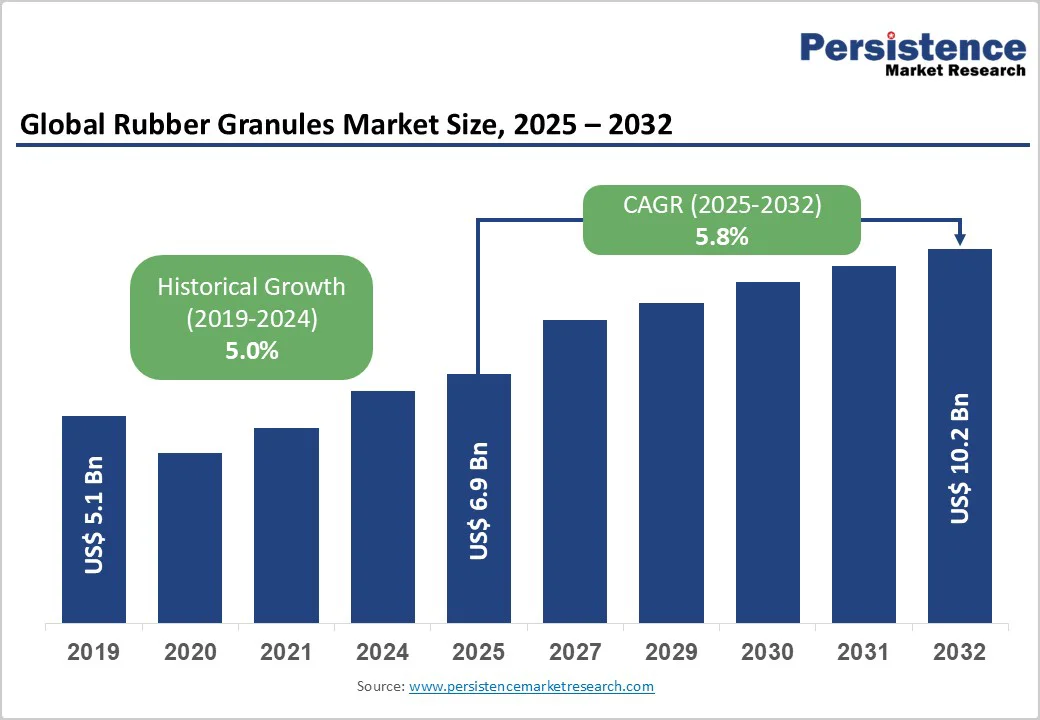
The global rubber granules market size is likely to be valued US$6.9 Billion in 2025, estimated to reach US$ 10.2 Billion by 2032 growing at a CAGR of 5.8% during the forecast period from 2025 to 2032, driven by the increasing emphasis on sustainable materials, rising demand for recycled products in construction and automotive sectors, and advancements in recycling technologies.
The need for eco-friendly alternatives to virgin materials has significantly boosted the adoption of rubber pellets across various industries, particularly in developed and emerging economies. The market is further propelled by innovations in granule blends that enhance durability and performance, catering to preferences for green building and noise-reduction solutions.
Key Industry Highlights:
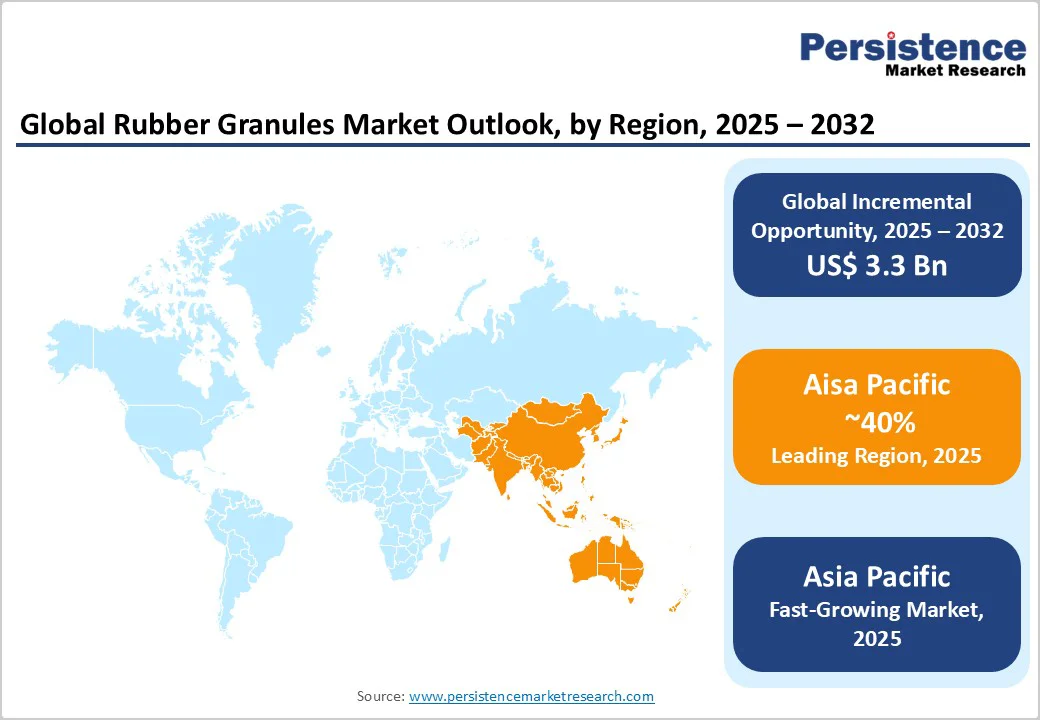
- Leading Region: Asia Pacific, commanding a 40% market share in 2025, driven by rapid infrastructure development, booming automotive production, and strong recycling initiatives in China and India.
- Fastest-growing Region: Europe, fueled by urbanization, expanding construction projects, and investments in sustainable manufacturing in countries such as Germany and France.
- Dominant Product Type: Recycled Rubber Granules, holding approximately 60% of the market share, due to environmental regulations, cost savings, and widespread use in eco-friendly applications.
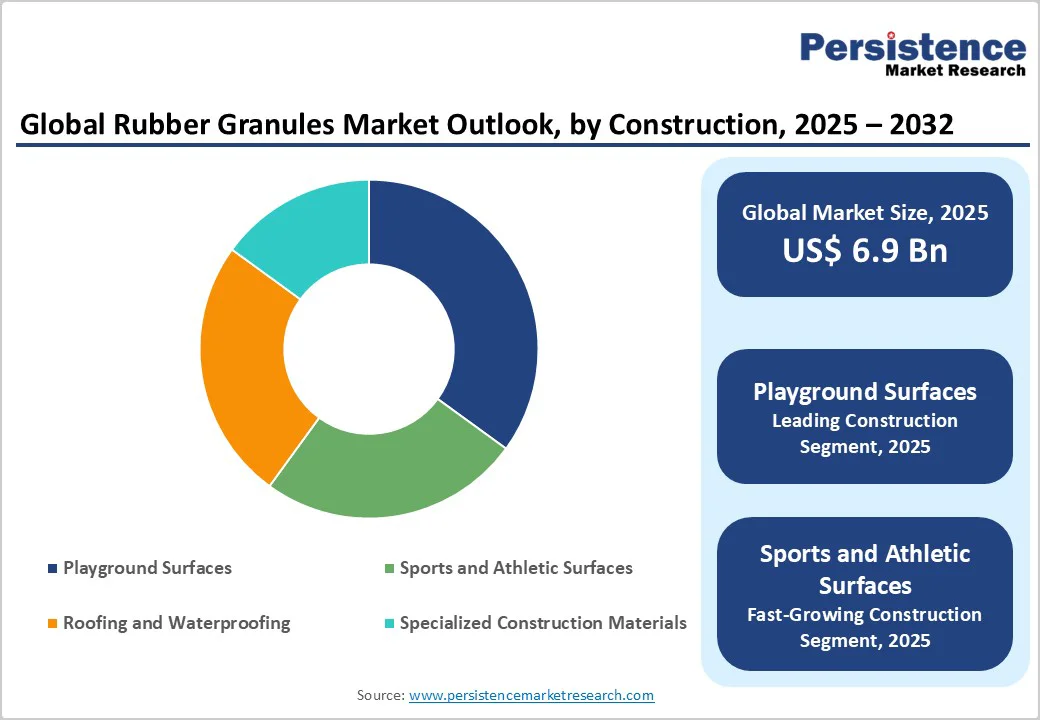
- Leading Construction: Playground Surfaces, accounting for over 40% of market revenue, driven by safety standards and urban recreational developments.
- Leading Automotive: Acoustic and Vibration Dampening, contributing nearly 45% of market revenue, owing to noise reduction needs in vehicles.
- Key Market Driver: Global tire waste generation, exceeding 1.5 billion units annually, boosts the need for recycled rubber crumbs in sustainable products.
- Growth Opportunity: Advancements in specialty blends for electric vehicles, enabling lightweight and high-performance components.
| Global Market Attribute | Key Insights |
|---|---|
| Rubber Granules Market Size (2025E) | US$6.9 Bn |
| Market Value Forecast (2032F) | US$10.2 Bn |
| Projected Growth (CAGR 2025 to 2032) | 5.8% |
| Historical Market Growth (CAGR 2019 to 2024) | 5.0% |
Market Factors - Growth, Barriers, and Opportunity Analysis
Rising Demand for Sustainable and Recycled Materials
The increasing demand for sustainable and recycled materials in the construction and automotive industries is a primary driver of the rubber granules market. These environmental imperative drives demand for accessible, upcycled fillers. Rubber particles derived from waste tires offer durability comparable to virgin rubber, with up to 90% cost reduction and a 70% reduction in the carbon footprint in lifecycle assessments.
For instance, products from companies such as Melos GmbH have demonstrated 95% efficacy in shock absorption for playgrounds, supporting green building certifications and reducing landfill waste by up to 80% in pilot projects. Additionally, the surge in infrastructure investments, totaling US$ 10 Tn globally by 2030, has accelerated adoption.
The push for circular economy principles, backed by regulations such as the EU's Waste Framework Directive, continues to propel the market forward, particularly in regions with high waste generation, such as the Asia Pacific and North America.
Fluctuating Raw Material Prices and Regulatory Hurdles
The fluctuating prices of raw rubber and stringent recycling regulations pose a significant restraint on market growth. While sustainable, volatility in natural rubber costs, up 20% in 2025 due to supply chain disruptions, impacts production expenses, with granule prices varying by 15-25%. Processing requires compliance with standards such as REACH in Europe, involving costs exceeding US$2 Mn per facility for emissions controls and quality testing.
Regulatory bodies such as the U.S. EPA and the EU Commission require extensive traceability data, which extends approval timelines to 18-24 months. For example, certifications for recycled blends by Genan Holding A/S have faced delays due to contamination concerns, increasing costs by 30%. Smaller recyclers struggle against established players such as Evonik Industries AG, limiting scalability in markets where alternative synthetics offer price stability.
Expansion in Electric Vehicles and Green Infrastructure
Advancements in electric vehicle components and green infrastructure projects present significant growth opportunities for the rubber flakes market. Specialty blends provide lightweight vibration dampening, improving EV range by 5-10% through weight reduction. These innovations align with the EV boom, with global sales projected at 17 Mn units in 2025.
For instance, companies such as Sigma International are developing conductive granules, with trials showing 85% enhancement in acoustic performance. Blends cut material costs by 40%, and integration with modular construction boosts efficiency. As infrastructure spending surges, estimated at US$94 Tn by 2040, these opportunities are expected to drive expansion in high-growth regions such as the Asia Pacific and Europe.
Category-wise Analysis
Product Type Insights
Recycled Rubber Granules dominate the market, expected to account for approximately 60% of the share in 2025. Their dominance is driven by stringent environmental regulations promoting tire recycling, cost-effectiveness compared to virgin materials, and versatility in applications ranging from construction to automotive components. The emphasis on circular economy principles has led to increased adoption, significantly reducing landfill waste and carbon emissions.
Specialty Rubber Granule Blends are the fastest-growing segment, fueled by demand for customized properties such as enhanced durability and conductivity. Their integration with advanced technologies supports innovation in electric vehicles and industrial applications, with ongoing R&D driving improved performance and market expansion.
Construction Insights
Playground surfaces dominate with over 40% share, driven by global safety standards and rising urbanization. Rubber pellets offer shock absorption, injury protection, anti-skid properties, and low maintenance, making them ideal for schools, parks, and recreational areas. Their durability and safety features support widespread adoption in public and private playgrounds worldwide.
Sports and athletic surfaces are the fastest-growing segment, driven by rising investments in sports infrastructure and multi-purpose facilities. The demand for high-performance, durable, and weather-resistant surfaces in stadiums, tracks, and training centers is fuelling growth, as these granules enhance safety, performance, and longevity for professional and recreational sports applications.
Automotive Insights
Acoustic and vibration-damping applications hold nearly 45% of the market share in 2025, driven by their essential role in enhancing vehicle comfort and reducing noise. These granules effectively absorb vibrations, making them ideal for underbody coatings, engine mounts, and interior components, helping automakers meet modern standards for noise reduction, ride quality, and passenger comfort.
Electric and hybrid vehicle applications are the fastest-growing segment, driven by the global shift toward sustainable transportation. Lightweight rubber crumbs enhance energy efficiency and driving range, while rising EV production and adoption create strong demand. These granules are increasingly used in underbody components, interior parts, and noise-reduction applications to support vehicle performance and sustainability.
Industrial Insights
Acoustics and vibration control applications dominate, with around 35% share, and are commonly used in machinery and equipment to reduce noise and enhance durability. Their ability to withstand harsh operating conditions ensures long-term performance, making them essential for industrial applications across manufacturing, heavy equipment, and processing plants, supporting operational efficiency and equipment longevity.
Polymer composites are the fastest-growing segment, driven by advancements in composite materials that enhance friction, durability, and performance. Their integration into manufacturing processes for automotive, construction, and industrial applications is accelerating demand, as these granules improve wear resistance, mechanical strength, and longevity, supporting innovation and efficiency in modern production.
Regional Insights
Asia Pacific Rubber Granules Market Trends
Asia Pacific commands 40% share and is the fastest-growing region, propelled by China and India’s massive urbanization, booming automotive industries, and extensive construction projects. These developments are driving strong demand for affordable, sustainable, and high-performance recycled rubber pellets.
In China, large-scale infrastructure investments, including smart cities, roadways, and public recreational spaces, are promoting the adoption of rubber crumbs for safety flooring, road surfacing, and vibration control. Similarly, India’s focus on urban renewal, road safety, and the use of sustainable construction materials has created a favorable environment for market growth.
The automotive boom across both countries, driven by rising vehicle production and the growing electric vehicle segment, is further enhancing demand for rubber crumbs in noise insulation, underbody coatings, and interior components. Governments are also implementing tire recycling regulations and sustainability initiatives to reduce landfill waste and promote circular economy practices.
North America Rubber Granules Market Trends
North America accounts for 30% in 2025, driven by a robust recycling infrastructure, stringent environmental regulations, and growing demand for sustainable materials across the construction and automotive industries. The country has emerged as a key player in rubber recycling, with advanced technologies transforming end-of-life tires into high-quality granules for diverse applications.
In construction, rubber particles are increasingly used in geotechnical applications such as road surfacing, drainage layers, and noise barriers due to their durability, shock absorption, and eco-friendly profile. The automotive industry further strengthens demand, particularly as electric and hybrid vehicles require lightweight, vibration-dampening materials for improved efficiency and comfort.
Government initiatives, including the U.S. Environmental Protection Agency (EPA) programs promoting tire waste reduction and circular economy practices, continue to support market expansion. The growing preference for sustainable infrastructure and energy-efficient manufacturing aligns with the country’s environmental goals, boosting the adoption of rubber crumbs in sports surfaces, playgrounds, and green construction projects.
Europe Rubber Granules Market Trends
Europe holds about 20% market share, led by Germany and the U.K. due to EU circular economy policies and green building incentives. In the U.K., the rubber particles market is witnessing strong growth, primarily driven by the shift toward sustainability, urban infrastructure upgrades, and increasing investments in sports and recreational facilities.
The country’s emphasis on eco-friendly construction aligns with government regulations promoting the use of recycled materials, particularly those derived from end-of-life tires. Sustainable sports surfaces-such as artificial turfs, playgrounds, and running tracks-are a key area of growth, supported by national initiatives encouraging physical activity and community development.
Rubber particles offer superior shock absorption, slip resistance, and durability, making them ideal for both public and private projects. The ongoing modernization of urban infrastructure, including parks, fitness zones, and multi-use sports complexes, further fuels demand.
Additionally, sustainability-focused programs, such as the U.K. Waste Strategy and tire recycling directives, encourage manufacturers to adopt circular economy practices. The automotive sector also contributes to market expansion through the integration of recycled rubber in noise and vibration control components.
Competitive Landscape
The global rubber granules market is highly competitive, characterized by the presence of leading manufacturers emphasizing sustainability, innovation, and performance. Major players are focusing on developing advanced, eco-friendly granules made from recycled and bio-based materials to meet the growing demand for sustainable solutions across construction, automotive, and sports industries.
Companies are actively engaging in mergers and acquisitions to strengthen their global presence, expand product portfolios, and enhance recycling capacities. Continuous investments in research and development are driving innovations in high-performance rubber particles with improved durability, weather resistance, and safety properties.
Strategic collaborations and partnerships are being formed to optimize supply chains, ensure quality consistency, and comply with stringent environmental and safety standards. Leading players are adopting circular economy practices and green manufacturing technologies to align with international sustainability goals, positioning themselves competitively in a market increasingly driven by regulatory support and consumer preference for eco-conscious products.
Key Developments
- In March 2025, GRP Limited began commercial production at its new manufacturing unit in Solapur, Maharashtra. This facility has an annual capacity of 31,875 metric tonnes of crumb rubber, a type of rubber granule. The expansion aims to meet growing demand from the reclaim rubber, tire pyrolysis, road surfacing, and rubber goods industries.
- In July 2025, Melos GmbH has announced a strategic partnership with a leading tire recycler to expand its production of recycled rubber granules. This collaboration aims to meet the rising demand for sustainable and high-quality granules across Europe, driven by increasing adoption in sports surfaces, playgrounds, and construction applications. The partnership strengthens Melos’s commitment to circular economy practices and supports the growing market need for eco-friendly materials in urban infrastructure and industrial projects.
Companies Covered in Rubber Granules Market
- Melos GmbH
- Lianyungang Dexiang New Materials
- Tyrec
- Sigma International
- J. Allock & Sons Ltd
- Khandesh Enterprises
- Jim Blackburn Trading
- Murfitts Industries
- Wuxi Yonghong Technology Co. Ltd
- India Thermoplastic Engineers
- Oyster Industries Pvt. Ltd
- Evonik Industries AG
- Others
Frequently Asked Questions
The global rubber granules market is projected to reach US$6.9 Billion in 2025, driven by surging demand for recycled materials amid rising sustainability initiatives and infrastructure developments worldwide.
The industry is primarily driven by the growing demand for sustainable and recycled materials across industries such as construction, automotive, and sports infrastructure.
The market is poised to witness a CAGR of 5.8% from 2025 to 2032, supported by innovations in recycled blends and expanding use in electric vehicles and green building projects.
Advancements in EV components and green infrastructure offer key opportunities, enabling customized rubber granule blends for lightweight, high-durability solutions with reduced environmental impact.
Key players include Melos GmbH, Tyrec, Sigma International, Evonik Industries AG, and Murfitts Industries, leading through innovations in recycling technologies and sustainable product offerings.


