




- Specialty & Fine Chemicals
- Liquid Silicone Rubber Market
Liquid Silicone Rubber Market Size, Share, and Growth Forecast 2026 - 2033
Liquid Silicone Rubber Market by Grade (Industrial Grade, Medical Grade, Food Grade, Specialty Grade, Others), by Processing Method (Liquid Injection Molding, Compression Molding, Transfer Molding, Extrusion), End-user (Healthcare & Medical Devices, Automotive, Electrical & Electronics, Consumer Goods, Industrial Machinery, Others), and Regional Analysis 2026 - 2033

Liquid Silicone Rubber Market Size and Trend Analysis
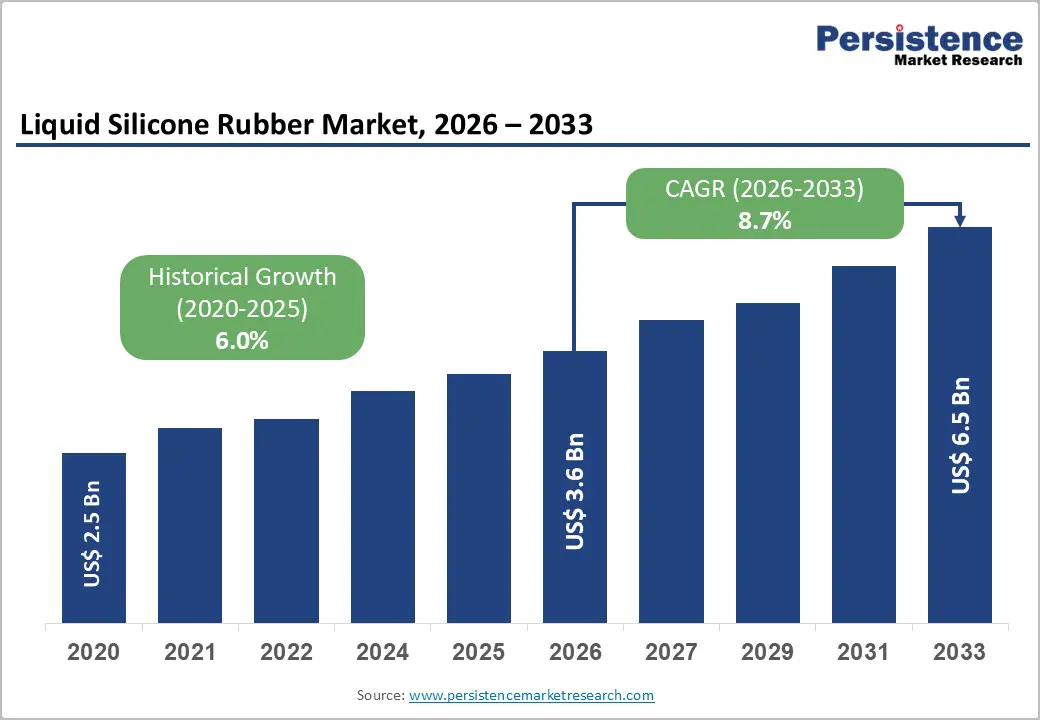
The global Liquid Silicone Rubber market size is likely to be valued at US$ 3.6 billion in 2026 and is expected to reach US$ 6.5 billion by 2033, growing at a CAGR of 8.7% during the forecast period from 2026 to 2033.
The market's robust and accelerating expansion is anchored in the convergence of three powerful structural demand drivers: the exponential growth of medical device manufacturing requires biocompatible materials, the global electrification trend in the automotive sector has intensified the demand for heat-resistant electrically insulating elastomers, and the proliferation of consumer electronics with the need for precision-molded high-purity components.
Key Industry Highlights:
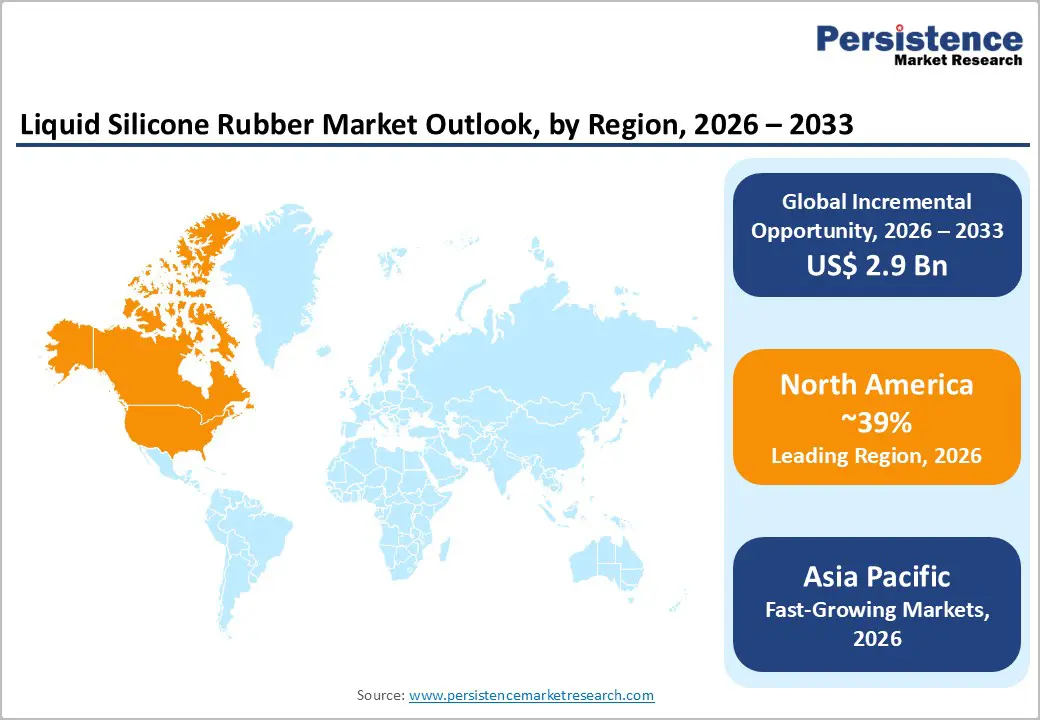
- Leading Region: North America holds about 39% market share, supported by the strong U.S. medical device industry, high FDA device approvals, and growing EV manufacturing investments that increase demand for automotive sealing applications.
- Fastest-Growing Region: Asia Pacific is the fastest-growing region with 9.8% CAGR, driven by China’s electronics manufacturing, Japan’s medical device sector, and India’s medical device incentives, expanding regional demand for silicone materials.
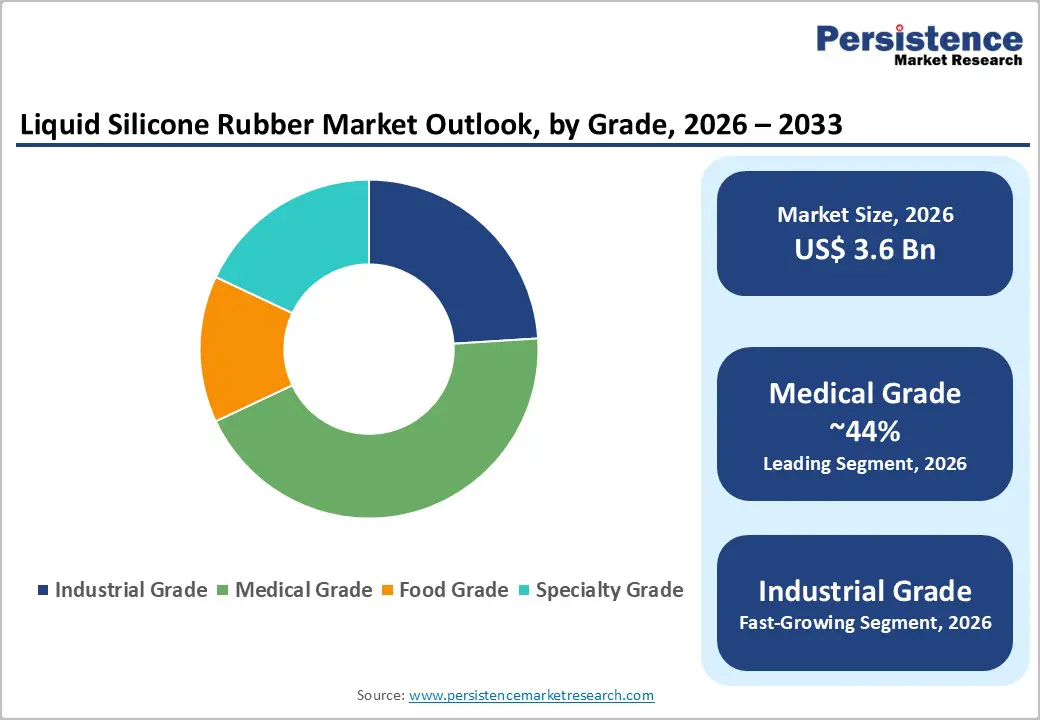
- Leading Grade Segment: Medical Grade LSR leads with about 44% revenue share, supported by strict biocompatibility regulations, high selling prices, and increasing use in catheters, implants, surgical tools, and wearable healthcare devices.
- Fastest-Growing Segment: The Healthcare & Medical Devices segment is the fastest-growing due to rising global healthcare spending, expanding medical device manufacturing, increasing demand for biocompatible materials, and growing adoption of wearable medical technologies and implantable devices.
- Key Opportunity: Wearable medical devices and 5G electronics present major opportunities, as rising demand for skin-contact sensors, biosensors, and electronic encapsulation components increases adoption of high-performance specialty liquid silicone rubber materials globally.
| Key Insights | Details |
|---|---|
|
Liquid Silicone Rubber Market Size (2026E) |
US$ 3.6 Billion |
|
Market Value Forecast (2033F) |
US$ 6.5 Billion |
|
Projected Growth CAGR (2026–2033) |
8.7% |
|
Historical Market Growth (2020–2025) |
6.0% |
Market Dynamics
Drivers - Global Healthcare Infrastructure Expansion and Medical Device Industry Growth Sustaining Premium LSR Demand
The global medical device industry continues to grow rapidly, driven by aging populations, improving healthcare access in emerging economies, and ongoing innovation in minimally invasive surgery, drug delivery technologies, and wearable patient monitoring devices. This strong growth is creating significant and long-term demand for medical-grade Liquid Silicone Rubber (LSR), which is widely preferred for healthcare applications requiring certified biocompatibility, sterilization resistance, and long-term biological stability.
Medical-grade LSR that complies with ISO 10993 and USP Class VI standards is commonly used across a wide range of medical devices, including catheters, respiratory mask seals, syringe plungers, implantable device coatings, hearing aid components, cardiac assist device membranes, and wearable biosensor interfaces where material performance directly impacts patient safety. The U.S. Food and Drug Administration (FDA) continues to process thousands of medical device approvals annually through its 510(k) and PMA pathways, each representing products that often include LSR components. Leading manufacturers such as SIMTEC Silicone Parts LLC and Trelleborg AB have reported growing demand for medical LSR components driven by rising procurement from surgical device, drug delivery, and wearable medical technology manufacturers.
EV Electrification and Automotive Industry Innovation Driving Accelerated Industrial-Grade LSR Procurement
The global shift toward battery electric vehicles (BEVs) and hybrid electric vehicles (HEVs) is creating strong new demand for industrial-grade Liquid Silicone Rubber in automotive applications. LSR is increasingly used in automotive sealing, thermal management systems, high-voltage insulation, and under-hood components because it offers excellent temperature resistance, chemical stability, electrical insulation properties, and durability under repeated thermal cycles. According to the International Energy Agency’s Global EV Outlook 2024, worldwide EV sales exceeded 14 million units in 2023, accounting for nearly 18% of total global car sales, while the global EV fleet surpassed 40 million vehicles.
Electric vehicles require significantly larger volumes of LSR components than conventional vehicles, including battery pack seals, high-voltage cable gaskets, charging port seals, e-motor shaft seals, and thermal protection barriers. These components collectively increase LSR consumption per vehicle. Leading silicone producers such as Dow and Wacker Chemie AG are supplying automotive-grade LSR solutions, including SILASTIC™ and ELASTOSIL® product lines, which are experiencing strong demand as global automakers accelerate electrification programs.
Restraints - High Raw Material Costs and Silicon Metal Supply Chain Concentration Impacting Manufacturer Margins
The Liquid Silicone Rubber market faces ongoing margin pressure due to high and volatile raw material costs, particularly for silicon metal and methylchlorosilane intermediates used in silicone production. Global silicon metal production is highly concentrated in China, which accounts for roughly 70% of the worldwide supply according to the U.S. Geological Survey. This concentration exposes the supply chain to risks such as energy price fluctuations, environmental compliance shutdowns, and potential export policy changes, all of which can disrupt supply and increase costs for silicone manufacturers.
Silicon metal has been classified as a critical material by both the U.S. Department of Energy and the European Commission due to these supply risks. These vulnerabilities directly affect pricing stability for downstream LSR producers. Mid-sized LSR manufacturers without upstream integration into silicone production are particularly vulnerable to these cost fluctuations, which can reduce profit margins and limit their ability to invest in capacity expansion, product development, and advanced manufacturing technologies.
Technical Limitations and Processing Complexity Constraining Adoption in Price-Sensitive Applications
Although Liquid Silicone Rubber offers excellent performance characteristics, its adoption in certain price-sensitive applications remains limited due to relatively high material costs compared to alternative elastomers such as thermoplastic elastomers (TPEs) and traditional rubber materials. In addition to material costs, the manufacturing process for LSR components requires specialized equipment, including Liquid Injection Molding systems, cold-runner tooling technology, and cleanroom processing environments for medical and food-grade products. These requirements significantly increase production setup costs.
Molds used in medical-grade LSR injection molding typically range between US$50,000 and US$250,000, creating a substantial capital investment barrier for manufacturers producing small-volume parts. While high-volume applications can absorb these tooling costs through economies of scale, smaller specialty product manufacturers may find it difficult to justify the investment. Industry organizations such as the American Chemistry Council have noted that elastomer material selection often depends on total system cost rather than performance alone, limiting LSR adoption in cost-sensitive industrial and consumer goods applications.
Opportunities - Wearable Medical Technology and Remote Patient Monitoring Creating High-Growth Medical LSR Application Category
The rapid expansion of wearable medical technologies is creating a major new growth opportunity for medical-grade liquid silicone rubber. Devices such as continuous glucose monitors, smartwatch-based cardiac sensors, wearable insulin pumps, neurostimulation therapy patches, and remote patient monitoring systems require materials that combine excellent skin compatibility with long-term durability and precise dimensional performance. LSR is particularly well-suited for these applications because it offers superior biocompatibility, hypoallergenic properties, flexibility, and resistance to sweat, oils, and repeated skin contact.
Regulatory support is also accelerating adoption. The U.S. Food and Drug Administration has strengthened its digital health initiatives through the Digital Health Center of Excellence, helping streamline approvals for wearable health monitoring devices. As a result, approvals for wearable cardiac monitoring and remote diagnostic devices increased significantly during 2023 and 2024. Market forecasts indicate that the global wearable medical device market could reach US$87.4 billion by 2030, creating strong demand for LSR components used in sensor housings, skin-contact seals, adhesive substrates, and protective device encapsulations.
5G Infrastructure and Advanced Electronics Manufacturing Expansion Generating New Electrical-Grade LSR Demand
The rapid global rollout of 5G telecommunications networks, combined with the growth of Internet of Things devices and advanced semiconductor technologies, is generating strong demand for specialty and electrical-grade Liquid Silicone Rubber. These materials are widely used in electronic connectors, cable management grommets, LED encapsulation, antenna components, and protective coatings for printed circuit boards. LSR provides valuable performance advantages for electronics applications because it offers excellent electrical insulation, high thermal stability, resistance to environmental exposure, and protection against moisture ingress.
According to the GSMA Mobile Economy 2024 report, global 5G connections surpassed 1.9 billion in 2023 and are projected to reach 5.5 billion by 2030. Each 5G base station and network component requires durable sealing and encapsulation materials capable of withstanding long-term outdoor exposure. Silicone manufacturers such as Momentive Performance Materials and Elkem ASA are actively expanding their electronic-grade LSR product lines to support this growth, while companies like DuPont are investing in technical service capabilities to help electronics manufacturers qualify next-generation silicone materials.
Category-wise Analysis
By Grade Insights
Medical Grade leads the global Liquid Silicone Rubber market by product grade, accounting for approximately 44% of total grade segment revenue in 2026. This strong commercial position is driven by the medical device industry's strict requirement for certified biocompatible materials that meet ISO 10993, USP Class VI, and FDA regulatory standards for any polymer used in patient-contact or implantable device applications. Medical-grade LSR typically commands the highest average selling prices in the market, usually priced 2–3 times higher than industrial-grade materials.
This premium reflects the higher raw material purity levels, extensive biological safety testing, detailed documentation, and strict supply chain traceability required for medical approvals. According to technical documentation from SIMTEC Silicone Parts LLC, medical-grade LSR is widely used in applications such as general surgery, cardiology, oncology, dialysis, neurosurgery, and wearable health monitoring devices. This broad range of medical applications supports the segment’s revenue leadership. While Industrial Grade accounts for approximately 37% of total volume share, it generates lower revenue per unit compared with medical-grade materials.
By Processing Method Insights
Liquid Injection Molding (LIM) leads the global Liquid Silicone Rubber market by processing method, accounting for approximately 58% of the total processing segment revenue in 2026. Its leadership position is largely due to LIM’s strong compatibility with the physical processing characteristics of LSR and its advantages in precision, automation, shorter cycle times, and the ability to produce flash-free parts. These benefits make it highly suitable for demanding applications in the medical, automotive, and electronics industries, which represent some of the highest-value LSR end-use markets.
In the LIM process, the two-part LSR compound is accurately metered, mixed, and injected into a heated closed mold, allowing automated, high-volume production of complex and tight-tolerance components. According to Cirtec Medical, injection pressures typically range from 250 to 10,000 psi. The process also reduces material waste through cold-runner systems and supports cleanroom manufacturing required for medical and food-grade products. Major raw material platforms supporting LIM include Dow’s SILASTIC™ LIM series and Shin-Etsu Chemical’s KE-2000 series. Compression Molding remains relevant for larger automotive sealing components and industrial parts.
By End-user Insights
The healthcare & medical devices segment leads the global liquid silicone rubber market by end-user, accounting for approximately 31% of total segment revenue in 2026. This leadership reflects the growing use of certified medical-grade LSR in a wide range of medical device applications across the global healthcare system. These applications include catheters, respiratory seals, implantable device encapsulations, drug delivery components, surgical instrument grips, and wearable patient monitoring interfaces.
Expanding healthcare infrastructure and rising medical device manufacturing investments worldwide are further strengthening demand for LSR-based medical components. Global healthcare initiatives and infrastructure development programs supported by the World Health Organization, along with expanding healthcare systems in countries such as China, India, Brazil, and Southeast Asian nations, are significantly increasing the geographic reach of medical-grade LSR demand. While healthcare dominates revenue share due to high-value materials, the Automotive segment represents the largest material consumption base.
Regional Insights
North America Liquid Silicone Rubber Market Trends
North America leads the global Liquid Silicone Rubber market, largely supported by the United States' position as the world’s largest medical device manufacturing hub. The U.S. medical device industry generates more than US$ 180 billion in annual revenue, according to AdvaMed, creating strong demand for high-performance silicone materials used in healthcare products. The region also benefits from a large and advanced automotive and electronics manufacturing ecosystem, which together represent one of the highest per-capita consumption bases for LSR globally.
The FDA’s Center for Devices and Radiological Health processes the largest number of medical device regulatory submissions worldwide, and each approved device often requires certified LSR components for manufacturing. This supports steady demand for suppliers such as SIMTEC Silicone Parts LLC and Reiss Manufacturing. Raw material supply in the region is supported by companies such as Momentive Performance Materials, headquartered in New York, along with major operations from Dow and DuPont serving North American medical and industrial manufacturers.
Europe Liquid Silicone Rubber Trends
Europe represents a technologically advanced and commercially significant market for Liquid Silicone Rubber, supported by a strong automotive industry, a well-established medical device sector, and the presence of major silicone producers. The region hosts two of the world’s leading LSR raw material manufacturers, Wacker Chemie AG and Elkem ASA, providing European manufacturers with direct access to advanced silicone technologies and application support services.
Germany’s automotive sector, led by companies such as Volkswagen Group, BMW, Mercedes-Benz, Bosch, and Continental, is undergoing rapid electrification, creating new opportunities for automotive-grade LSR used in EV sealing systems and thermal management components. Wacker Chemie AG, headquartered in Munich, continues to expand its silicone production capacity to meet growing demand. Additionally, the European Union’s Medical Device Regulation requires stricter biocompatibility testing and regulatory documentation for medical devices, indirectly strengthening demand for high-quality certified LSR materials. Elkem ASA, headquartered in Oslo, serves the European medical and electronics industries through its Silbione LSR product line.
Asia Pacific Liquid Silicone Rubber Trends
Asia Pacific is the fastest-growing regional market for Liquid Silicone Rubber, driven by strong industrial manufacturing activity and expanding healthcare infrastructure. China represents the largest consumption market for LSR globally, supported by its extensive electronics, automotive, and consumer goods manufacturing industries. Global LSR producers such as Shin-Etsu Chemical, Dow, and Wacker Chemie operate significant manufacturing and distribution networks across the region, while domestic Chinese companies including Bluestar Silicones and Shenzhen Inno Silica are increasing their presence with competitive pricing and improving product quality.
China’s growing medical device manufacturing sector is also increasing demand for medical-grade LSR components used in hospital equipment, diagnostic systems, and drug delivery devices. Japan’s highly advanced medical device sector, led by companies such as Terumo Corporation, Nihon Kohden, and Olympus, further strengthens regional demand for high-purity LSR materials. In addition, India’s medical device industry is expanding rapidly under the government’s Production Linked Incentive scheme, creating new opportunities for LSR suppliers across Asia.
Competitive Landscape
Numerous specialized contract manufacturers and molders compete in this segment by offering advanced application engineering and precision manufacturing capabilities. Companies such as SIMTEC Silicone Parts LLC, Trelleborg AB, Stockwell Elastomers, and Reiss Manufacturing focus on high-value markets including medical devices and automotive sealing solutions. Key competitive differentiators include FDA Master File registrations, ISO 13485-certified medical manufacturing systems, and proprietary silicone formulations designed for improved durability, low compression set, and enhanced performance in demanding industrial and healthcare environments.
Key Developments:
- In March 2025: Wacker Chemie AG expanded its ELASTOSIL LR medical-grade liquid silicone rubber portfolio with new ultra-low viscosity formulations designed for thin-wall components used in wearable medical devices such as continuous glucose monitoring sensors and biosensor systems, supporting growing demand for high-precision healthcare materials.
- In October 2024: Shin-Etsu Chemical Co., Ltd. expanded silicone production capacity at its Naoetsu Plant facility, increasing output of high-purity medical and specialty liquid silicone rubber materials to meet rising global demand from medical device manufacturers across North America, Europe, and Asia-Pacific.
- In June 2024, Elkem ASA introduced an upgraded Silbione MED-4000 Series medical-grade liquid silicone rubber range with enhanced regulatory documentation aligned with EU Medical Device Regulation (EU) 2017/745, enabling European medical device manufacturers to accelerate material qualification and regulatory approval timelines.
Companies Covered in Liquid Silicone Rubber Market
- Avanto Inc.
- Dow
- Elkem ASA
- Momentive Performance Materials
- SIMTEC Silicone Parts LLC
- Trelleborg AB
- Stockwell Elastomers
- Wacker Chemie AG
- Shin-Etsu Chemical Co., Ltd.
- Bluestar Silicones
- KCC Corporation
- Reiss Manufacturing
- DuPont
- Shenzhen Inno Silica
- Rogers Corporation
- Mesgo S.p.A.
- Specialty Silicone Products, Inc.
Frequently Asked Questions
The global Liquid Silicone Rubber market is valued at approximately US$ 3.6 billion in 2026 and is projected to reach US$ 6.5 billion by 2033, growing at a CAGR of 8.7%, supported by healthcare, EV, and electronics demand.
Key drivers include strong medical device demand for biocompatible materials, expanding electric vehicle production requiring advanced sealing components, and growing electronics and wearable technologies that require durable, flexible, and heat-resistant silicone materials.
Medical Grade LSR leads the market with about 44% revenue share, driven by strict biocompatibility regulations, higher pricing, and rising demand across catheters, implants, surgical tools, and wearable healthcare devices globally.
North America leads the market due to the large U.S. medical device industry, strong automotive and EV manufacturing, advanced healthcare infrastructure, and presence of major silicone manufacturers and precision LSR component suppliers.
The biggest opportunity lies in wearable medical devices and 5G electronics, where high-purity LSR materials are needed for skin-contact components, sensors, and electronic encapsulation, supporting rapid global technology adoption.


