




- Metalworking & Fabrication
- Press Brake Machine Size, Share, and Growth Forecast 2026 - 2033
Press Brake Machine Size, Share, and Growth Forecast 2026 - 2033
Press Brake Machine Market by Product Type (Mechanical Press Brake Machines, Pneumatic Press Brake Machines, Hydraulic Press Brake Machines), Capacity (up to 50 tons, 50-150 tons, 150-300 tons, 300-500 tons, above 500 tons), Operation (Manual, Semi-Automatic, Automatic), and Regional Analysis, 2026 - 2033

Press Brake Machine Market Size and Trend Analysis
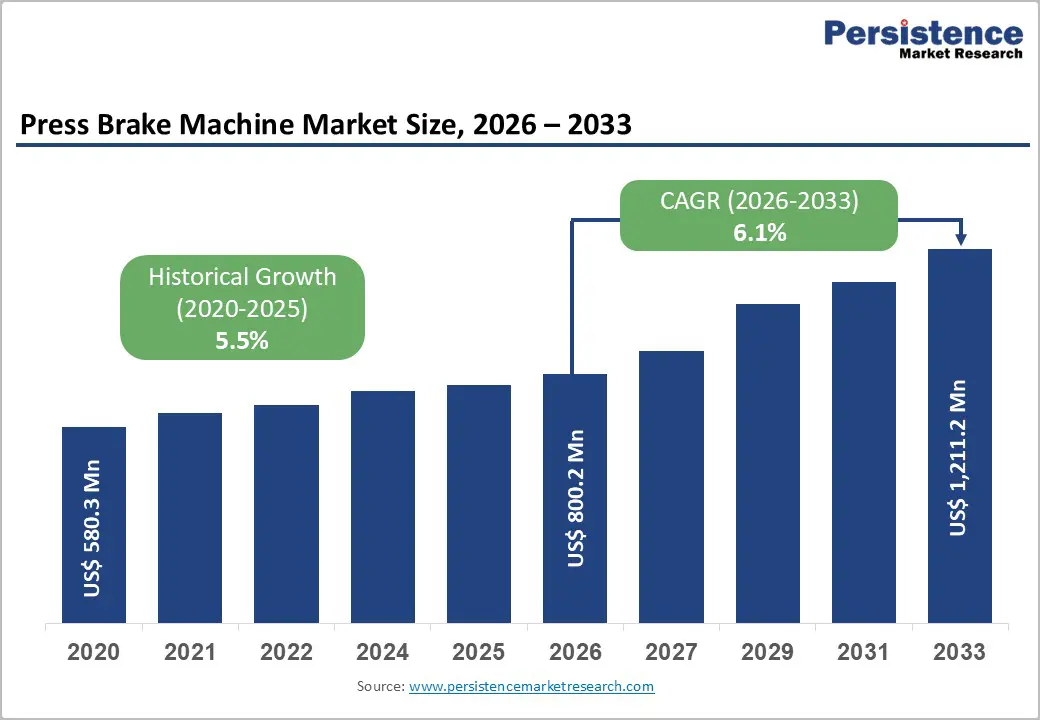
The global press brake machine market size is expected to be valued at US$ 800.2 million in 2026 and projected to reach US$ 1,211.2 million by 2033, growing at a CAGR of 6.1% between 2026 and 2033.
Automation in metal fabrication and infrastructure expansion are key growth catalyst, as manufacturers increasingly demand high-precision bending solutions for complex geometries. Rising automotive production, renewable energy installations, and industrial equipment manufacturing further strengthen demand.
According to the United Nations Industrial Development Organization, global manufacturing growth reached 3.4% in 2024, reflecting steady industrial momentum. Policy initiatives such as the European Green Deal and Make in India continue to encourage advanced, energy-efficient machinery adoption.
Key Industry Highlights:
- Leading Region: Europe dominates the press brake machine market with a 38% share in 2025, supported by strong German engineering capabilities and harmonized EU machinery standards.
- Leading Product Type: Hydraulic press brake machines lead the market with a 52% share in 2025, driven by superior force control and heavy-duty sheet metal versatility.
- Fastest Growing Region: Asia Pacific, holding 32% share in 2025, is the fastest-growing region, fueled by rapid industrialization across China, India, and ASEAN economies.
- Leading Operation: Semi-automatic press brake machines account for 45% share in 2025, offering an optimal balance between manual precision and automation efficiency.
- Key Market Opportunity: Servo-electric press brake technology presents strong growth opportunities, particularly in emerging markets seeking energy-efficient, high-precision fabrication solutions.
| Key Insights | Details |
|---|---|
| Press Brake Machine Size (2026E) | US$ 800.2 million |
| Market Value Forecast (2033F) | US$ 1,211.2 million |
| Projected Growth CAGR (2026 - 2033) | 6.1% |
| Historical Market Growth (2020 - 2025) | 5.5% |
Market Dynamics
Drivers - Accelerating Automation and Smart Manufacturing Integration Enhancing Precision and Productivity
Rising automation across manufacturing facilities is significantly driving demand for advanced press brake machines. The integration of CNC systems, robotics, and AI-enabled controls enables higher precision, repeatability, and faster production cycles. According to the International Federation of Robotics, global robot installations are increasing by around 12% annually, reflecting strong momentum in smart factory adoption.
Automated press brakes reduce human error, improve bending accuracy, and streamline complex sheet metal processing, particularly in automotive and electronics manufacturing. Industry associations such as the Fabricators & Manufacturers Association report that automation can lower downtime by nearly 30%. As manufacturers scale Industry 4.0 capabilities, investments in intelligent bending systems continue to accelerate.
Expanding Global Infrastructure and Urbanization Projects Driving Steel Fabrication Demand
Large-scale infrastructure development worldwide is creating sustained demand for durable and high-capacity press brake machines. The World Bank estimates that global infrastructure investment needs could reach US$ 94 trillion by 2040, significantly boosting structural steel fabrication requirements. Projects spanning transportation, energy, and urban development require precision-formed metal components.
Initiatives such as China’s Belt and Road Initiative have accelerated construction machinery demand, encouraging the adoption of versatile bending equipment for large frameworks. Rapid urbanization in India, supported by programs like Make in India, is further modernizing MSMEs, improving production efficiency, and reducing material waste across fabrication units.
Restraints - Significant Upfront Capital Costs Limiting Adoption Among Small and Mid-Sized Fabricators
High initial investment requirements remain a major restraint for the press brake machine market, particularly among small and medium-sized enterprises. Advanced CNC and automated models are typically 20-30% more expensive than conventional systems, creating financial barriers. The International Monetary Fund has indicated global inflationary pressures of around 5.8% in 2025, further tightening capital expenditure budgets across manufacturing sectors.
Economic uncertainty and rising input costs have prompted many fabricators to delay machinery upgrades. Industry bodies such as the Fabricators & Manufacturers Association note that financial constraints often postpone equipment modernization plans. As a result, adoption of high-end automated press brakes remains uneven across cost-sensitive markets.
Shortage of Skilled CNC Operators Restricts Efficient Utilization of Advanced Systems
A persistent shortage of skilled machine operators poses another key challenge to market expansion. Advanced press brake machines require trained personnel proficient in CNC programming, robotics integration, and precision calibration. The International Labour Organization highlights ongoing global workforce gaps in technical manufacturing roles.
In the United States, the U.S. Bureau of Labor Statistics projects nearly 2.1 million manufacturing job vacancies by 2025, underscoring the skills deficit. Without adequate training infrastructure, manufacturers struggle to fully utilize complex bending systems, slowing broader deployment of automated and high-precision equipment.
Opportunities - Advancements in CNC and Servo-Electric Technologies Unlocking High-Precision and Energy-Efficient Manufacturing Potential
Innovations in CNC-controlled and servo-electric press brake machines are creating strong growth opportunities in precision-driven industries. The Japan Machine Tool Builders' Association projects steady annual growth in advanced machine tool adoption, supported by energy savings of up to 50% compared to traditional hydraulic systems. These technologies enhance bending accuracy, repeatability, and operational efficiency.
Policy support for low-emission manufacturing under frameworks such as the European Commission's sustainability initiatives is accelerating demand for energy-efficient models. Expanding EV production lines by companies like Toyota Motor Corporation require high-precision forming solutions, with servo-electric adoption expected to expand steadily toward 2030.
Rapid Industrialization in Emerging Economies Creating Strong Demand for Automated Fabrication Equipment
Emerging economies, particularly in Asia Pacific, present significant opportunities for press brake manufacturers. Government-led industrial programs such as India’s Production Linked Incentive Scheme are strengthening domestic manufacturing capabilities and encouraging machinery modernization. The Directorate General of Foreign Trade reports notable growth in capital goods movement, reflecting rising industrial investments.
In Southeast Asia, machinery demand is expanding alongside electronics and automotive exports. Regional blocs such as the Association of Southeast Asian Nations are witnessing robust industrial expansion, supporting the adoption of automatic and CNC-based press brake systems to improve productivity, export competitiveness, and production scalability.
Category-wise Analysis
Product Type Insights
Hydraulic press brake machines lead the product segment, accounting for approximately 52% share in 2025. Their dominance stems from superior versatility, precise force control, and the ability to handle thick and complex sheet metal applications reliably. These systems are widely preferred in automotive and heavy fabrication industries where consistent bending accuracy is critical. Compliance with standards set by the Occupational Safety and Health Administration further enhances adoption, as hydraulic systems reduce operational risks compared to purely mechanical alternatives.
Servo-electric press brake machines are emerging as the fastest-growing category due to their energy efficiency, lower maintenance needs, and enhanced precision. Supported by sustainability goals and smart manufacturing integration, these systems are increasingly adopted in electronics, aerospace, and EV component manufacturing where accuracy and environmental performance are strategic priorities.
Capacity Insights
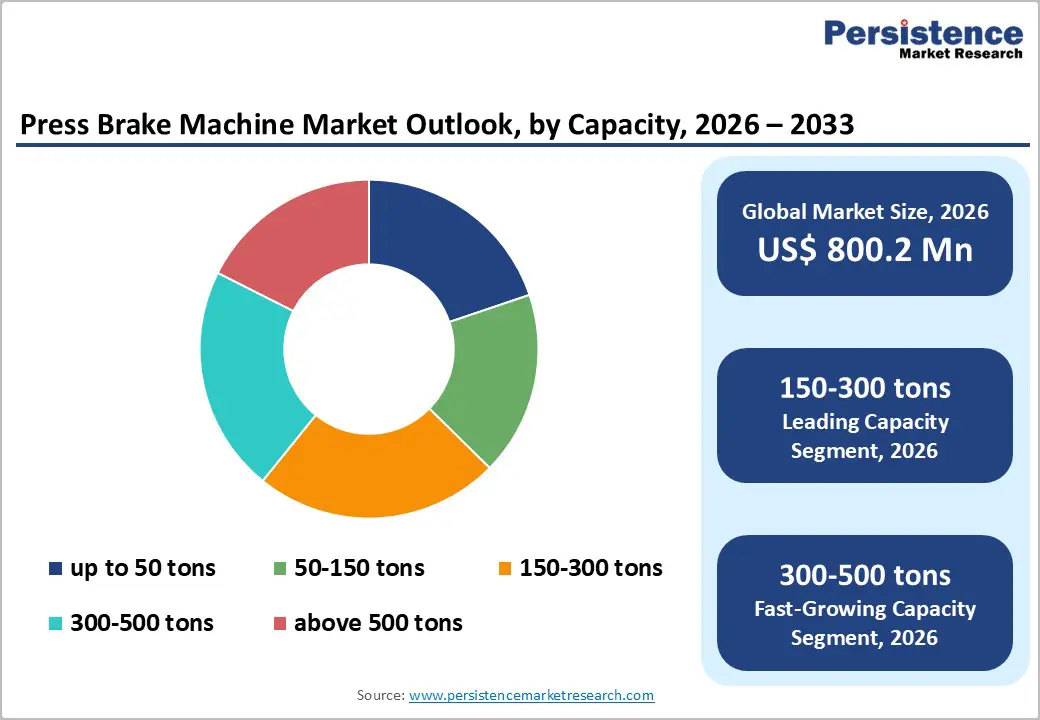
Press brake machines in the 150-300 tons capacity range hold the leading position with around 35% share in 2025. This segment offers an optimal balance between power and flexibility, making it suitable for mid-scale industrial applications such as HVAC systems, automotive panels, and structural components. Data from the United States Census Bureau indicates strong preference among fabrication shops for mid-range capacities due to operational efficiency and cost balance.
Machines above 300 tons are witnessing the fastest growth as infrastructure expansion and heavy industrial projects accelerate. Large-scale construction frameworks, shipbuilding, and energy installations require higher tonnage systems capable of bending thicker plates, driving demand for robust, high-capacity equipment across developing economies.
Operation Insights
Semi-automatic press brake machines dominate the operation segment, capturing nearly 45% share in 2025. These systems provide a balanced combination of manual control and automation, offering improved productivity without the complexity of fully automated units. Workforce studies by the International Labour Organization highlight that partial automation can reduce operator fatigue significantly, supporting efficiency and workplace safety.
Fully automatic and CNC-based press brake machines represent the fastest-growing operational category. Increasing adoption of back-gauge systems and digital controls, supported by manufacturing associations such as the Verein Deutscher Werkzeugmaschinenfabriken, is accelerating demand as industries prioritize precision, repeatability, and seamless integration into smart factory environments.
Regional Insights
North America Press Brake Machine Market Trends
North America is projected to grow at a CAGR of approximately 5.8% through the forecast period, supported by strong demand from automotive, aerospace, and defense industries. In the United States, innovation incentives and manufacturing modernization grants from the National Institute of Standards and Technology have encouraged smart press brake adoption.
Safety regulations from the Occupational Safety and Health Administration are also prompting equipment upgrades. In Canada, renewable energy expansion and industrial R&D support from the Natural Resources Canada are contributing to rising demand for advanced metal forming technologies.
Europe Press Brake Machine Market Trends
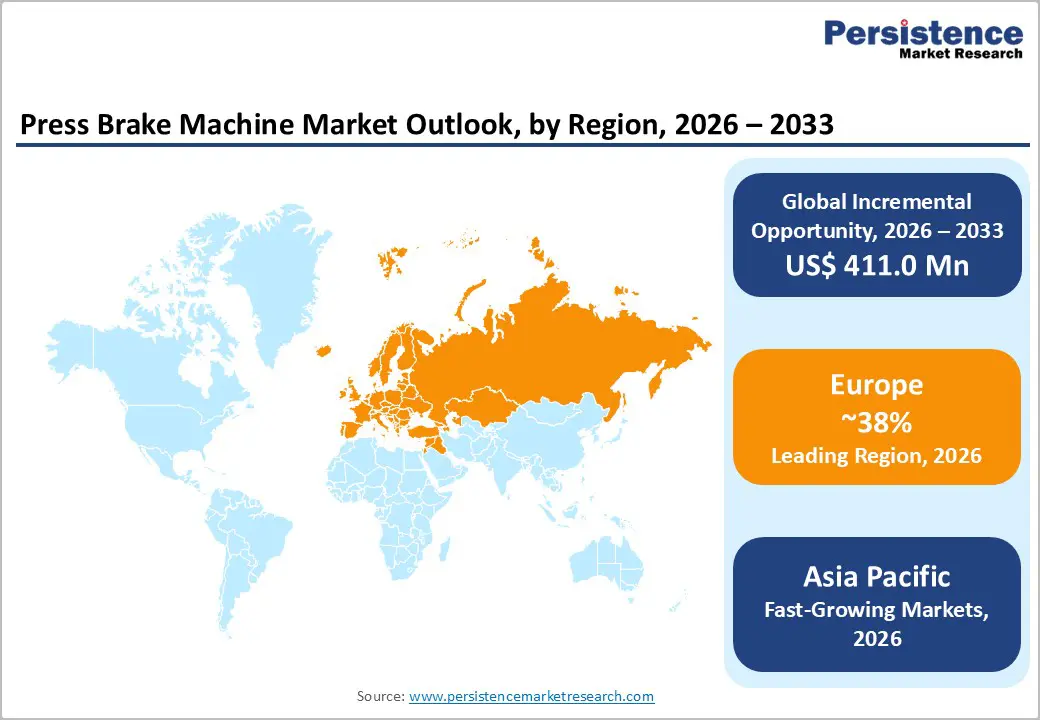
Europe leads the global press brake machine market with an estimated 38% share in 2025, supported by its strong precision engineering and automotive manufacturing base. Countries such as Germany drive regional dominance, with industry representation from the VDMA highlighting robust machine tool exports. Regulatory alignment under frameworks issued by the European Commission, including machinery safety standards, further supports modernization and equipment upgrades across fabrication facilities.
The region continues to benefit from investments in renewable energy and advanced manufacturing. Spain’s clean energy expansion and broader EU sustainability targets are encouraging adoption of high-precision and energy-efficient bending systems, strengthening Europe’s position in technologically advanced press brake solutions.
Asia Pacific Press Brake Machine Market Trends
Asia Pacific accounts for approximately 32% of the global market share in 2025 and represents the fastest-growing region, driven by rapid industrialization and manufacturing expansion. China remains central to regional growth, with the Ministry of Industry and Information Technology reporting strong industrial output momentum. Japan maintains leadership in servo-electric technologies through industry bodies such as the Japan Machine Tool Builders' Association.
Government-backed industrial programs, including India’s Production Linked Incentive Scheme, and rising electronics manufacturing in ASEAN economies are accelerating adoption of automated bending systems. Expanding export-oriented production in Vietnam and India further supports long-term regional growth.
Competitive Landscape
The press brake machine market is moderately consolidated, with leading manufacturers focusing heavily on IoT-enabled systems, digital controls, and smart factory integration to strengthen competitive positioning. Continuous investment in research and development supports advancements in servo-electric technologies, predictive maintenance features, and real-time performance monitoring. These innovations enhance operational efficiency, energy savings, and precision, allowing established players to differentiate through technology-driven value propositions.
Expansion strategies increasingly target high-growth Asian markets, where industrialization and infrastructure development are accelerating demand. Manufacturers are also introducing flexible financing and leasing models to attract small and medium-sized enterprises. According to the Fabricators & Manufacturers Association, such affordability initiatives are helping broaden access to advanced fabrication equipment.
Key Market Developments
- In November 2025, Amada Co., Ltd. launched the SRB-1003 model in Europe, strengthening its precision bending portfolio. The system integrates advanced automation features designed to enhance accuracy, reduce setup time, and support seamless integration within smart manufacturing environments.
- In July 2025, TRUMPF introduced the TruBend 3000 series at FABTECH, announcing U.S.-based production beginning mid-2026. The launch emphasizes compact design, energy efficiency, and improved user interface capabilities for fabricators.
- In June 2024, Yawei advanced its servo-electric press brake systems, focusing on higher energy efficiency and precision control. The development supports sustainability goals while improving bending consistency and reducing operational maintenance requirements.
Companies Covered in Press Brake Machine Size, Share, and Growth Forecast 2026 - 2033
- Trumpf
- AMADA
- AIZAWA TEKKOSHO LTD
- Boschert GmbH & Co.
- BYSTRONIC
- ERMAKSAN
- EUROMAC
- Gasparini Industries S.r.l.
- THE HACO GROUP
- Kojima Iron Works Co. Ltd.
- Komatsu Ltd
- LVD Group
- Nantong Tengzhong Machinery Co. Ltd
- RICO- Tomás Castro Silva, Lda.
- Wysong
Frequently Asked Questions
The global Press Brake Machine market is valued at US$ 800.2 million in 2026.
Rising automation and metal fabrication demand, supported by 3.4% global manufacturing growth reported by the United Nations Industrial Development Organization, are key drivers.
Europe leads with a 38% share in 2025, driven by strong German engineering and advanced manufacturing standards.
Asia Pacific is likely to account for 32% share in 2025 and is the fastest-growing region due to rapid industrialization.
Servo-electric press brake technology offers a major opportunity, delivering up to 50% energy savings for EV and precision manufacturing applications.
Major players include Amada Co., Ltd., TRUMPF, and Bystronic, alongside other global innovators.


