




- Technology
- Online Project Management Software Market
Online Project Management Software Market Size, Share, and Growth Forecast 2026 - 2033
Online Project Management Software Market by Component (Solution and Services), Deployment (On-Premise and Cloud), Organization (Large Enterprise and SME), Industry (BFSI, IT & Telecom, Healthcare, Retail, and Manufacturing), and Regional Analysis for 2026 - 2033

Online Project Management Software Market Size and Share Analysis
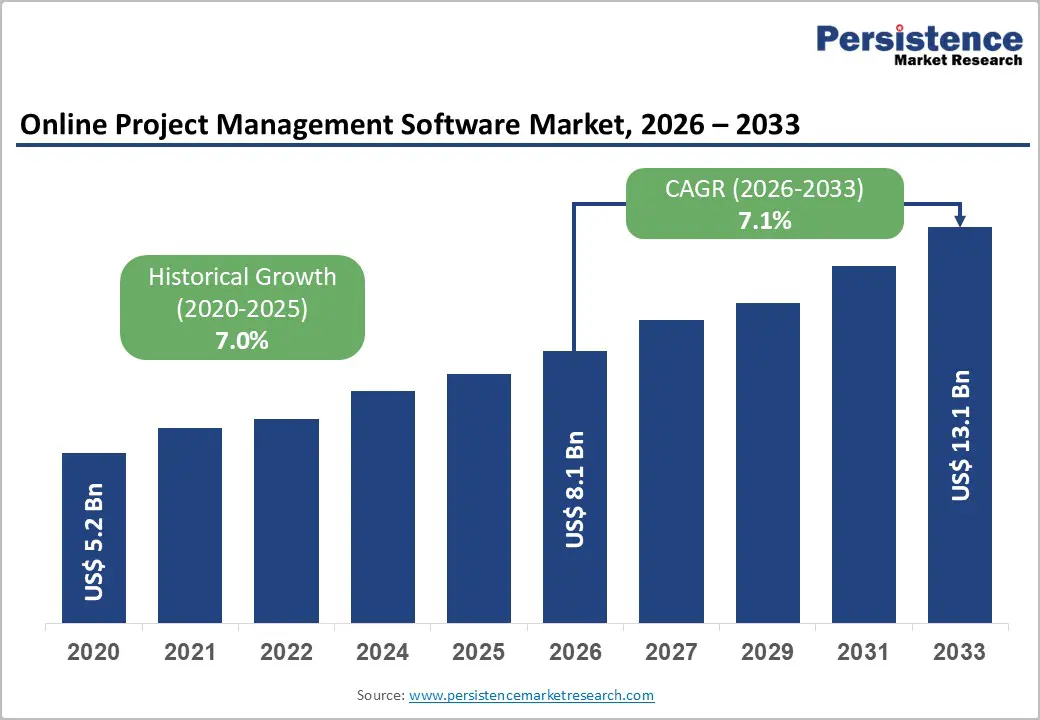
The global online project management software market size is likely to be valued at US$ 8.1 billion in 2026 and is projected to reach US$ 13.1 billion by 2033, growing at a CAGR of 7.1% between 2026 and 2033.
The market growth is fundamentally driven by the accelerating shift toward hybrid and remote work environments, where organizations require robust digital collaboration and real-time project visibility capabilities. The widespread adoption of cloud-based solutions, coupled with the integration of artificial intelligence for resource optimization and predictive analytics, is further reinforcing market expansion.
Key Industry Highlights:
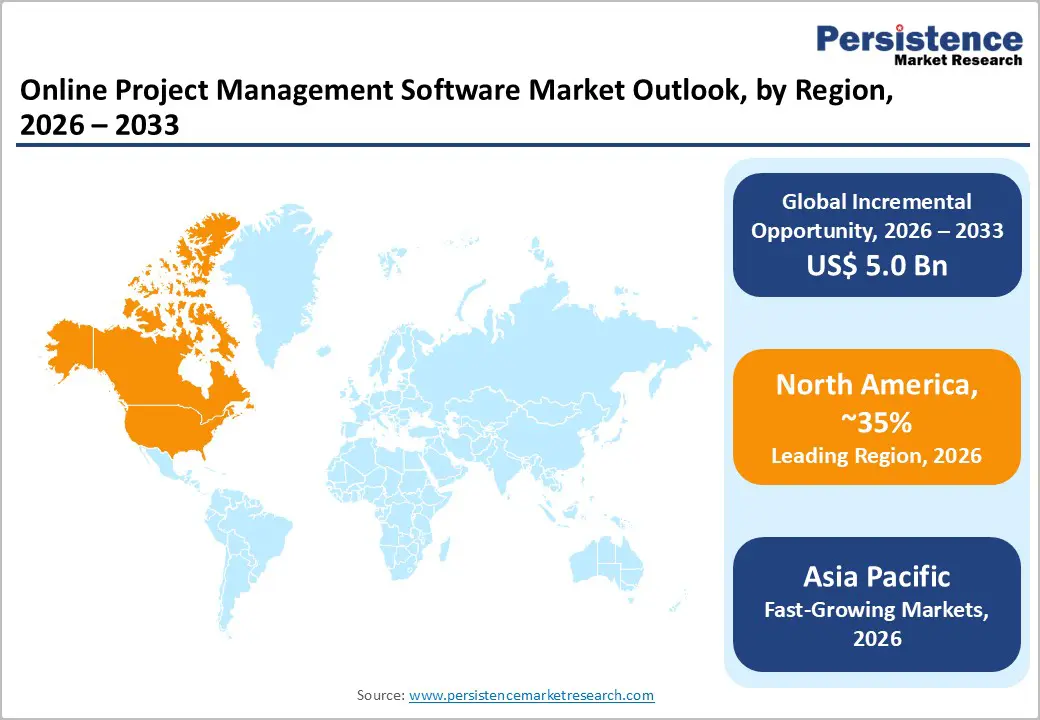
- Leading Region: North America maintains dominant market positioning, commanding approximately 35% of the global online project management software market by 2033, driven by advanced IT infrastructure development, substantial technology investment, and enterprise organizations' commitment to digital transformation initiatives.
- Fastest Growing Region: Asia Pacific represents the fastest-growing market region, demonstrating 9.2% CAGR through 2033 potential, driven by rapid economic growth, substantial infrastructure investment, digital transformation acceleration, and widespread cloud computing adoption in manufacturing, construction, and IT services sectors.
- Dominant Deployment: Cloud-based deployment solutions command dominant market positioning, capturing approximately 56.6% market share and demonstrating accelerating expansion driven by organizational preference for scalability, accessibility, and automatic updates.
- Fastest Growing Organization: The SME is the fastest-growing in the market, supported by rapid digitalization, increasing adoption of cloud-based tools, and the need for cost-effective project coordination solutions.
- Key Market Opportunity: Rising adoption of cloud-based project management tools by SMEs and distributed teams is expanding the customer base globally.
| Key Insights | Details |
|---|---|
|
Global Online Project Management Software Market Size (2026E) |
US$ 8.1 Bn |
|
Market Value Forecast (2033F) |
US$ 13.1 Bn |
|
Projected Growth CAGR(2026-2033) |
7.1% |
|
Historical Market Growth (2020-2025) |
6.6% |
Market Dynamics
Drivers - Shift Toward Cloud-Based Collaboration Driven by Remote and Hybrid Work Adoption
The persistent transformation toward hybrid and remote work models has fundamentally reshaped organizational project management requirements. With 94% of enterprises worldwide utilizing cloud computing as of 2025, and 69% of businesses adopting public cloud infrastructure as their primary operational environment, the demand for cloud-native project management solutions has intensified significantly. Organizations require solutions that enable real-time collaboration, task tracking, and progress monitoring across multiple time zones and geographical locations.
This shift has prompted enterprises to migrate from traditional on-premise solutions to cloud-based platforms, with cloud-based project management software capturing 56.6% market share in 2026 and continuing to expand at accelerated rates. The proliferation of remote workforce arrangements has made seamless integration with communication tools, file-sharing systems, and collaborative platforms essential, driving adoption among both large enterprises and SMEs, which reported 7.9% increase in project management tool purchases during recent periods.
Integration of Artificial Intelligence and Predictive Analytics
The incorporation of artificial intelligence and advanced analytics into project management platforms represents a transformative market driver. AI-powered features enable automated resource allocation optimization, predictive risk identification, anomaly detection in project timelines, and intelligent forecasting capabilities that enhance decision-making velocity. 22% of project managers report AI tools are currently deployed in their organizations, while 39% report plans to deploy AI tools, indicating substantial near-term expansion.
These technologies address critical pain points by automating routine tasks such as status reporting, schedule optimization, and resource conflict resolution. Furthermore, 87% of large enterprises have implemented AI solutions, with process automation leading adoption at 76%, demonstrating that AI integration is rapidly becoming a baseline expectation rather than a differentiation factor in enterprise project management solutions.
Restraints - Data Security, Privacy Risks, and Regulatory Compliance Challenges Limiting Adoption
Data security and privacy considerations represent significant market restraints despite widespread cloud adoption. Organizations handling sensitive information, particularly in BFSI, healthcare, and government sectors, express considerable hesitation regarding cloud-based project management solutions. 72% of SMEs have inadequate digital security measures, indicating widespread vulnerability awareness that restricts adoption enthusiasm. Regulatory compliance requirements across different jurisdictions, including GDPR in Europe, CCPA in California, and industry-specific standards in healthcare and finance, create complex implementation constraints. Organizations must ensure that project management platforms maintain compliance with these evolving regulatory frameworks while providing adequate data encryption, access controls, and audit trail capabilities.
Security breaches involving project data can expose sensitive business information, competitive strategies, and confidential client details, making risk-conscious enterprises reluctant to transition critical project information to cloud environments. The hybrid cloud model, preferred by 54% of enterprises for mission-critical workloads, reflects this security-consciousness, as organizations seek to balance scalability benefits with enhanced control over sensitive data. 47% cited unexpected costs as the leading reason for pulling workloads back on-premises, suggesting that security-related compliance costs further burden adoption decisions.
Opportunities - Expanded Integration with Enterprise Resource Planning and Sustainability Initiatives
Integration of project management software with broader enterprise resource planning (ERP) systems and newly emerging sustainability tracking capabilities presents substantial growth opportunities. Modern project management platforms increasingly embed financial tracking, resource planning, and operational analytics directly into project workflows, enabling organizations to connect project execution with financial outcomes and strategic objectives. Organizations increasingly require embedded financial tracking within project systems to manage budgets, expenses, and profitability across multi-project portfolios without relying on separate accounting systems. Corporate sustainability mandates and environmental, social, and governance (ESG) commitments are driving demand for project management solutions that incorporate sustainability metrics, carbon tracking, and emissions monitoring capabilities.
Some advanced platforms now offer dashboards that measure energy consumption, waste generation, and greenhouse gas emissions associated with project execution, enabling organizations to align project delivery with corporate sustainability commitments. The integration of real-time data analytics with scenario planning for risk management enables enterprises to model outcomes based on budget fluctuations, resource constraints, and timeline variations, facilitating proactive risk identification and mitigation planning. Furthermore, seamless integration with popular enterprise systems like Salesforce, Microsoft 365, and SAP solutions creates powerful ecosystem benefits that enhance organizational decision-making velocity and operational efficiency, driving substantial expansion in platform adoption among enterprises.
Increasing Complexity and Scale of Enterprise Projects Creating a Strong Demand
Modern enterprises are managing projects that are larger in scope, more interconnected, and subject to tighter timelines and compliance requirements than ever before, which presents a major opportunity for the global online project management software market. Organizations across sectors such as construction, engineering, IT, pharmaceuticals, energy, and financial services are executing multi-phase projects involving numerous stakeholders, vendors, and regulatory checkpoints. This rising complexity makes manual tracking and disconnected tools inefficient and risk-prone, increasing the need for centralized, end-to-end project management platforms. Online project management software enables enterprises to integrate scheduling, budgeting, resource allocation, risk management, and reporting within a single digital environment, improving visibility and decision-making at both project and portfolio levels.
Growing regulatory scrutiny and compliance requirements are pushing organizations to adopt systems that provide audit trails, documentation control, and real-time reporting capabilities. The opportunity is further strengthened by the integration of advanced technologies such as artificial intelligence, machine learning, and data analytics, which allow project managers to forecast delays, optimize resource utilization, and proactively manage risks. Large enterprises are also seeking solutions that seamlessly integrate with existing enterprise systems such as ERP, CRM, and HR platforms, driving demand for more sophisticated and customizable project management tools.
Category-wise Analysis
Components Insights
The Solution segment dominates the online project management software market, commanding the 65% share of the market. Solutions encompassing project scheduling, task management, resource allocation, collaboration features, and real-time progress tracking represent the core functionality driving market adoption. Organizations prioritize solutions offering comprehensive functionality, including Gantt charts, Kanban boards, portfolio management, and integrated reporting capabilities that address their fundamental project management requirements.
The solution segment's market leadership reflects its essential role in addressing core organizational pain points related to project visibility, team coordination, and deadline management. Solution providers increasingly differentiate through advanced features such as AI-powered predictive analytics, mobile-first architectures, and API-first design, enabling extensive third-party integrations. The continued migration from on-premise to cloud-based solutions is propelling the segment growth, particularly among enterprises seeking enhanced scalability and accessibility.
Deployment Insights
Cloud-based deployment represents the fastest-growing segment within the online project management software market, capturing approximately 56.6% market share in 2026 and demonstrating accelerating expansion. Cloud deployment offers compelling advantages, including scalability, accessibility from multiple locations, automatic software updates, and elimination of complex on-premise infrastructure management requirements. Cloud deployment enables organizations to access systems from any location with internet connectivity, supporting the global prevalence of remote and hybrid work models that have normalized throughout organizational ecosystems.
Enterprises increasingly adopt hybrid cloud environments combining public and private cloud infrastructure, preferred by 54% of organizations for managing mission-critical workloads while maintaining enhanced security and compliance controls. On-premise deployment retains relevance for organizations with stringent data sovereignty requirements, legacy system integration constraints, or limited cloud infrastructure familiarity, but represents a declining market segment as cloud technology maturity and security capabilities increasingly address traditional on-premise advantages.
Organization Analysis
Large Enterprises represent the dominant organizational segment within the online project management software market, accounting for substantial revenue contributions due to complex project portfolios, geographically dispersed teams, and sophisticated operational requirements. Large enterprises implement comprehensive project management solutions, managing thousands of concurrent projects, enterprise-wide resource allocation, compliance requirements, and multi-level governance structures. These organizations deploy advanced project management software providing integrated tools for resource planning, risk management, and real-time collaboration, enabling management of complex interdependent projects with extensive stakeholder coordination requirements.
SMEs represent the fastest-growing organizational segment, driven by increasing accessibility of affordable cloud-based solutions and recognition that project management tools provide competitive differentiation versus larger competitors. SMEs recognize that project management tools directly enhance competitive positioning by enabling operational efficiency equivalent to significantly larger organizations with substantially lower implementation costs.
Industry Insights
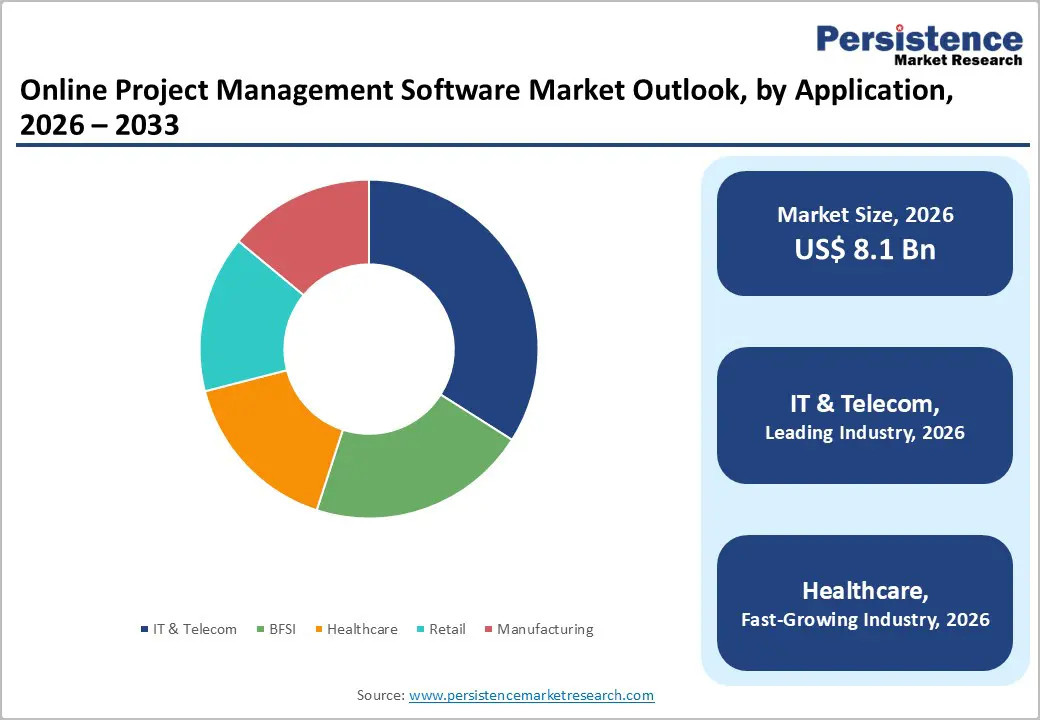
The IT and Telecom sector emerges as the dominant industry vertical within the online project management software market, leveraging project management solutions to efficiently manage technology-focused initiatives, software development projects, infrastructure deployments, and digital transformation programs. This sector extensively relies on project management software due to its characteristically dynamic environment, rapid innovation cycles, requirement for cross-functional collaboration, and necessity for precise resource allocation. IT & Telecom organizations extensively utilize project management software to track complex technical implementations, manage distributed development teams, and coordinate integration efforts across multiple technology platforms.
Healthcare and BFSI sectors increasingly adopt project management solutions, with healthcare demonstrating accelerating recognition of project management tool value in these highly regulated industries. BFSI organizations require project management capabilities specifically designed for regulatory compliance, audit trail documentation, and risk management integration.
Regional Insights
North America Online Project Management Software Trends
North America dominates the online project management software market, commanding approximately 35% market share by 2033 and representing the established center of software innovation, enterprise technology adoption, and digital transformation initiatives. The United States maintains market leadership driven by robust IT infrastructure development, substantial capital investment in technology solutions, and organizational commitment to digital transformation. North American enterprises demonstrate advanced technology adoption maturity, with 68% of businesses running most operations in the cloud and 78% of IT decision-makers considering the cloud their primary infrastructure strategy.
The region's competitive intensity drives organizations to invest aggressively in project management capabilities, enabling enhanced operational efficiency, reduced project delivery timelines, and improved resource use. Canadian market growth is propelled by rapid digital transformation initiatives, government funding supporting digital infrastructure modernization, and organizational recognition that SMEs require professional project management tools to compete effectively against larger competitors.
Europe Online Project Management Software Trends
Europe demonstrates substantial online project management software market share propelled by robust digital transformation initiatives, EU digitization funding programs supporting technology modernization, and organizational emphasis on data protection and regulatory compliance. The region benefits from government-sponsored digital transformation funding programs, including European Union initiatives supporting cloud migration, that subsidize organizational software investments and accelerate technology adoption.
European enterprises demonstrate particular commitment to data sovereignty, privacy protection, and regulatory compliance with GDPR and industry-specific standards, driving preference for hybrid cloud and private cloud deployment options offering enhanced control over sensitive information. Germany, United Kingdom, and France represent dominant European markets, with organizations in these countries implementing comprehensive project management solutions supporting digital transformation across government, financial services, manufacturing, and healthcare sectors.
Asia Pacific Online Project Management Software Trends
Asia Pacific represents the fastest-growing online project management software market region, demonstrating 18.2% CAGR in cloud services through 2025 and exceptional market expansion potential. The region benefits from rapid economic growth, substantial infrastructure investment, digital transformation acceleration, and widespread cloud computing adoption across organizational ecosystems. China, India, and Japan represent dominant Asia Pacific markets, with emerging economies, including Southeast Asia, demonstrating accelerating technology adoption.
The region's manufacturing sector emerges as a major project management software adopter, leveraging tools to manage large-scale infrastructure projects, supply chain modernization initiatives, and operational efficiency programs. Asian organizations increasingly recognize project management software value for enhancing regional coordination, supporting distributed team collaboration, and managing complex multi-stakeholder projects spanning multiple countries and business units.
Competitive Landscape for the Online Project Management Software Market
The online project management software market exhibits a moderately concentrated competitive structure, with the top ten vendors capturing approximately 60.5% share while maintaining diverse competitive dynamics and specialized provider ecosystems. Oracle Corporation maintains market leadership with 8.5% market share, followed by ServiceNow, Atlassian, Smartsheet, and Microsoft, representing major competitive players. Oracle leads through its comprehensive Primavera Cloud platform, advanced AI capabilities, and enterprise-grade portfolio management functionality addressing complex organizational requirements.
Companies increasingly employ AI-first strategies, embedding autonomous agents within platforms, differentiating through unique technology capabilities rather than feature parity. Strategic partnerships, mergers, acquisitions, and technology integrations represent dominant competitive expansion strategies as vendors enhance product portfolios and extend market reach. Organizations increasingly prioritize multi-vendor ecosystem approaches, adopting complementary specialized solutions for specific requirements rather than seeking single all-encompassing platform provider.
Key Market Developments
- In September 2024, Microsoft announced Copilot Pages, a new offering within Microsoft 365 enabling AI-powered project and document collaboration. This dynamic, persistent canvas supports multiplayer AI collaboration, rolling out to over 400 million users accessing Microsoft 365, representing significant product innovation and expanded AI integration throughout project management workflows.
- In September 2024, Oracle announced AI-first strategy enhancements embedding autonomous agents within Primavera Cloud and other portfolio management offerings, enabling continuous project data monitoring, schedule deviation detection, resource bottleneck forecasting, and automated mitigation workflow launching, transforming PPM into real-time decision-execution engines.
- In April 2024, Oracle NetSuite announced a comprehensive Enterprise Performance Management (EPM) solution including AI-powered narratives in financial reporting, NetSuite Planning and Budgeting, and Account Reconciliation features. This integration connects financial and operational planning while streamlining financial close processes with embedded AI capabilities.
Companies Covered in Online Project Management Software Market
- Microsoft Corporation
- Oracle Corporation
- ServiceNow, Inc.
- SAP SE
- Autodesk, Inc.
- UNIT 4
- Aconex Limited
- NetSuite Inc.
- Deltek
- Citrix Systems, Inc.
- Workfront, Inc.
- Atlassian Corp PLC
- Zoho Corporation
- Wrike, Inc.
- Basecamp, LLC
Frequently Asked Questions
The global online project management software market is projected to reach US$ 13.1 billion by 2033, growing at a 7.1% compound annual growth rate from 2026 to 2033, demonstrating substantial market expansion driven by accelerating cloud adoption, AI integration, and organizational digital transformation requirements.
Primary growth drivers include widespread adoption of remote and hybrid work models requiring cloud-based collaboration capabilities, integration of artificial intelligence for resource optimization and predictive analytics.
Cloud-based deployment solutions command the largest market segment, capturing approximately 56.68% market share, driven by organizational preference for scalability, accessibility, automatic updates, and elimination of complex on-premise infrastructure management requirements.
North America dominates the market, commanding approximately 35% market share by 2035, driven by advanced IT infrastructure development, robust capital investment in technology solutions, organizational commitment to digital transformation, and presence of major software vendors and technology companies.
Adoption of cost-effective AI-powered solutions presents substantial growth potential as organizations increasingly recognize competitive value of AI-powered resource forecasting, predictive risk identification, and intelligent automation.


