




- Medical Devices
- Micro Pumps Market
Micro Pumps Market Size, Share, and Growth Forecast, 2026 – 2033
Micro Pumps Market by Product Type (Mechanical, Piezoelectric, Peristaltic, Syringe Pumps, Non-Mechanical), Material (Silicon, Polymer, Glass, Metals), End-User (Healthcare & Medical Device Manufacturers, Pharmaceutical & Biotech Companies, Laboratory & Research Institutions, Industrial Manufacturers, Consumer Products Companies), and Regional Analysis for 2026-2033

Micro Pumps Market Share and Trends Analysis
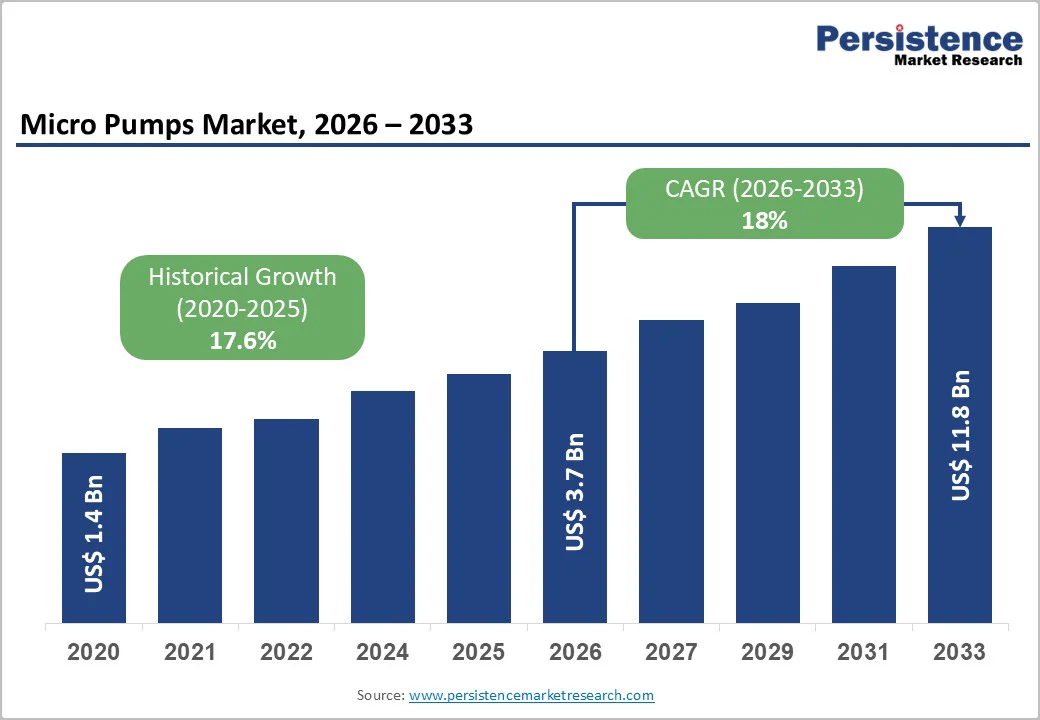
The global micro pumps market size is likely to be valued at US$ 3.7 billion in 2026, and is projected to reach US$ 11.8 billion by 2033, growing at a CAGR of 18 % during the forecast period 2026−2033. The market is expected to demonstrate one of the strongest growth trajectories within precision fluid-handling technologies, supported by sustained demand from medical devices, pharmaceutical manufacturing, and laboratory automation. Rising adoption of minimally invasive medical procedures, coupled with increased penetration of portable and wearable drug delivery systems, has elevated demand for compact, high-accuracy pumping solutions. Technological advancements in micro-electro-mechanical systems (MEMS), piezoelectric actuation, and polymer-based fabrication have significantly reduced unit costs while improving performance reliability.
Key Industry Highlights
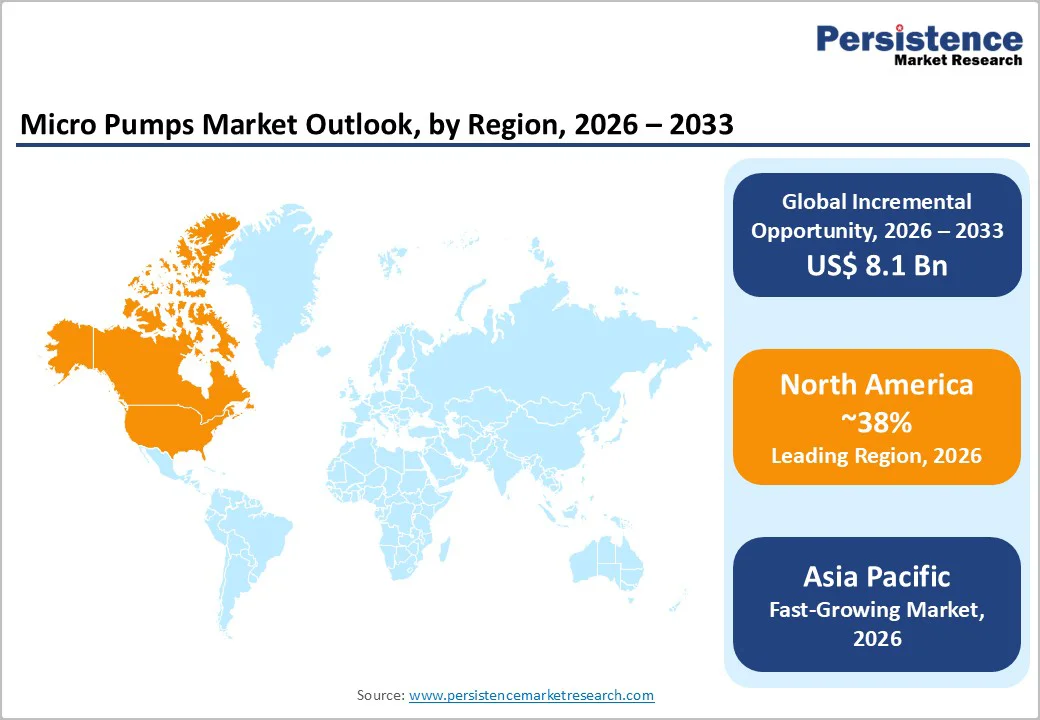
- Dominant Region: North America is predicted to hold a 38% market share in 2026, driven by advanced healthcare infrastructure and early adoption of wearable and implantable medical devices.
- Fastest-growing Regional Market: Asia Pacific is forecasted to be the fastest-growing market from 2026 to 2033, powered by rising healthcare spending and adoption of wearable medical devices.
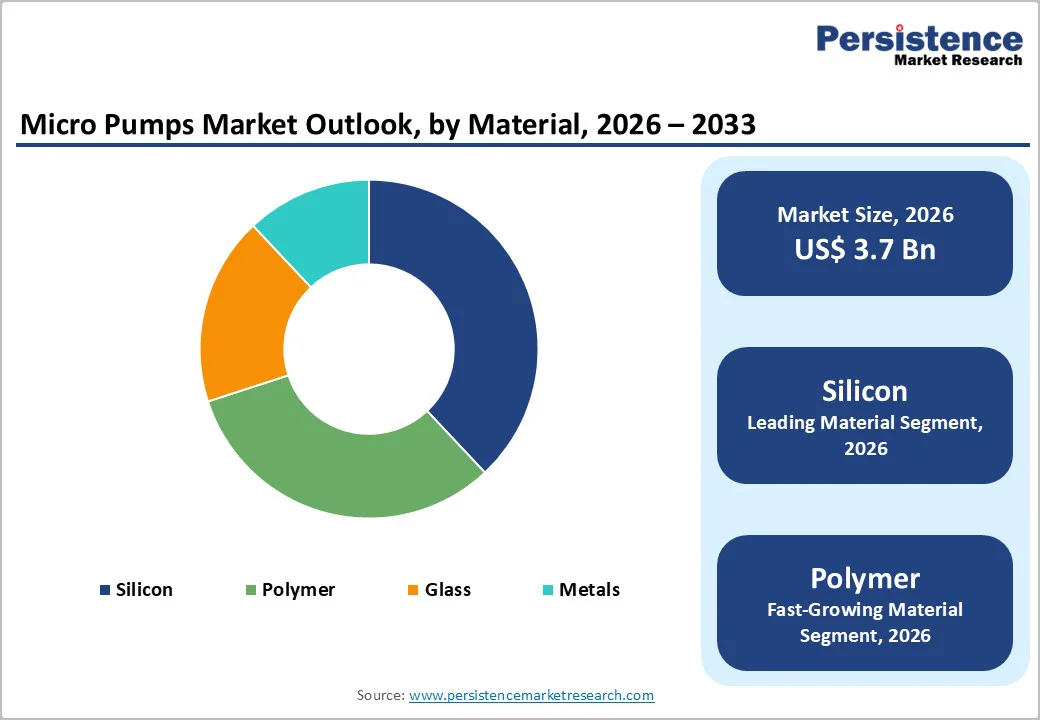
- Leading Material: Silicon-based micro pumps are likely to lead with about 38% market share in 2026 due to MEMS compatibility and high dimensional accuracy.
- Fastest-growing Material: Polymer-based micro pumps are slated to grow the fastest through 2033, owing to low production costs, chemical resistance, and suitability for disposable and wearable medical devices.
| Key Insights | Details |
|---|---|
| Micro Pumps Market Size (2026E) | US$ 3.7 Bn |
| Market Value Forecast (2033F) | US$ 11.8 Bn |
| Projected Growth (CAGR 2026 to 2033) | 18 % |
| Historical Market Growth (CAGR 2020 to 2025) | 5.5% |
Market Factors – Growth, Barriers, and Opportunity Analysis
Technological Advancements in Miniaturization and MEMS
Technological advancements in miniaturization and MEMS directly strengthen value creation by enabling compact, high-precision fluid control within tightly constrained environments. Reduced component size supports seamless integration into advanced medical, analytical, and industrial platforms where space efficiency, reliability, and low power consumption define purchasing decisions. MEMS fabrication techniques deliver consistent performance at scale, supporting mass production with tight tolerances. This alignment between engineering capability and system-level design requirements positions miniaturized architectures as a foundational enabler of next-generation device development.
Miniaturization combined with MEMS architecture transforms functional efficiency through precise flow regulation, rapid response times, and enhanced durability. MEMS-based micro-pumps can deliver highly accurate dosing in microliter or nanoliter volumes, enabling consistent performance in sensitive applications such as drug delivery, diagnostics, and laboratory automation. Smaller moving parts and integrated sensing reduce mechanical wear, increase lifespan, and allow continuous operation in demanding environments. Compact designs also simplify integration with electronic controls and sensors, supporting automation and real-time monitoring. These efficiency gains reduce operational costs, improve device reliability, and enable broader deployment in portable or wearable systems.
Regulatory and Qualification Complexities
Complexities surrounding regulations and qualifications act as a significant restraint due to the extensive approval processes required for devices incorporating micro-pumps. Products must meet stringent safety, performance, and quality standards across multiple regions, which involves rigorous testing, documentation, and compliance with international norms. Meeting these standards demands significant time and resource investment, delaying product launches and increasing operational costs. Small errors or deviations during validation can lead to costly redesigns or certification delays, impacting overall business efficiency and profitability.
The complexity intensifies when targeting medical and pharmaceutical applications, as regulatory authorities demand exhaustive clinical and technical evidence to ensure patient safety and device reliability. Companies must navigate varying regional requirements, maintain meticulous records, and continuously update their processes to align with evolving regulations. Compliance obligations require specialized expertise and significant investment in quality management systems, training, and documentation, which can strain resources and increase operational burden for organizations.
Integration with Smart and Wearable Medical Devices
Integrating micro pumps into smart wearable ecosystems offers manufacturers a high-value entry point into the personalized medicine market. These miniature pumps deliver fluids with exceptional precision while maintaining the small form factors necessary for patient-centric applications such as continuous glucose monitors and automated insulin delivery systems. As healthcare providers prioritize remote patient monitoring (RPM) and home-based treatments, the industry sees growing demand for autonomous devices that adjust medication dosages in real time. This capability not only improves therapeutic outcomes but also significantly boosts patient adherence by removing the burden of manual administration from the daily routine.
Pairing continuous health data generation with active fluid management creates a powerful closed-loop system that automates critical aspects of therapy and diagnostics. This synergy reduces the need for constant clinical intervention, allowing healthcare systems to scale their operations efficiently while maintaining high standards of care. For medical device developers, fusing connectivity with precise fluid control unlocks opportunities to design next-generation solutions that are both proactive and responsive. Ultimately, this convergence establishes a foundation for smarter, data-driven healthcare models that prioritize long-term patient wellness and operational sustainability.
Category-wise Analysis
Product Type Insights
The mechanical segment is likely to lead segment with a projected 34% of the micro pumps market revenue share in 2026 due to robust performance, high reliability, and cost efficiency across medical and industrial applications. Their dominance is reinforced by widespread deployment in laboratory equipment, medical infusion systems, and microfluidic devices. Established manufacturing processes, low maintenance requirements, and the ability to handle diverse fluid types further strengthen their market position, making them a preferred choice for applications such as hospital infusion pumps and chemical dosing systems in laboratories.
Piezoelectric micro pumps are anticipated to be the fastest-growing segment from 2026 to 2033, fueled by precise flow control, low power requirements, and seamless integration with wearable and portable medical devices. Increasing adoption in drug delivery systems, point-of-care diagnostic platforms, and implantable devices such as insulin pumps and portable oxygenators drives demand. Compact design, rapid response time, and high efficiency enable novel healthcare applications, positioning piezoelectric technology as a key driver of innovation and long-term market growth.
Material Insights
Silicon-based micro pumps are projected to capture 38% of the market share in 2026 due to their strong compatibility with MEMS and superior dimensional precision in medical and analytical uses. These pumps excel in high-accuracy devices such as laboratory instruments and diagnostic tools because of their exceptional stability and proven reliability. Manufacturers benefit from mature production methods that ensure consistent performance, making SBMPs the go-to option for mission-critical deployments where failure carries high risks. ?
Polymer-based micro pumps are anticipated to experience the fastest growth from 2026 to 2033, driven by robust chemical resistance, reduced manufacturing expenses, and adaptability to disposable medical and consumer products. Demand surges in point-of-care testing, wearable health monitors, and mass-market devices, where these pumps deliver lightweight construction and simple assembly processes. Developers targeting volume-driven markets should prioritize micro pumps made from polymers to achieve cost leadership, accelerate time-to-market, and meet the needs of scalable healthcare solutions in resource-constrained settings.
End-User Insights
Healthcare and medical device manufacturers are projected to capture nearly 42% of the revenue share in 2026. This significant portion reflects heavy reliance on infusion devices or implantable hardware that requires exact fluid management. Clinical environments utilize these technologies for vital tasks such as cardiac monitors and portable dialysis units to protect patient safety. Focusing on rigorous reliability standards helps producers maintain their leading position through established supply networks.
Pharmaceutical and biotech companies will likely serve as the quickest-growing segment between 2026 and 2033 due to rising bioprocess automation. These organizations adopt micro pumps to meet strict dosing needs while supporting continuous manufacturing for complex biologics. Modern systems used in automated drug formulation or lab-scale bioreactors allow firms to improve operational efficiency during output scaling. Prioritizing versatile innovations enables researchers to accelerate development and drive progress across the global medical landscape.
Regional Insights
North America Micro Pumps Market Trends
North America is expected to dominate with an estimated 38% of the micro pump market share in 2026, supported by a combination of technological advancement and strong healthcare infrastructure. The presence of established medical device manufacturers and a robust ecosystem for research and development enables rapid commercialization of innovative micro pump solutions. The region dominates due to early adoption of wearable and implantable medical devices, particularly in chronic disease management, including insulin delivery systems and portable infusion pumps. High patient awareness and strong reimbursement frameworks facilitate integration of precision fluid management technologies into clinical workflows, driving consistent demand and maintaining leadership in the market.
A key factor driving dominance is the synergy between advanced semiconductor manufacturing and MEMS-based micro pump technologies. North America leads in MEMS fabrication, allowing high-precision, reliable, and scalable production of silicon-based pumps, which are critical for medical diagnostics, lab automation, and pharmaceutical applications. Regulatory support for innovative medical devices accelerates approvals and market entry, enabling companies to leverage smart, connected, and automated micro pump solutions. This combination of technological capability, regulatory facilitation, and mature healthcare adoption underpins sustained leadership in the global micro pump market.
Europe Micro Pumps Market Trends
Europe is predicted to hold a significant position in the market through 2033, supported by advanced healthcare infrastructure, strong research and development capabilities, and supportive regulatory frameworks. Countries such as Germany, France, and the United Kingdom lead in medical device innovation, focusing on precision fluid management for diagnostics, drug delivery, and laboratory automation. The Europe market also benefits from a high concentration of micro pump manufacturers that specialize in MEMS-based and polymer-based technologies, enabling customized solutions for both medical and industrial applications. Emphasis on patient safety and compliance with stringent quality standards makes Europe a hub for high-accuracy, reliable micro pump deployment.
Europe is also witnessing rapid growth in wearable and home healthcare devices, positioning it as a key market for next-generation micro pump technologies. Integration with connected healthcare platforms and digital health initiatives supports adoption of automated drug delivery systems and portable diagnostic devices. Strategic collaborations between technology developers and pharmaceutical companies further enhance innovation, while increasing demand for minimally invasive procedures and point-of-care testing fuels expansion.
Asia Pacific Micro Pumps Market Trends
Asia Pacific is slated to emerge as the fastest-expanding regional market for micro pumps from 2026 to 2033, propelled by surging healthcare investments and booming pharmaceutical production. Nations such as China and India experience swift urbanization alongside expanding patient bases, which heighten needs for advanced fluid control in portable diagnostics and wearable therapies. Suppliers gain advantages by aligning product roadmaps with these demographics to secure early-mover status in high-volume, underserved territories. ?
Robust local fabrication strengths, abundant technical talent, and supportive public policies further accelerate infrastructure development for medical hardware. Point-of-care testing platforms, compact infusion units, and biologics processes open doors for widespread integration, while collaborations between domestic firms and international innovators speed up technology transfers. Developers pursuing chronic condition therapies and at-home care should emphasize adaptable designs to capitalize on policy-driven demand and foster enduring regional partnerships.
Competitive Landscape
The global micro pumps market landscape shows moderate fragmentation. The top five suppliers – Bartels Mikrotechnik GmbH, TTP Ventus Ltd., Parker Hannifin Corp, IDEX, and IVEK Corporation – collectively generate roughly 45% of global revenue. Rivalry centers on technology differentiation, high reliability, and application-specific customization as companies address diverse requirements across medical, pharmaceutical, and industrial sectors. Strong research and development (R&D) capabilities and innovation in MEMS-based, piezoelectric, and polymer micro pumps give these leaders a distinct advantage. For clients evaluating partnerships, aligning with these established players can reduce development risk and accelerate time-to-market.
Barriers to entry stay moderate. Significant capital investment needs, complex manufacturing processes, and stringent regulatory compliance create these hurdles. New entrants must navigate certification standards, quality assurance protocols, and clinical validation processes. These obligations extend time to market. Strategic partnerships, technology licensing, and regional manufacturing collaborations help both established companies and emerging participants strengthen market presence and capture growth opportunities in this evolving industry. Organizations should consider collaborative models to share development costs and access specialized expertise while maintaining flexibility for future product iterations.
Key Industry Developments
- In November 2025, Huawei launched a micro-pump liquid cooling case for Mate 80, Mate 80 Pro, and Mate 80 Pro Max smartphones in China. The upgraded full-coverage design features an ultra-thin cooling layer, precision pump, and heat-absorbing sheet for automatic temperature reduction during gaming or heavy loads, powered by reverse wireless charging.
- In November 2025, NANO Nuclear Energy Inc. successfully completed initial full-system testing of its patent-pending Annular Linear Induction Pump at up to 350°C, validating enhanced coil durability and magnetic performance for molten salt and liquid metal coolants in micro modular reactors. Designed as a maintenance-free electromagnetic alternative to mechanical pumps for nuclear, space, and undersea applications, the technology advances toward commercialization with improved manufacturing processes such as orbital laser welding.
- In November 2025, KORU Medical Systems announced a development agreement with a global pharmaceutical company to create next-generation subcutaneous immunoglobulin infusion systems compatible with vials and prefilled syringes. The collaboration leverages KORU's Freedom60® and FreedomEDGE® pumps, alongside SCHOTT TOPPAC® polymer syringes, to simplify large-volume treatments for immunodeficiency patients.?
Companies Covered in Micro Pumps Market
- Bartels Mikrotechnik GmbH
- TTP Ventus Ltd.
- Parker Hannifin Corp
- IDEX
- IVEK Corporation
- Takasago Electric, Inc.
- The Lee Company
- Xavitech
Frequently Asked Questions
The global micro pumps market is projected to reach US$ 3.7 billion in 2026.
Rising demand for precise fluid control in medical, pharmaceutical, and industrial applications drives the market.
The market is poised to witness a CAGR of 18 % from 2026 to 2033.
Expansion in point-of-care diagnostics, home healthcare, biopharmaceutical manufacturing, lab automation, and portable analytical devices are key market opportunities.
Some of the key market players include Bartels Mikrotechnik GmbH, TTP Ventus Ltd., Parker Hannifin Corp, IDEX, IVEK Corporation, and Takasago Electric, Inc.


