




- Biotechnology
- Time-resolved Fluorescence Microscope Market
Time-resolved Fluorescence Microscope Market Size, Share, and Growth Forecast, 2026 – 2033
Time-resolved Fluorescence Microscope Market by Product Type (Standalone Systems, Modular Systems, Accessory Equipment), Technology (Pulsed Laser Technology, Time-Correlated Single Photon Counting (TCSPC), Frequency Domain Technology, Time-Gated Detection Systems), End-User (Research Institutions, Pharmaceutical Companies, Biotechnology Firms, Clinical Laboratories), and Regional Analysis for 2026-2033

Time-resolved Fluorescence Microscope Market Share and Trends Analysis
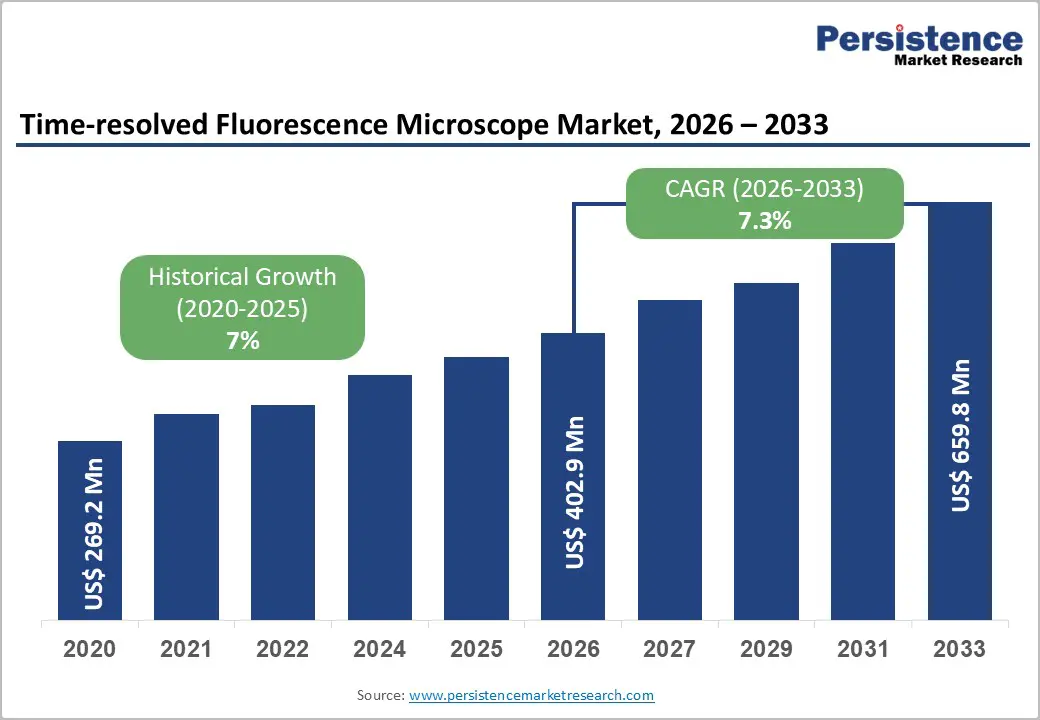
The global time-resolved fluorescence microscope market size is likely to be valued at US$ 402.9 million in 2026, and is projected to reach US$ 659.8 million by 2033, growing at a CAGR of 7.3% during the forecast period 2026−2033. Market expansion is driven by increasing demand for advanced imaging capabilities in clinical diagnostics and life science research that require temporal resolution to differentiate specific biological signals. Enhanced demand arises as research institutions adopt high performance imaging tools to support complex studies in cellular dynamics and molecular interactions, where conventional microscopy lacks temporal fidelity. Aging global populations and rising prevalence of chronic diseases support the need for precise diagnostic imaging platforms with temporal discrimination. Demographic shifts toward older age cohorts contribute to greater clinical caseloads of conditions such as cancer and neurodegenerative disorders, augmenting laboratory investment in advanced microscopy solutions. Increased clinical awareness of fluorescence based diagnostics supports adoption across pathology labs and translational research units.
Key Industry Highlights
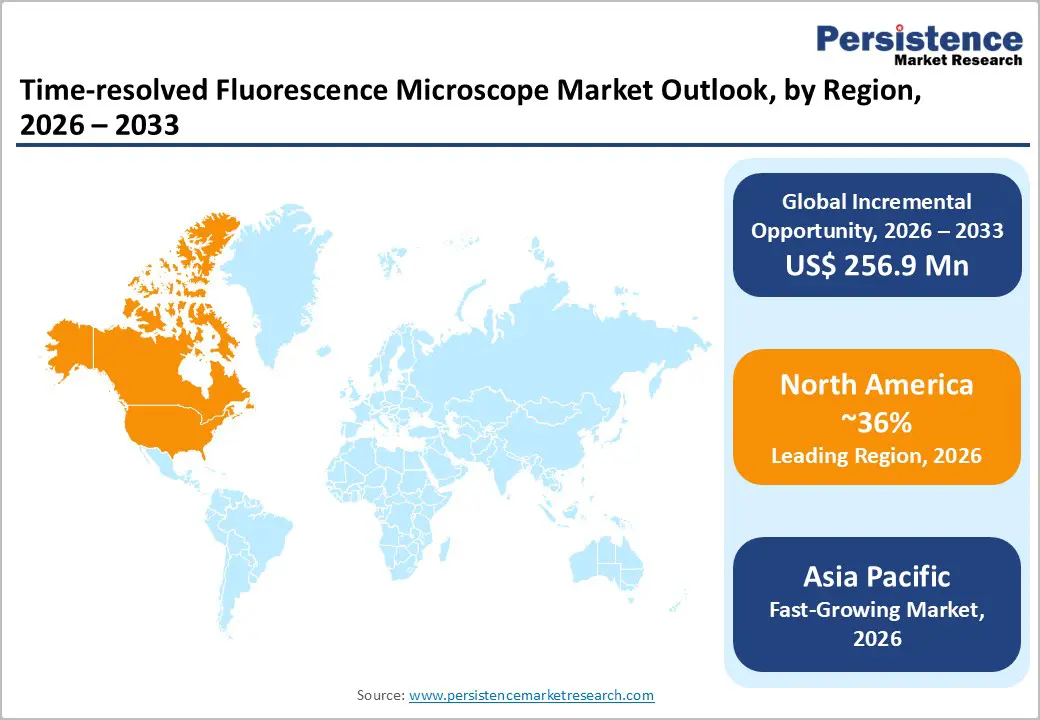
- Dominant Region: North America is projected to capture an estimated share of 36% in 2026, fueled by extensive academic and pharmaceutical research activity.
- Fastest-growing Regional Market: Asia Pacific is poised to be the fastest-growing market through 2033, driven by the speedy expansion of biotechnology ecosystems and rising healthcare expenditure.
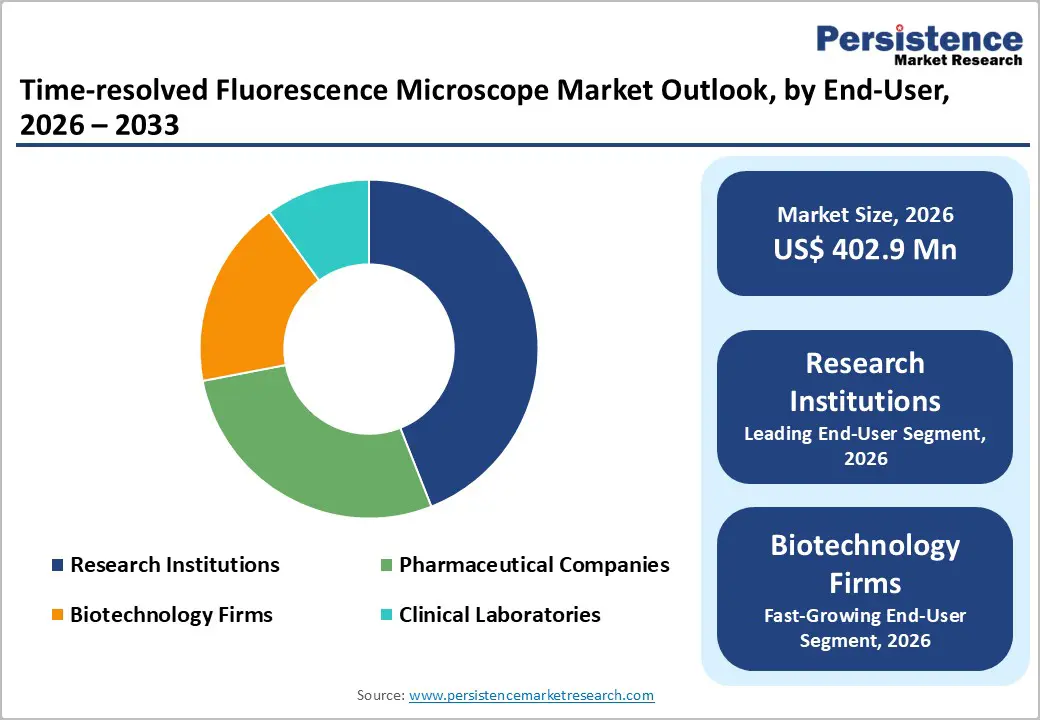
- Leading End-User: Research institutions are likely to hold around 44% market share in 2026, supported by the widespread adoption of advanced imaging for genomics, proteomics, and cellular biology applications.
- Fastest-growing End-User: Biotechnology firms are expected to post the highest CAGR through 2033, underpinned by accelerated drug discovery activity and digitalized laboratory workflows.
- July 2025: Zeiss acquired Pi Imaging Technology, a Swiss startup specializing in single-photon avalanche diode (SPAD) cameras and detectors, to enhance its high-end fluorescence microscopes with superior low-light sensitivity.
| Key Insights | Details |
|---|---|
| Time-resolved Fluorescence Microscope Market Size (2026E) | US$ 402.9 Mn |
| Market Value Forecast (2033F) | US$ 659.8 Mn |
| Projected Growth (CAGR 2026 to 2033) | 7.3% |
| Historical Market Growth (CAGR 2020 to 2025) | 7% |
Market Factors – Growth, Barriers, and Opportunity Analysis
Advancements in Biomedical and Pharmaceutical Research
Advancements in biomedical and pharmaceutical research increase demand for precision imaging tools that reveal molecular and cellular dynamics with high temporal resolution. Time-resolved fluorescence techniques, such as fluorescence lifetime imaging, capture decay patterns of fluorescent signals to provide quantitative insights into molecular interactions, metabolic activity, and intracellular processes. These capabilities allow researchers to visualize drug-target engagement and monitor dynamic biological events with high specificity, supporting accelerated discovery and validation in complex experimental environments. According to the National Institute of Biomedical Imaging and Bioengineering (NIBIB) under the National Institutes of Health (NIH), quantitative fluorescence lifetime imaging systems supported by NIH research produced at least four peer-reviewed publications over the past five years, demonstrating measurable adoption and impact in biomedical research.
Pharmaceutical research prioritizes tools that improve decision-making across the drug development lifecycle, including lead identification, candidate optimization, and toxicity profiling. Time-resolved fluorescence systems allow real-time kinetic analysis of protein binding, cellular uptake, and signal transduction, providing actionable insights into mechanism-of-action and efficacy. Research areas such as oncology, neuroscience, and immunology demand high temporal resolution to study dynamic processes driving disease progression and treatment response, reinforcing the strategic role of advanced time-resolved imaging technologies in accelerating discovery, improving experimental reliability, and supporting targeted R&D investments across scientific disciplines.
Requirement for Specialized Technical Expertise
Operating advanced time resolved fluorescence microscopes requires highly specialized technical skills spanning optical instrumentation, fluorescence lifetime analysis, and complex data interpretation. The instruments involve precise calibration of pulsed light sources, alignment of sensitive detectors, and management of signal-to-noise ratios, all of which demand rigorous training. Misalignment, improper setup, or incorrect parameter selection can produce inaccurate measurements, undermining reliability and reproducibility of results. Laboratories without personnel trained in photophysics, lifetime imaging techniques, or software for fluorescence decay analysis face significant operational challenges. Continuous evolution of hardware and analytical software adds further complexity, requiring ongoing skill development. Limited availability of trained personnel and steep learning curves restrict adoption, particularly in institutions where resources for specialized training are constrained.
The requirement for technical proficiency also has a direct impact on resource allocation, cost management, and operational efficiency. Institutions must dedicate significant investment to training programs, hire external specialists, or allocate internal staff exclusively to manage instrumentation. Analytical complexity in extracting meaningful lifetime distributions amplifies the risk of misinterpretation, which can compromise research outcomes and reduce confidence in experimental findings. Laboratories unable to bridge this skills gap may underutilize high-value equipment, delaying progress in critical projects. The dependence on experienced personnel limits scalability and constrains integration of advanced imaging into routine workflows.
Integration with Multimodal Imaging Platforms
Integration with multimodal imaging platforms represents a major growth opportunity for time resolved fluorescence microscopy due to its role in delivering more comprehensive biological insights and improved analytical power. Traditional standalone imaging methods often provide limited views of complex systems, focusing on either structural or functional aspects in isolation. Multimodal platforms combine complementary techniques such as fluorescence, phase contrast, Raman or molecular imaging into a unified workflow, enabling simultaneous capture of different data types from the same sample. This approach generates richer, multidimensional datasets that reveal both spatial and biochemical information, supporting deeper understanding of cellular dynamics, tissue heterogeneity and molecular interactions. A November 2025 study demonstrated that combining time resolved fluorescence with phase imaging enabled direct tracking of drug uptake and metabolic changes, delivering detailed cellular insights within a single experimental workflow.
In research and clinical contexts, the ability to co-register and analyze multimodal datasets enhances decision making and accelerates workflows. Integration of time resolved fluorescence with other imaging techniques reduces dependence on multiple sequential experiments and minimizes sample handling variability. Real time fusion of complementary imaging signals supports precise correlation of structural, dynamic and molecular data, enabling clearer interpretation of complex biological responses. This integrated perspective improves diagnostic confidence, strengthens phenotypic profiling accuracy and supports advanced End-Users such as high content screening in drug development. The shift toward hybrid imaging systems aligns with broader developments in spatial biology and computational imaging, where cross modality data integration and advanced analytics are becoming essential capabilities for next-generation research platforms.
Category-wise Analysis
Product Type Insights
Standalone systems are anticipated to secure around 46% of the time-resolved fluorescence microscope market revenue share in 2026, reflecting strong demand from large research institutions and centralized laboratories that prioritize integrated, high-performance imaging platforms. Standalone systems offer complete optical, detection, and software integration, reducing configuration complexity and minimizing interoperability risks. Research-intensive environments favor these systems due to reliability, reproducibility, and standardized performance across experiments. High capital investment capacity among government-funded laboratories and pharmaceutical research centers further reinforces preference for standalone configurations.
Modular systems are expected to be the fastest-growing segment during the 2026–2033 forecast period, propelled by increasing demand for customizable and scalable microscopy solutions. Modular architectures allow laboratories to upgrade components and equipment such as lasers, detectors, and analysis modules without replacing entire systems, improving capital efficiency. This flexibility aligns with evolving research requirements and budget constraints, particularly within biotechnology firms and academic institutions. Growth in interdisciplinary research drives demand for adaptable platforms that support multiple imaging modalities. Modular systems enable manufacturers to address diverse end-user needs through configurable offerings, expanding commercial reach.
Technology Insights
Time-correlated single photon counting (TCSPC) extracts are poised to dominate with a forecasted market share of over 41% in 2026, powered by superior temporal resolution and quantitative accuracy. TCSPC technology enables precise fluorescence lifetime measurements, critical for end-users in molecular interaction analysis and cellular metabolism studies. High data reliability supports clinical research and pharmaceutical validation processes, reinforcing institutional trust. Widespread academic validation and compatibility with established imaging workflows enhance acceptance. TCSPC systems also benefit from robust vendor support and standardized protocols, reducing implementation risk.
Time-gated detection systems are estimated to be the fastest-growing segment from 2026 to 2033, fueled by increasing demand for noise reduction and enhanced contrast in complex biological samples. Time-gated approaches improve signal discrimination in autofluorescent environments, supporting oncology and tissue imaging end-users. Intensifying focus on preventive healthcare and growing emphasis on early disease detection have stimulated the demand for technologies delivering high diagnostic clarity. The expansion of digital commerce platforms and direct manufacturer engagement accelerates market access. Improved affordability and simplified operation further support adoption, positioning time-gated detection as a high-growth technology segment.
End-User Insights
Research institutions are likely to be the leading end-user segment with a projected 44% of the time-resolved fluorescence microscope market share in 2026 due to sustained investment in fundamental and applied life science research. Public funding agencies and international research organizations prioritize advanced imaging capabilities to support innovation in genomics, proteomics, and cellular biology. High utilization rates, long equipment lifecycles, and institutional procurement frameworks reinforce consistent demand. Research institutions also serve as early adopters, validating new technologies and influencing downstream commercial adoption.
Biotechnology firms are anticipated to be the fastest-growing end-user segment from 2026 to 2033, fueled by increasing focus on accelerated drug discovery and assay development. This segment increasingly adopts advanced imaging technologies to support target validation, mechanism of action studies, and biomarker identification within compressed development timelines. Digitalization of laboratory workflows and demand for cost efficient, technology enabled service delivery continue to drive adoption, as firms seek integrated platforms that support automation, data standardization, and scalable analysis. High throughput imaging capabilities align with the need to screen large compound libraries while maintaining analytical precision and reproducibility. Biotechnology firms prioritize flexible imaging solutions that integrate with existing laboratory infrastructure, enhance researcher productivity, and reduce time to market for novel therapeutics.
Regional Insights
North America Time-resolved Fluorescence Microscope Market Trends
By 2026, North America is expected to lead with an estimated 36% of the time-resolved fluorescence microscope market share, supported by a mature research ecosystem and rapid uptake of advanced imaging solutions. Regional leadership is anchored in the United States, where sustained activity across academic research centers, pharmaceutical development hubs, and federally funded laboratories continues to drive technology adoption. Canada complements this landscape through publicly funded biomedical research programs, strong university collaboration networks, and national initiatives that emphasize translational science and innovation readiness.
Regional market momentum is strengthened by consistent public sector investment in life sciences, precision medicine, and translational research programs administered through institutions such as the National Institutes of Health and the National Science Foundation (NSF). These funding structures support procurement of high precision imaging systems, long term research projects, and infrastructure modernization. Regulatory oversight by the Food and Drug Administration (FDA) promotes standardized validation pathways for imaging technologies used in clinical and preclinical research, reinforcing purchasing confidence among hospitals, academic institutions, and contract research organizations. The competitive environment remains intensive, with established manufacturers maintaining localized production capabilities, service operations, and professional training programs to support end users.
Europe Time-resolved Fluorescence Microscope Market Trends
Europe represents a structurally distinct market environment shaped by policy driven research coordination, institutional continuity, and strong emphasis on scientific standardization. Activity is concentrated in Germany, the United Kingdom, and France, where established biomedical research ecosystems and pharmaceutical production clusters support steady adoption of advanced imaging technologies. Universities, public research laboratories, and clinical research centers act as primary demand generators, applying time resolved fluorescence microscopy across fundamental life science research, translational studies, and early phase clinical investigation. Cross border collaboration and shared research objectives reinforce consistent utilization of advanced imaging systems across multiple scientific domains.
Compelling initiatives of the European Union (EU) that prioritize collaborative research models, shared infrastructure, and cross border knowledge exchange are enabling the market here gain additional traction. Funding mechanisms under framework programs encourage multi country projects, increasing demand for compatible and standardized imaging platforms across institutions. Regulatory governance through entities such as the European Medicines Agency reinforces uniform research and validation requirements, reducing fragmentation and supporting smoother technology deployment across member states. Competitive dynamics reflect coexistence of global suppliers and specialized regional manufacturers offering modular and End-User focused systems.
Asia Pacific Time-resolved Fluorescence Microscope Market Trends
Asia Pacific is forecasted to be the fastest-growing market for time resolved fluorescence microscopes between 2026 and 2033, supported by rapid expansion of regional biotechnology ecosystems, rising healthcare expenditure, and increasing government focus on advanced research infrastructure. Regional demand is led by Japan and South Korea, where strong pharmaceutical manufacturing bases, established academic institutions, and continuous investment in precision research technologies support steady adoption. India and Southeast Asian economies strengthen growth momentum through expansion of academic research output, contract research organizations, and participation in global drug development and clinical research activities.
Governments across the region are prioritizing laboratory modernization, enhancing public research capacity and capability, and building and training the workforce in advanced analytical techniques. Regulatory reforms aimed at improving clinical research governance, transparency, and innovation promotion enhance market accessibility for high end imaging systems. Competitive dynamics increasingly favor technology transfer agreements, joint ventures, and localized manufacturing partnerships that improve cost efficiency and regional supply resilience. Capital deployment is being channeled toward broadening the presence of research laboratories, developing industry-specific and market-relevant skills, and promoting the adoption of modular imaging platforms aligned with diverse budget requirements.
Competitive Landscape
The global time-resolved fluorescence microscope market exhibits a moderately consolidated structure, with a limited number of global manufacturers capturing a substantial share of overall revenue through advanced technology portfolios, comprehensive service networks, and strong brand recognition. Key players such as Leica Microsystems, Bruker, Olympus Corporation, PicoQuant, and Nikon Corporation Healthcare Business Unit drive market dynamics by offering high-performance imaging systems tailored for diverse research and clinical applications. Their competitive advantage relies on technological innovation, system reliability, precision performance, and after-sales support, which fosters long-term relationships with academic institutions, pharmaceutical companies, and contract research organizations.
Smaller manufacturers complement the market by providing flexible and cost-efficient solutions that address specific research requirements, allowing broader accessibility for emerging laboratories and growing research centers. These players contribute to overall market diversity and encourage innovation in design, usability, and integration with digital analytics platforms. Investment by global and regional companies emphasizes research and development, product upgrades, and expansion of training and technical support networks to meet increasing demand for high-throughput, high-resolution imaging systems. Strategic collaborations, partnerships, and technology transfer agreements further strengthen market presence, enabling companies to enhance service coverage and local manufacturing capabilities.
Key Industry Developments
- In December 2025, Renishaw integrated time-resolved Raman spectroscopy (TRRS) into its inVia confocal Raman microscope, using a pulsed 532 nm laser and SPAD array to separate fast Raman signals from slower fluorescence backgrounds.This breakthrough enables clear spectra from challenging fluorescent samples such as Kapton polyimide, sesame oil, pigments in Legos, and high-temperature sapphire at 1500°C, expanding applications in chemicals, polymers, food, and materials analysis.
- In August 2025, researchers at the Queen Mary University of London developed FRAP-SR (Fluorescence Recovery After Photobleaching in Super-Resolution regime), combining lattice structured illumination microscopy with FRAP to achieve 60-nanometer live-cell imaging.
This gentle technique minimizes phototoxicity while enabling real-time observation of dynamic processes such as DNA repair and chromosome dynamics, supporting drug screening beyond diffraction limits. - In June 2025, Janelia Research Campus scientists developed blinx, a machine learning method that analyzes fluorescence intensity fluctuations to count individual molecules within a single microscope light spot. Unlike prior techniques providing single estimates, blinx delivers probability distributions for prediction confidence and detects more molecules, enabling protein identification through key amino acid counts in biological samples.
Companies Covered in Time-resolved Fluorescence Microscope Market
- Leica Microsystems
- Bruker
- Olympus Corporation
- PicoQuant
- Nikon Corporation Healthcare Business Unit
- HORIBA Group
- Hamamatsu Photonics
- ISS, Inc.
- Becker & Hickl GmbH.
- Edinburgh
- Thermo Fisher Scientific Inc.
Frequently Asked Questions
The global time-resolved fluorescence microscope market is projected to reach US$ 402.9 million in 2026.
The market is driven by technological advancements in imaging platforms and rising clinical and research demand for high-precision, time-resolved analysis.
The market is poised to witness a CAGR of 7.3% from 2026 to 2033.
Key market opportunities include the integration of multimodal imaging with digital platforms to address unmet research and diagnostic needs.
Some of the key market players include Leica Microsystems, Bruker, Olympus Corporation, PicoQuant, and Nikon Corporation Healthcare Business Unit.


