Remote Patient Monitoring Services Market Size, Share, Growth, and Regional Forecast, 2026 to 2033

Remote Patient Monitoring Services Market by Service Type (Vital Sign Monitoring, Chronic Disease Management, Post Surgical Recovery Monitoring, Specialized Care, Patient Engagement & Education Services), Deployment (Software-as-a-Service (SaaS), Mobile App-First RPM Services, Telehealth-embedded RPM, Others), End User (Payers, Providers, Patients), and Regional Analysis from 2026 to 2033

ID: PMRREP19942
Calendar

March 2026

188 Pages

Author : Vaishnavi Patil

Key Industry Highlights:

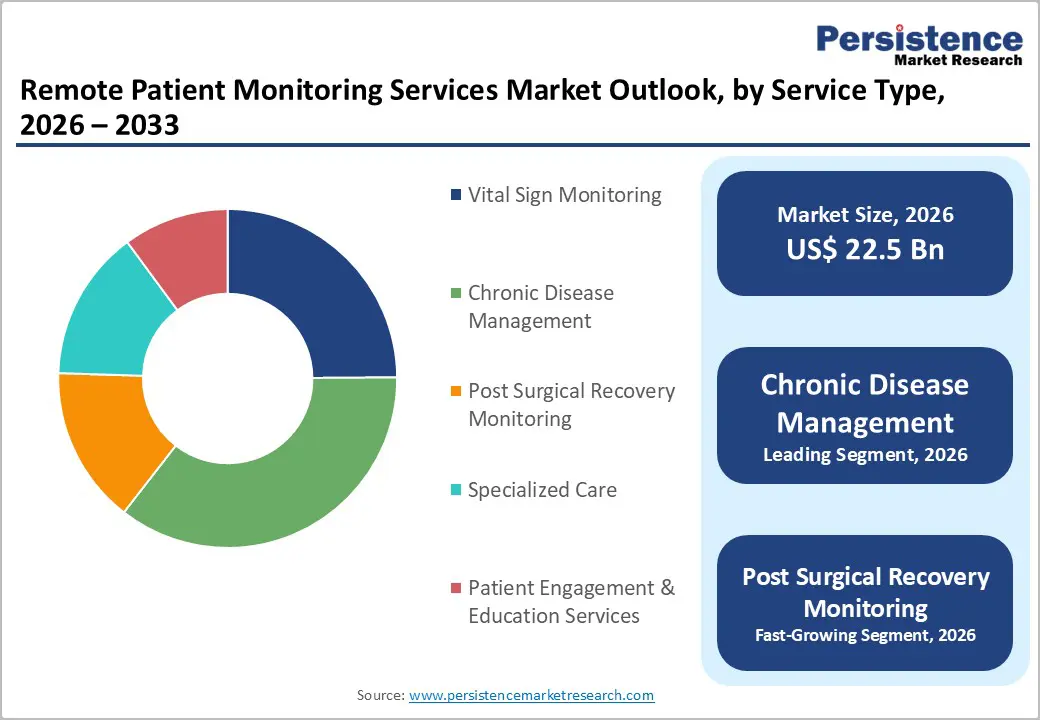
  • Dominant Service Segment: Chronic disease management is the leading service in the remote patient monitoring services market, accounting for 35.6% share in 2025. Its growth is fueled by widespread adoption for managing conditions like diabetes, hypertension, and heart failure, supported by wearable devices, cloud-based platforms, and continuous patient monitoring solutions.
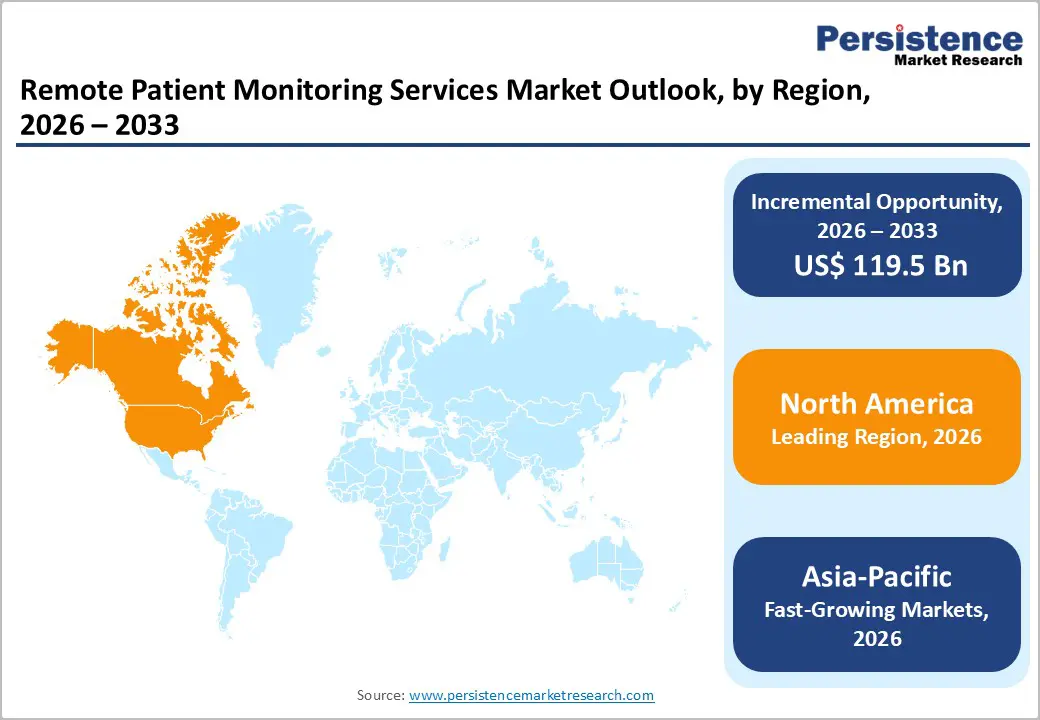
  • Dominant Region: North America leads the remote patient monitoring services market with a 44.5% share in 2025, driven by advanced healthcare infrastructure, high chronic disease prevalence, strong telehealth adoption, favorable reimbursement policies, and the presence of major RPM platform providers.
  • Market Drivers: Expansion is driven by rising chronic disease prevalence, increasing digital health adoption, growing demand for remote patient monitoring, technological advancements in connected devices and AI analytics, and supportive government healthcare initiatives.
  • Market Opportunity: Key opportunities include AI-enabled RPM analytics, mobile-first monitoring platforms, integration with telehealth services, expansion into emerging Asia-Pacific and Latin American markets, and adoption of patient engagement and education solutions for improved treatment adherence.
Key Insights Details
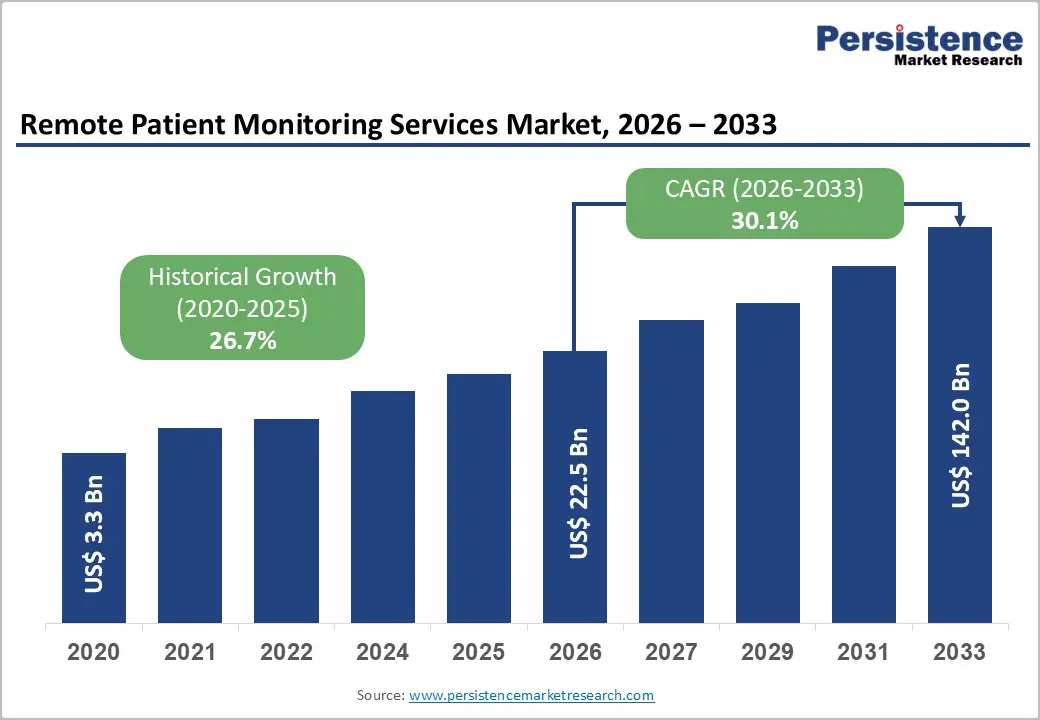
Global Remote Patient Monitoring Services Market Size (2026E) US$ 22.5 Bn
Market Value Forecast (2033F) US$ 142.0 Bn
Projected Growth (CAGR 2026 to 2033) 30.1%
Historical Market Growth (CAGR 2020 to 2025) 26.7% 

remote-patient-monitoring-services-market-2026-2033

Market Dynamics

Driver: Increasing adoption of digital health and telemedicine solutions

The adoption of digital health technologies, including telemedicine and remote patient monitoring (RPM), has increased dramatically in recent years, driven by both provider and patient demand for accessible care. In the U.S., physician adoption of telehealth expanded from about 15.4% in 2019 to over 86.5% in 2021, according to the CDC/NCHS data brief tracking telemedicine use before and after the COVID-19 pandemic. This reflects a structural shift in healthcare delivery, where remote consultations and digital tools have become mainstream components of care delivery rather than niche services, enabling RPM to scale alongside other digital health tools.

Beyond telehealth visits, RPM devices and systems have seen robust uptake among providers. Market analyses estimate that by 2024 about 88% of providers have begun using remote monitoring technologies in practice, and the use of wearables for RPM is projected to grow rapidly, increasing around 35% annually as patient and clinician comfort with connected health devices continues to rise. These adoption trends demonstrate that digital health platforms are now a core part of modern care strategies, broadening demand for RPM services across chronic disease management and post-acute care.

Restraint: Data privacy and cybersecurity concerns with patient health information

As healthcare systems become more digitized, data privacy and cybersecurity risk have escalated, posing a significant restraint for RPM services which depend on secure collection, transfer, and storage of sensitive patient information. Recent statistics show healthcare remains the most targeted sector for data breaches, with an average data breach cost of about USD 7.42 million per incident, higher than any other industry in 2025. These breaches often expose personally identifiable information, which undermines patient trust and can reduce willingness to engage with digital health tools, including remote monitoring platforms.

The volume and sophistication of attacks add further pressure. Healthcare organizations reported that nearly all 93% experienced at least one cyberattack in the past year, and breaches affected hundreds of millions of records globally, averaging over 758,000 compromised records per day. This persistent threat landscape means providers must invest significantly in cybersecurity infrastructure, training, and compliance frameworks such as HIPAA, driving up operational costs and creating barriers for smaller practices or emerging markets. The result is a tangible limit on RPM adoption where security concerns outweigh potential clinical benefits.

Opportunity: Integration of artificial intelligence (AI) and predictive analytics for patient care

One of the most promising opportunities in the Remote Patient Monitoring Services Market is the integration of artificial intelligence (AI) and predictive analytics, which enhances the value of RPM by enabling providers to anticipate clinical risks and tailor interventions. Research in healthcare predictive analytics highlights that machine learning models can identify patterns in patient data that traditional monitoring might overlook, supporting earlier intervention, personalized care, and more precise risk stratification. These capabilities directly align with RPM’s goal of continuous, proactive patient management.

Emerging implementations of AI in healthcare have also been associated with measurable improvements in outcomes; for example, predictive models applied in clinical settings have reduced readmission rates by 10 - 20% in studies examining AI-driven analytics. This suggests that RPM systems equipped with predictive capabilities could help reduce costly hospital readmissions and improve patient health metrics while optimizing clinician workload. As AI technologies mature and integrate more deeply with wearable sensors, EHR data, and mobile platforms, RPM can evolve from reactive monitoring to a predictive, precision-oriented care tool, unlocking new clinical and economic value streams.

Category-wise Analysis

By Service Type Insights

Chronic Disease Management dominates the remote patient monitoring (RPM) services market because chronic conditions such as diabetes, hypertension, and heart failure require continuous monitoring and long-term care. In the U.S., 90% of the $4.9 trillion annual healthcare expenditure is attributed to chronic and mental health conditions, highlighting the massive healthcare burden. RPM allows real-time tracking of vital signs, medication adherence, and lifestyle data, enabling early intervention and reducing hospitalizations. Studies show that RPM for chronic disease management can reduce hospital readmissions by up to 38% and improve patient outcomes. The continuous data flow supports clinicians in proactive treatment, patient engagement, and remote care coordination, making chronic disease management the largest service segment in RPM globally.

By Deployment Insights

Software-as-a-Service (SaaS) dominates RPM deployment because cloud-based solutions offer scalability, cost-efficiency, and rapid implementation. Over 83% of healthcare organizations now use cloud services to store, manage, and analyze patient data, enabling SaaS RPM platforms to operate without heavy on-premises IT infrastructure. SaaS allows real-time access to patient metrics, seamless integration with electronic health records, and continuous software updates, which are critical for timely intervention in remote monitoring. Subscription-based pricing reduces upfront costs, making RPM adoption feasible for hospitals, clinics, and home care providers. The flexibility, interoperability, and security of SaaS platforms facilitate large-scale deployment across multiple sites and devices, positioning SaaS as the dominant RPM deployment model worldwide.
remote-patient-monitoring-services-market-outlook-by-service-type-2026-2033

Regional Insights

North America Remote Patient Monitoring Services Market Trends

North America, especially the United States, leads the remote patient monitoring services market due to widespread RPM adoption, advanced healthcare infrastructure, and robust reimbursement policies. Medicare began covering RPM in 2018, and by 2022 RPM spending by Medicare rose from roughly $15 million in 2019 to more than $300 million, with over 570,000 Medicare enrollees using RPM services, indicating rapid uptake and payer support. High smartphone and broadband penetration in the U.S. also supports RPM integration into routine care, with RPM devices projected to be used by 70.6 million U.S. patients (≈26 % of the population) by 2025 under expanded coverage policies. These elements create a strong ecosystem for RPM deployment and scaling across clinical and home settings.

Europe Remote Patient Monitoring Services Market Trends

Europe is a key region for RPM services due to coordinated digital health strategies, aging populations, and strong public healthcare systems. A WHO European Region survey found that 77% of countries provide telemedicine or remote patient monitoring services, reflecting broad institutional adoption across 40 member states. European Union initiatives such as national telehealth strategies and interoperable digital infrastructures promote integration of RPM with broader care delivery, particularly for chronic disease and elderly care. Chronic conditions like cardiovascular disease and diabetes are highly prevalent in Europe’s aging population, pushing demand for continuous remote monitoring. Additionally, universal health coverage systems in countries like Germany, the UK, and France support reimbursement of digital care, making RPM financially viable and encouraging provider adoption across diverse urban and rural regions.

Asia-Pacific Remote Patient Monitoring Services Market Trends

Asia Pacific is the fastest-growing region in the remote patient monitoring services market due to its large population, rising chronic disease burden, and rapid digital health expansion. The region’s Internet user base reached 5.4 billion in 2024, creating a massive foundation for digital health services, including RPM. High chronic disease prevalence for example, the International Diabetes Federation reported over 238 million adults with diabetes in Asia-Pacific drives demand for remote monitoring to manage long-term conditions outside hospitals. National digital health initiatives such as India’s National Digital Health Mission and expanding 4G/5G networks also improve RPM accessibility in rural and underserved areas. These structural and demographic factors underpin accelerated adoption and the region’s leading growth trajectory for RPM services.
remote-patient-monitoring-services-market-outlook-by-region-2026-2033

Competitive Landscape

The remote patient monitoring services market is competitive, led by major players like Roche, Abbott, Siemens Healthineers, and Myriad Genetics, who leverage advanced devices, cloud-based RPM platforms, telehealth integration, and strategic partnerships to enhance patient monitoring, improve chronic disease management, and expand their global healthcare service offerings.

Key Industry Developments:

  • In July 2025, Medtronic announced a strategic partnership with Philips to broaden access to advanced patient monitoring solutions. The collaboration aimed to integrate Medtronic’s clinical expertise with Philips’ monitoring technologies, enabling healthcare providers to deliver continuous, real-time patient data across hospital and home care settings.
  • In April 2024, Philips partnered with SmartQare to automate and simplify continuous patient monitoring both inside and outside hospitals. The collaboration aimed to integrate Philips’ patient monitoring technologies with SmartQare’s digital platform, enabling healthcare providers to remotely track patient vital signs, improve care efficiency, and reduce clinical workload.

Companies Covered in Remote Patient Monitoring Services Market

  • Koninklijke Philips N.V.
  • Conduit Health Partners
  • Tellihealth
  • CareSimple
  • Bosch Global Software Technologies Private Limited 
  • CareSpan
  • HealthSnap
  • Hicuity Health
  • RPM Logix
  • Health Recovery Solutions
  • Teladoc Health
  • Vivo Care, Inc.
  • Others
Frequently Asked Questions

The global remote patient monitoring services market is projected to be valued at US$ 22.5 Bn in 2026.

Rising chronic diseases, digital health adoption, telemedicine growth, technological advancements, and supportive government initiatives drive RPM.

The global remote patient monitoring services market is poised to witness a CAGR of 30.1% between 2026 and 2033.

Integration of AI, expansion in emerging markets, mobile-first RPM, telehealth partnerships, and advanced remote diagnostics.

Koninklijke Philips N.V, Conduit Health Partners, Tellihealth, CareSimple, Bosch Global Software Technologies Private Limited, and CareSpan.

Remote Patient Monitoring Services Market Report Scope
Report Attribute Details
Historical Data/Actuals 2020 - 2025
Forecast Period 2026 - 2033
Market Analysis Value: US$ Bn
Geographical Coverage 
  • North America 
  • Europe 
  • East Asia 
  • South Asia & Oceania 
  • Latin America 
  • Middle East and Africa 
Segmental Coverage 
  • Service Type
  • Deployment
  • End User
  • Region 
Competitive Analysis 
  • Koninklijke Philips N.V.
  • Conduit Health Partners
  • Tellihealth
  • CareSimple
  • Bosch Global Software Technologies Private Limited 
  • CareSpan
  • HealthSnap
  • Hicuity Health
  • RPM Logix
  • Health Recovery Solutions
  • Teladoc Health
  • Vivo Care, Inc.
  • Others
Report Highlights 
  • Market Forecast and Trends 
  • Competitive Intelligence & Share Analysis  
  • Growth Factors and Challenges 
  • Strategic Growth Initiatives 
  • Pricing Analysis
  • Future Opportunities and Revenue Pockets 
  • Industry Market Analysis Tools
Market Segmentation

By Service Type

  • Vital Sign Monitoring
  • Chronic Disease Management
  • Post Surgical Recovery Monitoring
  • Specialized Care
  • Patient Engagement & Education Services

By Deployment

  • Software-as-a-Service (SaaS)
  • Mobile App-First RPM Services
  • Telehealth-embedded RPM
  • Others

By End-user

  • Payers
  • Providers
  • Patients

By Region

  • North America
  • Europe
  • East Asia
  • South Asia & Oceania
  • Latin America
  • Middle East and Africa

Related Reports

  1. Executive Summary
    1. Global Remote Patient Monitoring Services Market Snapshot, 2026 and 2033
    2. Market Opportunity Assessment, 2026 - 2033, US$ Bn
    3. Key Market Trends
    4. Future Market Projections
    5. Premium Market Insights
    6. Industry Developments and Key Market Events
    7. PMR Analysis and Recommendations
  2. Market Overview
    1. Market Scope and Definition
    2. Market Dynamics
      1. Drivers
      2. Restraints
      3. Opportunity
      4. Challenges
      5. Key Trends
    3. Macro-Economic Factors
      1. Global Sectorial Outlook
      2. Global GDP Growth Outlook
    4. COVID-19 Impact Analysis
    5. Forecast Factors - Relevance and Impact
  3. Value Added Insights
    1. Regulatory Landscape
    2. Product Adoption Analysis
    3. Value Chain Analysis
    4. Key Deals and Mergers
    5. PESTLE Analysis
    6. Porter’s Five Force Analysis
  4. Global Remote Patient Monitoring Services Market Outlook:
    1. Key Highlights
      1. Market Size (US$ Bn) and Y-o-Y Growth
      2. Absolute $ Opportunity
    2. Market Size (US$ Bn) Analysis and Forecast
      1. Historical Market Size (US$ Bn) Analysis, 2020-2025
      2. Market Size (US$ Bn) Analysis and Forecast, 2026-2033
    3. Global Remote Patient Monitoring Services Market Outlook: Service Type
      1. Introduction / Key Findings
      2. Historical Market Size (US$ Bn) Analysis, By Service Type, 2020 - 2025
      3. Market Size (US$ Bn) Analysis and Forecast, By Service Type, 2026 - 2033
        1. Vital Sign Monitoring
        2. Chronic Disease Management
        3. Post Surgical Recovery Monitoring
        4. Specialized Care
        5. Patient Engagement & Education Services
      4. Market Attractiveness Analysis: Service Type
    4. Global Remote Patient Monitoring Services Market Outlook: Deployment
      1. Introduction / Key Findings
      2. Historical Market Size (US$ Bn) Analysis, By Deployment, 2020 - 2025
      3. Market Size (US$ Bn) Analysis and Forecast, By Deployment, 2026 - 2033
        1. Software-as-a-Service (SaaS)
        2. Mobile App-First RPM Services
        3. Telehealth-embedded RPM
        4. Others
      4. Market Attractiveness Analysis: Deployment
    5. Global Remote Patient Monitoring Services Market Outlook: End User
      1. Introduction / Key Findings
      2. Historical Market Size (US$ Bn) Analysis, By End User, 2020 - 2025
      3. Market Size (US$ Bn) Analysis and Forecast, By End User, 2026 - 2033
        1. Payers
        2. Providers
        3. Patients
      4. Market Attractiveness Analysis: End User
  5. Global Remote Patient Monitoring Services Market Outlook: Region
    1. Key Highlights
    2. Historical Market Size (US$ Bn) Analysis, By Region, 2020 - 2025
    3. Market Size (US$ Bn) Analysis and Forecast, By Region, 2026 - 2033
      1. North America
      2. Europe
      3. East Asia
      4. South Asia and Oceania
      5. Latin America
      6. Middle East & Africa
    4. Market Attractiveness Analysis: Region
  6. North America Remote Patient Monitoring Services Market Outlook:
    1. Key Highlights
    2. Historical Market Size (US$ Bn) Analysis, By Market, 2020 - 2025
      1. By Country
      2. By Service Type
      3. By Deployment
      4. By End User
    3. Market Size (US$ Bn) Analysis and Forecast, By Country, 2026 - 2033
      1. U.S.
      2. Canada
    4. Market Size (US$ Bn) Analysis and Forecast, By Service Type, 2026 - 2033
      1. Vital Sign Monitoring
      2. Chronic Disease Management
      3. Post Surgical Recovery Monitoring
      4. Specialized Care
      5. Patient Engagement & Education Services
    5. Market Size (US$ Bn) Analysis and Forecast, By Deployment, 2026 - 2033
      1. Software-as-a-Service (SaaS)
      2. Mobile App-First RPM Services
      3. Telehealth-embedded RPM
      4. Others
    6. Market Size (US$ Bn) Analysis and Forecast, By End User, 2026 - 2033
      1. Payers
      2. Providers
      3. Patients
    7. Market Attractiveness Analysis
  7. Europe Remote Patient Monitoring Services Market Outlook:
    1. Key Highlights
    2. Historical Market Size (US$ Bn) Analysis, By Market, 2020 - 2025
      1. By Country
      2. By Service Type
      3. By Deployment
      4. By End User
    3. Market Size (US$ Bn) Analysis and Forecast, By Country, 2026 - 2033
      1. Germany
      2. France
      3. U.K.
      4. Italy
      5. Spain
      6. Russia
      7. Rest of Europe
    4. Market Size (US$ Bn) Analysis and Forecast, By Service Type, 2026 - 2033
      1. Vital Sign Monitoring
      2. Chronic Disease Management
      3. Post Surgical Recovery Monitoring
      4. Specialized Care
      5. Patient Engagement & Education Services
    5. Market Size (US$ Bn) Analysis and Forecast, By Deployment, 2026 - 2033
      1. Software-as-a-Service (SaaS)
      2. Mobile App-First RPM Services
      3. Telehealth-embedded RPM
      4. Others
    6. Market Size (US$ Bn) Analysis and Forecast, By End User, 2026 - 2033
      1. Payers
      2. Providers
      3. Patients
    7. Market Attractiveness Analysis
  8. East Asia Remote Patient Monitoring Services Market Outlook:
    1. Key Highlights
    2. Historical Market Size (US$ Bn) Analysis, By Market, 2020 - 2025
      1. By Country
      2. By Service Type
      3. By Deployment
      4. By End User
    3. Market Size (US$ Bn) Analysis and Forecast, By Country, 2026 - 2033
      1. China
      2. Japan
      3. South Korea
    4. Market Size (US$ Bn) Analysis and Forecast, By Service Type, 2026 - 2033
      1. Vital Sign Monitoring
      2. Chronic Disease Management
      3. Post Surgical Recovery Monitoring
      4. Specialized Care
      5. Patient Engagement & Education Services
    5. Market Size (US$ Bn) Analysis and Forecast, By Deployment, 2026 - 2033
      1. Software-as-a-Service (SaaS)
      2. Mobile App-First RPM Services
      3. Telehealth-embedded RPM
      4. Others
    6. Market Size (US$ Bn) Analysis and Forecast, By End User, 2026 - 2033
      1. Payers
      2. Providers
      3. Patients
    7. Market Attractiveness Analysis
  9. South Asia & Oceania Remote Patient Monitoring Services Market Outlook:
    1. Key Highlights
    2. Historical Market Size (US$ Bn) Analysis, By Market, 2020 - 2025
      1. By Country
      2. By Service Type
      3. By Deployment
      4. By End User
    3. Market Size (US$ Bn) Analysis and Forecast, By Country, 2026 - 2033
      1. India
      2. Southeast Asia
      3. ANZ
      4. Rest of South Asia & Oceania
    4. Market Size (US$ Bn) Analysis and Forecast, By Service Type, 2026 - 2033
      1. Vital Sign Monitoring
      2. Chronic Disease Management
      3. Post Surgical Recovery Monitoring
      4. Specialized Care
      5. Patient Engagement & Education Services
    5. Market Size (US$ Bn) Analysis and Forecast, By Deployment, 2026 - 2033
      1. Software-as-a-Service (SaaS)
      2. Mobile App-First RPM Services
      3. Telehealth-embedded RPM
      4. Others
    6. Market Size (US$ Bn) Analysis and Forecast, By End User, 2026 - 2033
      1. Payers
      2. Providers
      3. Patients
    7. Market Attractiveness Analysis
  10. Latin America Remote Patient Monitoring Services Market Outlook:
    1. Key Highlights
    2. Historical Market Size (US$ Bn) Analysis, By Market, 2020 - 2025
      1. By Country
      2. By Service Type
      3. By Deployment
      4. By End User
    3. Market Size (US$ Bn) Analysis and Forecast, By Country, 2026 - 2033
      1. Brazil
      2. Mexico
      3. Rest of Latin America
    4. Market Size (US$ Bn) Analysis and Forecast, By Service Type, 2026 - 2033
      1. Vital Sign Monitoring
      2. Chronic Disease Management
      3. Post Surgical Recovery Monitoring
      4. Specialized Care
      5. Patient Engagement & Education Services
    5. Market Size (US$ Bn) Analysis and Forecast, By Deployment, 2026 - 2033
      1. Software-as-a-Service (SaaS)
      2. Mobile App-First RPM Services
      3. Telehealth-embedded RPM
      4. Others
    6. Market Size (US$ Bn) Analysis and Forecast, By End User, 2026 - 2033
      1. Payers
      2. Providers
      3. Patients
    7. Market Attractiveness Analysis
  11. Middle East & Africa Remote Patient Monitoring Services Market Outlook:
    1. Key Highlights
    2. Historical Market Size (US$ Bn) Analysis, By Market, 2020 - 2025
      1. By Country
      2. By Service Type
      3. By Deployment
      4. By End User
    3. Market Size (US$ Bn) Analysis and Forecast, By Country, 2026 - 2033
      1. GCC Countries
      2. Egypt
      3. South Africa
      4. Northern Africa
      5. Rest of Middle East & Africa
    4. Market Size (US$ Bn) Analysis and Forecast, By Service Type, 2026 - 2033
      1. Vital Sign Monitoring
      2. Chronic Disease Management
      3. Post Surgical Recovery Monitoring
      4. Specialized Care
      5. Patient Engagement & Education Services
    5. Market Size (US$ Bn) Analysis and Forecast, By Deployment, 2026 - 2033
      1. Software-as-a-Service (SaaS)
      2. Mobile App-First RPM Services
      3. Telehealth-embedded RPM
      4. Others
    6. Market Size (US$ Bn) Analysis and Forecast, By End User, 2026 - 2033
      1. Payers
      2. Providers
      3. Patients
    7. Market Attractiveness Analysis
  12. Competition Landscape
    1. Market Share Analysis, 2025
    2. Market Structure
      1. Competition Intensity Mapping By Market
      2. Competition Dashboard
    3. Company Profiles (Details - Overview, Financials, Strategy, Recent Developments)
      1. Koninklijke Philips N.V.
        1. Overview
        2. Segments and Products
        3. Key Financials
        4. Market Developments
        5. Market Strategy
      2. Conduit Health Partners
      3. Tellihealth
      4. CareSimple
      5. Bosch Global Software Technologies Private Limited 
      6. CareSpan
      7. HealthSnap
      8. Hicuity Health
      9. RPM Logix
      10. Health Recovery Solutions
      11. Teladoc Health
      12. Vivo Care, Inc.
      13. Others
  13. Appendix
    1. Research Methodology
    2. Research Assumptions
    3. Acronyms and Abbreviations

Research Methodology Framework for Market Research Excellence

At Persistence Market Research, we implement a comprehensive, validated, and multi-dimensional approachto market analysis that delivers actionable insights across complex market landscapes. Our methodology combines the analytical rigor of leading consulting firms with innovative research techniques, ensuring robust market assessments that guide strategic decision-making with confidence.

Core Research Philosophy

Our methodology is built on four foundational pillars:

Research Philosophy Image

At Persistence Market Research, our methodology is designed to transcend conventional market studies by combining analytical rigor, multi-source validation, and future-focused insights.

We integrate advanced research frameworks, robust data collection strategies, cutting-edge analytics, and innovative technologies to deliver a 360-degree view of complex markets.

We integrate advanced research frameworks, robust data collection strategies, cutting-edge analytics, and innovative technologies to deliver a 360-degree view of complex markets.

Each stage spanning from strategic scoping and hypothesis-building to competitive intelligence, quality validation, and actionable recommendations is engineered to provide clients with unmatched clarity, precision, and confidence in decision-making.

By embedding innovation and technology at the core, our approach ensures that insights are not only comprehensive but also predictive, empowering businesses to seize opportunities, mitigate risks, and achieve sustainable growth

Research Philosophy Image

Capturing Key Information and Events

During this phase, key research objectives focus on essential information and data points for assessing the market, including:

Research Philosophy Image

TAM-SAM-SOM Framework Implementation

We employ both top-down and bottom-up approaches to ensure accurate market sizing.

Top-Down Market SizingBottom-Up Market Sizing
Universe Definition: Total global/regional market identificationUnit Economics: Average transaction values, purchase frequencies, customer lifecycle
Segmentation Filters: Geographic, demographic, and behavioral constraintsCustomer Segmentation: Detailed buyer persona development and sizing
Market Share Analysis: Competitive landscape assessment and share allocationPenetration Analysis: Market penetration rates by segment and geography
Growth Rate Application: Historical trends and forward-looking growth assumptionsScaling Methodology: Extrapolation techniques with confidence intervals

Validation & Cross-Verification

  • Triangulation: Comparing top-down and bottom-up results for consistency
  • Sensitivity Analysis: Testing key assumptions and parameter variations
  • Peer Benchmarking: Comparison with analogous markets and industry benchmarks
  • Expert Review: External validation through industry specialist consultation

Research Philosophy Image

Forecasting & Projection Modeling

Our proprietary forecasting models incorporate multiple variables and scenarios.

Forecasting Components

  • Historical Trend Analysis: 10-year historical growth patterns and cyclical variations
  • Driver-Based Modeling: Economic indicators, demographic shifts, technology adoption
  • Scenario Planning: Base case, optimistic, and conservative projections
  • Monte Carlo Simulations: Probability-weighted outcomes and risk assessments

Model Validation

  • Back-Testing: Historical accuracy assessment over 3–5-year periods
  • Cross-Validation: Multiple modeling approaches for result comparison
  • External Benchmarking: Comparison with established market forecasts
  • Continuous Calibration: Quarterly model updates based on new data

Comprehensive Data Collection Strategy

Our secondary research phase establishes a robust knowledge base utilizing diverse, credible sources.

Secondary Data Sourcess

  • Industry Publications & Reports
  • Government & Regulatory Data
  • Financial Intelligence (filings & reports)
  • Academic Research & Digital Intelligence

Quality Assurance Protocol

  • Source credibility assessment and publication date validation
  • Data consistency checks across multiple sources
  • Bias identification and neutralization techniques
  • Information gap tracking for primary research prioritization

Research Philosophy Image

Primary Research Excellence

Our primary research methodology employs best-in-class techniques to capture unique market insights.

Quantitative Research Methods

  • Large-Scale Surveys: Statistically representative samples with 95% confidence intervals
  • Survey Methodology: Multi-channel deployment (online, telephone, in-person)
  • Question Architecture and Response Optimization

Qualitative Research Methods

  • Executive Interviews
  • Focus Groups
  • Expert Consultations

Quality Assurance & Validation Framework

Multi-Stage Validation Process

  • Source Verification and Consistency Testing
  • Outlier Detection and Bias Assessment
  • Peer Review Process and External Validation
  • Sensitivity Analysis and Confidence Intervals

Research Philosophy Image

Methodology Validation & Credibility

Our research methodology has been extensively validated through:

  • Academic Partnerships: Collaborations with top-tier business schools and research institutions
  • Client Success Stories: Documented case studies demonstrating research impact and ROI
  • Continuous Benchmarking: Performance comparison with leading global research firms

This comprehensive methodology framework positions Persistence Market Research at the forefront of market intelligence, combining the analytical sophistication of top-tier consulting firms with innovative research techniques. Our approach ensures that every market assessment delivers precise, actionable, and strategically valuable insights that drive business success in competitive market environments.

Ready to unlock your market potential? Contact our research experts to discuss how our validated methodology can transform your strategic decision-making with data-driven market intelligence.

Copyright © 2026 Persistence Market Research. All Rights Reserved

Connect With Us -
Remote Patient Monitoring Services Market Size, 2033