




- Nutraceuticals & Functional Foods
- Microencapsulated Omega-3 Powder Market
Microencapsulated Omega-3 Powder Market Size, Share, and Growth Forecast, 2026 - 2033
Microencapsulated Omega-3 Powder Market by Nature (Organic, Conventional), Product Type (Alpha-linolenic Acid (ALA), Others), Distribution Channel (Direct, Indirect, Supermarket/Hypermarket, Others), and Regional Analysis for 2026 - 2033

Microencapsulated Omega-3 Powder Market Size and Trends Analysis
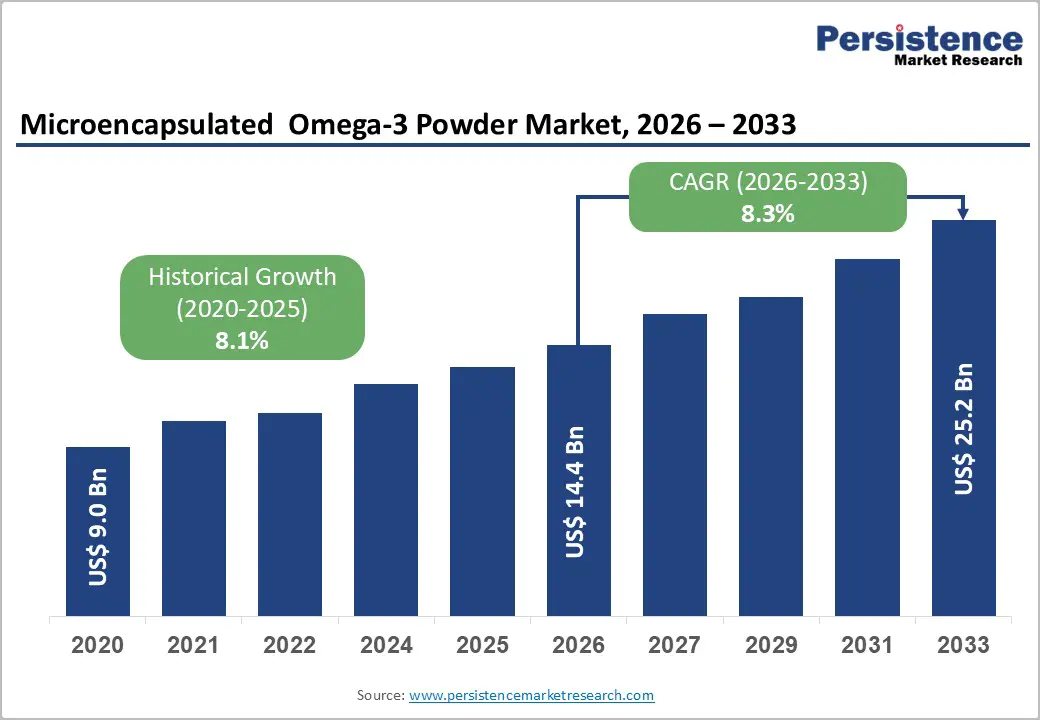
The global microencapsulated omega-3 powder market size is likely to be valued at US$14.4 billion in 2026, and is expected to reach US$25.2 billion by 2033, growing at a CAGR of 8.3% during the forecast period from 2026 to 2033, driven by the increasing prevalence of fortified functional foods, rising demand for stable omega-3 delivery in supplements, and advancements in microencapsulation technologies.
Growing demand for odorless, shelf-stable microencapsulated omega-3 powder, especially DHA and EPA variants, is accelerating adoption across applications. Advances in organic and conventional formulations are further boosting uptake by offering more bioavailable, versatile options. Increasing recognition of microencapsulated omega-3 powder as critical for heart and brain health in emerging wellness markets remains a major growth driver.
Key Industry Highlights:
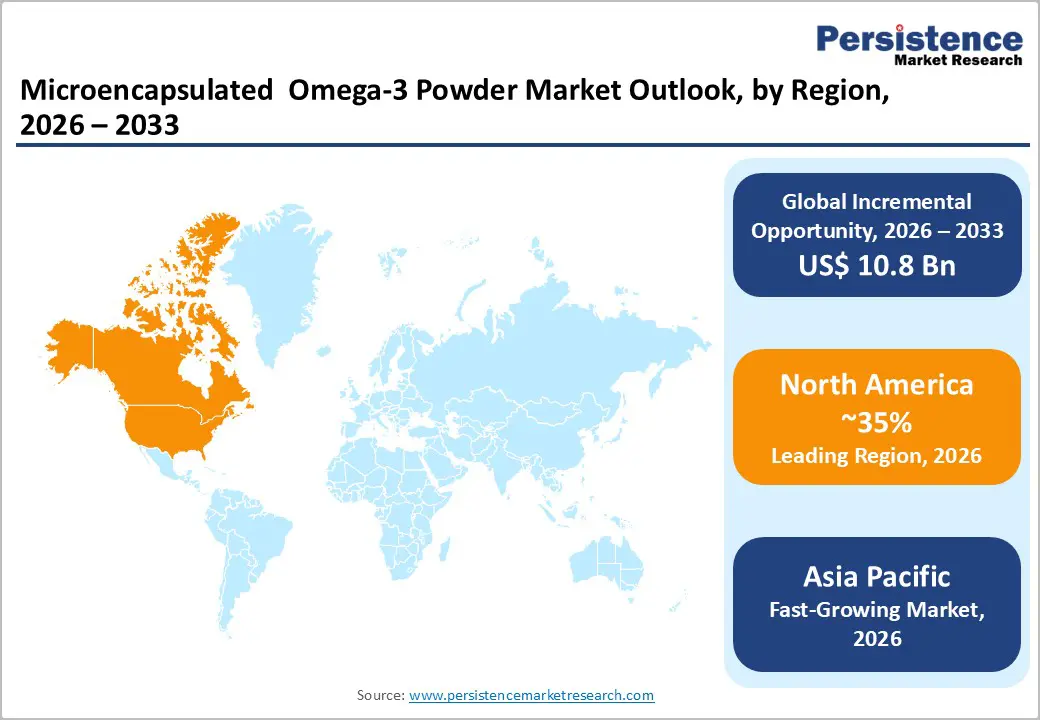
- Leading Region: North America, anticipated to account for a 35% market share in 2026, driven by high supplement consumption, advanced food fortification, and strong demand in the U.S.
- Fastest-growing Region: Asia Pacific, likely to be fueled by rising health awareness, expanding nutraceutical industry, and growing investments in fortified foods in China and India.
- Dominant Nature: Conventional, to hold approximately 60% of the revenue share, as it provides a cost-effective, high-volume supply for industrial use.
- Leading Product Type: Docosahexaenoic Acid (DHA), to account for over 40% of the revenue share, due to its role in brain health and infant nutrition.
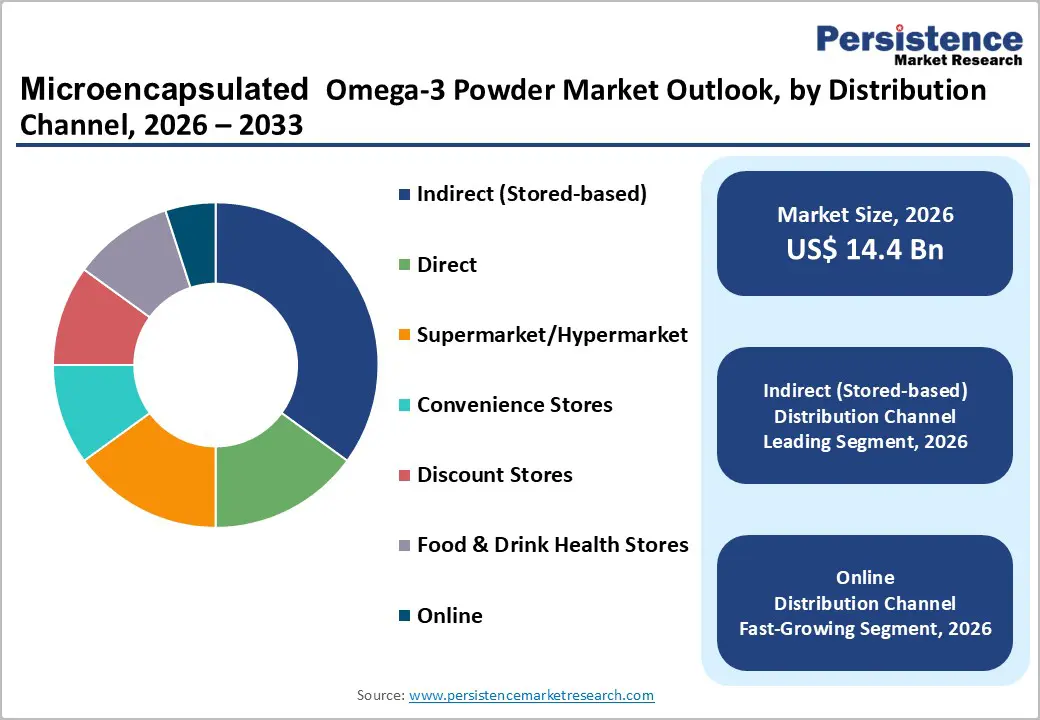
- Leading Distribution Channel: Indirect (Store-based), to contribute nearly 50% of the market revenue, due to wide retail availability in supermarkets and health stores.
| Key Insights | Details |
|---|---|
| Microencapsulated Omega-3 Powder Market Size (2026E) | US$14.4 Bn |
| Market Value Forecast (2033F) | US$25.2 Bn |
| Projected Growth (CAGR 2026 to 2033) | 8.3% |
| Historical Market Growth (CAGR 2020 to 2025) | 8.1% |
Market Factors - Growth, Barriers, and Opportunity Analysis
Rising Demand for Fortified Functional Foods and Stable Omega-3 Delivery
The rising demand for fortified functional foods is a major driver accelerating growth in the microencapsulated omega-3 powder market. Consumers are increasingly prioritizing everyday nutrition that delivers targeted health benefits such as heart health, cognitive support, and inflammation management. As a result, food manufacturers are actively fortifying staple products, including dairy alternatives, cereals, nutrition bars, beverages, and meal replacements, with omega-3 fatty acids. Conventional omega-3 oils are highly susceptible to oxidation, which can negatively impact their taste, odor, and shelf life, thereby limiting their direct use in food formulations.
This challenge has intensified demand for stable omega-3 delivery systems, where microencapsulation plays a critical role. By enclosing omega-3 oils within protective coatings, microencapsulation shields the fatty acids from heat, light, moisture, and oxygen during processing and storage. This enables manufacturers to maintain nutritional integrity while ensuring neutral taste and extended product shelf life. Microencapsulated omega-3 powder allows precise dosing and uniform dispersion in dry and liquid food matrices, making them ideal for large-scale fortification programs.
Complex Formulation and Processing Requirements
Complex formulation and processing requirements represent a significant restraint in the microencapsulated omega-3 powder market. Omega-3 fatty acids are highly sensitive compounds that degrade easily when exposed to heat, oxygen, light, and moisture. Designing an encapsulation system that effectively protects these oils while maintaining nutritional efficacy requires careful selection of wall materials such as proteins, carbohydrates, or lipids, each of which behaves differently under processing conditions. Achieving the right balance between protection, controlled release, and bioavailability adds further formulation complexity.
Processing challenges also arise during encapsulation techniques such as spray drying or coacervation. Parameters, including temperature, pressure, particle size, and drying speed, must be precisely controlled to prevent oxidation or leakage of omega-3 oils. Even minor deviations can reduce encapsulation efficiency, compromise shelf stability, or negatively affect taste and aroma. Ensuring uniform dispersion of microencapsulated particles in diverse food matrices such as beverages, powders, or baked products requires extensive testing and reformulation.
Advancements in High-Load and Clean-Label Delivery Platforms
Advancements in high-load and clean-label microencapsulated omega-3 powder delivery platforms are transforming the global nutrition landscape by addressing two major challenges, oxidation barriers and consumer trust. High-load platforms are engineered to achieve 30-50% omega-3 content, reducing reliance on fillers and enabling potent dosing in supplements. Innovations, such as multi-layer coating, protein-lipid shells, starch encapsulation, and antioxidant integration, significantly improve stability and reduce fishy aftertaste, lowering formulation costs for brands and consumer campaigns.
Progress in clean-label platforms, including organic DHA powder, non-GMO EPA, vegan ALA variants, and allergen-free blends, supports more transparent nutrition by minimizing synthetics, the product’s first line of defense against clean-label scrutiny. These formats eliminate chemical preservatives, enhance bioavailability, and allow versatile use without masking agents, making them highly suitable for mass functional food programs. New technologies such as nano-encapsulation, bio-adhesive coatings, and VLP-based carriers further enhance efficacy and shelf life.
Category-wise Analysis
Nature Insights
Conventional is anticipated to dominate the market, accounting for approximately 60% of the revenue share in 2026. Its dominance is driven by cost-effectiveness, large-scale availability, and versatility, making it preferred for industrial fortification. Conventional provides a reliable supply, ensures stability, and contributes to affordability, making it suitable for large-scale food campaigns. Their adaptable nature allows easy integration across multiple applications, particularly in large-scale fortification programs. Conventional options offer dependable supply continuity and stable performance, enabling manufacturers to meet high demand without cost pressures. Their affordability makes them practical for mass consumption initiatives, supporting broader market penetration and sustained adoption across industrial and institutional food segments.
Organic represents the fastest-growing segment, due to its clean-label appeal and expanding use in premium supplements. Its pesticide-free profile makes it ideal for targeted wellness, reducing concerns. Continuous innovations in organic sourcing are further strengthening its premium status, driving rapid adoption across North America and Europe, where demand for non-GMO, natural omega-3 is accelerating. The launch of Biotis DHA Flex Powder by FrieslandCampina Ingredients demonstrates strong growth in organic and clean-label omega-3 formats, particularly in premium and health-focused markets. These products are algae-based microencapsulated DHA powder designed for vegan and vegetarian formulations in foods, beverages, and supplements, enabling brands to deliver omega-3 benefits without fish oil and appeal to consumers who prefer natural, non-GMO, sustainable sources of essential fatty acids.
Product Type Insights
The Docosahexaenoic Acid (DHA) segment is anticipated to lead the market, holding approximately 40% of the revenue share in 2026, driven by brain health needs, large infant nutrition programs, and strong global demand for cognitive support. Their dominance continues as brands expand functional lines. Rising adoption of EPA cardiovascular and expanded ALA vegan campaigns highlight the growing focus on targeted benefits. DSM has been actively expanding its algae-derived DHA portfolio. The company’s life-science division markets high-purity DHA oils and microencapsulated DHA powder specifically formulated for fortified foods, beverages, and nutritional products, supporting brain and eye development, particularly in infants and young children. DSM’s algae DHA is also widely incorporated into prenatal and adult cognitive health supplements, reflecting strong multi-segment demand.
Eicosapentaenoic Acid (EPA) is expected to be the fastest-growing segment, driven by strong demand for heart health benefits and the growing inclusion of EPA in joint health supplements. The shift toward anti-inflammatory products, combined with improved absorption, is accelerating their adoption. Market growth is further supported by advancements in high-purity EPA and the ongoing development of combined formulations entering consumer trials. International health brand Vinsic has officially launched its flagship high-purity EPA fish oil, produced using the patented KD-pür® CO2 supercritical extraction technology. With an EPA purity of up to 99%, this product meets prescription-grade standards and offers a premium solution for lipid management worldwide.
Distribution Channel Insights
The indirect (store-based) segment is expected to dominate the market, contributing nearly 50% of revenue in 2026, as it is the primary hub for consumer access, large retail programs, and management of diverse products requiring shelf visibility. Their strong reach, promotional teams, and ability to handle high-volume or health-focused blends drive higher consumption. Store-based channels are leading supermarket rollouts as well as administering emerging specialty trials. Nature’s Bounty, a major vitamins and dietary supplement brand, places a wide range of its omega-3 products (including microencapsulated forms) in store-based retail chains such as Walmart, CVS Health pharmacy sections, and Kroger supermarkets. These physical retail locations serve as high-visibility hubs where consumers can compare different brands, view product labels in person, and make impulse purchases while grocery shopping.
Online represents the fastest-growing segment, driven by its strong digital presence and expanding role in subscription models. They offer convenient, quick, and accessible deliveries, attracting buyers who prefer home, low-contact settings. Increased outreach programs, review focus, and wider availability of routine and premium powders further accelerate e-sales, boosting rapid adoption across both urban and semi-urban areas. Nordic Naturals, a leading omega-3 supplement brand, has significantly expanded its online presence through e-commerce platforms such as Amazon, iHerb, and its own direct-to-consumer (D2C) online store, where consumers can purchase a wide range of omega-3 products, including DHA, EPA, and microencapsulated omega-3 powder. The company also offers subscription models and auto-replenishment services on its website, allowing customers to receive regular deliveries with added convenience and discounted pricing.
Regional Insights
North America Microencapsulated Omega-3 Powder Market Trends
North America is projected to lead, accounting for nearly 35% of the market share in 2026, driven by the region’s advanced nutraceutical infrastructure, strong research and development capabilities, and high public awareness of omega-3 benefits. Distribution systems in the U.S. and Canada provide extensive support for supplement programs, ensuring wide accessibility of microencapsulated omega-3 powder across food & beverage, nutraceuticals, and pharma populations. Increasing demand for organic, convenient, and easy-to-incorporate forms is further accelerating adoption, as these formats improve stability and reduce barriers associated with fishy taste.
Innovation in microencapsulated omega-3 technology, including stable encapsulation, improved bioavailability delivery, and targeted functional enhancement, is attracting significant investment from both public and private sectors. Government initiatives and wellness campaigns continue to promote use against heart disease, cognitive decline, and emerging health threats, creating sustained market demand. The growing focus on EPA grades and specialty uses, particularly for infant nutrition and others, is expanding the target applications for microencapsulated omega-3 powder.
Europe Microencapsulated Omega-3 Powder Market Trends
Europe growth is fueled by increasing awareness of omega-3 benefits, strong supplement systems, and government-led wellness programs. Countries such as Germany, France, and the U.K. have well-established nutrition frameworks that support routine incorporation and encourage adoption of innovative powder delivery methods, including microencapsulated omega-3 powder. These stable formulations are particularly appealing for supplement populations, health-conscious consumers, and food users, improving compliance and coverage rates.
Technological advancements in microencapsulated omega-3 development, such as enhanced stability, application-targeted delivery, and improved organic grades, are further boosting market potential. European authorities are increasingly supporting research and trials for powder against both routine and specialized needs, strengthening market confidence. The growing emphasis on convenient, clean-label options is aligned with the region’s focus on preventive health and reducing synthetic intake. Public awareness campaigns and promotion drives are expanding reach in both urban and rural areas, while suppliers are investing in encapsulation and novel variants to increase efficacy.
Asia Pacific Microencapsulated Omega-3 Powder Market Trends
Asia Pacific is likely to be the fastest-growing market for microencapsulated omega-3 powder in 2026, driven by rising health awareness, increasing government initiatives, and expanding application programs across the region. Countries such as India, China, Japan, and Southeast Asian nations are actively promoting powder campaigns to address nutritional growth and emerging functional needs. Microencapsulated omega-3 powder is particularly attractive in these regions due to their stable administration, ease of processing, and suitability for large-scale supplement drives in both urban and rural populations.
Technological advancements are supporting the development of stable, effective, and easy-to-formulate microencapsulated omega-3 powder, which can withstand challenging climatic conditions and minimize oxidation dependence. These innovations are critical for reaching remote facilities and improving overall bioavailability coverage. Growing demand for food & beverages, nutraceuticals, and pharmaceuticals applications is contributing to market expansion. Public-private partnerships, increased supplement expenditure, and rising investment in encapsulation research and manufacturing capacity are further accelerating growth. The convenience of powder delivery, combined with improved stability and reduced risk of rancidity, positions microencapsulated omega-3 powder as a preferred choice.
Competitive Landscape
The global microencapsulated omega-3 powder market features competition between established nutraceutical leaders and emerging encapsulation specialists. In North America and Europe, Koninklijke DSM N.V. and BASF SE lead through strong R&D, distribution networks, and supplement ties, bolstered by innovative grades and stability programs. In Asia Pacific, KD Pharma Group advances with localized solutions, enhancing accessibility.
High-load delivery boosts efficacy, cuts oxidation risks, and enables mass integrations across regions. Strategic partnerships, collaborations, and acquisitions merge expertise, expand portfolios, and speed commercialization. Organic formulations solve purity issues, aiding penetration in clean-label areas.
Key Industry Developments
- In April 2024, FrieslandCampina Ingredients launched two algae-based, high-load microencapsulated DHA powder, Biotis DHA FlexP 15 (15% DHA, vegan) and Biotis DHA FlexP 20 (20% DHA, dairy-based). The proprietary process protects DHA from oxidation, ensuring superior sensory quality, excellent solubility, and easy mixing, even in cold water.
Companies Covered in Microencapsulated Omega-3 Powder Market
- Clover Corporation
- Venkatesh Biosciences LLP
- Novotech Nutrition
- Socius Ingredients
- Koninklijke DSM N.V.
- KD Pharma Group
- BASF SE
- Wincobel
- Skuny Bioscience Co., Ltd.
- Stepan Company
- Glanbia Nutritionals
- Biosearch SA
- Benexia
Frequently Asked Questions
The global microencapsulated omega-3 powder market is projected to reach US$14.4 billion in 2026.
The rising prevalence of fortified functional foods and demand for stable omega-3 delivery are key drivers.
The microencapsulated omega-3 powder market is poised to witness a CAGR of 8.3% from 2026 to 2033.
Advancements in high-load and clean-label delivery platforms are key opportunities.
Koninklijke DSM N.V., BASF SE, Cargill, Incorporated, KD Pharma Group, and Stepan Company are the key players.


