Latin America Medical Gloves Market Size, Share, and Growth Forecast for 2025 - 2032

Latin America Medical Gloves Market by Product Type (Examination Gloves – Latex Powder, Latex Powder-Free, Nitrile, Vinyl, Polyisoprene; Surgical Gloves – Latex Powder, Latex Powder-Free, Nitrile, Neoprene, Polyisoprene), by End User (Hospitals, Specialty Clinics, Ambulatory Surgical Centres), and Country Analysis

ID: PMRREP33428
Calendar

July 2025

258 Pages

Author : Abhijeet Surwase

Latin America Medical Gloves Market Size and Share Analysis

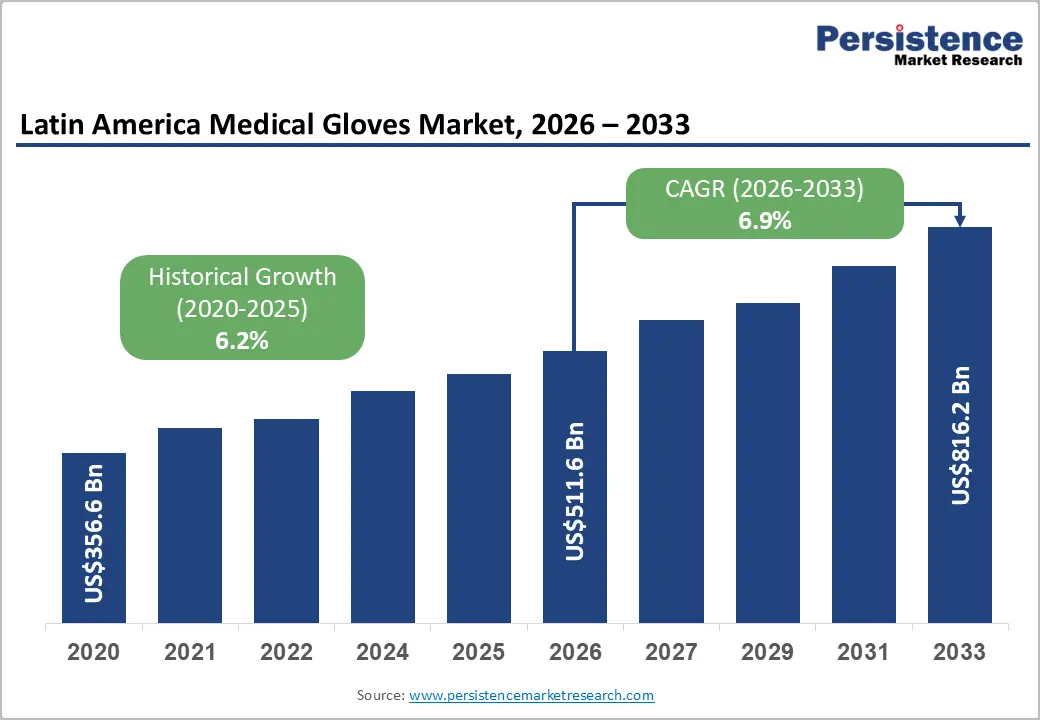
The Latin America Medical Gloves Market recorded a CAGR of 5.3% in the last 5 years (2019 to 2024) to reach a market valuation of US$ 445.1 million in 2024. The market is forecasted to reach US$ 728.4 million by the end of 2032, expanding at a CAGR of 6.5%.

Medical gloves are used during any medical procedure or examination to prevent infection and cross-contamination between patients and healthcare professionals. Depending on the application, medical gloves are made of various polymer materials such as rubber, latex, PVC, neoprene, and others. They are available as powdered gloves and non-powdered forms as per usage needs and the required application.

  • Examination gloves accounted for a leading market share of 74.7% in 2024.
  • Sales of medical gloves in Latin America amounted to 5.2% revenue share of the global medical gloves market in 2024.

Increasing demand for medical gloves due to rising worker awareness about hygiene and health, and an increase in the frequency of workplace accidents, are the main factors fuelling Latin American market growth. Disposable gloves are popular because they are less expensive than reusable gloves. Due to the rising number of accidents in the medical field, it is now mandatory to wear protective gloves when working with acids, especially in research and development.

Rise in the occurrence of chronic diseases, increased awareness of safety and sanitation, stringent regulations regarding the use of gloves, an increase in the number of hospitals in most nations, and a rise in the prevalence of hospital-acquired infectious diseases are factors that will drive the growth of the medical gloves market in Latin America. Rising employee safety and health awareness, as well as increasing accidental fatalities, are expected to drive market growth during the forecast period.

Distributors play an important role in the market because product manufacturers rely on vendors to get their products to customers. Globalization and glove manufacturer consolidation are expected to have a significant impact on distributors, compelling them to expand their perspectives and look beyond traditional boundaries.

Most medical glove companies in Latin America prefer to work with small distributors to reduce the expenses and time to set up their business from scratch. Such collaborations help strengthen their competitiveness by expanding their range of services as well as help in accelerating and optimizing the future product pathway, from product manufacturing, regulatory submission, and commercialization, to distribution.

Attribute Key Insights

Latin America Medical Gloves Market Size (2025)

US$ 468.7 Million

Projected Market Value (2032)

US$ 728.4 Million

Market Growth Rate (2025 to 2032)

6.5% CAGR

Market Share of Top 5 Countries

74%

What Should Manufacturers of Medical Gloves in Latin America Focus On?

Research and Innovation to Be Key Going Forward

Gloves are protection items that are widely used in the medical and industrial sectors. However, they are ignored by many hospitals in underdeveloped and developing countries. The market includes various innovative products that provide patient and healthcare worker safety in a perioperative environment - before, after, and during the time of surgery.

Due to the significant impact of chemicals and allergies, companies are predominantly focusing on developing advanced products that incorporate new non-latex materials and technologies Strong focus on research and innovation by important players for the development of disposal and cost-effective gloves that provide high quality, high-performing protection to healthcare workers will lead to growth opportunities in the market.

Several companies are focusing on improving healthcare settings by manufacturing cost-effective gloves that help hospitals, ambulatory care sites, and pharmacies focus on patient care while reducing costs, increasing profitability, and improving efficiency.

Recently launched, new and innovative gloves offer unique advantages that complement the extensive product portfolio of companies. Innovations in gloves, such as the use of new crosslinking technology by UV light and optimal tactile sense, will augment market growth in the years ahead.

Can Market Growth Be Affected in Any Way?

Risk of Contamination and Increasing Concerns about Medical Waste

In hospitals around the world, hospital-acquired infections have become a significant risk for patients and healthcare workers alike. Cross-contamination at the hands of HCPs is thought to be the most common mode of HAI transmission. HAIs can result in life-threatening infections such as central line-associated bloodstream infections, catheter-associated urinary tract infections, ventilator-associated pneumonia (VAP), and methicillin-resistant Staphylococcus aureus.

Medical gloves are important in protecting healthcare professionals, patients, and others in close proximity. The Centre for Devices and Radiological Health at the FDA, on the other hand, has imposed a ban on powder gloves, powdered surgeon's gloves, and powdered patient examination gloves for lubricating surgical gloves because there is a significant and unreasonable risk of injury and illness that cannot be eliminated or corrected by changing the label.

Some of the risks associated with the use of powdered gloves are granulomas, inflammation, and respiratory allergic reactions. This factor can hinder the demand growth of medical gloves to some extent.

Increasing concerns about medical waste, which is difficult to dispose of and fills landfills, may also stymie the expansion of the market. Medical waste is mainly produced by disposables used in operating rooms as well as during surgical procedures. Medical waste from the healthcare, nursing, dental, veterinary, laboratory, and pharmaceutical sectors may have unintended consequences.

Poor management of disposable surgical waste results in pathogen and toxic chemical contamination of land and water, which may further restrict the expansion of the medical gloves market.

Country-wise Insights

Why is Brazil a Prominent Market for Medical Gloves in Latin America?

“Increasing Awareness about Hygiene & Rise in Chronic Diseases”

Brazil accounted for 29.2% share of the Latin American market for medical gloves in 2024.

Brazil is one of the largest consumers of medical gloves due to increased public awareness about hand hygiene and well-established healthcare settings that are accessible to a significant number of this region's population.

Rising prevalence of chronic and infectious diseases such as cancer and heart disease, which frequently demand medical procedures for treatment, including surgery, is expected to drive up demand for surgical consumables. Quality standards of surgical gloves are far better compared to examination gloves and are more commonly used by OR nurses and surgeons.

The sterile nature, exact size, and specific design of surgical gloves provide surgeons with great precision and tactile sensitivity during a surgical procedure.

How is Mexico Faring in the Latin American Market for Medical Gloves?

“Increasing Demand for Gloves and Support from Government”

Mexico is the most lucrative market in the region and is forecasted to evolve at a CAGR of 8.1% over the decade.

Mexico is one of the prominent producers of medical gloves in the world, with a significant portion of its production being exported to other countries. The COVID-19 pandemic increased the demand for medical gloves globally, including in Latin American countries such as Mexico. The country has seen a rise in the demand for gloves due to the increased need for personal protective equipment (PPE) in healthcare settings.

A point to note though is that the production of medical gloves has faced some challenges in Mexico due to issues such as raw material shortages and logistic problems. The country relies heavily on imports for the production of nitrile, a key material used in the manufacture of medical gloves, which has led to supply chain disruptions.

Category-wise Insights

Which Type of Medical Gloves is Most Widely Adopted in Latin America?

“High Demand for Examination Gloves for No Risk of Contamination”

Examination gloves accounted for 74.7% share of the market in 2024.

Examination gloves are an essential component of healthcare settings, and Latin America is one of the prominent markets for medical gloves. The region has a high demand for gloves due to its large population, growing healthcare infrastructure, and increasing focus on hygiene and infection control measures.

In terms of material, latex gloves have traditionally been the most widely used in Latin America. However, in recent years, there has been a shift toward nitrile gloves due to their superior barrier properties, durability, and resistance to chemicals.

Which End User Will Account for Most Sales in the Market?

“High Need for Clinical Use of Examination Gloves in Hospitals”

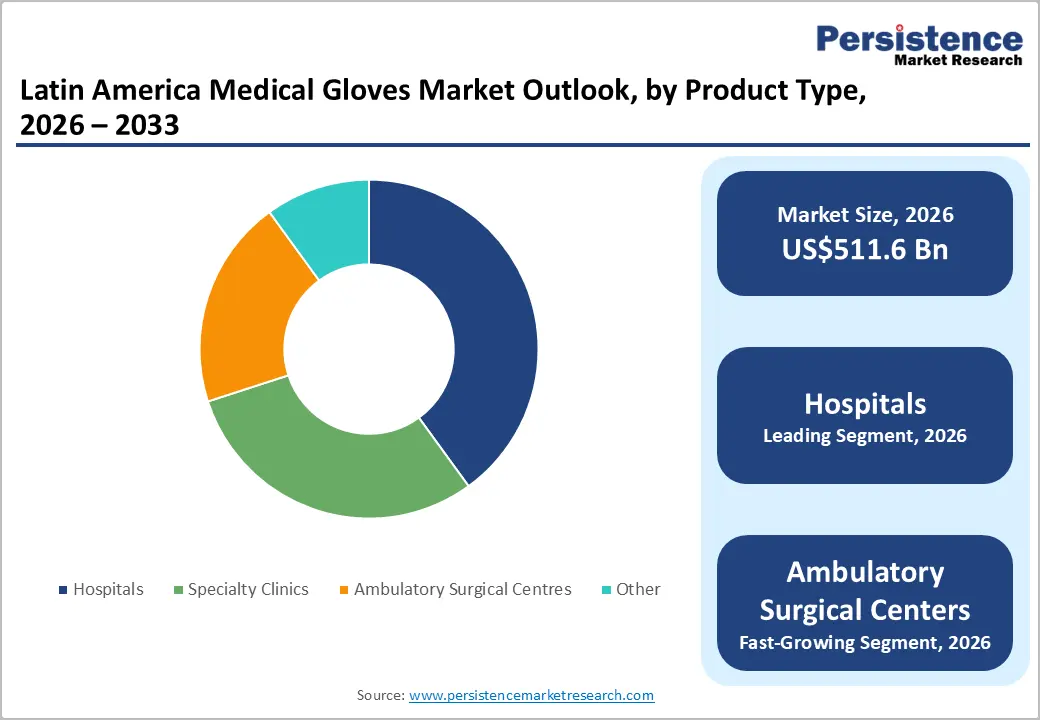
Hospitals accounted for a market value share of 59.4% in 2024 in the Latin American market.

Hospitals use examination gloves as a critical component of infection control to protect healthcare workers and patients from the spread of infectious diseases. Latin America has a significant population, and this leads to a high volume of patients in healthcare settings. This means that there is a greater need for examination gloves to prevent the spread of infectious diseases.

Many Latin American countries have regulatory requirements that mandate the use of examination gloves in healthcare settings. For instance, in Brazil, the Ministry of Health recommends the use of gloves for all medical procedures.

There is growing awareness in Latin America about the importance of infection control measures in healthcare settings. This has led to a greater emphasis on the use of personal protective equipment, including examination gloves, to prevent the spread of infectious diseases.

Competition Landscape

The Latin American medical gloves market is marked by the presence of established as well emerging market players. To create innovative products, several market players are aggressively funding research and development. Thus, the availability of technology options with commercialization potential is expected to augment market growth and help players strengthen their position in the market.

  • In May 2019, Thermo Fisher Scientific opened a new distribution centre in Coyol Free Zone, Alajuela for boosting the supply of medical supply and PPE equipment.

Similarly, the team at Persistence Market Research has tracked recent developments related to companies in the Latin America medical gloves market, which are available in the full report.

Latin America Medical Gloves Industry Research Segmentation

Product Type:

  • Examination Gloves
    • Latex Powder
    • Latex Powder-Free
    • Nitrile
    • Vinyl
    • Polyisoprene
  • Surgical Gloves
    • Latex Powder
    • Latex Powder-Free
    • Nitrile
    • Neoprene
    • Polyisoprene

End User:

  • Hospitals
  • Specialty Clinics
  • Ambulatory Surgical Centres

Country:

  • Brazil
  • Mexico
  • Colombia
  • Argentina
  • Chile
  • Uruguay
  • Cuba
  • Peru
  • Rest of LATAM

Companies Covered in Latin America Medical Gloves Market

  • Top Glove Corporation Bhd
  • Top Glove Corporation Bhd
  • Medline Industries
  • Thermo Fisher Scientific Inc.
  • Cardinal Health, Inc.
  • B. Braun Melsungen AG
  • Denorex Corporation
  • SHOWA GROUP
  • Owens & Minor, O&M Halyard
  • Hartalega Holdings Bernard
  • Safe Glove Co. Ltd.
  • Supermen Corporation Berhad
  • Huzza Alpha Borealis Investment Management
  • Ansell Commercial Mexico S.A. De C
  • Global Glove and Safety Manufacturing, Inc.
Frequently Asked Questions

As of 2024, the market is valued at US$ 445.1 million.

The market is expected to reach US$ 728.4 million by 2032.

The market is projected to grow at a 6.5% CAGR during this period.

Examination gloves hold the leading share, accounting for 74.7% in 2024.

Latin America contributed approximately 5.2% of global revenue in 2024.

Latin America Medical Gloves Industry Report Scope
Attribute Details

Forecast Period

2025 to 2032

Historical Data Available for

2019 to 2024

Market Analysis

USD Million for Value

Key Countries Covered

  • Brazil
  • Argentina
  • Mexico
  • Colombia
  • Chile
  • Peru
  • Uruguay
  • Cuba
  • The Rest of Latin America.

Key Market Segments Covered

  • Product
  • End User
  • Country

Key Companies Covered

  • Top Glove Corporation Bhd
  • Medline Industries
  • Thermo Fisher Scientific Inc.
  • Cardinal Health, Inc.
  • B. Braun Melsungen AG
  • Dynarex Corporation
  • SHOWA GROUP
  • Owens & Minor, O&M Halyard
  • Hartalega Holdings Berhad
  • Safe Glove Co. Ltd.
  • Supermax Corporation Berhad
  • Huzza Alpha Borealis Investment Management
  • Ansell Commercial Mexico S.A. De C
  • Global Glove and Safety Manufacturing, Inc.

Report Coverage

  • Market Forecast
  • Competition Intelligence
  • DROT Analysis
  • Market Dynamics and Challenges
  • Strategic Growth Initiatives

Customization & Pricing

Available upon Request

Related Reports

1. Executive Summary

    1.1. Market Outlook

    1.2. Demand Side Trends

    1.3. Supply Side Trends

    1.4. Analysis and Recommendations

2. Market Overview

    2.1. Market Coverage / Taxonomy

    2.2. Market Definition / Scope / Limitations

    2.3. Inclusion and Exclusions

3. Key Market Trends

    3.1. Key Trends Impacting the Market

    3.2. Innovation/Development Trends

4. Key Inclusions

    4.1. Import Export Scenario

    4.2. Regulatory Scenario

    4.3. Key Promotional Strategies by Manufacturers

    4.4. Product Adoption Analysis by Region

    4.5. Porter’s Analysis

    4.6. PESTLE Analysis

    4.7. Value Chain Analysis

5. Market Background

    5.1. Macro-Economic Factors

        5.1.1. GDP Growth Outlook

        5.1.2. Healthcare Industry Outlook

        5.1.3. Global Medical Gloves Outlook

    5.2. Forecast Factors - Relevance & Impact

        5.2.1. Top Companies Historical Growth

        5.2.2. Cost of The Products

        5.2.3. Adoption of Products

        5.2.4. Pipeline Products

        5.2.5. New Product Approvals

        5.2.6. Increased Mergers and Acquisitions

        5.2.7. Historic and Current Revenue of Key Players

        5.2.8. Technology Advancements

    5.3. Market Dynamics

        5.3.1. Drivers

        5.3.2. Restraints

        5.3.3. Opportunity Analysis

6. COVID-19 Crisis Analysis

    6.1. 2023 Market Scenario

    6.2. COVID-19 and Impact Analysis

        6.2.1. By Product

        6.2.2. By End User

        6.2.3. By Region

7. Latin America Market Demand (in Volume) Analysis 2019–2024 and Forecast, 2025–2032

    7.1. Historical Market Volume (Units) Analysis, 2019–2024

    7.2. Current and Future Market Volume (Units) Projections, 2025–2032

        7.2.1. Y-o-Y Growth Trend Analysis

8. Latin America Market - Pricing Analysis

    8.1. Regional Pricing Analysis by Product

    8.2. Pricing Analysis by Key Manufacturers

    8.3. Pricing Break-up

        8.3.1. Manufacturer Level Pricing

        8.3.2. Distributor Level Pricing

    8.4. Average Pricing Analysis Benchmark

    8.5. Pricing Assumptions

9. Latin America Market Demand (in Value or Size in US$ Mn) Analysis 2019–2024 and Forecast, 2025–2032

    9.1. Historical Market Value (US$ Mn) Analysis, 2019–2024

    9.2. Current and Future Market Value (US$ Mn) Projections, 2025–2032

        9.2.1. Y-o-Y Growth Trend Analysis

        9.2.2. Absolute $ Opportunity Analysis

10. Latin America Market Analysis 2019–2024 and Forecast 2025–2032, By Product

    10.1. Introduction / Key Findings

    10.2. Historical Market Size (US$ Mn) and Volume (Units) Analysis by Product, 2019–2024

    10.3. Current and Future Market Size (US$ Mn) and Volume (Units) Analysis and Forecast by Product, 2025–2032

        10.3.1. Examination Gloves

            10.3.1.1. Latex Powder

            10.3.1.2. Latex Powder Free

            10.3.1.3. Nitrile

            10.3.1.4. Vinyl

            10.3.1.5. Polyisoprene

        10.3.2. Surgical Gloves

            10.3.2.1. Latex Powder

            10.3.2.2. Latex Powder Free

            10.3.2.3. Nitrile

            10.3.2.4. Neoprene

            10.3.2.5. Polyisoprene

    10.4. Market Attractiveness Analysis by Product

11. Latin America Market Analysis 2019–2024 and Forecast 2025–2032, By End User

    11.1. Introduction / Key Findings

    11.2. Historical Market Size (US$ Mn) Analysis by End User, 2019–2024

    11.3. Current and Future Market Size (US$ Mn) Analysis and Forecast by End User, 2025–2032

        11.3.1. Hospitals

        11.3.2. Specialty Clinics

        11.3.3. Ambulatory Surgical Centers

    11.4. Market Attractiveness Analysis by End User

12. Latin America Market Analysis 2019–2024 and Forecast 2025–2032, By Country

    12.1. Introduction

    12.2. Historical Market Size (US$ Mn) and Volume (Units) Analysis by Country, 2019–2024

    12.3. Current and Future Market Size (US$ Mn) and Volume (Units) Analysis and Forecast by Country, 2025–2032

        12.3.1. Brazil

        12.3.2. Mexico

        12.3.3. Colombia

        12.3.4. Argentina

        12.3.5. Chile

        12.3.6. Uruguay

        12.3.7. Cuba

        12.3.8. Peru

        12.3.9. Rest of LATAM

    12.4. Market Attractiveness Analysis by Country

13. Brazil Market Analysis 2019–2024 and Forecast 2025–2032

    13.1. Introduction

    13.2. Historical Market Size (US$ Mn) and Volume (Units) Trend Analysis by Market Taxonomy, 2019–2024

    13.3. Current and Future Market Size (US$ Mn) and Volume (Units) Analysis and Forecast by Market Taxonomy, 2025–2032

        13.3.1. By Product

        13.3.2. By End User

    13.4. Market Attractiveness Analysis

        13.4.1. By Product

        13.4.2. By End User

    13.5. Drivers and Restraints - Impact Analysis

14. Mexico Market Analysis 2019–2024 and Forecast 2025–2032

    14.1. Introduction

    14.2. Historical Market Size (US$ Mn) and Volume (Units) Trend Analysis by Market Taxonomy, 2019–2024

    14.3. Current and Future Market Size (US$ Mn) and Volume (Units) Analysis and Forecast by Market Taxonomy, 2025–2032

        14.3.1. By Product

        14.3.2. By End User

    14.4. Market Attractiveness Analysis

        14.4.1. By Product

        14.4.2. By End User

    14.5. Drivers and Restraints - Impact Analysis

15. Colombia Market Analysis 2019–2024 and Forecast 2025–2032

    15.1. Introduction

    15.2. Historical Market Size (US$ Mn) and Volume (Units) Trend Analysis by Market Taxonomy, 2019–2024

    15.3. Current and Future Market Size (US$ Mn) and Volume (Units) Analysis and Forecast by Market Taxonomy, 2025–2032

        15.3.1. By Product

        15.3.2. By End User

    15.4. Market Attractiveness Analysis

        15.4.1. By Product

        15.4.2. By End User

    15.5. Drivers and Restraints - Impact Analysis

16. Argentina Market Analysis 2019–2024 and Forecast 2025–2032

    16.1. Introduction

    16.2. Historical Market Size (US$ Mn) and Volume (Units) Trend Analysis by Market Taxonomy, 2019–2024

    16.3. Current and Future Market Size (US$ Mn) and Volume (Units) Analysis and Forecast by Market Taxonomy, 2025–2032

        16.3.1. By Product

        16.3.2. By End User

    16.4. Market Attractiveness Analysis

        16.4.1. By Product

        16.4.2. By End User

    16.5. Drivers and Restraints - Impact Analysis

17. Chile Market Analysis 2019–2024 and Forecast 2025–2032

    17.1. Introduction

    17.2. Historical Market Size (US$ Mn) and Volume (Units) Trend Analysis by Market Taxonomy, 2019–2024

    17.3. Current and Future Market Size (US$ Mn) and Volume (Units) Analysis and Forecast by Market Taxonomy, 2025–2032

        17.3.1. By Product

        17.3.2. By End User

    17.4. Market Attractiveness Analysis

        17.4.1. By Product

        17.4.2. By End User

    17.5. Drivers and Restraints - Impact Analysis

18. Uruguay Market Analysis 2019–2024 and Forecast 2025–2032

    18.1. Introduction

    18.2. Historical Market Size (US$ Mn) and Volume (Units) Trend Analysis by Market Taxonomy, 2019–2024

    18.3. Current and Future Market Size (US$ Mn) and Volume (Units) Analysis and Forecast by Market Taxonomy, 2025–2032

        18.3.1. By Product

        18.3.2. By End User

    18.4. Market Attractiveness Analysis

        18.4.1. By Product

        18.4.2. By End User

    18.5. Drivers and Restraints - Impact Analysis

19. Cuba Market Analysis 2019–2024 and Forecast 2025–2032

    19.1. Introduction

    19.2. Historical Market Size (US$ Mn) and Volume (Units) Trend Analysis by Market Taxonomy, 2019–2024

    19.3. Current and Future Market Size (US$ Mn) and Volume (Units) Analysis and Forecast by Market Taxonomy, 2025–2032

        19.3.1. By Product

        19.3.2. By End User

    19.4. Market Attractiveness Analysis

        19.4.1. By Product

        19.4.2. By End User

    19.5. Drivers and Restraints - Impact Analysis

20. Peru Market Analysis 2019–2024 and Forecast 2025–2032

    20.1. Introduction

    20.2. Historical Market Size (US$ Mn) and Volume (Units) Trend Analysis by Market Taxonomy, 2019–2024

    20.3. Current and Future Market Size (US$ Mn) and Volume (Units) Analysis and Forecast by Market Taxonomy, 2025–2032

        20.3.1. By Product

        20.3.2. By End User

    20.4. Market Attractiveness Analysis

        20.4.1. By Product

        20.4.2. By End User

    20.5. Drivers and Restraints - Impact Analysis

21. Rest of LATAM Market Analysis 2019–2024 and Forecast 2025–2032

    21.1. Introduction

    21.2. Historical Market Size (US$ Mn) and Volume (Units) Trend Analysis by Market Taxonomy, 2019–2024

    21.3. Current and Future Market Size (US$ Mn) and Volume (Units) Analysis and Forecast by Market Taxonomy, 2025–2032

        21.3.1. By Product

        21.3.2. By End User

    21.4. Market Attractiveness Analysis

        21.4.1. By Product

        21.4.2. By End User

    21.5. Drivers and Restraints - Impact Analysis

22. Market Structure Analysis

    22.1. Market Analysis by Tier of Companies

    22.2. Market Revenue (US$) Share Analysis of Top Players

        22.2.1. Brazil

        22.2.2. Mexico

        22.2.3. Colombia

        22.2.4. Argentina

    22.3. Market Volume (Units) Share Analysis of Top Players

        22.3.1. Brazil

        22.3.2. Mexico

        22.3.3. Colombia

        22.3.4. Argentina

    22.4. Market Presence Analysis

        22.4.1. Regional footprint of Players

        22.4.2. Product footprint by Players

        22.4.3. Channel footprint by Players

23. Competition Analysis

    23.1. Competition Dashboard

    23.2. Competition Benchmarking

    23.3. Competition Deep Dive (Global Players)

        23.3.1. Top Glove Corporation Bhd

            23.3.1.1. Overview

            23.3.1.2. Product Portfolio

            23.3.1.3. Key Financials

            23.3.1.4. Sales Footprint

            23.3.1.5. SWOT Analysis

            23.3.1.6. Key Developments

            23.3.1.7. Strategy Overview

        23.3.2. Top Glove Corporation Bhd

            23.3.2.1. Overview

            23.3.2.2. Product Portfolio

            23.3.2.3. Key Financials

            23.3.2.4. Sales Footprint

            23.3.2.5. SWOT Analysis

            23.3.2.6. Key Developments

            23.3.2.7. Strategy Overview

        23.3.3. Medline Industries

            23.3.3.1. Overview

            23.3.3.2. Product Portfolio

            23.3.3.3. Key Financials

            23.3.3.4. Sales Footprint

            23.3.3.5. SWOT Analysis

            23.3.3.6. Key Developments

            23.3.3.7. Strategy Overview

        23.3.4. Thermo Fisher Scientific Inc.

            23.3.4.1. Overview

            23.3.4.2. Product Portfolio

            23.3.4.3. Key Financials

            23.3.4.4. Sales Footprint

            23.3.4.5. SWOT Analysis

            23.3.4.6. Key Developments

            23.3.4.7. Strategy Overview

        23.3.5. Cardinal Health, Inc.

            23.3.5.1. Overview

            23.3.5.2. Product Portfolio

            23.3.5.3. Key Financials

            23.3.5.4. Sales Footprint

            23.3.5.5. SWOT Analysis

            23.3.5.6. Key Developments

            23.3.5.7. Strategy Overview

        23.3.6. B. Braun Melsungen AG

            23.3.6.1. Overview

            23.3.6.2. Product Portfolio

            23.3.6.3. Key Financials

            23.3.6.4. Sales Footprint

            23.3.6.5. SWOT Analysis

            23.3.6.6. Key Developments

            23.3.6.7. Strategy Overview

        23.3.7. Denorex Corporation

            23.3.7.1. Overview

            23.3.7.2. Product Portfolio

            23.3.7.3. Key Financials

            23.3.7.4. Sales Footprint

            23.3.7.5. SWOT Analysis

            23.3.7.6. Key Developments

            23.3.7.7. Strategy Overview

        23.3.8. SHOWA GROUP

            23.3.8.1. Overview

            23.3.8.2. Product Portfolio

            23.3.8.3. Key Financials

            23.3.8.4. Sales Footprint

            23.3.8.5. SWOT Analysis

            23.3.8.6. Key Developments

            23.3.8.7. Strategy Overview

        23.3.9. Owens & Minor, O&M Halyard

            23.3.9.1. Overview

            23.3.9.2. Product Portfolio

            23.3.9.3. Key Financials

            23.3.9.4. Sales Footprint

            23.3.9.5. SWOT Analysis

            23.3.9.6. Key Developments

            23.3.9.7. Strategy Overview

        23.3.10. Hartalega Holdings Bernard

            23.3.10.1. Overview

            23.3.10.2. Product Portfolio

            23.3.10.3. Key Financials

            23.3.10.4. Sales Footprint

            23.3.10.5. SWOT Analysis

            23.3.10.6. Key Developments

            23.3.10.7. Strategy Overview

        23.3.11. Safe Glove Co. Ltd.

            23.3.11.1. Overview

            23.3.11.2. Product Portfolio

            23.3.11.3. Key Financials

            23.3.11.4. Sales Footprint

            23.3.11.5. SWOT Analysis

            23.3.11.6. Key Developments

            23.3.11.7. Strategy Overview

        23.3.12. Supermen Corporation Berhad

            23.3.12.1. Overview

            23.3.12.2. Product Portfolio

            23.3.12.3. Key Financials

            23.3.12.4. Sales Footprint

            23.3.12.5. SWOT Analysis

            23.3.12.6. Key Developments

            23.3.12.7. Strategy Overview

        23.3.13. Huzza Alpha Borealis Investment Management

            23.3.13.1. Overview

            23.3.13.2. Product Portfolio

            23.3.13.3. Key Financials

            23.3.13.4. Sales Footprint

            23.3.13.5. SWOT Analysis

            23.3.13.6. Key Developments

            23.3.13.7. Strategy Overview

        23.3.14. Ansell Commercial Mexico S.A. De C

            23.3.14.1. Overview

            23.3.14.2. Product Portfolio

            23.3.14.3. Key Financials

            23.3.14.4. Sales Footprint

            23.3.14.5. SWOT Analysis

            23.3.14.6. Key Developments

            23.3.14.7. Strategy Overview

        23.3.15. Global Glove and Safety Manufacturing, Inc.

            23.3.15.1. Overview

            23.3.15.2. Product Portfolio

            23.3.15.3. Key Financials

            23.3.15.4. Sales Footprint

            23.3.15.5. SWOT Analysis

            23.3.15.6. Key Developments

            23.3.15.7. Strategy Overview

24. Assumptions and Acronyms Used

25. Research Methodology


Research Methodology Framework for Market Research Excellence

At Persistence Market Research, we implement a comprehensive, validated, and multi-dimensional approachto market analysis that delivers actionable insights across complex market landscapes. Our methodology combines the analytical rigor of leading consulting firms with innovative research techniques, ensuring robust market assessments that guide strategic decision-making with confidence.

Core Research Philosophy

Our methodology is built on four foundational pillars:

Research Philosophy Image

At Persistence Market Research, our methodology is designed to transcend conventional market studies by combining analytical rigor, multi-source validation, and future-focused insights.

We integrate advanced research frameworks, robust data collection strategies, cutting-edge analytics, and innovative technologies to deliver a 360-degree view of complex markets.

We integrate advanced research frameworks, robust data collection strategies, cutting-edge analytics, and innovative technologies to deliver a 360-degree view of complex markets.

Each stage spanning from strategic scoping and hypothesis-building to competitive intelligence, quality validation, and actionable recommendations is engineered to provide clients with unmatched clarity, precision, and confidence in decision-making.

By embedding innovation and technology at the core, our approach ensures that insights are not only comprehensive but also predictive, empowering businesses to seize opportunities, mitigate risks, and achieve sustainable growth

Research Philosophy Image

Capturing Key Information and Events

During this phase, key research objectives focus on essential information and data points for assessing the market, including:

Research Philosophy Image

TAM-SAM-SOM Framework Implementation

We employ both top-down and bottom-up approaches to ensure accurate market sizing.

Top-Down Market SizingBottom-Up Market Sizing
Universe Definition: Total global/regional market identificationUnit Economics: Average transaction values, purchase frequencies, customer lifecycle
Segmentation Filters: Geographic, demographic, and behavioral constraintsCustomer Segmentation: Detailed buyer persona development and sizing
Market Share Analysis: Competitive landscape assessment and share allocationPenetration Analysis: Market penetration rates by segment and geography
Growth Rate Application: Historical trends and forward-looking growth assumptionsScaling Methodology: Extrapolation techniques with confidence intervals

Validation & Cross-Verification

  • Triangulation: Comparing top-down and bottom-up results for consistency
  • Sensitivity Analysis: Testing key assumptions and parameter variations
  • Peer Benchmarking: Comparison with analogous markets and industry benchmarks
  • Expert Review: External validation through industry specialist consultation

Research Philosophy Image

Forecasting & Projection Modeling

Our proprietary forecasting models incorporate multiple variables and scenarios.

Forecasting Components

  • Historical Trend Analysis: 10-year historical growth patterns and cyclical variations
  • Driver-Based Modeling: Economic indicators, demographic shifts, technology adoption
  • Scenario Planning: Base case, optimistic, and conservative projections
  • Monte Carlo Simulations: Probability-weighted outcomes and risk assessments

Model Validation

  • Back-Testing: Historical accuracy assessment over 3–5-year periods
  • Cross-Validation: Multiple modeling approaches for result comparison
  • External Benchmarking: Comparison with established market forecasts
  • Continuous Calibration: Quarterly model updates based on new data

Comprehensive Data Collection Strategy

Our secondary research phase establishes a robust knowledge base utilizing diverse, credible sources.

Secondary Data Sourcess

  • Industry Publications & Reports
  • Government & Regulatory Data
  • Financial Intelligence (filings & reports)
  • Academic Research & Digital Intelligence

Quality Assurance Protocol

  • Source credibility assessment and publication date validation
  • Data consistency checks across multiple sources
  • Bias identification and neutralization techniques
  • Information gap tracking for primary research prioritization

Research Philosophy Image

Primary Research Excellence

Our primary research methodology employs best-in-class techniques to capture unique market insights.

Quantitative Research Methods

  • Large-Scale Surveys: Statistically representative samples with 95% confidence intervals
  • Survey Methodology: Multi-channel deployment (online, telephone, in-person)
  • Question Architecture and Response Optimization

Qualitative Research Methods

  • Executive Interviews
  • Focus Groups
  • Expert Consultations

Quality Assurance & Validation Framework

Multi-Stage Validation Process

  • Source Verification and Consistency Testing
  • Outlier Detection and Bias Assessment
  • Peer Review Process and External Validation
  • Sensitivity Analysis and Confidence Intervals

Research Philosophy Image

Methodology Validation & Credibility

Our research methodology has been extensively validated through:

  • Academic Partnerships: Collaborations with top-tier business schools and research institutions
  • Client Success Stories: Documented case studies demonstrating research impact and ROI
  • Continuous Benchmarking: Performance comparison with leading global research firms

This comprehensive methodology framework positions Persistence Market Research at the forefront of market intelligence, combining the analytical sophistication of top-tier consulting firms with innovative research techniques. Our approach ensures that every market assessment delivers precise, actionable, and strategically valuable insights that drive business success in competitive market environments.

Ready to unlock your market potential? Contact our research experts to discuss how our validated methodology can transform your strategic decision-making with data-driven market intelligence.

Copyright © 2026 Persistence Market Research. All Rights Reserved

Connect With Us -