




- Automotive
- Fuel Dispenser Market
Fuel Dispenser Market Size, Share, and Growth Forecast 2026 - 2033
Fuel Dispenser Market by Fuel Type (Petroleum Fuels, Compressed Fuels, Biofuels, Others), by Dispenser System (Submersible, Suction), by Operation (Mobile, Stationary), by Flow Meter (Mechanical, Electronic), by Regional Analysis, 2026-2033

Fuel Dispenser Market Size and Trend Analysis
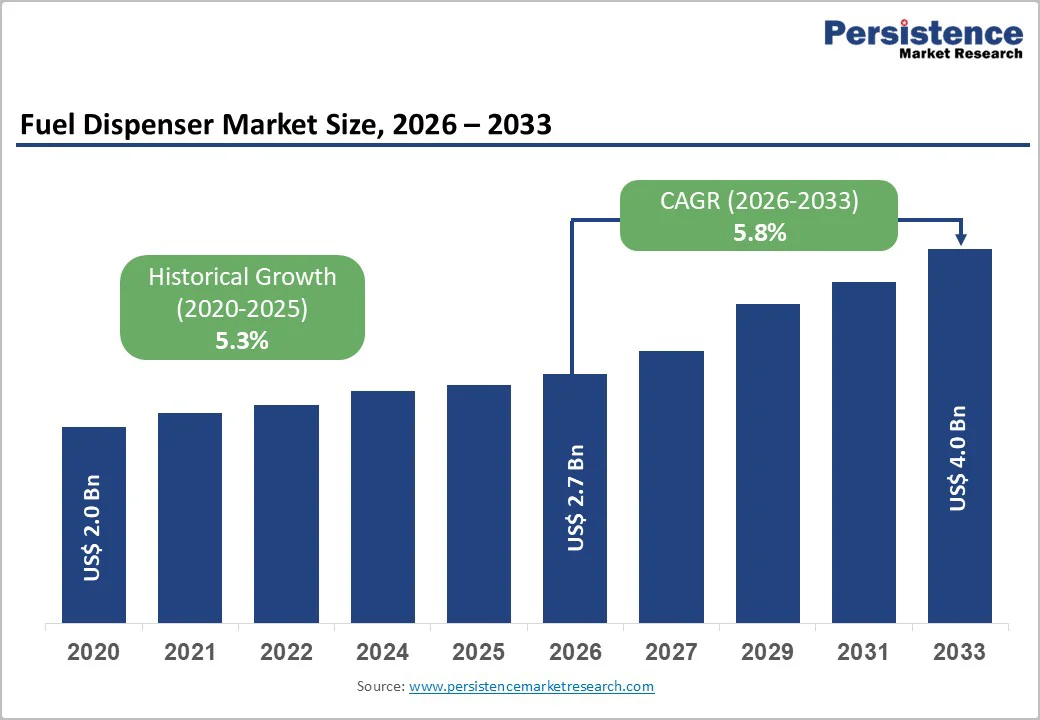
The global Fuel Dispenser market size is expected to be valued at US$ 2.7 billion in 2026 and projected to reach US$ 4.0 billion by 2033, growing at a CAGR of 5.8% between 2026 and 2033.
The market expansion is driven by three interconnected growth catalysts: first, the global proliferation of retail fueling infrastructure across emerging economies—particularly in Asia Pacific, Middle East, and Latin America—where vehicle ownership is accelerating alongside urbanization and rising disposable incomes; second, the modernization and retrofitting of aging fuel station equipment in developed markets to accommodate digital payment systems, IoT-enabled monitoring platforms, and regulatory compliance with accuracy standards such as OIML R117 (requiring measurement errors ≤ ±0.3%); third, the structural transformation of fuel retail toward multi-energy distribution models integrating petroleum fuels, compressed natural gas (CNG), liquefied natural gas (LNG), biofuels, hydrogen, and electric vehicle charging infrastructure, necessitating next-generation dispenser systems capable of handling diverse fuel properties and safety protocols.
Key Market Highlights
- Leading Region: Asia Pacific leads the fuel dispenser market in 2025 with a 46% share, supported by rapid vehicle ownership growth, expanding alternative fuel infrastructure, and strong government initiatives in China, India, and ASEAN countries.
- Fastest-Growing Region: Asia Pacific is expected to remain the fastest-growing region at a 6.3% CAGR during 2026–2033, driven by net-zero commitments, CNG and hydrogen adoption, and expanding fuel-station
- networks across emerging Asian economies.
- Dominant Segment: Submersible dispenser systems dominate the market with a 78% share in 2025 due to higher reliability, faster fueling, lower maintenance costs, and suitability for high-traffic stations.
- Fastest Growing Segment: Electronic flow meters are projected to grow at a 6.2% CAGR from 2026 to 2033, supported by stricter accuracy regulations, digital integration, and retrofit demand for smart dispensing systems.
- Key Market Opportunity: Integrated multi-energy dispensing platforms combining conventional fuels, alternative fuels, and EV charging represent the largest growth opportunity as fuel stations evolve into future-ready energy hubs.
| Global Market Attributes | Key Insights |
|---|---|
| Fuel Dispenser Market Size (2026E) | US$ 2.7 billion |
| Market Value Forecast (2033F) | US$ 4.0 billion |
| Projected Growth CAGR (2026-2033) | 5.8% |
| Historical Market Growth (2020-2025) | 5.3% |
Market Dynamics
Market Growth Drivers
Expansion of Alternative Fuel Infrastructure and Multi-Fuel Dispensing Capabilities
The accelerating transition toward cleaner transportation fuels is fundamentally reshaping fuel dispenser demand patterns and product specifications. Compressed Natural Gas (CNG) dispenser market is experiencing exceptional growth, with installations projected to expand from 300,000 units in 2024 to 500,000 units by 2028, driven by stringent emission reduction mandates in urban transport systems and fleet operations. Countries including India, China, Italy, Argentina, and Brazil are aggressively expanding CNG refueling networks to support public transit systems, commercial logistics fleets, and private vehicle adoption.
Over 42% of dispenser infrastructure investments are now directed toward eco-friendly fuel compatibility, and approximately 33% of newly upgraded fueling systems can dispense biofuels, ethanol blends (up to E85), and emerging hydrogen-based alternatives. Manufacturers, including Tatsuno Corporation, have developed drift-free metering units with 0.25% accuracy specifically engineered for higher ethanol blending ratios (up to 80% ethanol) and calibration intervals extended to seven years, reducing maintenance costs while ensuring regulatory compliance.
Technological Advancement in IoT-Enabled Smart Dispensers and Digital Payment Integration
The fuel dispensing industry is undergoing digital transformation through the integration of Internet of Things (IoT) connectivity, cloud-based analytics, and contactless payment systems, driving operational efficiency gains and enhancing customer experiences. More than 60% of new dispenser installations now incorporate IoT-enabled monitoring systems providing real-time fuel tracking, predictive maintenance alerts, remote diagnostics, and inventory management optimization.
Gilbarco Veeder-Root, a global leader, has introduced advanced platforms including Remote Dispenser Management (RDM) solutions enabling retailers to perform software updates, configuration changes, and troubleshooting remotely without costly technician site visits, reducing operational downtime by up to 35%. The company’s FlexPay payment terminals support EMV chip card payments, NFC contactless transactions, mobile wallet integration, and 2D barcode scanning, addressing the petroleum industry’s October 2017 EMV liability shift requirements.
Market Restraints
High Capital Investment and Installation Costs for Advanced Dispenser Systems
The deployment of next-generation fuel dispensers incorporating electronic flow meters, IoT connectivity, EMV-compliant payment terminals, and multi-fuel compatibility requires substantial upfront capital investment, creating financial barriers particularly for independent fuel station operators and small-scale retail networks in emerging markets. Advanced submersible dispenser systems with integrated Outdoor Payment Terminals (OPTs), remote monitoring capabilities, and compliance with stringent accuracy standards such as OIML R117-1 can command 30-50% price premiums compared to legacy mechanical systems.
Installation costs are further elevated by requirements for modifications to underground storage tanks, electrical infrastructure upgrades to support electronic payment systems and connectivity, and specialized training for maintenance personnel. These cost factors compress return-on-investment timelines and delay equipment replacement cycles, particularly in price-sensitive markets where competitive dynamics and regulatory price controls constrain fuel retail margins.
Regulatory Complexity and Compliance Requirements Across Jurisdictions
Fuel dispenser manufacturers and operators navigate fragmented regulatory frameworks governing measurement accuracy, safety certifications, environmental standards, and payment security protocols that vary significantly across national and regional jurisdictions. Compliance with International Organization of Legal Metrology (OIML) R117 standards requires dispensers to maintain measurement accuracy within ±0.3% for petroleum fuels and ±0.5% for liquefied gases, necessitating sophisticated calibration procedures, temperature-compensation mechanisms, and periodic verification testing.
European markets impose additional requirements through the Measuring Instruments Directive (MID) Annex VII (MI-005), including vibration testing for electronic components, electromagnetic compatibility assessments, and harmonized conformity assessment procedures. Payment system security requires adherence to Payment Card Industry (PCI) Point-to-Interaction (PTS) 4.0+ standards and integration with regional payment processing networks. This regulatory complexity increases product development timelines, certification costs, and operational compliance burdens, particularly for manufacturers serving multiple geographic markets simultaneously.
Market Opportunities
Integration of Electric Vehicle Charging Infrastructure into Traditional Fuel Retail Ecosystems
The convergence of traditional petroleum distribution and electric vehicle charging infrastructure presents transformative opportunities for fuel dispenser manufacturers to develop integrated multi-energy dispensing platforms and capture emerging revenue streams. Dover Fueling Solutions exemplifies this strategic pivot through the September 2024 launch of the Wayne PWR™ DC fast charger, a distributed charging system with 640 kW power electronics cabinets capable of supplying up to four individual dispensers (up to 400 kW each), with dynamic power allocation in 40 kW increments.
The system supports both CCS1 and NACS (SAE J3400) charging connectors, addressing North American market transition requirements and enabling station operators to attract a broader range of EV drivers. In May 2025, the company expanded the Wayne PWR lineup with four additional power cabinet configurations (160 kW, 200 kW, 240 kW, and 400 kW), each supporting up to two dispensers. As fuel stations increasingly serve as multi-energy hubs offering petroleum fuels, CNG/LNG, biofuels, and EV charging under unified operational frameworks, manufacturers capable of delivering modular, future-ready dispenser architectures are well positioned to capture premium-value opportunities.
Expansion in High-Growth Emerging Markets with Accelerating Vehicle Ownership and Infrastructure Development
Emerging economies across the Asia Pacific, the Middle East, Latin America, and Africa represent exceptional growth vectors as vehicle ownership rates accelerate alongside urbanization, rising middle-class populations, and infrastructure investment programs. The Asia Pacific oil and gas infrastructure market is projected to expand at a 7.0% CAGR, with China commanding 40% market share, driven by energy demand growth and domestic resource development initiatives. At the same time, India emerges as the fastest-growing market supported by aggressive pipeline network expansion, LNG infrastructure deployment, and the government’s net-zero emission target by 2070, spurring CNG vehicle adoption.
Multinational oil and gas companies, including Shell, BP, TotalEnergies, and Indian Oil Corporation, are entering strategic partnerships with local operators to deploy large-scale fueling stations featuring advanced dispenser systems, ancillary convenience retail services, and integrated EV charging points. These expansions prioritize energy-efficient, smart fueling stations complying with international safety and environmental standards, creating sustained demand for durable, scalable, and cost-efficient dispensers optimized for high-volume retail environments.
Category-wise Insights
Fuel Type Analysis
Petroleum fuels remain the dominant fuel type in the fuel dispenser market, accounting for nearly 73% share in 2025 due to the deeply entrenched use of gasoline and diesel in global transportation systems. A vast installed base of petroleum-compatible dispensing infrastructure and sustained demand from passenger vehicles, freight logistics, agriculture, and industrial operations support this segment. Developing economies continue to rely heavily on petroleum fuels owing to cost competitiveness, fuel availability, and slower adoption of alternative fuels. While long-term challenges persist from electrification and emissions regulations, petroleum fuel dispensers continue to benefit from replacement demand, station modernization, and high utilization rates at existing retail outlets, ensuring stable revenue generation over the medium term.
Dispenser System Analysis
Submersible dispenser systems dominate the market with around 78% share in 2025, reflecting their operational superiority in high-throughput fueling environments. By positioning pumps directly inside underground storage tanks, these systems ensure consistent fuel pressure, faster dispensing, and reduced mechanical stress compared to suction-based designs. Lower failure rates, quieter operation, and 20–30% lower lifecycle maintenance costs make submersible systems the preferred choice for busy retail stations and fleet refueling hubs. Their compatibility with electronic controls and remote monitoring further strengthens adoption. Growth in this segment is primarily driven by new station development in emerging markets and systematic replacement of aging infrastructure in mature economies.
Operation Analysis
Stationary fuel dispensers account for approximately 91% of total market demand in 2025, underscoring their central role in global fuel distribution. Fixed installations at retail stations, logistics depots, airports, and industrial facilities benefit from economies of scale, permanent power connectivity, and integrated safety systems. These advantages enable the deployment of advanced electronic flow meters, digital payment terminals, and real-time monitoring platforms, enhancing operational efficiency and regulatory compliance. Stationary dispensers are essential for reliably and safely handling high fuel volumes, making them indispensable to both public and commercial fueling infrastructure. Continued investment in station upgrades and multi-energy forecourt development supports sustained demand for this segment.
Flow Meter Analysis
Electronic flow meters lead the technology landscape with roughly 64% market share in 2025, driven by their high accuracy, digital integration, and regulatory compliance advantages. These meters use electronic sensors and microcontroller-based processing to deliver precise volume measurements that meet stringent international accuracy standards. Built-in temperature compensation ensures reliable performance across varying climatic conditions, reducing billing discrepancies caused by fuel expansion or contraction. Electronic flow meters also integrate seamlessly with IoT platforms, enabling real-time diagnostics, predictive maintenance, and automated reporting. Growth in this segment is supported by mandatory accuracy regulations, large-scale retrofit activity in legacy dispensers, and increasing adoption of smart fueling and payment systems.
Regional Insights
North America Fuel Dispenser Market Trends and Insights
North America accounts for around 28% of the global fuel dispenser market in 2025, supported by a highly developed retail fueling ecosystem and sustained fuel demand across personal mobility, logistics, and agriculture. The United States dominates regional demand due to its extensive network of fuel stations and high throughput requirements, which continue to drive replacement and upgrade cycles. Market maturity is reflected in strong adoption of electronic flow meters, contactless and digital payment solutions, and IoT-enabled monitoring platforms that improve uptime and regulatory compliance.
Measurement accuracy and efficiency standards enforced by federal agencies play a critical role in shaping technology investments and procurement decisions. The region is also witnessing a gradual shift toward integrated forecourt models, where conventional fuel dispensing is complemented by alternative fuels and electric vehicle charging. Government-backed infrastructure programs are accelerating this transition by reducing investment barriers for station operators. Overall growth remains steady, with demand concentrated in modernization, retrofit installations, and multi-energy dispensing solutions designed to future-proof existing fuel retail assets.
Europe Fuel Dispenser Market Trends and Insights
The European fuel dispenser market is defined by stringent regulatory oversight, advanced digitalization, and an accelerated transition toward low-carbon mobility. Measurement accuracy requirements under EU directives, combined with aggressive decarbonization policies, are driving widespread replacement of legacy dispensing equipment with compliant, software-enabled systems. Major Western European economies account for the bulk of demand, while Southern and Eastern Europe are emerging as important upgrade markets. Fuel retailers increasingly prioritize integrated energy and payment management platforms, reflecting a shift from hardware-centric models to digitally orchestrated fueling operations.
Contactless payments, automated fleet fueling, and back-office software integration are now standard expectations rather than differentiators. Europe also leads in multi-fuel station development, with widespread deployment of biofuels, CNG and LNG for commercial transport, and rapidly expanding electric vehicle charging infrastructure. Hydrogen dispensing is gaining traction in select markets aligned with fuel cell vehicle strategies. The market is forecast to grow steadily, driven by station modernization, regulatory harmonization, and continued investment in alternative fuel infrastructure.
Asia Pacific Fuel Dispenser Market Trends and Insights
Asia Pacific leads the global fuel dispenser market with roughly 46% share in 2025, underpinned by rapid urbanization, rising vehicle ownership, and continuous expansion of retail fueling infrastructure. China represents the largest contributor, supported by its vast automotive base, highway development, and strong focus on alternative fuels for commercial transport. India is the fastest-growing major market, driven by aggressive rollout of CNG stations, biofuel promotion programs, and long-term decarbonization commitments. Southeast Asian economies are also witnessing robust growth as expanding urban centers require high-density fueling networks.
Japan and South Korea differentiate the regional landscape through technological sophistication, emphasizing high-precision metering, long calibration cycles, and early adoption of hydrogen and EV-compatible dispensing systems. Cost-efficient manufacturing across the region supports competitive pricing and large-scale deployments. Asia Pacific is expected to sustain the strongest growth globally, with demand concentrated in submersible electronic dispensers, multi-fuel platforms, and digitally enabled payment and monitoring solutions tailored for high-throughput urban stations.
Competitive Landscape
The global fuel dispenser market is moderately consolidated, with a small group of large manufacturers accounting for more than half of total revenues. At the same time, a broad base of regional and niche suppliers remains active across specialized applications. Fragmentation is most visible in segments such as mobile fueling units, alternative fuel dispensers, marine and aviation refueling systems, where localized expertise, regulatory familiarity, and service responsiveness provide competitive advantages. Market structure is increasingly shaped by vertical integration across metering, electronics, and payment technologies to improve cost control, quality assurance, and supply reliability.
Leading participants emphasize technology differentiation through IoT-enabled dispensers, cloud-based fleet and station management platforms, and modular architectures supporting multiple fuels and energy formats. Geographic expansion into emerging economies through local manufacturing and partnerships remains a key growth strategy. Competitive intensity is further influenced by the consolidation of service networks and software capabilities through selective acquisitions. New business models centered on service-based contracts, predictive maintenance, and data-driven fueling analytics are gaining traction as differentiation shifts beyond hardware.
Key Market Developments
February 2025: Gasboy has launched the AtlasX Series of fuel dispensers, featuring nine models for commercial and retail fueling. These durable units support gasoline, diesel, biofuels up to B100, and DEF, with modern web connectivity, backlit displays, and programmable interfaces for faster, user-friendly fleet management.
December 2025: Dover Fueling Solutions has launched 4Court Media, a retail media network on Wayne Ovation fuel dispenser screens. It empowers advertisers to engage consumers while fueling, while allowing retailers to generate revenue via targeted ads and promotions, boosting site monetization.
Companies Covered in Fuel Dispenser Market
- Gilbarco Veeder-Root (Vontier Corporation)
- Dover Fueling Solutions (Dover Corporation)
- Tatsuno Corporation
- Scheidt & Bachmann GmbH
- Tokheim
- Bennett Pump Company
- Censtar Science & Technology Corp. Ltd.
- Piusi S.p.A.
- Zhejiang Datian Machine Co. Ltd.
- Korea EnE Co. Ltd.
- Beijing Sanki Petroleum Technology Co. Ltd.
- Tominaga Mfg. Co. Ltd.
- Jiangsu Henghe Petroleum Machinery Co. Ltd.
- Neotec Corporation
- PECO Facet Inc.
- Sanki Petro Equipment Co. Ltd.
- S.M. EnergyTek Inc.
Frequently Asked Questions
The global Fuel Dispenser market is expected to reach US$ 2.7 billion in 2026.
Key drivers include expansion of retail fuel stations in emerging markets, growth of alternative fuels, IoT-enabled dispenser upgrades, and stricter accuracy regulations.
Asia Pacific leads the market in 2025 with about 46% share.
The shift toward multi-energy dispensing stations integrating fuels and EV charging offers the largest growth opportunity.
The market is dominated by global leaders including Gilbarco Veeder-Root (Vontier Corporation), Dover Fueling Solutions (Dover Corporation), Tatsuno Corporation, Scheidt & Bachmann GmbH, and Censtar Science & Technology Corp. etc.


