




- Food Ingredients & Additives
- Fat Filled Milk Powder Market
Fat Filled Milk Powder Market Size, Share, and Growth Forecast, 2026 – 2033
Fat Filled Milk Powder Market by Fat Content (Below 26% Fat Content, Others), Application (Bakery Products, Confectionery, Dairy Products, Infant Nutrition, Beverages, Others), and Regional Analysis for 2026 - 2033

Fat Filled Milk Powder Market Size and Trends Analysis
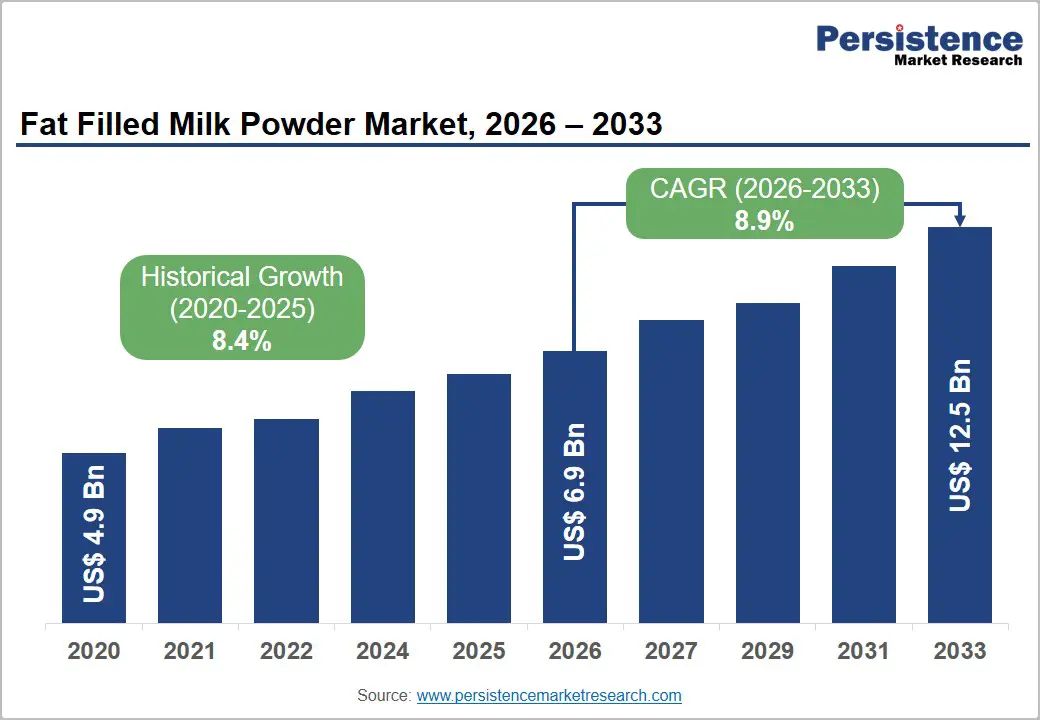
The global fat-filled milk powder market size is likely to be valued at US$6.9 billion in 2026 and is estimated to reach US$12.5 billion by 2033, growing at a CAGR of 8.9% during the forecast period from 2026 to 2033, driven by the rising use of cost-optimized dairy ingredients in bakery, confectionery, recombined dairy, and nutrition formulations. Demand is strengthening as urban food consumption shifts toward packaged, shelf-stable products that require reliable milk solids functionality without the full cost of milk fat. Regulatory oversight on dairy hygiene, traceability, and import quality is pushing processors toward standardized powder ingredients with predictable composition and longer storage life.
Key Industry Highlights:
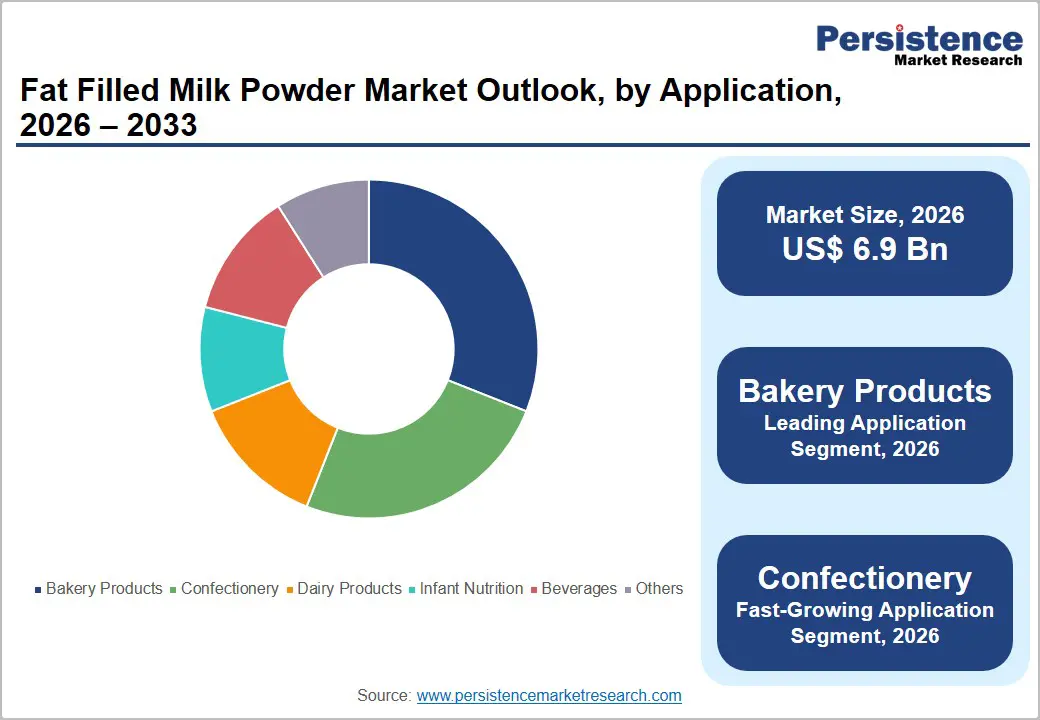
- Leading Application: Bakery products are estimated to hold roughly 31% revenue share in 2026, driven by high-volume use in cakes, biscuits, fillings, and premixes.
- Fastest-growing Application: The confectionery segment is forecast to grow the fastest, driven by wider use of cost-optimized milk powders in chocolate compounds, coatings, and fillings.
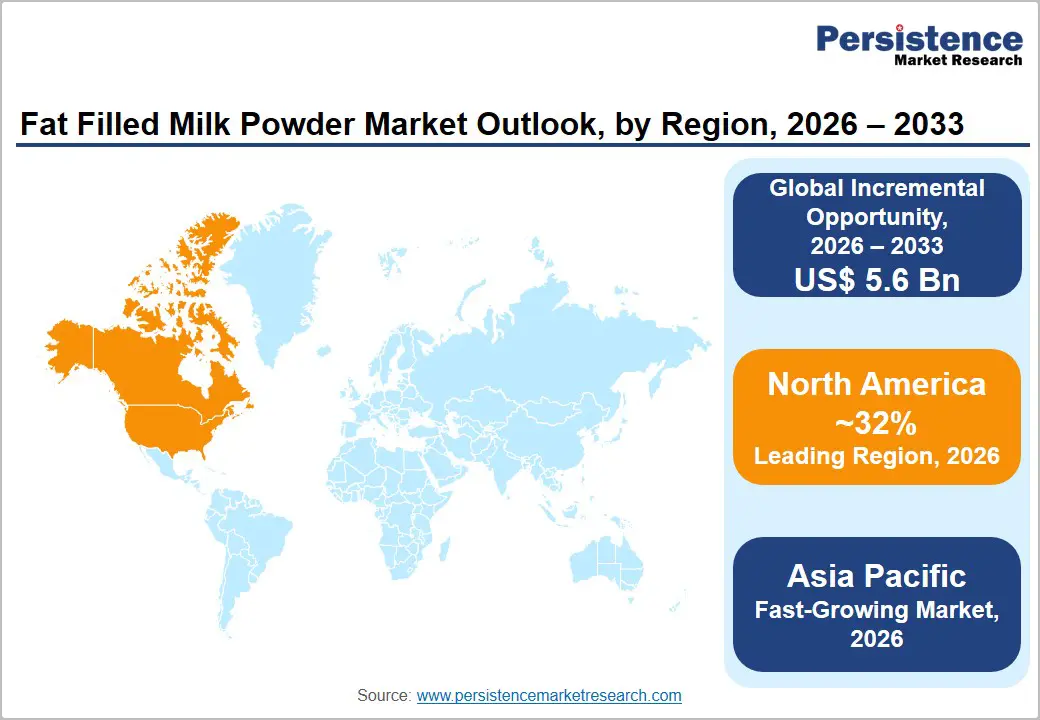
- Regional Leadership: North America is projected to capture roughly 32% of the market share by 2026, driven by advanced powder-processing infrastructure and strong industrial food manufacturing demand.
- Competitive Environment: The market reflects a moderately fragmented structure, with players such as Fonterra, Arla Foods Ingredients, Vreugdenhil Dairy Foods, Dana Dairy Group, and Hoogwegt competing on formulation capability, supply reliability, and procurement scale.
- Innovation Trends: Energy-efficient spray drying, customized fat-protein blending, and localized milk-powder sourcing partnerships are shaping long-term product development and cost competitiveness.
DRO Analysis
Driver - Rising Demand for Affordable Dairy Solids in Industrial Food Manufacturing
Fat-filled milk powder is gaining relevance as it enables food manufacturers to retain milk-solids functionality while replacing higher-cost milk fat with vegetable fat. That cost-performance balance is especially valuable in bakery creams, confectionery fillings, recombined dairy beverages, sweetened condensed milk, and frozen desserts, where fat profile control and shelf stability directly affect formulation economics. As branded food companies expand into value and mid-tier price bands, ingredient systems that reduce volatility in finished-product cost become more attractive.
This demand trend is supported by continued growth in powder-based dairy flows and processed food manufacturing. The Organization for Economic Co-operation and Development-Food and Agriculture Organization (OECD-FAO) Agricultural Outlook 2025–2034 indicates that rising incomes and urbanization in middle-income economies are lifting consumption of dairy products, with skim milk powder and whole milk powder remaining important trade categories in global dairy ingredient flows. In Southeast Asia, imported milk products remain a major part of the dairy supply, creating a structural opening for blended powders that can deliver lower-cost nutrition and stable industrial performance.
Restraint - Product Type limits in premium nutrition and label-sensitive categories
Fat-filled milk powder also faces a ceiling in product types where dairy authenticity, milk-fat functionality, or ingredient-label simplicity are non-negotiable. Infant nutrition, premium dairy powders, and some clean-label consumer products often require tighter standards on fat source, compositional claims, and nutritional positioning. In those settings, full cream or whole milk powder can retain an advantage despite higher cost, limiting how far fat-filled milk powder can penetrate premium formulations.
That limitation affects scalability because the fastest-growing value pools in nutrition are often linked to specialized clinical, pediatric, and premium wellness products. Manufacturers serving those channels may use fat-filled formats only in selected stock-keeping units (SKUs) or avoid them altogether to protect formulation claims and brand positioning. This keeps the market concentrated in industrial and price-sensitive product types rather than allowing uniform penetration across all milk powder end-uses.
Opportunity - Import Substitution and Localized Blending in High-Dependency Dairy Markets
A major opportunity lies in import-dependent dairy economies where reconstituted milk products, sweetened condensed milk, and value dairy beverages already rely heavily on powder inputs. In these markets, local blending and packing of fat-filled milk powder can reduce delivered ingredient cost, improve working-capital efficiency for food manufacturers, and lower exposure to fresh milk seasonality. The model is commercially attractive where domestic raw milk availability remains insufficient for rising packaged-food demand.
The growth pathway is clear: processors can pair imported skim solids with locally or regionally sourced vegetable fat, then supply industrial customers with customized fat percentages and instantized formats. This approach becomes more compelling when governments support dairy processing capacity, cold-chain investment, or food manufacturing localization.
Category-wise Analysis
Fat Content Insights
The 28% fat content segment is expected to account for approximately 38% of the fat-filled milk powder market in 2026, supported by its widespread use in bakery, confectionery, and recombined dairy applications where a balance between functionality, mouthfeel, and cost efficiency is essential. Compared with higher-fat formulations, it offers a more economical solution while maintaining desirable sensory properties, and it provides greater richness than lower-fat alternatives. Its versatility across a broad range of food and beverage formulations continues to support strong demand, with ingredient suppliers offering 28% fat-filled milk powder for applications such as chocolate, yogurt, and beverage products, reinforcing its commercial adoption across food manufacturing industries.
The above 30% fat content segment is projected to register the fastest growth during the forecast period, driven by increasing demand for premium confectionery fillings, creamers, dessert mixes, and bakery products that require enhanced creaminess, richer texture, and improved sensory performance. These higher-fat formulations provide manufacturers with an effective alternative to full cream milk powder in selected applications while maintaining product quality and functionality. Rising milk fat costs are further encouraging the adoption of high-fat vegetable-based blends, enabling food manufacturers to optimize production costs without compromising performance or consistency across industrial formulations.
Application Insights
Bakery products are expected to account for approximately 31% of the fat-filled milk powder market in 2026, driven by their extensive use in cakes, biscuits, pastries, fillings, creams, and bakery premixes that require consistent dairy solids, enhanced browning, and cost-effective formulation. The segment benefits from high-volume production, recurring demand, and the versatility of fat-filled milk powder across a wide range of baked goods. Ongoing investments in dairy ingredient production to support bakery and chocolate applications further reinforce demand for specialized milk powder solutions in industrial food manufacturing.
The confectionery segment is projected to witness the fastest growth during the forecast period, supported by rising demand for milk-based ingredients in chocolate compounds, fillings, coatings, candies, and other sweet snacks where rich dairy flavor and smooth texture are essential. Fat-filled milk powder enables manufacturers to optimize formulation costs while maintaining processing efficiency and product quality. Increasing investments in chocolate and confectionery production, particularly across Asia, are further accelerating adoption as manufacturers expand output to meet growing consumer demand for affordable, dairy-enriched indulgent products.
Regional Insights
North America Fat Filled Milk Powder Market Trends
North America is expected to lead with an estimated 32% global market share in 2026. Due to a well-established dairy processing base, high skim milk powder availability, and strong demand from bakery, confectionery, and beverage manufacturers. The region benefits from advanced spray-drying infrastructure, integrated dairy supply chains, and stringent quality-control systems that support large-scale production of standardized dairy ingredients.
U.S. Fat Filled Milk Powder Market Insights
The U.S. is projected to account for nearly 76% of the North America market share in 2026, driven by its large milk powder production base, extensive food manufacturing capacity, and broad use of dairy ingredients across processed food categories. Demand remains concentrated in bakery premixes, confectionery fillings, frozen desserts, and beverage powders, where cost control and stable functionality are critical.
Canada Fat Filled Milk Powder Market Insights
Canada is expected to hold around 24% of the North America market share in 2026, supported by a stable dairy sector, established food processing capabilities, and consistent demand for shelf-stable dairy ingredients in industrial product types. The market is benefiting from growing use of milk powders in bakery products, dessert mixes, and confectionery formulations, where longer shelf life and easier storage improve manufacturing efficiency.
Europe Fat Filled Milk Powder Market Trends
Europe is forecast to capture approximately 28% of the fat-filled milk powder market share in 2026, supported by its mature dairy industry, extensive milk powder production capacity, and strong position in dairy ingredient exports. The region has a well-developed processing ecosystem that supports the production of skimmed milk powder and related ingredients used in fat-filled powder formulations.
Germany Fat Filled Milk Powder Market Insights
Germany is projected to represent about 22% of the Europe market in 2026, driven by its strong dairy manufacturing base and deep integration with bakery, confectionery, and industrial food production. The country benefits from a large network of dairy processors, ingredient suppliers, and packaged food manufacturers that require consistent milk-solids inputs for fillings, coatings, cream systems, and dessert product types.
Netherlands Fat Filled Milk Powder Market Insights
The Netherlands is expected to account for nearly 18% of the Europe market in 2026, supported by its role as a major dairy export hub and its strong concentration of milk powder processors and dairy ingredient traders. The country benefits from efficient port logistics, a high level of dairy specialization, and a strong presence in global ingredient trade.
Asia Pacific Fat Filled Milk Powder Market Trends
Asia Pacific is forecast to be the fastest-growing region and is expected to hold around 30% of the global market share in 2026, stimulated by rising consumption of packaged foods, growing dairy ingredient imports, and expanding milk powder processing capacity. The region combines strong demand from bakery, confectionery, dairy beverages, and nutrition products with a large population base and rapid urbanization.
China Fat Filled Milk Powder Market Insights
China is projected to contribute approximately 34% of the Asia Pacific market share in 2026, supported by large-scale demand from bakery, beverage, confectionery, and nutrition manufacturers that require reliable dairy ingredients at controlled cost. Industrial users are increasingly focused on standardized powders that offer stable quality, good solubility, and predictable fat composition for mass-market formulations.
India Fat Filled Milk Powder Market Insights
India is expected to account for nearly 21% of the Asia Pacific market share in 2026, driven by rapid growth in packaged dairy products, bakery and confectionery production, and continued investment in domestic milk powder infrastructure. The country is benefiting from rising milk procurement, expanding cooperative processing capacity, and new powder manufacturing facilities that improve local availability of dairy solids. Growth is also supported by stronger linkages between dairy farmers and nutrition supply chains, which are improving raw milk access for powder production.
Competitive Landscape
The global fat filled milk powder market is moderately fragmented, with competition shaped by access to skim milk powder, vegetable fat sourcing, export networks, and product type-specific formulation capability. Large dairy ingredient processors hold an advantage in procurement scale, drying infrastructure, and customer relationships with bakery, confectionery, dairy, and beverage manufacturers. Competition is strongest in industrial B2B supply rather than branded consumer powder channels.
Key participants include Fonterra Co-operative Group, Arla Foods Ingredients, Vreugdenhil Dairy Foods, Dana Dairy Group, and Hoogwegt International, alongside regional dairy cooperatives and specialist exporters. Competitive differentiation is increasingly linked to consistent fat-protein customization, instantized powder performance, supply-chain reliability, and cost-efficient manufacturing. Companies with strong positions in skim solids, export logistics, and customer technical support are better placed to defend margins and expand into higher-value customized blends.
Key Industry Developments:
- In April 2026, StoneX partnered with Expana to launch a fat-filled milk powder over-the-counter dairy derivatives contract, strengthening price-risk management tools for participants exposed to dairy commodity volatility.
- In October 2025, StoneX partnered with Expana to launch a new suite of over-the-counter dairy derivatives, with the first contracts covering fat-filled milk powder to strengthen pricing transparency and risk management across the dairy trade.
Companies Covered in Fat Filled Milk Powder Market
- Fonterra Co-operative Group
- Arla Foods Ingredients Group P/S
- Vreugdenhil Dairy Foods
- Dana Dairy Group
- Lactalis Ingredients
- NZMP
- Alpen Food Group B.V.
- Holland Dairy Foods
- BONILAIT PROTEINES
- TATURA Milk Industries
- Polindus
- Revala Ltd.
- United Dairy Ingredients
- Nutrimilk Limited
Frequently Asked Questions
The global fat-filled milk powder market is projected to reach US$6.9 billion in 2026.
The rising need for cost-effective dairy ingredients in bakery, confectionery, beverages, and recombined dairy products, supported by longer shelf life and formulation flexibility, is driving the fat-filled milk powder market.
The fat-filled milk powder market is poised to witness a CAGR of 8.9% from 2026 to 2033.
Expanding use in emerging dairy-deficient markets, growing demand for affordable milk-based ingredients in processed foods, and innovation in customized fat-filled formulations are creating key opportunities in the fat-filled milk powder market.
Some of the key market players include Fonterra Co-operative Group, Arla Foods Ingredients, Vreugdenhil Dairy Foods, Dana Dairy Group, and Hoogwegt International.


