




- Beauty & Personal Care
- Facial Mask Market
Facial Mask Market Size, Share, and Growth Forecast 2026 - 2033
Facial Mask Market by Product (Medical Masks and Respirators), Usage (Reusable, and Disposable), Distribution Channel (Institutional Sales, and Retail Sales), Regional Analysis, 2026 - 2033

Facial Mask Market Size and Trend Analysis
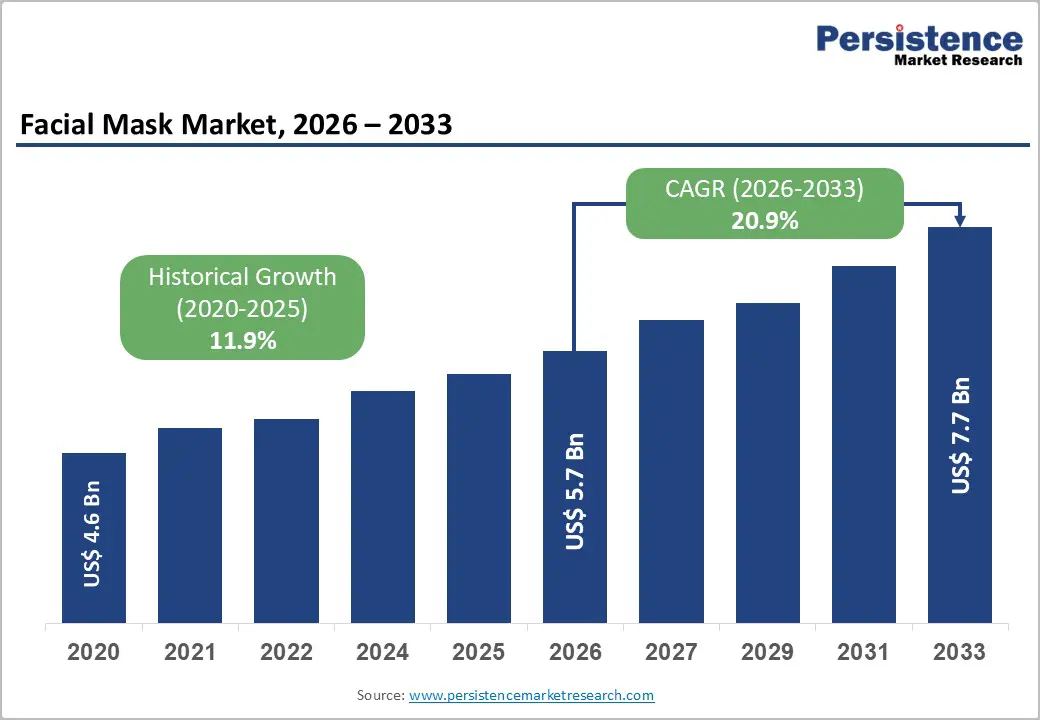
The global facial mask market size is likely to be valued at US$ 5.7 billion in 2026 and is expected to reach US$ 7.7 billion by 2033, growing at a CAGR of 20.9% during the forecast period from 2026 to 2033.
This steady expansion is underpinned by rising respiratory-disease prevalence, aging populations, and stricter occupational-safety norms that have elevated demand for high-filtration and patient-interface masks across healthcare, industrial, and home-care settings.
The global facial mask market size is likely to be valued at US$ 5.7 billion in 2026 and is expected to reach US$ 7.7 billion by 2033, growing at a CAGR of 20.9% during the forecast period from 2026 to 2033.
This steady expansion is underpinned by rising respiratory-disease prevalence, aging populations, and stricter occupational-safety norms that have elevated demand for high-filtration and patient-interface masks across healthcare, industrial, and home-care settings.
Key Industry Highlights:
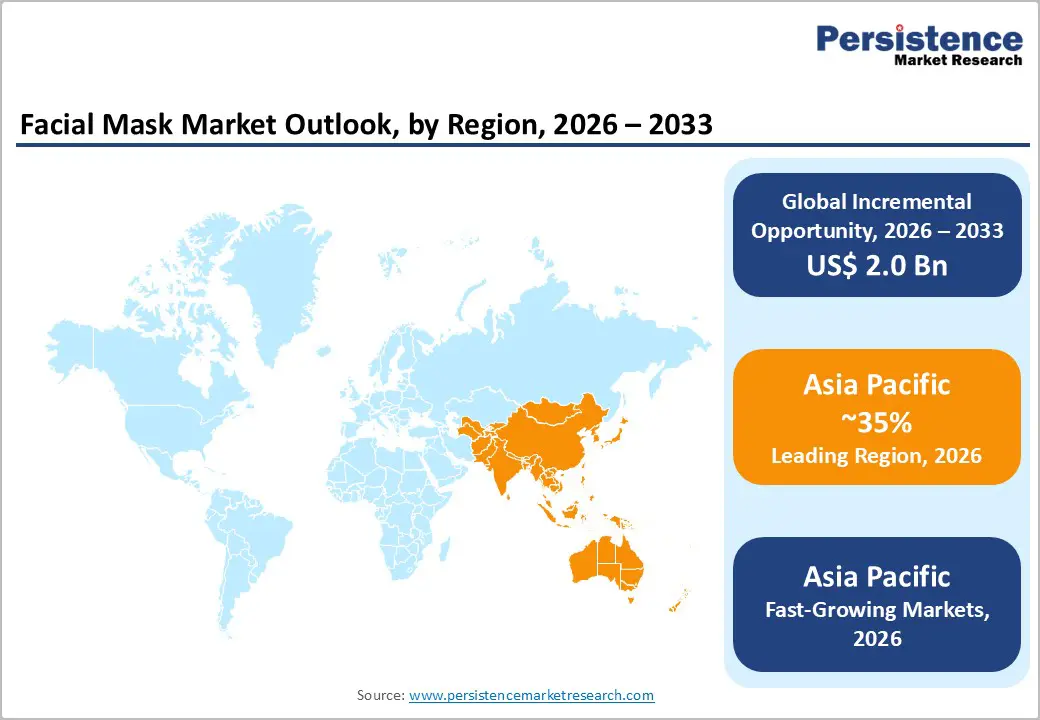
- Leading Region: Asia Pacific leads the Facial Mask Market, holding 35% share, due to large populations, rising healthcare expenditure, and strong domestic manufacturing of medical masks, respirators, and NIV masks in China, Japan, India, and ASEAN countries.
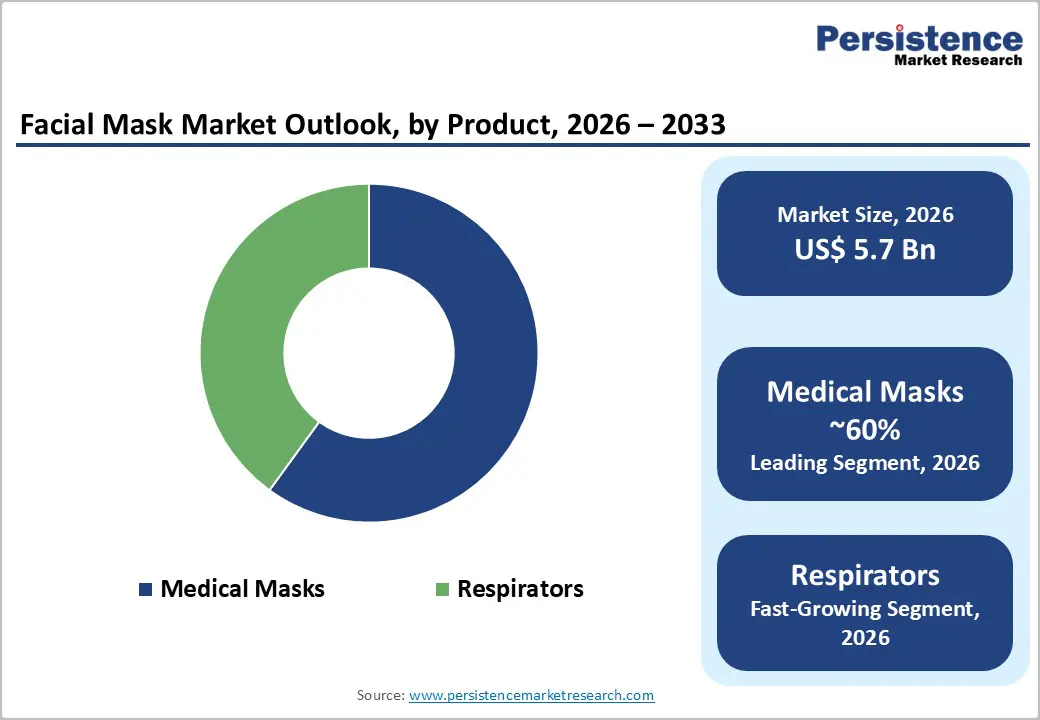
- Dominant segment: Non-invasive ventilation (NIV) masks dominate the medical-mask category, capturing an estimated 60% share due to widespread use in ICUs, emergency departments, and home-care settings.
- Fastest-growing segment: N95-class respirators and FFP2/FFP3-equivalent masks are among the fastest-growing segments, fueled by regulatory mandates, air-pollution concerns, and occupational-safety requirements in healthcare and industrial sectors.
- Key Opportunity: The expansion of home-care and sleep-apnea therapy using NIV and CPAP masks integrated with telehealth platforms represents a major opportunity, particularly in North America, Europe, and Asia Pacific.
| Key Insights | Details |
|---|---|
| Facial Mask Market Size (2026E) | US$ 5.7 Billion |
| Market Value Forecast (2033F) | US$ 7.7 Billion |
| Projected Growth CAGR (2026 - 2033) | 20.9% |
| Historical Market Growth (2020 - 2025) | 11.9% |
Market Dynamics
Drivers - Rising Global Respiratory Disease Burden Is Accelerating Demand for NIV, Oxygen, and Critical-Care Facial Masks
The growing global prevalence of chronic respiratory conditions such as COPD, asthma, and sleep-related breathing disorders is a major driver of the Facial Mask Market, especially for non-invasive ventilation masks, oxygen masks, and anesthesia masks. According to the World Health Organization, COPD alone causes more than 3 million deaths each year, with millions of patients requiring short-term or long-term ventilatory support through facial mask systems.
Hospitals are increasingly adopting non-invasive ventilation to lower infection risks and reduce ICU stays, thereby significantly boosting demand for high-performance NIV masks. Clinical studies show that NIV can cut intubation rates by nearly 40% in suitable patients. Combined with expanding ICU infrastructure in emerging economies, this growing reliance on respiratory care is steadily increasing demand across hospitals, clinics, and home-care environments worldwide.
Stricter Workplace Safety Regulations and Pollution Concerns Are Driving Widespread Adoption of High-Filtration Respirators
Tightening workplace safety regulations and rising air-pollution levels are strongly increasing demand for respirators, dust masks, half-face masks, and full-face masks across healthcare, construction, and industrial sectors. In the United States, the National Institute for Occupational Safety and Health mandates the use of N95-class respirators in high-risk environments such as hospitals and laboratories. Several countries in Asia and Europe have also adopted strict filtration standards during pollution emergencies.
Government programs in high-smog regions frequently distribute certified masks to protect public health, reinforcing everyday usage habits. Meanwhile, global safety frameworks now require certified protective equipment for workers exposed to chemicals, dust, and airborne pathogens. This regulatory push, combined with growing awareness of occupational health risks, is driving long-term procurement of respirators and powered air-purifying systems across both public and private sectors.
Restraints - High Equipment Costs and Unstable Reimbursement Policies Are Limiting Advanced Mask Adoption in Developing Healthcare Systems
One of the major challenges in the Facial Mask Market is the high cost of advanced respiratory and anesthesia mask systems, which limits their adoption in low-income regions and smaller healthcare facilities. Non-invasive ventilation (NIV) systems often require specialized masks, increasing the overall cost of treatment. For clinics and hospitals in developing economies, the combined costs of equipment, disposables, and ongoing maintenance can place significant financial strain on limited budgets.
In addition, inconsistent reimbursement policies for respiratory care products across parts of Latin America, Africa, and the Middle East create financial uncertainty for hospitals and home-care providers. Even when the clinical advantages of advanced facial masks are clearly proven, limited insurance coverage reduces the willingness of healthcare providers to invest in high-end solutions. As a result, these cost-related barriers slow the adoption of advanced facial mask technologies, especially in rural and underserved areas, ultimately restraining the overall growth of the global market.
Complex Regulatory Approvals and Compliance Costs Are Slowing Product Innovation and Market Entry for Smaller Manufacturers
The Facial Mask Market also faces pressure from increasingly strict regulatory standards that raise development costs and extend product approval timelines. In Europe, manufacturers must comply with comprehensive medical device and protective equipment regulations that require clinical testing, performance validation, and ongoing post-market monitoring. In the United States, the Food and Drug Administration classifies many ventilation and anesthesia masks as regulated medical devices, often requiring formal clearance before commercialization.
These processes demand strong quality systems, technical documentation, and compliance expertise. For smaller manufacturers, these regulatory hurdles can limit product launches and geographic expansion. While these standards improve safety and performance, they also concentrate market power among large global players that can absorb regulatory costs, making entry difficult for new and regional competitors.
Opportunity - Rapid Growth of Home-Based Sleep Apnea and Respiratory Therapy is Expanding Demand for CPAP and NIV Masks
Rapid growth in home-based respiratory care is creating strong opportunities for non-invasive ventilation masks, CPAP masks, and oxygen masks outside hospital environments. Millions of adults globally suffer from sleep apnea, yet diagnosis and treatment rates remain relatively low, leaving a large untapped patient pool. Medical technology companies such as ResMed have introduced advanced CPAP mask designs focused on comfort, improved airflow, and better patient adherence.
Features such as lightweight frames, moisture-control fabrics, and ergonomic headgear are helping users maintain long-term therapy compliance. The integration of telehealth platforms and remote monitoring with respiratory devices is also improving treatment outcomes and encouraging insurance coverage for home care. Together, these developments are expanding the customer base and driving steady repeat demand for facial mask consumables.
Sustainability Trends Are Encouraging Development of Reusable, Eco-Friendly Facial Masks Across Industrial and Consumer Markets
Environmental concerns are increasingly shaping innovation in the Facial Mask Market, particularly in reusable and eco-friendly designs. While disposable masks remain essential in hospitals due to strict infection-control protocols, industries and consumers are showing growing interest in long-lasting respirators with replaceable filters. Manufacturers are responding with washable materials, modular components, and recyclable packaging to reduce waste.
Research highlighting performance loss from improper cleaning has also encouraged the development of easy-maintenance designs and antimicrobial coatings. In countries such as Japan and South Korea, demand for environmentally responsible protective equipment is accelerating the adoption of reusable formats in non-medical settings. This sustainability focus not only reduces long-term costs for users but also aligns with corporate environmental goals, creating a fast-growing niche within the broader facial mask industry.
Category-wise Analysis
Product Insights
Within the medical masks segment, non-invasive ventilation masks represent the largest value share, accounting for roughly 60% of revenues. Their dominance is driven by extensive use in ICUs, emergency departments, and home-care therapy for respiratory failure, COPD flare-ups, and sleep-related breathing disorders. Global clinical bodies actively promote NIV as a frontline treatment in suitable patients, which has made NIV masks a standard interface for CPAP and BiPAP systems. Hospitals are expanding critical-care capacity to reduce invasive ventilation risks, further increasing adoption. As healthcare systems focus on shorter hospital stays and improved patient outcomes, demand for high-seal, comfortable NIV masks continues to rise. This sustained clinical reliance firmly positions NIV masks as the core revenue generator within the medical-mask category.
Usage Insights
Disposable masks currently account for around 70% of the global Facial Mask Market, largely driven by healthcare usage. Hospitals and clinics prioritize single-use masks to minimize cross-infection risks and simplify hygiene protocols. During pandemic periods, government stockpiling policies further strengthened reliance on disposable formats. Medical masks, anesthesia masks, and respirators are the main contributors to this segment’s dominance. In contrast, reusable masks are more common in offices, schools, and industrial workplaces, where long-term cost savings are prioritized over strict medical sterility. However, rising environmental awareness is gradually improving the appeal of reusable solutions outside healthcare. Despite this shift, disposable products are expected to remain the preferred choice in acute-care settings due to regulatory and safety requirements.
Distribution Channel Insights
Institutional buyers such as hospitals, clinics, diagnostic centers, and research institutes generate roughly 60% of the total facial mask market revenue. These organizations purchase large volumes of medical masks, respirators, NIV masks, oxygen masks, and anesthesia masks to meet safety regulations and daily clinical demand. Hospitals alone account for a substantial share due to rising surgical procedures, growing ICU capacity, and aging patient populations.
Public health programs and emergency preparedness strategies further support consistent institutional procurement. Long-term supplier contracts and bulk purchasing agreements also reinforce this channel’s dominance. While retail and online sales are expanding, especially for consumer respirators, institutional buyers remain the backbone of market revenue due to their predictable, high-volume purchasing behavior.
Regional Insights
North America Facial Mask Market Trends
North America remains one of the most advanced and highly regulated markets for facial masks, led by the United States. Strict workplace safety standards enforced by OSHA and medical device regulations ensure high demand for certified respirators, NIV masks, and anesthesia masks. Government-supported stockpiling programs introduced after the pandemic have created long-term baseline demand for medical masks.
The region is also a hub for innovation, with companies such as Koninklijke Philips N.V. and ResMed developing smart respiratory masks integrated with remote monitoring platforms. Rising awareness of air quality, occupational hazards, and chronic respiratory disease management is further expanding the market size. Premium product adoption is particularly strong, making North America a high-value region despite moderate population growth. Continued investment in healthcare technology and preparedness initiatives will sustain long-term market expansion.
Europe Facial Mask Market Trends
Europe benefits from a harmonized regulatory framework that ensures consistent quality standards across countries. Major markets such as Germany, the United Kingdom, France, and Spain show strong demand for medical masks, respirators, and NIV interfaces. Hospitals and industrial sectors strictly follow PPE regulations, supporting recurring institutional purchases. In the UK, the National Health Service is a major buyer of oxygen masks and respiratory equipment, driven by aging demographics and rising chronic disease rates. Germany’s strong manufacturing and healthcare infrastructure further reinforces regional consumption. Public investments in critical-care capacity and infection-control programs are steadily increasing demand across Southern and Western Europe. Overall, Europe represents a stable, regulation-driven market with consistent growth opportunities in both healthcare and industrial respiratory protection segments.
Asia Pacific Facial Mask Market Trends
Asia Pacific is the fastest-growing and largest regional market, supported by massive population size, expanding healthcare infrastructure, and strong domestic manufacturing. China has heavily invested in hospital capacity and respiratory care systems, boosting demand for NIV, oxygen, and anesthesia masks. Japan’s aging population and high prevalence of sleep apnea continue driving home-care CPAP mask usage. Rising air pollution levels across major Asian cities are increasing consumer adoption of high-filtration respirators.
India and Southeast Asian countries are emerging as global manufacturing hubs, supplying low-cost medical masks to both domestic and export markets. Government healthcare expansion programs in rural areas are improving access to respiratory care equipment. These combined demand-side and supply-side advantages position Asia Pacific as the most dynamic growth engine within the global facial mask market.
Competitive Landscape
The global facial mask market is moderately consolidated, with several multinational corporations dominating high-value segments such as medical masks, respirators, and NIV systems, alongside numerous regional producers of disposable products. Leading companies, including Honeywell International, Drägerwerk, Koninklijke Philips N.V., ResMed, and Fisher & Paykel Healthcare, leverage strong R&D capabilities, global distribution, and regulatory expertise. These firms are increasingly investing in smart masks, digital monitoring features, and telehealth integration to improve patient outcomes and build recurring revenue models. Subscription-based consumable programs and direct-to-consumer platforms are also gaining traction. At the same time, sustainability-focused innovations are becoming key differentiators. Overall, success in this market is increasingly defined by technology leadership, regulatory compliance strength, and the ability to deliver long-term value-added solutions.
Key Developments:
- In January 2025: ResMed introduced an advanced CPAP mask combining tube-up design, moisture-control materials, and built-in digital sensors that transmit real-time therapy data to cloud platforms. This innovation improves patient comfort, boosts treatment adherence, and supports remote monitoring across global home-care respiratory programs.
- In March 2024, 3M invested approximately US$100 million to expand automated N95 respirator manufacturing lines across U.S. facilities. The move strengthens domestic supply chains, meets sustained healthcare and industrial demand, and reinforces 3M’s long-term leadership in high-filtration respiratory protection products.
- In September 2023: Philips unveiled an intelligent NIV mask featuring real-time leak detection and adaptive pressure control powered by artificial intelligence. Designed for critical-care settings, the solution enhances therapy efficiency, improves patient comfort, and advances Philips’ digital respiratory-care innovation strategy.
Companies Covered in Facial Mask Market
- Fisher & Paykel Healthcare Corporation Ltd.
- ResMed
- Air Liquide Medical Systems
- Cantel Medical Corp.
- 3M Company
- Honeywell International Inc.
- Drägerwerk AG & Co. KGaA
- Koninklijke Philips N.V.
- Cardinal Health
- Teleflex Inc.
- Well Lead Medical Co., Ltd.
- Ambu A/S
- Vincent Medical
- Flexicare Medical Ltd.
- SunMed LLC
- BD
- Medtronic plc
- Getinge AB
- GE Healthcare
- Smiths Medical
Frequently Asked Questions
The global Facial Mask Market is valued at US$ 5.7 Billion in 2026 and is projected to reach US$ 7.7 Billion by 2033, growing at a CAGR of 4.3% from 2026 to 2033, with a historical CAGR of 3.8% between 2020 and 2025.
Key demand drivers include rising prevalence of respiratory diseases, aging populations, stricter occupational‑safety regulations, and post‑pandemic infection‑control policies that boost demand for medical masks, respirators, NIV masks, and oxygen masks across healthcare and industrial sectors.
The non‑invasive ventilation (NIV) masks segment is the leading sub‑segment within medical masks, capturing an estimated 60% share due to widespread use in ICUs, emergency departments, and home‑care respiratory therapy.
Asia Pacific is the largest regional market for facial masks, accounting for roughly 40% of global value, driven by large populations, rising healthcare expenditure, and strong domestic manufacturing in China, Japan, India, and ASEAN countries.
A key opportunity lies in the expansion of home‑care and sleep‑apnea therapy using NIV and CPAP masks integrated with telehealth platforms, which is expected to drive long‑term demand in North America, Europe, and Asia Pacific.
Leading players include Fisher & Paykel Healthcare Corporation Ltd., ResMed, Air Liquide Medical Systems, Cantel Medical Corp., 3M Company, Honeywell International Inc., Drägerwerk AG & Co. KGaA, Koninklijke Philips N.V., Cardinal Health, and Teleflex Inc., among others.


