




- Automation & Robotics
- Automated Intralogistics Material Handling Solutions Market
Automated Intralogistics Material Handling Solutions Market Size, Share and Growth Forecast for 2025 - 2032
Automated Intralogistics Material Handling Solutions Market by Automation Type (In-Built Machinery and Remote Operated), By Equipment Type (Conveyor System, AGV, AMR Robots, Robotic Stations, Picking & Sortation Systems, Stacker Cranes, Racking Systems and Palletizing Robots), Storage (Storage, Dispatch, Sorting & Conveying, Oil and Gas and Others), End User, and Regional Analysis for 2025 - 2032

Automated Intralogistics Material Handling Solutions Market Share and Trends Analysis
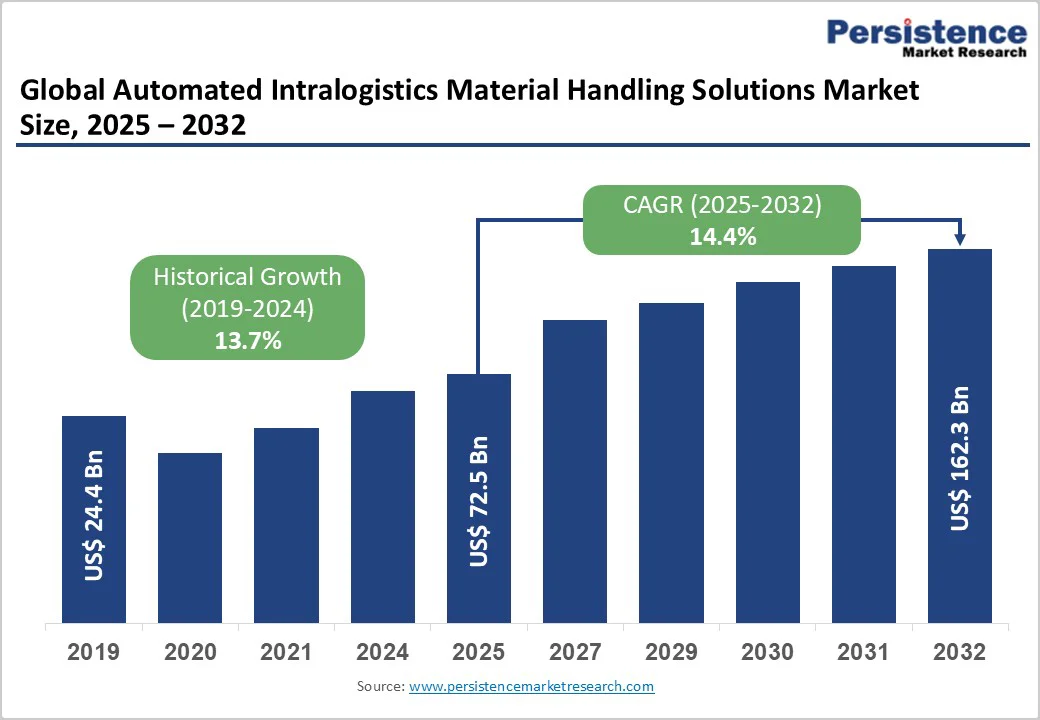
The global automated intralogistics material handling solutions market size is likely to be valued at US$72.5 billion in 2025 and is projected to reach US$186.1 billion, growing at a CAGR of 14.4% between 2025 and 2032.
This substantial growth trajectory reflects the accelerating convergence of e-commerce expansion, labor market constraints, and technological innovation, driving the transformation of warehouses and distribution centers across global supply chains.
Key Industry Highlights:
- Product Flagship: Conveyor systems and Automated Guided Vehicles (AGVs) dominate the industrial automation equipment segment with a 37.8% share, driven by their widespread use in manufacturing, warehousing, and logistics for efficient material handling.
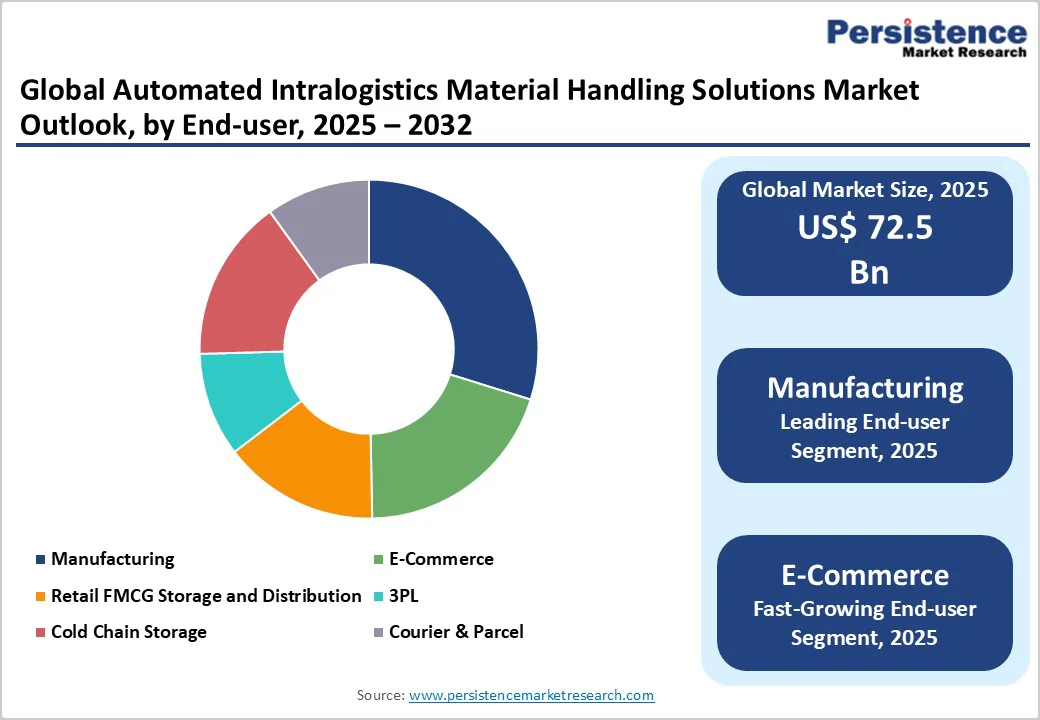
- End-User Market Dynamics: The manufacturing sector leads with a 38% share, generating a US$59.6 billion opportunity through 2032, owing to automation adoption for productivity and cost efficiency. The e-commerce and retail sector is expanding rapidly, representing the fastest-growing segment at 32.5%, fueled by surging fulfillment automation needs and last-mile delivery optimization.
- Application Technology Performance: Storage applications command a 42.8% segment share, valued at US$76.2 billion through 2032, due to the growing importance of automated warehousing and inventory optimization.
- Regional Growth Patterns: Asia Pacific leads the market with a 39% share and a strong 16.2% CAGR, supported by large-scale AMR deployments in China (58,000 units) and India’s 18.14% automation market growth trajectory. The region’s expanding manufacturing base and smart logistics initiatives continue to reinforce its leadership in the adoption of automation technology.
- Strategic Market Developments: Key industry players are advancing AI integration through platforms such as Swisslog’s SynQ 2.0, while AMR fleet deployments, exemplified by the DHL-Locus partnership, enhance logistics efficiency.
- Technology Evolution: The market is transitioning toward intelligent and connected automation ecosystems, leveraging AI, IoT, and robotics-as-a-service (RaaS) models to enhance flexibility, predictive maintenance, and operational intelligence.
| Key Insights | Details |
|---|---|
| Estimated Market Size (2025E) | US$72.5 Bn |
| Projected Market Value (2032F) | US$ 162.3 Bn |
| Value CAGR (2025 to 2032) | 14.4% |
| Historical Market Growth Rate (CAGR 2019 to 2024) | 13.7% |
Market Dynamics
Drivers - E-commerce Proliferation and Last-Mile Delivery Pressures
The exponential growth of online retail continues to exert unprecedented pressure on warehouse and fulfillment operations. E-commerce revenue is projected to reach US$5 billion in 2025, growing to US$6.5 billion by 2029, with e-commerce applications accounting for 42% of all AGV and AMR deployments in warehouse operations.
This surge demands rapid order processing capabilities, with automated picking systems improving fulfillment speeds by up to 300% according to McKinsey research.
The micro-fulfillment center market exemplifies this transformation, projected to expand from US$6.2 billion in 2024 to US$31.6 billion by 2030 at a 31.1% CAGR. Retailers are embedding automated fulfillment hubs within urban stores to compress last-mile delivery software windows, with Walmart's robotic micro-fulfillment centers now processing approximately 55% of digital grocery volume.
Same-day delivery expectations have driven order fulfillment cycle times below 10 minutes in advanced operations, requiring sophisticated automation infrastructure, including goods-to-person robotics, high-density storage systems, and AI-powered routing software.
Labor Shortages and Rising Workforce Costs
Persistent labor market challenges have accelerated automation adoption as organizations struggle to recruit and retain warehouse personnel for physically demanding roles.
Labor shortages rank as the primary driver of warehouse automation investment among 25% of organizations, while labor costs account for over 56.7% of warehouse operational expenses. This dual pressure of availability constraints and cost escalation has fundamentally shifted investment priorities toward automated solutions that reduce workforce dependencies.
By 2024, more than 200,000 AGV and AMR units were deployed globally, representing a 25% increase from 2022 levels, as organizations seek to fill critical staffing gaps. Autonomous mobile robots have reduced labor requirements by enabling 24/7 operations without shift constraints or productivity variations associated with human fatigue.
Manufacturing facilities deploying AMRs report that robots handle 50% of all tasks, including assembly, inspection, and component transport, allowing human workers to focus on strategic activities requiring judgment and creativity.
Key opportunities
Rapid Increase in Demand due to E-commerce Market Growth
The e-commerce business is booming as a result of the exceptional increase in the number of online customers following the COVID-19 pandemic.
In their facilities, e-commerce enterprises have implemented automated conveyor systems or AGVs that transport materials from one point to a goods-to-operator station, the most efficient way to process orders. The number of online customers has skyrocketed, resulting in a boom in the e-commerce industry. Automation has been widely utilized in e-commerce facilities, benefiting the growth of the market.
The most efficient method of processing orders is to use conveyor systems. With palletizing and AMR robots, the operator becomes 25% more efficient, and in a large distribution center with single-order picking across long distances, the operator can achieve up to 75% more efficiency.
Restraints - Challenges When Used With Contrasting Applications
Intralogistics material handling in warehouses or other facilities is a significant element, given that it increases the efficiency of transport systems. In production sites, distribution sites, and cross-docking sites, various requirements of autonomous systems must be fulfilled according to the needs of the facility. The main aim is to ensure a feasible and economic in-house material handling medium having a high service level and the least maintenance.
It must deliver a high return on investment because it is a one-time investment for most end users. The increasing complexity, increasing contrast of applications, dynamics of production systems, fewer order quantities and the associated small batch production are a few of the many challenges that intralogistics systems fail to deal with, and they result in restrained growth of the market.
Category-wise Analysis
By Automation Type Insights
The remotely operated automated material handling systems account for around 60% of the global automated intralogistics material handling solutions market. To modernize more warehouses worldwide, remote-operated technology is being rolled out more than ever.
This enhances workplace safety and facilitates material handling operations. Gantry cranes, overhead cranes, container-handling equipment, and even coil-handling equipment can all benefit from remote control technology. This type of material handling allows operators to emphasis more on their loads and less on the equipment itself, keeping everyone safe.
By Equipment Type Insights
For more than a decade, autonomous mobile robots (AMRs) have been used in warehouses, distribution centers, and manufacturing facilities. Over time, more experienced material handling companies have begun incorporating them more widely into their solutions. AMR offers more application flexibility than typical conveyor belts or other technologies such as monorails.
They show great potential to increase fulfillment speed, especially for palletized shipments. From 2025 to 2032, the segment is expected to create an absolute dollar opportunity of over US$17.8 billion. AMRs are helping to streamline operations across industrial sites.
By Sector Insights
From 2025 to 2032, the storage industry is projected to create an absolute dollar opportunity of more than $76.2 billion. Automated intralogistics material handling solutions used in storage systems include mobile racking systems, flow racking, compact storage, cantilever racking, FIFO racking, multi-level racking and many more.
With the development of warehouse infrastructure, storage systems are being used more efficiently to meet the increasing demand.
By End-use Insights
From 2025 to 2032, manufacturing is expected to create an absolute dollar opportunity of more than $59.6 billion. Automated intralogistics material-handling solutions for advanced manufacturing applications are used in numerous industries, including automotive, tire, chemical, pharmaceutical, textile, food and beverage, and consumer goods. Material handling plays a pivotal role in manufacturing.
Region Analysis
North America: Technology Leadership and Labor Market Dynamics
North America accounts for 28% of the global automated intralogistics material-handling solutions market, driven by advanced e-commerce infrastructure, severe labor shortages, and early adoption of automation technologies. The United States leads with 92% of the regional share, supported by a highly developed fulfillment network and strong technology ecosystem.
Valued at USD 4.6 billion in 2023, the U.S. warehouse automation market is projected to grow at a 16% CAGR to reach USD 26.3 billion by 2030. Labor scarcity and rising wages-exceeding 15% annually in several markets-have accelerated automation ROI and adoption. By mid-2025, over 43,000 active AMRs operated in U.S. warehouses, with California and Texas leading deployments at 9,200 and 7,800 units, respectively.
Europe: Industry 4.0 Excellence and Sustainability Integration
Europe accounts for 25% of the global automated intralogistics material handling solutions market, driven by advanced manufacturing, strong Industry 4.0 adoption, and sustainability-focused automation initiatives.
The region’s well-established industrial sectors-including automotive, machinery, chemicals, and consumer goods-demand sophisticated, high-precision handling systems. Germany, France, and the Netherlands host over 34,000 deployed units, with Germany serving as Europe’s automation hub due to its strong OEM and system integrator base.
European warehouse automation prioritizes energy efficiency and compliance, with 71% of AMRs featuring multilingual interfaces for multinational operations. Regulatory frameworks on carbon emissions and data security are accelerating investments in electric and hybrid logistics solutions, while AGV retrofits in legacy factories have surged 38% amid widespread modernization efforts.
Asia Pacific: Manufacturing Powerhouse and Rapid Scaling
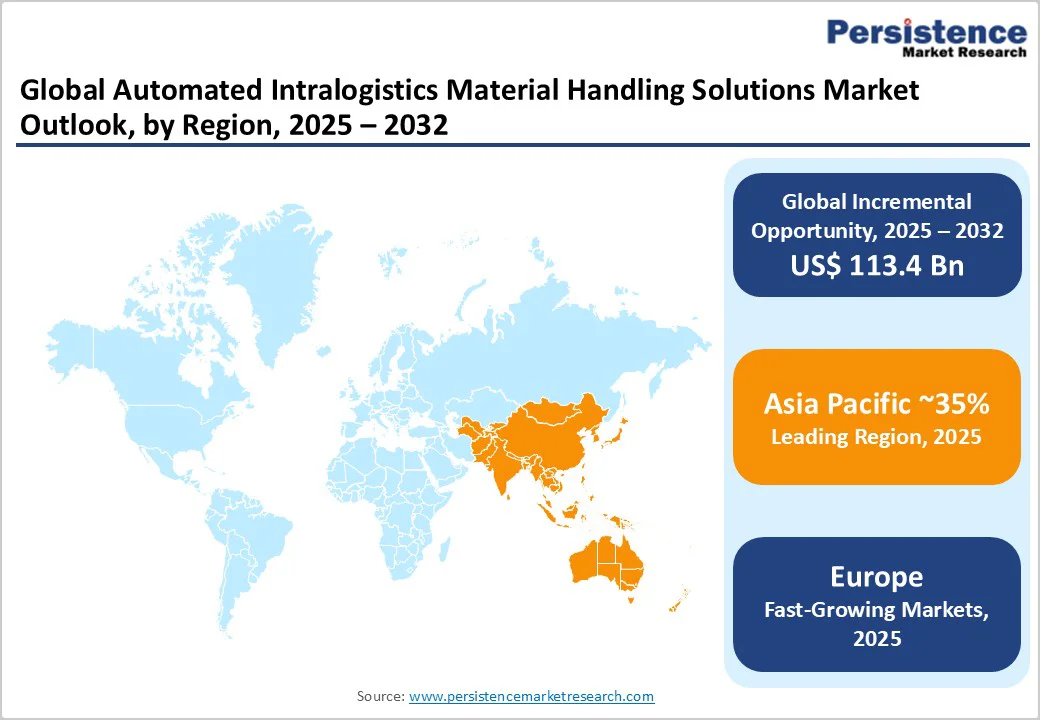
Asia Pacific dominates the global automated intralogistics material handling solutions market with a 39% share and a strong 16.2% CAGR, driven by concentrated manufacturing activity, rapid e-commerce growth, and large-scale infrastructure modernization.
The region hosts over 110,000 deployed robotic units, led by China’s 58,000 active AMRs, the world’s largest national base. Supportive government policies promoting smart manufacturing, export competitiveness, and logistics digitalization are fueling adoption.
China’s position as the “world’s factory” continues to drive demand for intralogistics automation to boost efficiency and reduce labor costs. Leading e-commerce platforms such as Alibaba’s Cainiao Network utilize AMRs, robotic sorting, and AI analytics, while cost-effective domestic AMR production strengthens China’s role as a global automation hub.
Competitive Landscape
The automated intralogistics material handling solutions market demonstrates moderate consolidation with leading players collectively holding 22-25% market share. Major suppliers include Daifuku Co. Ltd., Dematic (KION Group), SSI Schaefer, Honeywell Intelligrated, Toyota Industries Corporation, Mitsubishi Logisnext, and Jungheinrich AG, which leverage comprehensive automation portfolios and global implementation capabilities.
These Tier 1 providers benefit from established OEM relationships, extensive engineering resources, and proven track records delivering complex, large-scale projects across diverse industry verticals.?
For instance,
- In 2024, DHL Supply Chain announced a strategic partnership with Locus Robotics in 2024 to deploy autonomous mobile robots across its global warehouse network, enhancing operational efficiency and reducing labor costs.
- In 2024, Swisslog unveiled SynQ 2.0 software, designed to optimize warehouse operations through advanced data analytics and AI integration. This launch represents evolution from hardware-centric automation toward intelligent orchestration platforms that maximize performance across multi-vendor equipment fleets.
Companies Covered in Automated Intralogistics Material Handling Solutions Market
- Linde Material Handling
- Dematic
- Jungheinrich AG
- Daifuku Co., Ltd.
- Toyota Industries Corporation
- Mitsubishi Logisnext Co., Ltd.
- Mecalux SA
- Fives Group
- Godrej & Boyce Mfg. Co. Ltd.
- SSI SCHAEFER
- Nexon Automation
- Hannibal Industries
- Conveyco
- KÖHL Maschinenbau AG
- Hans Turck GmbH & Co. KG
- Others Key Players
Frequently Asked Questions
The Automated Intralogistics Material Handling Solutions market is estimated to be valued at US$ 72.5 Bn in 2025.
The key demand driver for the Automated Intralogistics Material Handling Solutions Market is the rising need for operational efficiency and real-time inventory management across manufacturing, e-commerce, and logistics sectors.
In 2025, the Asia Pacific region will dominate the market with an exceeding 35% revenue share in the global Automated Intralogistics Material Handling Solutions market.
Among the Automation Type, remotely operated automated holds the highest preference, capturing beyond 60.8% of the market revenue share in 2025, surpassing other Automation Type.
The key players in Automated Intralogistics Material Handling Solutions are Linde Material Handling, Dematic, Jungheinrich AG and Daifuku Co., Ltd.


