




- Technology
- Automated Border Control Market
Automated Border Control Market Size, Share, and Growth Forecast 2026 - 2033
Automated Border Control Market by Control Type (ABC E-gates, ABC Kiosks), Application (Airports, Seaports, Land Borders), and Regional Analysis, 2026 - 2033

Automated Border Control Market Size and Trend Analysis
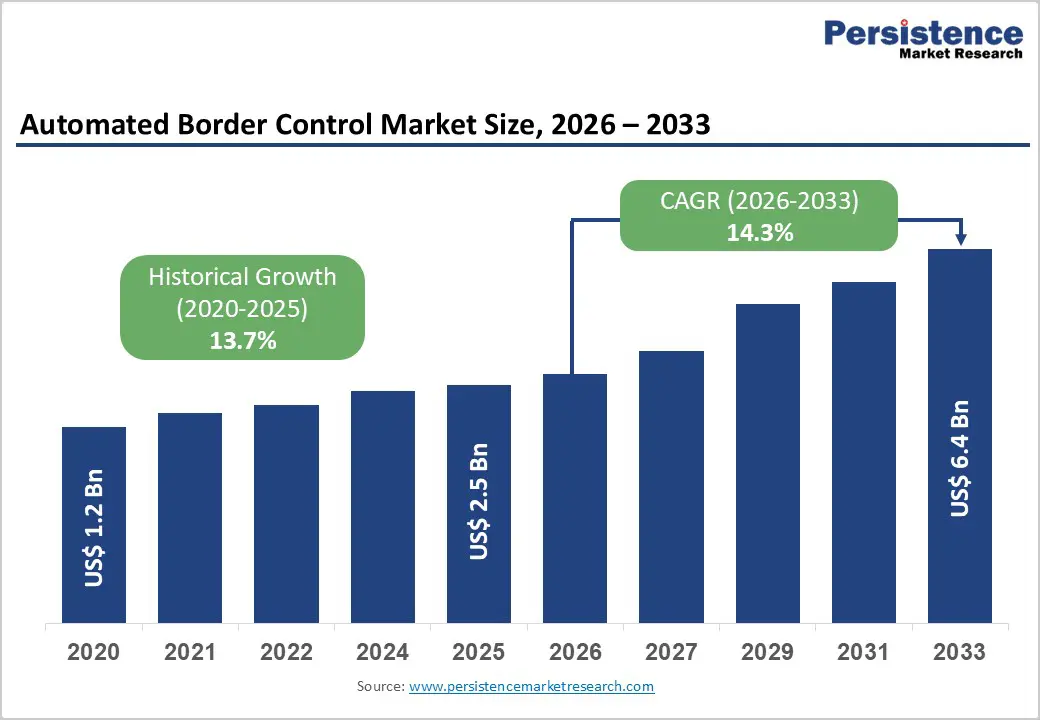
The global automated border control (ABC) market size is expected to be valued at US$ 2.5 billion in 2026 and projected to reach US$ 6.4 billion by 2033, growing at a CAGR of 14.3% between 2026 and 2033.
This strong market growth is driven by international travel volumes expected to surpass 5.6 billion passengers by 2027, alongside large-scale government investments in modernizing border security and biometric infrastructure. Regulatory mandates such as the EU’s Entry/Exit System across 29 Schengen nations are accelerating automated identity verification adoption. Additionally, rapid advancements in AI-powered multimodal biometrics-combining facial, iris, and fingerprint recognition—are enabling faster, more accurate, and secure passenger processing globally.
Key Market Highlights
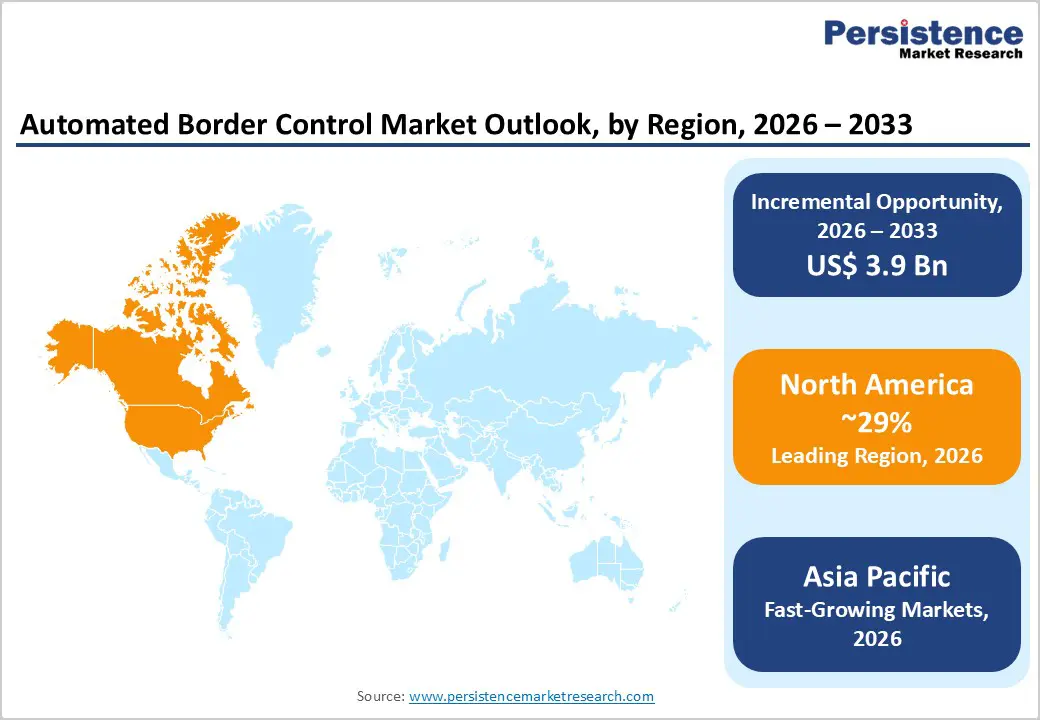
- Leading Region: North America leads the market with a 29% share in 2025, supported by advanced border modernization, smart border investments, and major international aviation hubs.
- Fastest Growing Region: Asia Pacific is the fastest-growing region with an 18.8% CAGR through 2033, driven by rising international travel, government border initiatives, and high-traffic airports.
- Dominant Segment: ABC E-gates dominate with 66% market share in 2025 due to widespread airport deployment, ICAO compliance, and high passenger throughput.
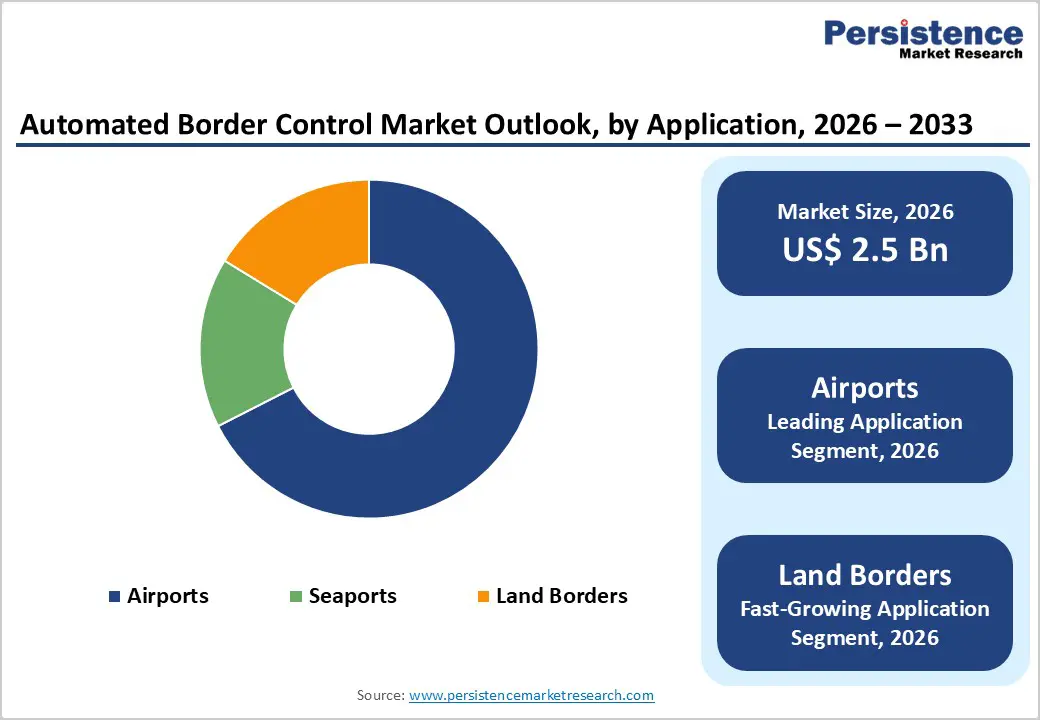
- Fastest Growing Segment: Land borders are the fastest-growing application segment with a 17.5% CAGR, fueled by cross-border trade, security mandates, and U.S.-Mexico border modernization.
- Key Market Opportunity: Seaports and land borders offer strong growth opportunities, supported by cargo security mandates, smart border investments, and lower infrastructure penetration compared to airports.
| Key Insights | Details |
|---|---|
|
Automated Border Control Market Size (2026E) |
US$ 2.5 billion |
|
Market Value Forecast (2033F) |
US$ 6.4 billion |
|
Projected Growth CAGR(2026-2033) |
14.3% |
|
Historical Market Growth (2020-2025) |
13.7% |
Market Dynamics
Drivers - Explosive Growth in International Travel and Border Crossing Volumes
Global travel recovery has generated unprecedented pressure on border control authorities to simultaneously enhance security while maintaining operational efficiency. International air travel is projected to exceed 5.6 billion passengers annually by 2027, representing a 4.5% year-over-year growth rate from 2024-2027 baseline levels, with particularly robust expansion in emerging markets including India, China, and Southeast Asia. The Latin American region has experienced a particularly strong recovery, with airport traffic rebounding to over 90% of pre-pandemic levels in 2024, creating urgent imperatives for border automation investment.
Major international hubs, including São Paulo-Guarulhos International Airport (GRU), Brazil’s busiest airport, have demonstrated compelling business case validation through the deployment of 42 automated biometric e-gates in Terminal 3, which increased passenger throughput by approximately 40% while reducing individual processing time from traditional manual procedures to approximately 10 seconds. The convergence of sustained growth in travel demand with limited border personnel availability is compellingly justifying capital-intensive ABC infrastructure investments, as governments recognize that manual processing capacity cannot scale to accommodate projected traveler volumes.
Regulatory Mandates and Government-Driven Digitalization Initiatives
Government regulatory frameworks are creating powerful market catalysts, with the European Union’s Entry/Exit System (EES) mandate requiring all 29 Schengen member countries to implement automated identity verification systems for third-country nationals by April 10, 2026, representing a transformative policy driver for ABC infrastructure deployment across European Union borders. The EU Smart Borders Initiative has allocated substantial capital funding for biometric technology modernization, with implementation expected to generate standardized identity verification protocols across European borders.
Beyond Europe, governments in the Asia-Pacific are accelerating ABC infrastructure investments, with India’s Digital Yatra initiative and IATA One ID frameworks promoting standardized biometric border-crossing across the region’s fastest-growing aviation markets. The Canadian government’s Digital Border Strategy targets full automation of border operations by 2030, including the implementation of AI-driven eGates with multilingual support at major airports, such as Toronto Pearson and Vancouver, representing a strategic infrastructure modernization. Mexico has expanded eligibility for its Automated Border Entry program to additional nationalities, with recent additions including Australia, Israel, and Slovakia, demonstrating a systematic expansion of biometric self-service infrastructure across the Americas.
Restraints - High Capital Investment Requirements and Infrastructure Modernization Barriers
The deployment of comprehensive automated border control infrastructure requires substantial capital expenditure, with typical ABC e-gate installations ranging from US$200,000 to US$500,000 per unit, including hardware, software, biometric sensors, and document readers. A major airport terminal requiring 50-100 e-gates to maintain adequate passenger throughput capacity necessitates capital investment of US$10-50 million, creating budgetary constraints for developing economies and smaller airport operators.
Beyond hardware procurement, comprehensive ABC system deployment requires substantial professional services expenditure for system integration, biometric database development, training of border personnel, and establishment of real-time connectivity with existing government databases and international watchlists. Additionally, retrofitting ABC systems in existing border facilities requires operational disruption during installation, creating resistance among airport authorities concerned about passenger experience degradation and operational continuity during the system installation and testing phases.
Privacy Concerns and Biometric Data Protection Regulatory Complexity
The collection, processing, and storage of biometric data (facial images, fingerprint scans, iris data) raise fundamental human rights and privacy concerns that complicate the authorization of ABC system deployment. The European Union’s GDPR (General Data Protection Regulation) and the proposed ePrivacy Directive impose stringent data protection requirements, including consent management, breach notification within 72 hours, and comprehensive data protection impact assessments, thereby increasing the compliance burden for border authorities.
Emerging regulatory frameworks in regions including Latin America and the Asia Pacific create inconsistent data protection requirements across borders, complicating the implementation of standardized, globally-integrated ABC architectures. Civil society and privacy advocacy organizations have raised concerns regarding potential misuse of biometric databases for surveillance and authoritarian control, particularly in jurisdictions with weak democratic protections and limited judicial oversight. The balancing of legitimate security imperatives against fundamental privacy rights creates regulatory uncertainty that delays ABC deployment decisions and increases implementation costs by requiring specialized privacy compliance infrastructure.
Opportunity - Seaport and Land Border Modernization as an Emerging High-Growth Opportunity
While ABC e-gates have achieved significant deployment penetration at major international airports, seaports, and land borders represent an emerging high-growth opportunity with substantially lower current infrastructure penetration. The International Maritime Organization has mandated enhanced cargo security protocols, creating a driver for integration of automated biometric systems at seaports for container manifest verification and personnel identity authentication. Land border automation has emerged as a particularly attractive opportunity, with Land ports advancing at 17.5% CAGR as cross-border commerce volumes accelerate and vehicle smuggling detection becomes an increasingly critical national security priority.
The U.S.-Mexico border region, representing one of the world’s highest-traffic land borders with recorded 320,000 monthly crossings as of 2024, represents a compelling modernization opportunity, with the U.S. Department of Homeland Security's investment in smart border technologies, including non-intrusive inspection systems and biometric verification. The Canada-U.S. border modernization initiative has prioritized the deployment of ABC infrastructure at major land crossings to facilitate legitimate commerce while enhancing security screening. Integration of biometric verification with non-intrusive inspection technologies enables comprehensive security architectures that simultaneously accelerate legitimate traveler and cargo movement while preventing smuggling and unauthorized crossing. The fragmentation of land borders and seaport deployment presents expansion opportunities for ABC solution providers targeting underserved infrastructure segments.
Artificial Intelligence and Predictive Analytics Integration for Enhanced Threat Detection
The integration of advanced artificial intelligence and machine learning into ABC systems enables automated risk assessment, behavioral-anomaly detection, and real-time threat identification, substantially exceeding manual border officer capabilities. Modern ABC platforms incorporate AI-driven facial micro-expression analysis, gait recognition, and travel history pattern matching, enabling identification of anomalies indicating potential security risks, fraudulent documentation, or database watchlist matches with minimal false-positive generation.
Cloud-native analytics capabilities enable real-time correlation of traveler information across international databases, including Interpol notices, travel sanctions, and immigration violations, generating comprehensive security risk profiles supporting border officer decision-making. The EU Entry/Exit System (EES) mandate for 29 Schengen member countries creates a compelling deployment opportunity for vendors offering AI-powered identity verification integrated with European border infrastructure. Governments seeking to maintain homeland security while facilitating legitimate travel demand are accelerating the adoption of AI-powered ABC systems, creating a robust market expansion opportunity.
Category-wise Insights
Control Type Analysis
ABC E-gates command the dominant position within the control type category, capturing approximately 66% of market share in 2025, reflecting their extensive deployment at major international airport terminals worldwide and superior operational efficiency compared to alternative technologies. ABC E-gates offer exceptional capability for processing high-volume passenger traffic, utilizing fully automated biometric verification procedures that combine facial recognition, iris scanning, and fingerprint analysis with optical passport readers, enabling identity verification in approximately 10-17 seconds per traveler.
The leadership position reflects standardization of International Civil Aviation Organization (ICAO) compliance protocols and multi-biometric module specifications, lowering integration risk and encouraging airport authorities to incorporate e-gates into terminal refresh programs. The modular design architecture of contemporary e-gates enables phased installation without requiring terminal closure, a critical advantage during peak travel seasons when operational continuity is paramount. The European Union’s Entry/Exit System (EES) mandate, requiring deployment across 29 Schengen member countries, represents a transformative opportunity for e-gate vendors, with the expected deployment timeline creating concentrated market demand.
Application Analysis
Airports represent the leading application segment within the Application Category, commanding approximately 72% of market share in 2025, reflecting concentrated capital deployment at major international aviation hubs processing tens of thousands of passengers daily. Airport border control operations represent the highest-value use case for ABC systems due to continuous passenger traffic demands, strong regulatory pressure to improve operational efficiency, and the availability of capital budgets that justify substantial infrastructure investment.
Major international airports, including London Heathrow, Paris Charles de Gaulle, Singapore Changi, and Tokyo Narita, have deployed comprehensive ABC networks comprising hundreds of e-gates and biometric kiosks, establishing industry benchmarks that inspire broader adoption. The Asia Pacific region is experiencing particularly robust airport ABC adoption, driven by exponential growth in international travel to China, India, and Southeast Asian hubs, with Changi Airport Singapore recognized as a global leader in biometric processing with average traveler throughput exceeding 60 passengers per hour per e-gate.
Regional Insights
North America Automated Border Control Market Trends and Insights
North America maintains the strongest regional market position, commanding approximately 29% of global market share in 2025, driven by sophisticated border control modernization initiatives, significant government infrastructure investment, and the concentration of major international airport hubs that require advanced biometric systems. The United States represents the largest North American market, with the U.S. Department of Homeland Security and the Transportation Security Administration (TSA) investing substantially in ABC infrastructure modernization across major airports, including Los Angeles, Chicago, New York JFK, and Miami. The U.S. government has prioritized the integration of smart border technologies, with 2024 federal contracts totaling US$450 million for the deployment of autonomous surveillance and biometric verification systems to address rising migration volumes and border security imperatives.
Canada emerges as a particularly strong growth driver, with the Digital Border Strategy targeting comprehensive automation of border operations by 2030, featuring AI-driven eGates with multilingual support at major airports, including Toronto Pearson and Vancouver. The Canadian government has emphasized the development of privacy-focused biometric technologies, positioning the country as a global leader in privacy-by-design ABC architectures. Mexico has expanded the Automated Border Entry program, recently adding Australia, Israel, and Slovakia to the list of eligible nationalities for biometric self-service kiosk use at major airports, demonstrating a systematic expansion of passport-based biometric processing across the North American region.
Europe Automated Border Control Market Trends and Insights
Europe represents the second-largest regional market, capturing approximately 26% of global market share in 2025, with market dynamics fundamentally shaped by the European Union’s Entry/Exit System (EES) regulatory mandate requiring operational deployment across 29 Schengen member countries by April 10, 2026. The EES implementation represents a transformative market catalyst, requiring standardized biometric identification systems across European borders with a synchronized deployment timeline, creating concentrated vendor demand.
Germany dominates the European market, commanding a market share exceeding 20% in 2024, with a comprehensive deployment of next-generation e-gates featuring real-time facial recognition and document authentication across all major airport terminals. Germany’s Federal Police partnership with Secunet Security Networks has spearheaded technological innovations, establishing Germany as the European leader in border control modernization. The United Kingdom, France, and Spain are accelerating ABC infrastructure deployment, with Eurostar terminals positioned 49 EES processing kiosks in preparation for regulatory transition. The European Union’s Smart Borders Initiative has promoted interoperability standards and data-sharing protocols, enabling seamless traveler movement across Schengen borders while maintaining comprehensive security screening.
Asia Pacific Automated Border Control Market Trends and Insights
Asia Pacific emerges as the fastest-growing regional market, projected to expand at 18.8% CAGR during 2026-2033, driven by explosive international travel growth, government-mandated border modernization initiatives, and concentration of the world’s highest-traffic aviation hubs. China maintains the region’s largest ABC market, with government mandates requiring enhanced biometric security protocols and investment in smart airport initiatives across major hubs, including Beijing Capital, Shanghai Pudong, and Guangzhou Baiyun.
India represents the Asia Pacific region’s highest-growth opportunity, withthe Digital Yatra initiative and the IATA One ID framework promoting standardized biometric border crossing across the subcontinent’s rapidly expanding aviation sector. Chennai International Airport has initiated biometric e-gate rollout, integrating boarding pass scanning with facial recognition, reducing immigration processing from ~25 seconds to ~10 seconds per traveler. Japan, Singapore, and Australia have established ABC infrastructure benchmarks inspiring regional adoption, with Changi Airport Singapore recognized globally as leader in contactless, biometric-enabled border processing. Southeast Asia is experiencing a robust recovery in travel demand, with ASEAN member states incrementally deploying biometric kiosk infrastructure at major international gateways to streamline cross-border movement within the region.
Competitive Landscape
The global automated border control market reflects a moderately consolidated structure, shaped by a mix of large multinational technology providers and specialized regional players. Leading vendors strengthen their position through end-to-end platforms that integrate biometric hardware, identity-verification software, and managed service capabilities, enabling long-term government contracts. Competitive advantage is increasingly defined by proprietary facial recognition algorithms, advanced liveness detection, and AI-driven analytics that enhance accuracy and real-time threat assessment.
The industry continues to experience strategic consolidation, with biometric and security capabilities being integrated into broader digital identity ecosystems. Regional specialists compete by offering highly customized solutions tailored to local regulatory frameworks, airport infrastructure, and passenger processing requirements. Across the landscape, vendors are prioritizing privacy-by-design architectures, interoperability with national security databases, and scalable cloud-enabled platforms to meet rising global passenger volumes and government mandates for secure, automated border processing.
Key Developments:
- December 2025: São Paulo–Guarulhos International Airport (GRU), Brazil's busiest hub, completes phase one of installing 42 SITA Automated Border Control gates in Terminal 3, featuring facial recognition, fingerprint readers, and biometric passport checks for 10-second clearances.
- January 2025: Indian Government Accelerates Biometric Border Control Deployment — Chennai International Airport launched biometric e-gate rollout, integrating boarding pass scanning with facial recognition, reducing immigration processing time to approximately 10 seconds per traveler.
Companies Covered in Automated Border Control Market
- Gemalto N.V.
- Indra Sistemas, S.A.
- Atos SE
- SITA SA
- IDEMIA Group (OT-Morpho)
- Secunet Security Networks AG
- Vision-Box
- DERMALOG Identification Systems GmbH
- Veridos GmbH
- Gunnebo Group
- Vancouver Airport Authority
- Thales Group
- NEC Corporation
- Indra Sistemas, S.A.
- Unisys
- Cisco Systems Inc.
- IN Groupe
Frequently Asked Questions
The market is expected to reach US$ 2.5 billion by 2026.
Rising international travel, regulatory mandates like the EU EES, government digitalization initiatives, AI-enabled biometrics, and post-pandemic border modernization drive adoption.
North America leads the market, while the Asia Pacific is the fastest-growing region.
Land borders, seaport automation, and AI-powered risk detection present major growth opportunities.
The leading market players include SITA, Secunet Security Networks AG, Indra Sistemas S.A., Veridos GmbH, Thales Group, DERMALOG Identification Systems GmbH, NEC Corporation, etc.


