Potato Protein Market Size, Share, Growth, and Regional Forecast, 2026 to 2033

Potato Protein Market by Product Type (Potato Protein Isolate, Potato Protein Concentrate), by Nature (Organic, Conventional), End-user (Food & Beverage, Animal Nutrition, Sports Nutrition, Pharmaceuticals & Nutraceuticals, Personal Care & Cosmetics, Infant Formula), and Regional Analysis, 2026 - 2033

ID: PMRREP31500
Calendar

April 2026

285 Pages

Author : Amol Patil

Key Industry Highlights

  • Leading Region: Europe, holding a dominant share, driven by advanced processing infrastructure, strict regulatory standards, and strong presence of key players such as Royal Avebe and Emsland Group
  • Fastest-Growing Region: Asia Pacific, fueled by rising middle-class consumption, increasing demand for plant-based proteins, and expanding accessibility through platforms like Alibaba Group
  • Fastest-Growing Product Type Segment: Potato Protein Isolate, supported by rising demand for high-purity proteins in sports nutrition, infant formula, and clinical applications
  • Growth Indicators: Increasing demand for allergen-free, clean-label, and high-quality plant proteins across food, nutraceutical, and specialty nutrition sectors
  • Opportunities: Expanding use of potato protein peptides in personal care and dermaceutical formulations as sustainable alternatives to animal-derived ingredients
  • Consumer Trends: Growing preference for hypoallergenic, plant-based, and multifunctional proteins with strong emphasis on transparency, sustainability, and nutritional performance
  • Key Developments: In July 2025, PoLoPo shifted focus toward high-protein potatoes for snack applications; in March 2025, Brenntag Specialties and Royal Avebe expanded their partnership in Poland to strengthen distribution and market reach
Key Insights Details
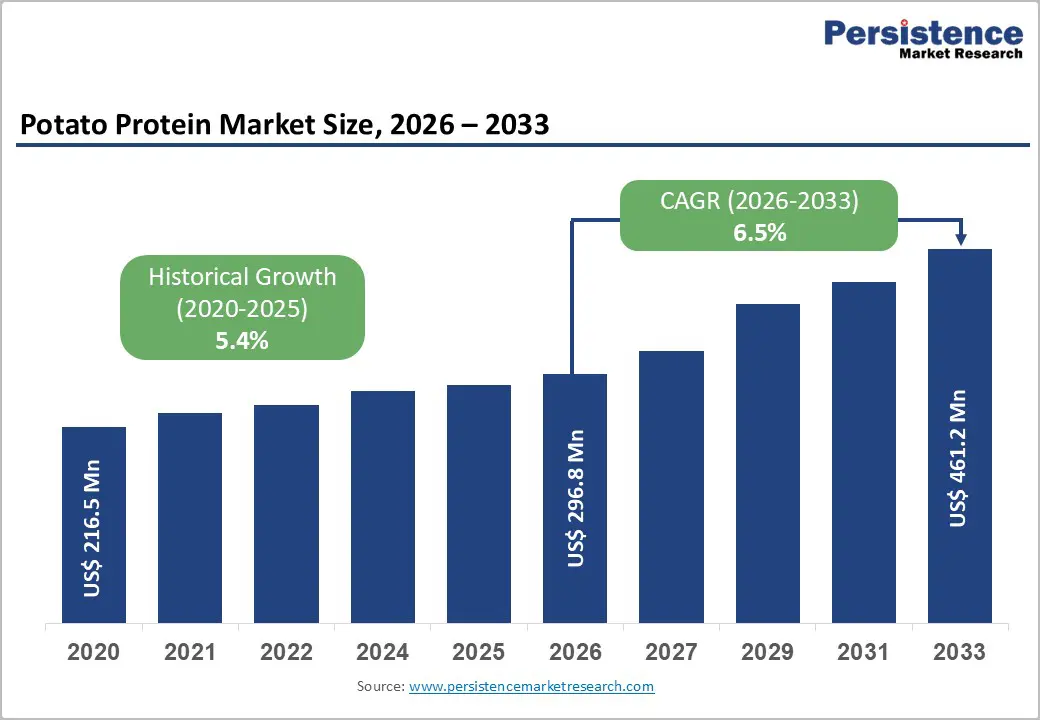
Global Potato Protein Market Size (2026E) US$ 296.8 Mn
Market Value Forecast (2033F) US$ 461.2 Mn
Projected Growth (CAGR 2026 to 2033) 6.5%
Historical Market Growth (CAGR 2020 to 2025) 5.4%

Market Dynamics

Driver - Rising Demand for Allergen-Free and High-Quality Plant Proteins

The accelerating demand for allergen-free, clean-label protein sources is a key driver for the global potato protein market. Unlike soy or dairy proteins, potato protein is naturally free from common allergens such as gluten, lactose, and soy, making it highly suitable for sensitive consumer groups. Its high biological value and well-balanced amino acid profile, particularly rich in lysine, position it as a competitive alternative in premium food formulations. Food manufacturers are increasingly incorporating potato protein into bakery, snacks, and meat analogues to meet rising demand for hypoallergenic and digestible protein ingredients.

Beyond food applications, potato protein is gaining traction in specialized nutrition segments, including infant formula and clinical nutrition, where purity and digestibility are critical. Its low antinutritional factors and neutral flavor enhance formulation flexibility. As regulatory scrutiny around allergen labeling intensifies and consumers seek safer, transparent ingredients, potato protein is emerging as a strategic solution for next-generation plant-based product development.

Restraints - High Production Costs and Extraction Complexity

The global potato protein market faces notable constraints due to high production costs and technically complex extraction processes. Unlike conventional plant proteins, potato protein is primarily derived as a by-product of starch processing, requiring advanced separation, purification, and drying technologies to achieve functional and food-grade quality. Maintaining protein integrity during extraction is challenging, as excessive heat or chemical treatment can denature proteins and reduce solubility and emulsification performance. Additionally, the relatively low protein yield per ton of raw potatoes increases cost pressure compared to soy or pea protein. These factors, combined with energy-intensive processing and wastewater management requirements, elevate operational expenses, limiting scalability and restricting adoption in price-sensitive, high-volume applications.

Opportunity - Surging Demand in the Personal Care and Dermaceutical Sector

The expanding convergence of nutrition and beauty is unlocking strong opportunities for potato protein in the personal care and dermaceutical sector. Hydrolyzed potato protein peptides are gaining traction in advanced skincare and haircare formulations due to their film-forming, moisturizing, and skin-smoothing properties. These bioactive peptides help improve skin elasticity and support barrier repair, making them increasingly relevant in anti-aging and sensitive-skin products. As consumers shift toward plant-based and ethically sourced ingredients, manufacturers are actively replacing animal-derived collagen and synthetic polymers with sustainable botanical alternatives, positioning potato protein as a functional, clean-label ingredient in premium cosmetic applications.

Further opportunities lie in the development of high-purity, low-odor, and low-color potato protein isolates specifically engineered for topical use. Innovations in enzymatic hydrolysis and purification are enhancing bioavailability and sensory performance, enabling integration into serums, creams, and scalp treatments. By aligning with green chemistry principles and sustainable sourcing narratives, companies can access high-margin segments and diversify beyond traditional food applications into the fast-evolving beauty and wellness market.

Category-wise Analysis

Product Type Insights

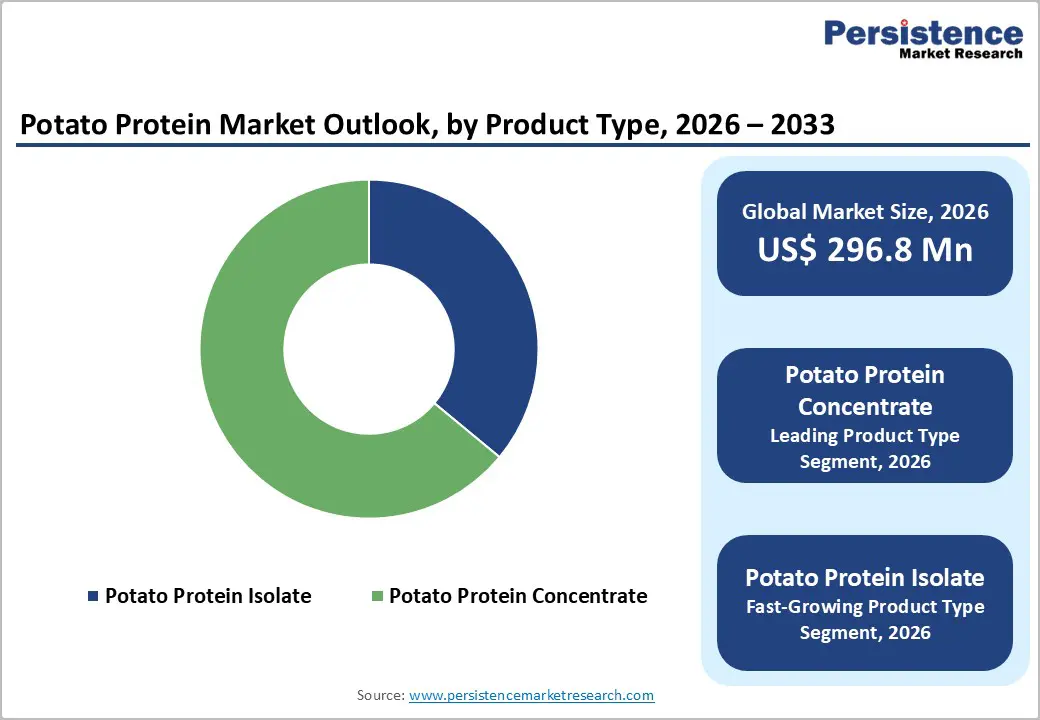
The potato protein concentrate segment dominates the global potato protein market, accounting for nearly 64% share in 2025, driven by its cost-efficiency and suitability for bulk applications. With a protein content typically ranging between 70-80%, concentrates are widely utilized in animal nutrition and food fortification, where functional performance and affordability are critical. Their high digestibility, favorable amino acid profile, and mineral content make them particularly valuable in livestock feed formulations, improving growth efficiency and nutrient absorption. Additionally, concentrates are increasingly incorporated into processed foods as a plant-based protein enhancer, supporting texture and nutritional enrichment in cost-sensitive product categories.

In contrast, potato protein isolate is emerging as the fastest-growing segment, fueled by rising demand for high-purity protein ingredients exceeding 90% concentration. Its superior solubility, foaming capacity, and emulsification properties make it ideal for premium applications such as sports nutrition, infant formula, and specialized dietary products. Advances in extraction technologies are further enhancing isolate quality, enabling its adoption in high-performance and clinical nutrition segments.

End-user Insights

The food & beverage segment remains the dominant end-use category in the global potato protein market, supported by its multifunctional role in modern food formulations. Potato protein is widely used as a texturizer in plant-based meat analogues and as a binding and stabilizing agent in egg-free bakery products, sauces, and ready-to-eat meals. Its neutral taste, high solubility, and emulsification capacity make it highly adaptable for clean-label and allergen-free formulations. Additionally, its compatibility with gluten-free and vegan products strengthens its integration across processed and functional food categories.

Meanwhile, Sports Nutrition and Pharmaceuticals & Nutraceuticals are emerging as high-growth segments, driven by demand for high-quality, plant-based proteins. Rich in essential amino acids such as lysine and methionine, potato protein supports muscle recovery and clinical nutrition applications. The Animal Nutrition sector also remains significant, particularly in premium pet food and aquaculture, where it enhances digestibility, growth performance, and immune health.
Region-wise Insights

Europe Potato Protein Market Trends and Insights

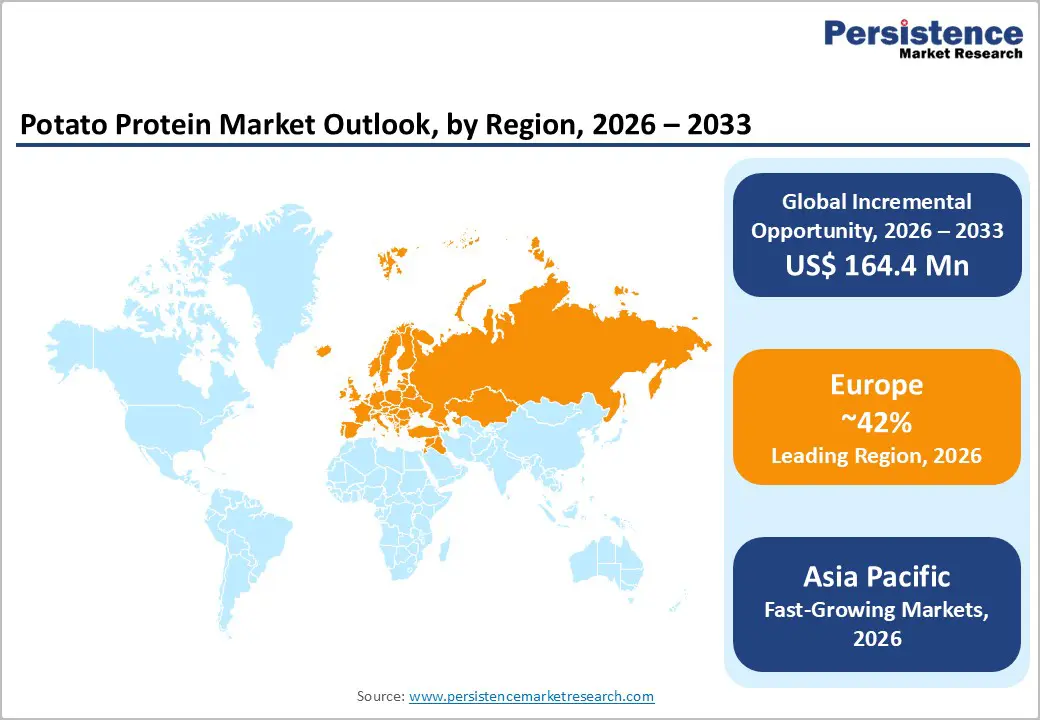
Europe continues to anchor the global potato protein landscape, supported by its advanced agri-processing ecosystem and strong regulatory backbone. The region accounts for a dominant share of the market, driven by large-scale production clusters across Germany, the Netherlands, France, and Denmark. Strict quality and safety frameworks established by the European Food Safety Authority have reinforced global confidence in European-origin ingredients, particularly in non-GMO and clean-label formulations. This regulatory clarity enables manufacturers to maintain premium positioning across food, feed, and nutraceutical applications.

Innovation in Europe is increasingly aligned with circular bio-economy principles, where potato side-streams are efficiently valorized into high-purity protein ingredients. Companies such as Royal Avebe and Emsland Group are advancing R&D in plant-based sports nutrition and functional foods. Strong consumer inclination toward sustainable and climate-friendly proteins, combined with government-backed agricultural initiatives, ensures Europe remains a key value-driven hub for premium potato protein innovation.

Asia Pacific Potato Protein Market Trends and Insights

Asia Pacific is emerging as the fastest-growing region in the potato protein market, driven by rapid urbanization, rising disposable incomes, and evolving dietary preferences across China, India, and ASEAN countries. Expanding middle-class population are increasingly adopting protein-rich, Western-style diets, including fortified snacks and functional foods. Growing awareness of heart health and the shift toward plant-based nutrition in urban centers are accelerating demand for high-quality, non-allergenic protein sources, positioning potato protein as a viable alternative to soy and dairy proteins.

The region also benefits from cost-effective manufacturing and strong raw material availability in key markets. In China, government-led agricultural modernization initiatives are encouraging starch processors to integrate protein extraction technologies, enhancing value creation. Meanwhile, the expansion of organized retail and the growing influence of platforms like Alibaba Group are improving accessibility to premium protein products. Increasing incorporation of potato protein into high-protein noodles, beverages, and convenience foods is strengthening Asia Pacific’s role as a major consumption and production hub.
Competitive Landscape

The global potato protein market exhibits a moderately consolidated structure, where a group of established global conglomerates and specialized European refiners hold significant influence. Key market leaders such as Avebe, Roquette Frères, and Emsland Group dominate the landscape through extensive vertical integration controlling everything from potato cultivation partnerships to final refined extraction. These companies employ strategies focused on geographic expansion, technological innovation in hydrolysis, and strategic acquisitions to secure raw material supplies in high-yield regions. However, the market remains dynamic at the regional level, with a vibrant array of specialized firms like Finnamyl and Meelunie B.V. catering to niche demands for organic and pharmaceutical-grade variants. Key differentiators in this market include the protein purity of the isolates, the functional versatility of the concentrates, and the attainment of prestigious safety and sustainability certifications like FSSC 22000. Emerging business model trends show a move toward direct-from-source traceability to satisfy the demands of modern industrial buyers.

Key Developments:

  • In July 2025, PoLoPo announced a strategic shift to focus on developing high-protein potatoes tailored for the snack industry, aiming to enhance nutritional value and functional performance in processed snack applications.
  • In March 2025, Brenntag Specialties and Royal Avebe expanded their strategic partnership across Poland, strengthening distribution capabilities and accelerating the availability of advanced potato-based ingredients for food and nutrition applications.
  • In November 2024, IQI Trusted Petfood Ingredients entered into an exclusive partnership with Royal Avebe to introduce ProtaSTAR, a potato-based protein ingredient, into the global pet food market, targeting improved digestibility and sustainable protein sourcing.

Companies Covered in Potato Protein Market

  • Kerry Group plc
  • AGRANA Beteiligungs-AG
  • Roquette Frères
  • Tereos S.A.
  • Südzucker AG
  • Kemin Industries
  • Emsland Group
  • Meelunie B.V.
  • Finnamyl
  • Avebe
  • AKV Amba
  • Aminola
  • Others
Frequently Asked Questions

The global Potato Protein market is projected to be valued at US$ 296.8 Mn in 2026.

Rising Demand for Allergen-Free and High-Quality Plant Proteins is a major driver of the global Potato Protein market.

The global Potato Protein market is poised to witness a CAGR of 6.5% between 2026 and 2033.

Surging Demand in the Personal Care and Dermaceutical Sector is a significant opportunity in the Potato Protein market.

Major players in the global Potato Protein market include Kerry Group plc, AGRANA Beteiligungs-AG, Roquette Frères, Tereos S.A., Südzucker AG, Kemin Industries, Emsland Group, and others.

Potato Protein Market Report Scope
Report Attribute Details
Historical Data/Actuals 2020 - 2025
Forecast Period 2026 - 2033
Market Analysis Value: US$ Mn, Volume: Tons
Geographical Coverage
  • North America
  • Europe
  • East Asia
  • South Asia and Oceania
  • Middle East and Africa
  • Latin America
Segmental Coverage
  • Product Type
  • Nature
  • End-user
  • Region
Competitive Analysis
  • Kerry Group plc
  • AGRANA Beteiligungs-AG
  • Roquette Frères
  • Tereos S.A.
  • Südzucker AG
  • Kemin Industries
  • Emsland Group
  • Meelunie B.V.
  • Finnamyl
  • Avebe
  • AKV Amba
  • Aminola
  • Others
Report Highlights
  • Market Forecast and Trends
  • Competitive Intelligence & Share Analysis
  • Growth Factors and Challenges
  • Strategic Growth Initiatives
  • Future Opportunities and Revenue Pockets
  • Market Analysis Tools
Market Segmentation

By Product Type

  • Potato Protein Isolate
  • Potato Protein Concentrate

By Nature

  • Organic
  • Conventional

By End-user

  • Food & Beverage
  • Animal Nutrition
  • Sports Nutrition
  • Pharmaceuticals & Nutraceuticals
  • Personal Care & Cosmetics
  • Infant Formula
  • Others

By Region

  • North America
  • Europe
  • East Asia
  • South Asia and Oceania
  • Latin America
  • Middle East and Africa

Related Reports

  1. Executive Summary
    1. Global Potato Protein Market Snapshot 2026 and 2033
    2. Market Opportunity Assessment, 2026-2033, US$ Mn
    3. Key Market Trends
    4. Industry Developments and Key Market Events
    5. Demand Side and Supply Side Analysis
    6. PMR Analysis and Recommendations
  2. Market Overview
    1. Market Scope and Definitions
    2. Market Dynamics
      1. Driver
      2. Restraint
      3. Opportunities
      4. Trends
    3. Macro-Economic Factors
    4. Forecast Factors - Relevance and Impact
    5. COVID-19 Impact Assessment
  3. Value Added Insights
    1. Value Chain analysis
    2. Key Market Players
    3. Key Promotional Strategies by key players
    4. PESTLE Analysis
    5. Porter's Five Forces Analysis
    6. Regulatory Landscape
  4. Price Trend Analysis, 2025
    1. Region-wise Price Analysis
    2. Price by Segments
    3. Price Impact Factors
  5. Global Potato Protein Market Outlook: Historical (2020 - 2025) and Forecast (2026 - 2033)
    1. Key Highlights
    2. Global Potato Protein Market Outlook: Product Type
      1. Introduction/Key Findings
      2. Historical Market Size (US$ Mn) and Volume (Tons) Analysis by Product Type, 2020-2025
      3. Current Market Size (US$ Mn) and Volume (Tons) Forecast, by Product Type, 2026-2033
        1. Potato Protein Isolate
        2. Potato Protein Concentrate
      4. Market Attractiveness Analysis: Product Type
    3. Global Potato Protein Market Outlook: Nature
      1. Introduction/Key Findings
      2. Historical Market Size (US$ Mn) and Volume (Tons) Analysis by Nature, 2020-2025
      3. Current Market Size (US$ Mn) and Volume (Tons) Forecast, by Nature, 2026-2033
        1. Organic
        2. Conventional
      4. Market Attractiveness Analysis: Nature
    4. Global Potato Protein Market Outlook: End Use
      1. Introduction/Key Findings
      2. Historical Market Size (US$ Mn) and Volume (Tons) Analysis by End Use, 2020-2025
      3. Current Market Size (US$ Mn) and Volume (Tons) Forecast, by End Use, 2026-2033
        1. Food & Beverage
        2. Animal Nutrition
        3. Sports Nutrition
        4. Pharmaceuticals & Nutraceuticals
        5. Personal Care & Cosmetics
        6. Infant Formula
        7. Others
      4. Market Attractiveness Analysis: End Use
  6. Global Potato Protein Market Outlook: Region
    1. Key Highlights
    2. Historical Market Size (US$ Mn) and Volume (Tons) Analysis by Region, 2020-2025
    3. Current Market Size (US$ Mn) and Volume (Tons) Forecast, by Region, 2026-2033
      1. North America
      2. Europe
      3. East Asia
      4. South Asia & Oceania
      5. Latin America
      6. Middle East & Africa
    4. Market Attractiveness Analysis: Region
  7. North America Potato Protein Market Outlook: Historical (2020 - 2025) and Forecast (2026 - 2033)
    1. Key Highlights
    2. Pricing Analysis
    3. North America Market Size (US$ Mn) and Volume (Tons) Forecast, by Country, 2026-2033
      1. U.S.
      2. Canada
    4. North America Market Size (US$ Mn) and Volume (Tons) Forecast, by Product Type, 2026-2033
      1. Potato Protein Isolate
      2. Potato Protein Concentrate
    5. North America Market Size (US$ Mn) and Volume (Tons) Forecast, by Nature, 2026-2033
      1. Organic
      2. Conventional
    6. North America Market Size (US$ Mn) and Volume (Tons) Forecast, by End Use, 2026-2033
      1. Food & Beverage
      2. Animal Nutrition
      3. Sports Nutrition
      4. Pharmaceuticals & Nutraceuticals
      5. Personal Care & Cosmetics
      6. Infant Formula
      7. Others
  8. Europe Potato Protein Market Outlook: Historical (2020 - 2025) and Forecast (2026 - 2033)
    1. Key Highlights
    2. Pricing Analysis
    3. Europe Market Size (US$ Mn) and Volume (Tons) Forecast, by Country, 2026-2033
      1. Germany
      2. Italy
      3. France
      4. U.K.
      5. Spain
      6. Russia
      7. Rest of Europe
    4. Europe Market Size (US$ Mn) and Volume (Tons) Forecast, by Product Type, 2026-2033
      1. Potato Protein Isolate
      2. Potato Protein Concentrate
    5. Europe Market Size (US$ Mn) and Volume (Tons) Forecast, by Nature, 2026-2033
      1. Organic
      2. Conventional
    6. Europe Market Size (US$ Mn) and Volume (Tons) Forecast, by End Use, 2026-2033
      1. Food & Beverage
      2. Animal Nutrition
      3. Sports Nutrition
      4. Pharmaceuticals & Nutraceuticals
      5. Personal Care & Cosmetics
      6. Infant Formula
      7. Others
  9. East Asia Potato Protein Market Outlook: Historical (2020 - 2025) and Forecast (2026 - 2033)
    1. Key Highlights
    2. Pricing Analysis
    3. East Asia Market Size (US$ Mn) and Volume (Tons) Forecast, by Country, 2026-2033
      1. China
      2. Japan
      3. South Korea
    4. East Asia Market Size (US$ Mn) and Volume (Tons) Forecast, by Product Type, 2026-2033
      1. Potato Protein Isolate
      2. Potato Protein Concentrate
    5. East Asia Market Size (US$ Mn) and Volume (Tons) Forecast, by Nature, 2026-2033
      1. Organic
      2. Conventional
    6. East Asia Market Size (US$ Mn) and Volume (Tons) Forecast, by End Use, 2026-2033
      1. Food & Beverage
      2. Animal Nutrition
      3. Sports Nutrition
      4. Pharmaceuticals & Nutraceuticals
      5. Personal Care & Cosmetics
      6. Infant Formula
      7. Others
  10. South Asia & Oceania Potato Protein Market Outlook: Historical (2020 - 2025) and Forecast (2026 - 2033)
    1. Key Highlights
    2. Pricing Analysis
    3. South Asia & Oceania Market Size (US$ Mn) and Volume (Tons) Forecast, by Country, 2026-2033
      1. India
      2. Southeast Asia
      3. ANZ
      4. Rest of SAO
    4. South Asia & Oceania Market Size (US$ Mn) and Volume (Tons) Forecast, by Product Type, 2026-2033
      1. Potato Protein Isolate
      2. Potato Protein Concentrate
    5. South Asia & Oceania Market Size (US$ Mn) and Volume (Tons) Forecast, by Nature, 2026-2033
      1. Organic
      2. Conventional
    6. South Asia & Oceania Market Size (US$ Mn) and Volume (Tons) Forecast, by End Use, 2026-2033
      1. Food & Beverage
      2. Animal Nutrition
      3. Sports Nutrition
      4. Pharmaceuticals & Nutraceuticals
      5. Personal Care & Cosmetics
      6. Infant Formula
      7. Others
  11. Latin America Potato Protein Market Outlook: Historical (2020 - 2025) and Forecast (2026 - 2033)
    1. Key Highlights
    2. Pricing Analysis
    3. Latin America Market Size (US$ Mn) and Volume (Tons) Forecast, by Country, 2026-2033
      1. Brazil
      2. Mexico
      3. Rest of LATAM
    4. Latin America Market Size (US$ Mn) and Volume (Tons) Forecast, by Product Type, 2026-2033
      1. Potato Protein Isolate
      2. Potato Protein Concentrate
    5. Latin America Market Size (US$ Mn) and Volume (Tons) Forecast, by Nature, 2026-2033
      1. Organic
      2. Conventional
    6. Latin America Market Size (US$ Mn) and Volume (Tons) Forecast, by End Use, 2026-2033
      1. Food & Beverage
      2. Animal Nutrition
      3. Sports Nutrition
      4. Pharmaceuticals & Nutraceuticals
      5. Personal Care & Cosmetics
      6. Infant Formula
      7. Others
  12. Middle East & Africa Potato Protein Market Outlook: Historical (2020 - 2025) and Forecast (2026 - 2033)
    1. Key Highlights
    2. Pricing Analysis
    3. Middle East & Africa Market Size (US$ Mn) and Volume (Tons) Forecast, by Country, 2026-2033
      1. GCC Countries
      2. South Africa
      3. Northern Africa
      4. Rest of MEA
    4. Middle East & Africa Market Size (US$ Mn) and Volume (Tons) Forecast, by Product Type, 2026-2033
      1. Potato Protein Isolate
      2. Potato Protein Concentrate
    5. Middle East & Africa Market Size (US$ Mn) and Volume (Tons) Forecast, by Nature, 2026-2033
      1. Organic
      2. Conventional
    6. Middle East & Africa Market Size (US$ Mn) and Volume (Tons) Forecast, by End Use, 2026-2033
      1. Food & Beverage
      2. Animal Nutrition
      3. Sports Nutrition
      4. Pharmaceuticals & Nutraceuticals
      5. Personal Care & Cosmetics
      6. Infant Formula
      7. Others
  13. Competition Landscape
    1. Market Share Analysis, 2025
    2. Market Structure
      1. Competition Intensity Mapping
      2. Competition Dashboard
    3. Company Profiles
      1. Kerry Group plc
        1. Company Overview
        2. Product Portfolio/Offerings
        3. Key Financials
        4. SWOT Analysis
        5. Company Strategy and Key Developments
      2. AGRANA Beteiligungs-AG
      3. Roquette Frères
      4. Tereos S.A.
      5. Südzucker AG
      6. Kemin Industries
      7. Emsland Group
      8. Meelunie B.V.
      9. Finnamyl
      10. Avebe
      11. AKV Amba
      12. Aminola
      13. Others
  14. Appendix
    1. Research Methodology
    2. Research Assumptions
    3. Acronyms and Abbreviations

Research Methodology Framework for Market Research Excellence

At Persistence Market Research, we implement a comprehensive, validated, and multi-dimensional approachto market analysis that delivers actionable insights across complex market landscapes. Our methodology combines the analytical rigor of leading consulting firms with innovative research techniques, ensuring robust market assessments that guide strategic decision-making with confidence.

Core Research Philosophy

Our methodology is built on four foundational pillars:

Research Philosophy Image

At Persistence Market Research, our methodology is designed to transcend conventional market studies by combining analytical rigor, multi-source validation, and future-focused insights.

We integrate advanced research frameworks, robust data collection strategies, cutting-edge analytics, and innovative technologies to deliver a 360-degree view of complex markets.

We integrate advanced research frameworks, robust data collection strategies, cutting-edge analytics, and innovative technologies to deliver a 360-degree view of complex markets.

Each stage spanning from strategic scoping and hypothesis-building to competitive intelligence, quality validation, and actionable recommendations is engineered to provide clients with unmatched clarity, precision, and confidence in decision-making.

By embedding innovation and technology at the core, our approach ensures that insights are not only comprehensive but also predictive, empowering businesses to seize opportunities, mitigate risks, and achieve sustainable growth

Research Philosophy Image

Capturing Key Information and Events

During this phase, key research objectives focus on essential information and data points for assessing the market, including:

Research Philosophy Image

TAM-SAM-SOM Framework Implementation

We employ both top-down and bottom-up approaches to ensure accurate market sizing.

Top-Down Market SizingBottom-Up Market Sizing
Universe Definition: Total global/regional market identificationUnit Economics: Average transaction values, purchase frequencies, customer lifecycle
Segmentation Filters: Geographic, demographic, and behavioral constraintsCustomer Segmentation: Detailed buyer persona development and sizing
Market Share Analysis: Competitive landscape assessment and share allocationPenetration Analysis: Market penetration rates by segment and geography
Growth Rate Application: Historical trends and forward-looking growth assumptionsScaling Methodology: Extrapolation techniques with confidence intervals

Validation & Cross-Verification

  • Triangulation: Comparing top-down and bottom-up results for consistency
  • Sensitivity Analysis: Testing key assumptions and parameter variations
  • Peer Benchmarking: Comparison with analogous markets and industry benchmarks
  • Expert Review: External validation through industry specialist consultation

Research Philosophy Image

Forecasting & Projection Modeling

Our proprietary forecasting models incorporate multiple variables and scenarios.

Forecasting Components

  • Historical Trend Analysis: 10-year historical growth patterns and cyclical variations
  • Driver-Based Modeling: Economic indicators, demographic shifts, technology adoption
  • Scenario Planning: Base case, optimistic, and conservative projections
  • Monte Carlo Simulations: Probability-weighted outcomes and risk assessments

Model Validation

  • Back-Testing: Historical accuracy assessment over 3–5-year periods
  • Cross-Validation: Multiple modeling approaches for result comparison
  • External Benchmarking: Comparison with established market forecasts
  • Continuous Calibration: Quarterly model updates based on new data

Comprehensive Data Collection Strategy

Our secondary research phase establishes a robust knowledge base utilizing diverse, credible sources.

Secondary Data Sourcess

  • Industry Publications & Reports
  • Government & Regulatory Data
  • Financial Intelligence (filings & reports)
  • Academic Research & Digital Intelligence

Quality Assurance Protocol

  • Source credibility assessment and publication date validation
  • Data consistency checks across multiple sources
  • Bias identification and neutralization techniques
  • Information gap tracking for primary research prioritization

Research Philosophy Image

Primary Research Excellence

Our primary research methodology employs best-in-class techniques to capture unique market insights.

Quantitative Research Methods

  • Large-Scale Surveys: Statistically representative samples with 95% confidence intervals
  • Survey Methodology: Multi-channel deployment (online, telephone, in-person)
  • Question Architecture and Response Optimization

Qualitative Research Methods

  • Executive Interviews
  • Focus Groups
  • Expert Consultations

Quality Assurance & Validation Framework

Multi-Stage Validation Process

  • Source Verification and Consistency Testing
  • Outlier Detection and Bias Assessment
  • Peer Review Process and External Validation
  • Sensitivity Analysis and Confidence Intervals

Research Philosophy Image

Methodology Validation & Credibility

Our research methodology has been extensively validated through:

  • Academic Partnerships: Collaborations with top-tier business schools and research institutions
  • Client Success Stories: Documented case studies demonstrating research impact and ROI
  • Continuous Benchmarking: Performance comparison with leading global research firms

This comprehensive methodology framework positions Persistence Market Research at the forefront of market intelligence, combining the analytical sophistication of top-tier consulting firms with innovative research techniques. Our approach ensures that every market assessment delivers precise, actionable, and strategically valuable insights that drive business success in competitive market environments.

Ready to unlock your market potential? Contact our research experts to discuss how our validated methodology can transform your strategic decision-making with data-driven market intelligence.

Copyright © 2026 Persistence Market Research. All Rights Reserved

Connect With Us -