




- Food Ingredients & Additives
- Potato Fiber Market
Potato Fiber Market Size, Share, and Growth Forecast, 2026 - 2033
Potato Fiber Market by Fiber Type (Soluble Fiber, Insoluble Fiber, Resistant Starch), Source Type (Potatoes, Sweet Potatoes, Cassava, Corn, Wheat), and Regional Analysis, 2026 - 2033

Potato Fiber Market Size and Trends Analysis
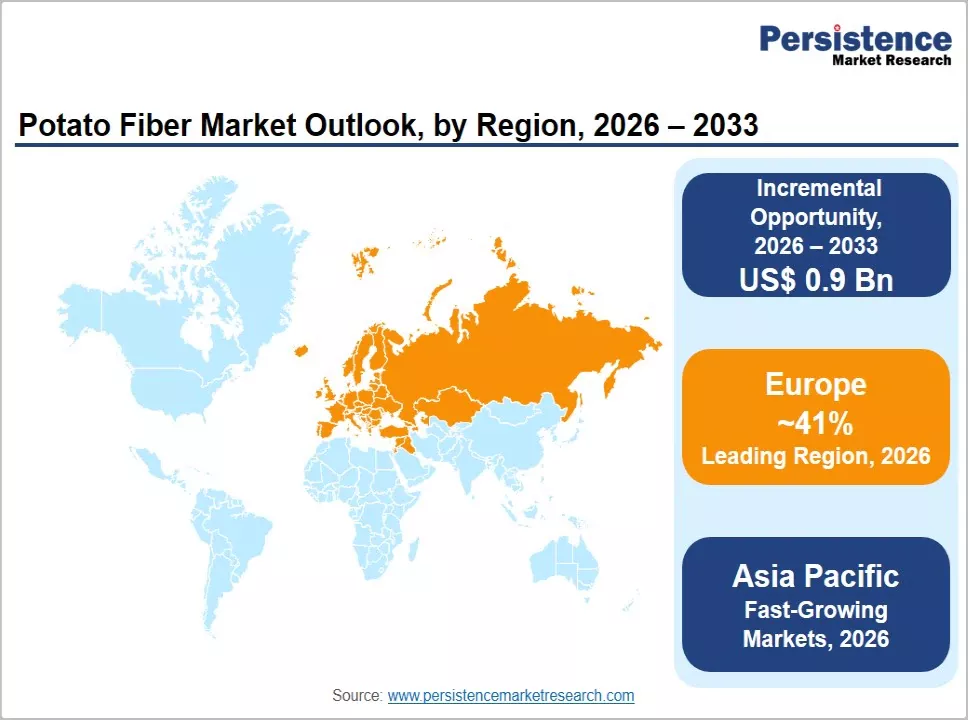
The global potato fiber market size is likely to be valued at US$ 2.4 billion in 2026 and is expected to reach US$ 3.3 billion by 2033, growing at a CAGR of 4.6% during the forecast period from 2026 to 2033, as food manufacturers look for clean-label, plant-based ingredients that raise fiber content, improve texture, and retain moisture without synthetic additives.
Potato fiber is recovered as a co-product of starch processing, which supports circular production models and gives suppliers a stable raw material stream. Rising interest in gut health, weight management, and high-fiber bakery, meat, and snack products is widening its use across food and pet food applications.
Key Industry Highlights:
- Leading Region: Europe is anticipated to be the leading region, accounting for a market share of 41% in 2026, supported by a large potato starch industry, established processing clusters, exponential clean-label demand, and wide use of fibers in bakery and meat products.
- Fastest-growing Region: Asia Pacific is likely to be the fastest-growing region in the potato fiber market in 2026, driven by rising health awareness, growing demand for functional foods, expanding processed food manufacturing, and increasing use of plant-based fibers.
- Leading Fiber Type: Insoluble fiber is projected to represent the leading fiber type in 2026, accounting for 62% of the revenue share, owing to its strong water-binding, texturizing, and fat-replacement properties in bakery and meat applications.
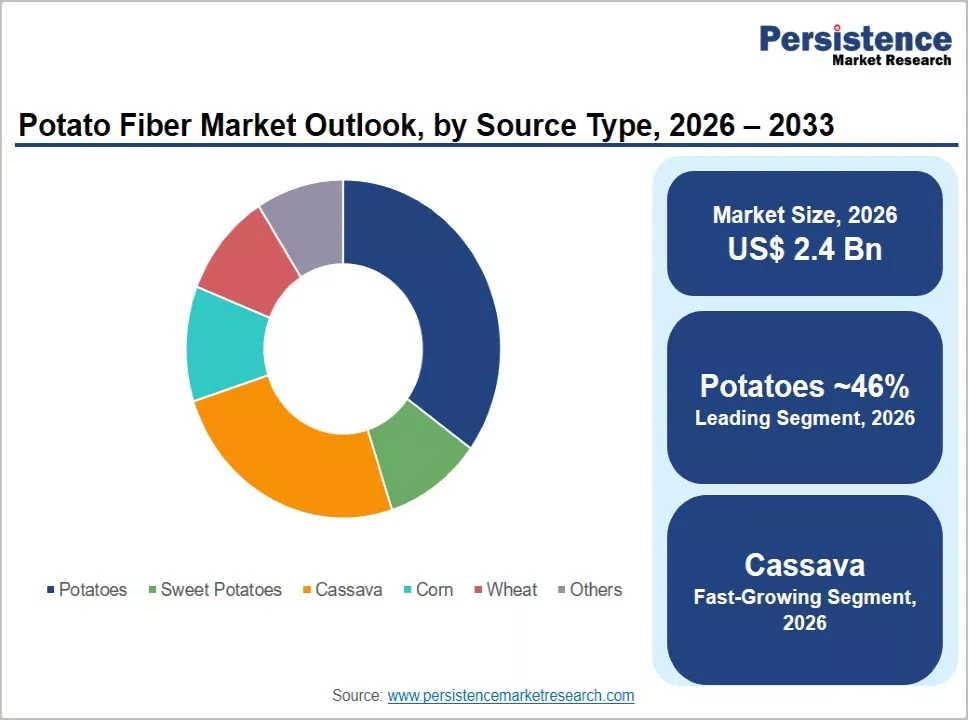
- Leading Source Type: Potatoes are anticipated to be the leading source type, accounting for over 46% of the revenue share in 2026, as starch factories generate large volumes of potato fiber as a dependable, low-allergen co-product.
- Key Opportunity: The key market opportunity lies in developing clean-label functional fibers and resistant starch ingredients for high-fiber bakery, plant-based meat, snacks, and pet food, while using starch by-product streams more effectively.
DRO Analysis
Driver - Rising Demand for Clean-Label Fiber Fortification and Functional Texturizers
Food companies are under pressure to remove additives, shorten ingredient lists, and still deliver the texture consumers expect. Potato fiber helps manufacturers hold water, improve crumb softness, reduce cooking losses, and replace modified starches or phosphates in selected recipes. It is labeled in many markets as a simple plant fiber, which fits clean-label positioning. These functional benefits make it attractive for bakery, meat, snacks, sauces, and plant-based products.
Consumer interest in digestive health and satiety continues to support fiber fortification. Shoppers increasingly check labels for fiber content, and manufacturers respond with high-fiber breads, wraps, cereals, and snack bars. Protein and fiber enrichment is a growing theme in snacks, and Emsland Group said in June 2026 that it would present ingredient and application solutions for protein- and fiber-enriched snacks at SNACKEX 2026 in Lisbon.
Supply chain integration also strengthens demand. Starch producers already process large volumes of potatoes, so fiber is recovered alongside starch and protein with limited additional raw material cost. This zero-waste approach appeals to buyers that track sustainability metrics and want traceable, plant-derived ingredients. Pet food and animal nutrition producers are also using potato fiber to support digestive health and manage moisture in formulated products.
Restraint - Raw Material Seasonality, Competition from Other Fibers, and Functional Limitations
Potato fiber production depends on the starch potato campaign, which runs for a limited part of the year and varies with weather, yields, and farmer contracts. Poor harvests or disease pressure can reduce supply and raise costs. Royal Avebe, for example, completed its 2025 potato campaign in April 2026 before entering an inter-campaign period, illustrating the seasonal nature of the supply base.
Competition from other fibers also limits growth. Citrus, pea, oat, apple, and cellulose fibers offer overlapping functions, and buyers often switch based on price, color, and flavor neutrality. Potato fiber can contribute a slight color or flavor note in delicate recipes, and high dosage levels may affect texture. Variation in fiber quality between batches, along with differing labeling rules across regions, can complicate formulation work for global manufacturers.
Opportunity - Resistant Starch, Value-Added Fiber Grades, and Alternative Starchy Crops
Suppliers can move up the value chain by developing specialized fibers and resistant starch ingredients that deliver measurable digestive and metabolic benefits. Resistant starch, which behaves like a soluble fermentable fiber in the gut, is attracting attention in functional foods, bakery, and nutrition products. Targeted claims, clinical evidence, and application support can help ingredient companies command premium pricing over commodity fibers.
Product innovation in particle size, water-binding capacity, and color can widen use in sectors such as plant-based meat, gluten-free bakery, and protein bars. Customized grades that deliver specific moisture control and bite can help brands reduce additives and improve yields. Companies are also strengthening potato derivative portfolios, as seen in Royal Avebe's acquisition of Solan in September 2025, which expanded its potato flakes and granules business.
Alternative sources create further opportunities. Sweet potato, cassava, corn, and wheat processing streams can supply fibers and resistant starches in regions where potatoes are less available. Asia Pacific, Africa, and Latin America have large cassava and corn processing industries that could support local ingredient production. Partnerships between starch processors and food manufacturers can accelerate commercialization and help diversify supply across crops.
Category-wise Analysis
Fiber Type Insights
Insoluble fiber is expected to lead accounting for 62% of revenue in 2026. Its position reflects excellent water-binding, bulking, and texturizing performance in bread, meat products, sauces, and snacks. Insoluble fibers help increase yield, reduce syneresis, and improve softness without relying on synthetic additives. Manufacturers also appreciate their neutral label presentation. For example, Ingredion has offered clean-label potato fibers under the Potex name for bakery, savory, and meat applications.
Resistant starch is likely to represent the fastest-growing segment, supported by interest in gut microbiome health, blood sugar management, and low-calorie bulking. Soluble fibers continue to serve beverages, dairy, and nutrition products where clarity and solubility are important, while advances in processing are creating blended fiber systems that combine water-binding with digestive health benefits.
Source Type Insights
Potatoes are projected to lead the market, capturing around 46% of the revenue share in 2026. Potato starch plants in Europe and North America generate dependable fiber streams as a co-product, supporting consistent quality and supply. The ingredient is naturally free from major allergens and suits clean-label brands. Companies such as Royal Avebe and Emsland Group operate large potato processing networks and supply fibers alongside starches and proteins.
Cassava is likely to be the fastest-growing source type, supported by large processing volumes in Southeast Asia, Africa, and Latin America and rising interest in locally sourced, gluten-free ingredients. Corn and wheat remain major sources for fibers and resistant starches because of scale and well-established supply chains. Sweet potato provides niche opportunities in functional foods and color-rich products.
Regional Insights
North America Potato Fiber Market Trends
North America is likely to be a significant market for potato fiber in 2026, due to its large processed food industry and rising demand for high-fiber, clean-label products. Manufacturers are reformulating breads, snacks, and meat products to improve nutrition and texture. Ingredient companies are expanding portfolios of plant-based fibers and resistant starches for functional foods.
U.S. Potato Fiber Market Trends
The U.S. is expected to dominate the regional market, accounting for approximately 84% of the market share in 2026, owing to its extensive packaged food sector and strong interest in fiber fortification. Potato processors and ingredient companies supply fibers for bakery, snacks, and pet food. Regulatory attention on dietary fiber definitions also shapes product positioning.
Canada Potato Fiber Market Trends
Canada is expected to account for around 16% of the regional market share in 2026. Demand is supported by bakery, meat, and plant-based food manufacturers using plant fibers for texture and nutrition. Domestic potato production and trade links with the U.S. support access to ingredients, while health-focused consumers drive demand for high-fiber products.
Europe Potato Fiber Market Trends
Europe is anticipated to be the leading region, accounting for a market share of 41% in 2026, supported by a large potato starch industry, strong clean-label regulation and consumer preference, and established ingredient manufacturers. Bakery, meat, and snack producers across the region use potato fibers for texture and moisture control. Sustainability goals encourage the use of co-products and full utilization of crops.
Germany Potato Fiber Market Trends
Germany is expected to dominate the regional market, accounting for approximately 31% of the Europe market share in 2026, owing to its large potato processing sector and strong bakery and meat industries. Companies such as Emsland Group operate multiple production sites and supply fibers and starches to food manufacturers. Demand is supported by high-fiber bread trends and reformulation to cut additives.
Netherlands Potato Fiber Market Trends
The Netherlands is likely to be a significant market for potato fiber, holding approximately 20% of the Europe market share in 2026. Its strong starch potato cooperative base, led by Royal Avebe, supports research and ingredient innovation. Collaboration between processors, research institutes, and food companies is widening applications in plant-based and bakery products.
Asia Pacific Potato Fiber Market Trends
The Asia Pacific region is likely to be the fastest-growing region in the potato fiber market in 2026, as rising incomes, urbanization, and health awareness increase demand for fiber-enriched foods. Expanding bakery, noodle, and convenience food sectors create new applications, while local starch producers explore cassava, corn, and sweet potato fibers. Multinational ingredient firms are expanding technical support in the region.
China Potato Fiber Market Trends
China is projected to dominate the regional market, holding around 33% share of the market in 2026, due to its large food processing industry and growing interest in functional ingredients. Rising demand for high-fiber bakery products, meat products, and health foods supports uptake. Domestic starch manufacturers are also developing locally sourced fiber ingredients.
India Potato Fiber Market Trends
India is expected to emerge as a significant market, accounting approximately 20% share in 2026. Growth in packaged foods, bakery, and snack manufacturing, along with rising awareness of digestive health, supports demand. Local production of cassava and potato starch provides raw material options, while manufacturers increasingly seek fiber ingredients for fortified products.
Competitive Landscape
The global potato fiber market exhibits a moderately consolidated structure, driven by the presence of large starch processors, specialty ingredient companies, and regional suppliers. Key competitive factors include raw material access, fiber functionality, product consistency, clean-label credentials, application support, and the ability to supply both food and animal nutrition customers.
With key leaders including Royal Avebe, Emsland Group, Roquette Frères S.A., J. Rettenmaier & Söhne GmbH + Co KG, and Ingredion Incorporated, the market comprises providers with differing product portfolios and geographic footprints. These players compete through functional fiber grades, resistant starch innovation, capacity investments, and partnerships with bakery, meat, and snack manufacturers.
Key Industry Developments:
- In June 2026, Emsland Group announced that it would showcase ingredient solutions and application expertise for protein- and fiber-enriched snacks at SNACKEX 2026 in Lisbon, highlighting growing demand for fiber-enriched potato-based snacks.
- In September 2025, Royal Avebe acquired Solan, Poland's leading potato flakes and granules producer, as part of its Strengthen and Accelerate strategy, adding more than 100 employees and 140 growers and expanding its potato ingredient portfolio.
Companies Covered in Potato Fiber Market
- Royal Avebe
- Emsland Group
- Roquette Frères S.A.
- J. Rettenmaier & Söhne GmbH + Co KG (JRS)
- Ingredion Incorporated
- Lyckeby Starch AB
- AGRANA Beteiligungs-AG
Frequently Asked Questions
The potato fiber market is projected to reach US$ 2.4 billion in 2026.
Growing demand for clean-label fiber fortification, rising interest in digestive health, and use of potato fiber as a functional texturizer in bakery, meat, and snack products.
The potato fiber market is expected to grow at a CAGR of 4.6% from 2026 to 2033.
Development of clean-label functional fibers and resistant starch ingredients for high-fiber bakery, plant-based meat, snacks, and pet food, using starch co-product streams more effectively.
Royal Avebe, Emsland Group, Roquette Frères S.A., J. Rettenmaier & Söhne GmbH + Co KG and Ingredion Incorporated are the leading players.


