




- Food Ingredients & Additives
- Sweet Potato Flour Market
Sweet Potato Flour Market Size, Share, and Growth Forecast 2026 - 2033
Sweet Potato Flour Market by Nature (Organic, Conventional), Distribution Channel, End-user, and Regional Analysis, 2026 - 2033

Sweet Potato Flour Market Size and Trend Analysis
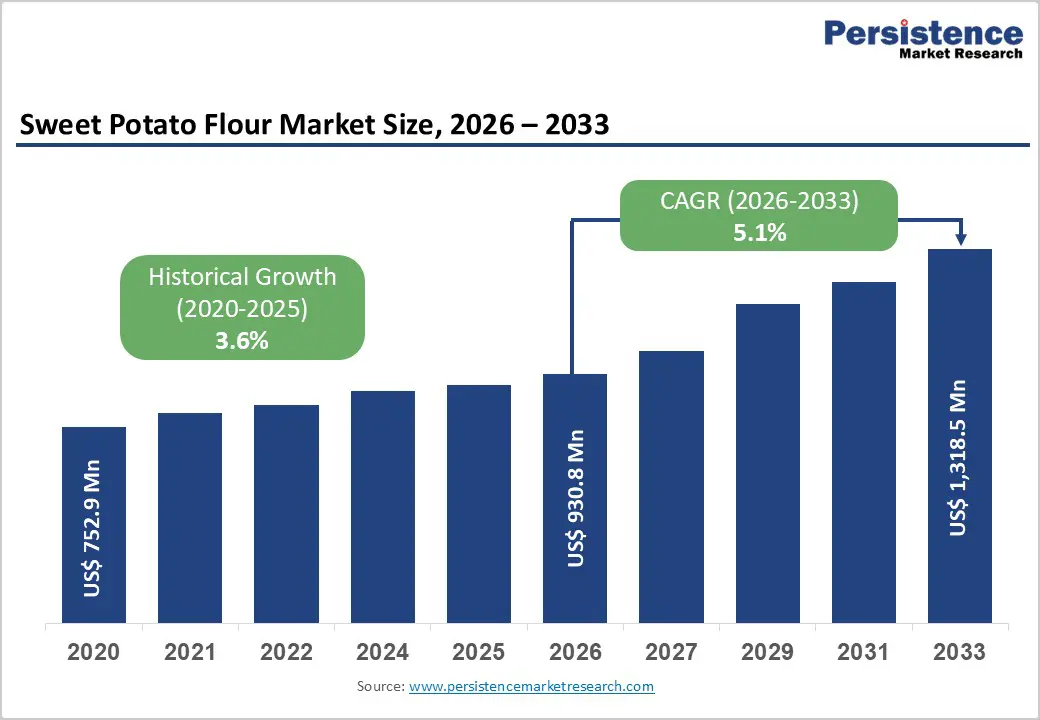
The global sweet potato flour market size is expected to be valued at US$ 930.8 million in 2026 and projected to reach US$ 1,318.5 million by 2033, growing at a CAGR of 5.1% between 2026 and 2033.
The rising demand for gluten-free, nutrient-rich, and clean-label food ingredients is encouraging growth. Derived from dried sweet potatoes, this flour is widely used in bakery, snacks, baby food, and functional food applications due to its high fiber, β-carotene, and antioxidant content. Increasing health awareness, dietary shifts, and demand for plant-based alternatives are driving market growth globally. Asia Pacific dominates production and consumption, supported by abundant raw material availability. Additionally, expanding applications in processed foods and growing adoption in developed markets are further enhancing demand, making sweet potato flour an emerging ingredient in modern food formulations.
Key Industry Highlights:
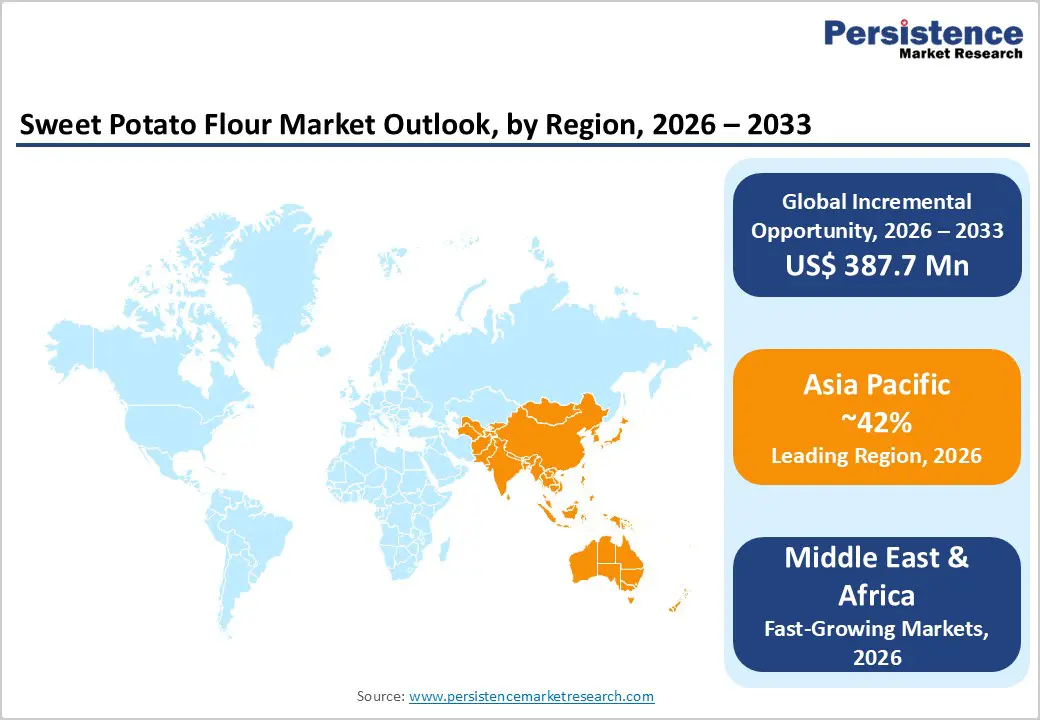
- Leading Region: Asia Pacific leads with around 42% share in 2025, driven by dominant production, strong domestic consumption, and expanding processing capacities across China, India, Indonesia, and Vietnam.
- Fastest-growing region: Middle East & Africa is fastest-growing, supported by strong cultivation in countries like Nigeria and Tanzania, rising urban demand, and increasing investments in agro-processing and food security.
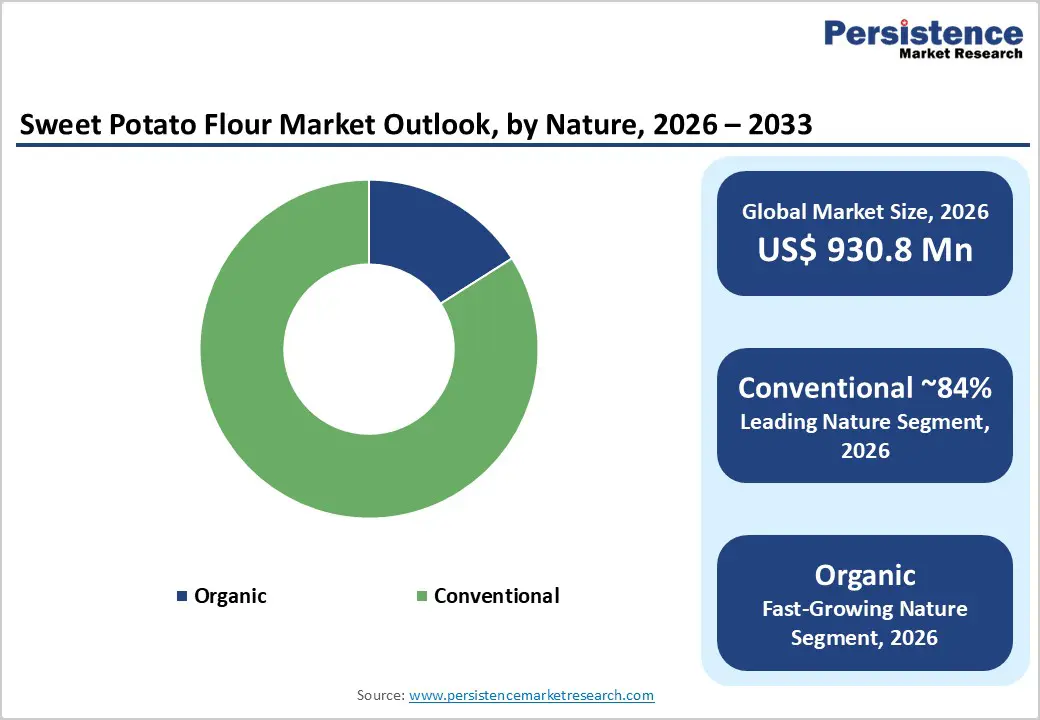
- Dominant segment: Conventional segment dominates with nearly 84% share, due to widespread non-organic farming practices and abundant raw material availability across major producing regions in Asia and Africa.
- Fastest-growing segment: Online retail under Business-to-Consumer is fastest-growing, driven by rapid e-commerce expansion, increasing demand for gluten-free products, and improved accessibility to specialty flours globally.
- Key market opportunity: A significant opportunity exists in developing high-value bakery, snack, nutraceutical, and functional beverage products using sweet potato flour, especially in gluten-free, clean label, and plant-based categories.
| Key Insights | Details |
|---|---|
| Sweet Potato Flour Market Size (2026E) | US$ 930.8 million |
| Market Value Forecast (2033F) | US$ 1,318.5 million |
| Projected Growth CAGR (2026 - 2033) | 5.1% |
| Historical Market Growth (2020 - 2025) | 3.6% |
Market Dynamics
Drivers - Rising Demand for Gluten-free and Nutrient-dense Flours
A primary growth driver for the sweet potato flour market is the global shift toward gluten-free and nutrient-rich flour alternatives, supported by growing diagnosis and awareness of celiac disease and non-celiac gluten sensitivity. The prevalence of celiac disease is estimated at around 1% of the world’s population, with similar rates indicated in the U.S. and parts of Europe, which has accelerated demand for gluten-free products and flours. Scientific and applied research shows that sweet potato flour offers higher dietary fiber, β-carotene and phenolic antioxidants than standard 72% extraction wheat flour, enhancing both nutritional profile and functional properties in composite breads, cookies and noodles. Studies on bakery products formulated with sweet potato flour report increased fiber, improved micronutrient content and good sensory acceptance, confirming its suitability as a partial replacement for wheat flour in breads, biscuits and cakes. These benefits align closely with broader trends in gluten-free and clean label flour markets, supporting sustained demand for sweet potato flour as a specialty ingredient.
Growth of clean label, functional and plant-based food categories
Another factor is the rapid expansion of clean label and functional food categories, where manufacturers seek minimally processed, recognizable ingredients that deliver both nutrition and functionality. Clean label flour markets are projected to grow robustly, supported by consumer preference for flours without artificial additives and with simple ingredient lists, while regulatory frameworks from agencies like FDA, EFSA, and FSSAI encourage transparent labeling and natural ingredients. Sweet potato flour aligns with these criteria by providing natural color, sweetness and viscosity, along with substantial starch and dietary fiber content of around 53.9 g/100 g starch and up to 41.11% total dietary fiber in some formulations. Research on gluten-free cookies, breads and noodles demonstrates that sweet potato flour can be used to develop high-protein, lower-calorie, fiber-enriched products that meet consumer expectations for taste, texture and shelf life, reinforcing its positioning as a functional and clean label ingredient.
Restraints - Processing, standardization and supply chain challenges
The sweet potato flour market faces restraints related to processing optimization, product standardization and raw material supply chains. Studies highlight that drying temperature, grinding pattern and particle size significantly affect the physicochemical, hydration and pasting properties of sweet potato flour, influencing its performance as a gluten-free or composite flour in bakery and noodle applications. Inconsistent processing can result in variable starch digestibility, color, viscosity and texture, complicating large-scale adoption by industrial bakeries and food manufacturers. Additionally, sweet potato production is still geographically concentrated China alone accounts for over 50% of global sweet potato output and the top 3-5 countries together contribute more than 65-80%, making regional supply chains vulnerable to climate, disease and logistical disruptions.
Opportunities - Tapping Asia Pacific and African production hubs for value-added processing
A second key opportunity is leveraging major sweet potato-producing regions especially Asia Pacific and sub-Saharan Africa to scale value-added flour processing and exports. FAOSTAT data and related analyses show that China alone produces around 46-51 million tons of sweet potatoes annually and accounts for roughly 54-56% of global output, while countries such as Malawi, Tanzania, Nigeria, Ethiopia and Rwanda collectively contribute a significant additional share. Recent market commentary highlights that the global sweet potato market was valued at over US$ 300 billion in 2024, with Asia Pacific and Africa emerging as key growth regions, and that whole roots still represent about 85% of the market, leaving substantial headroom for processed forms such as paste and flour. By investing in drying, milling and quality-control infrastructure near farm clusters, processors and companies in these regions can convert surplus and lower-grade roots into export-grade flour for bakery, sauces, snacks, baby food and nutraceutical applications, increasing farmer incomes and reducing post-harvest losses.
Category-wise Analysis
Nature Insights
By nature, conventional sweet potato flour dominates the global market, accounting for approximately 84% of total sales in 2025. This strong position is primarily due to the widespread cultivation of sweet potatoes using traditional farming practices across major producing countries such as China, India, Nigeria, Tanzania, and Malawi. In these regions, farmers rely heavily on conventional agricultural inputs like fertilizers and pest control methods, as transitioning to organic farming involves higher costs, certification challenges, and lower initial yields. With global sweet potato production exceeding 86 million tons, the majority of raw material naturally comes from conventional systems, making it the primary source for milling and food processing industries.
However, organic sweet potato flour is emerging as the fastest-growing segment, driven by increasing demand for clean-label and sustainably sourced ingredients. Consumers in developed regions, especially North America and Europe, are increasingly prioritizing organic products due to perceived health and environmental benefits. Retailers are also expanding their portfolios of organic gluten-free flours, creating favorable market conditions. As awareness around food quality and sustainability grows, organic sweet potato flour is expected to witness strong adoption across premium and health-focused product categories.
End-user Insights
By end use, the food and beverage industry represents the largest consumer of sweet potato flour, contributing nearly 40% of global demand in 2025. This dominance is attributed to its wide application in bakery, snacks, sauces, and beverages. Sweet potato flour is widely used as a partial substitute for wheat flour in products such as bread, cakes, cookies, and biscuits, enhancing nutritional value without compromising taste or texture. Studies indicate that replacing 10-50% of wheat flour with sweet potato flour improves fiber content, β-carotene levels, and antioxidant properties, while maintaining acceptable sensory quality and shelf stability in finished products.
Meanwhile, nutraceuticals and functional foods are projected to be the fastest-growing end-use segment. The flour’s high carotenoid and β-carotene content, along with strong antioxidant properties, make it suitable for health-focused applications. Manufacturers are increasingly incorporating it into snack bars, fortified foods, powdered beverages, and meal replacements. As consumers shift toward preventive healthcare and natural nutrition, sweet potato flour is gaining traction as a clean-label ingredient supporting immunity, eye health, and overall wellness.
Regional Insights
North America Sweet Potato Flour Market Trends and Insights
In North America, demand for sweet potato flour is strongly driven by the expanding gluten-free and clean-label food market. The prevalence of celiac disease, affecting nearly 1% of the population, has significantly increased the consumption of gluten-free alternatives, particularly in the United States. The regional gluten-free products market is witnessing near double-digit growth, with bakery products emerging as the leading and fastest-growing category. Consumers are increasingly shifting toward healthier, nutrient-rich ingredients, boosting the adoption of sweet potato flour in breads, cookies, and snack bars due to its high fiber, β-carotene, and antioxidant content.
Regulatory support and innovation ecosystems further strengthen market growth in North America. The U.S. Food and Drug Administration (FDA) enforces strict labeling standards for allergens and gluten-free claims, promoting transparency and consumer trust. Additionally, food companies and startups are investing in research and development to create plant-based, functional, and clean-label products. This includes composite flours, fortified bakery items, and protein-rich snacks incorporating sweet potato flour. With strong retail penetration and innovation, North America is emerging as a key hub for product development.
Asia Pacific Sweet Potato Flour Market Trends and Insights
Asia Pacific holds a dominant position in the sweet potato flour market due to its extensive production and consumption base. China alone produces over 46 million metric tons annually, accounting for more than half of global output, while countries like India, Indonesia, and Vietnam contribute significantly. Sweet potatoes are deeply integrated into regional diets, and increasing efforts are being made to convert surplus production into value-added products such as flour. Applications in noodles, bakery products, snacks, and baby food are expanding rapidly, supported by ongoing research in gluten-free and functional food formulations across East and Southeast Asia.
The region is also benefiting from rapid urbanization, rising incomes, and changing dietary preferences. Consumers are increasingly seeking convenient, healthy, and naturally derived food products, driving demand for sweet potato flour in packaged foods and beverages. Governments across the Asia Pacific are promoting agro-processing and reducing post-harvest losses through investments in drying and milling infrastructure. These initiatives, combined with strong raw material availability, position the Asia Pacific as the largest and fastest-evolving regional market for sweet potato flour.
Competitive Landscape
The global sweet potato flour market is highly fragmented, with numerous regional processors, agricultural firms, and specialty ingredient companies competing rather than a few dominant multinational players. Key participants include companies such as Saipro Biotech, Live Glean, Barry Farm Foods, FutureCeuticals, and Urban Platter, focusing on dehydration, milling, and value-added ingredient solutions for bakery, snacks, and nutraceutical applications. Competitive strategies center on securing consistent raw material supply, investing in advanced processing technologies, and obtaining organic and food safety certifications. Companies also collaborate with food manufacturers to develop clean-label and gluten-free products. Additionally, emerging models include direct-to-consumer online sales and integrated supply chains connecting farmers, processors, and export markets across Asia and Africa.
Key Developments:
- In May 2025, IFCG Egypt showcased innovative applications of sweet potatoes in food manufacturing, highlighting the use of sweet potato flour and puree to improve nutritional value, texture, and flavor across diverse products. The initiative emphasizes utilizing high-quality Egyptian sweet potatoes to develop versatile, health-focused, and functional food solutions, particularly in bakery and snack segments, aligning with the growing demand for natural and nutrient-rich ingredients.
- In August 2025, Starbucks Japan launched a seasonal “Hojicha Scented Roasted Sweet Potato Mousse Tea Latte,” combining roasted green tea with sweet potato flavors to deliver a unique autumn-inspired beverage experience.
Companies Covered in Sweet Potato Flour Market
- Saipro Biotech Private Limited
- Live Glean
- Barry Farm Foods
- FutureCeuticals, Inc.
- SACOMA
- Hearthy Foods
- Milne MicroDried
- BULK POWDERS
- Azuri Health Ltd
- Xian Shunyi Bio-Chemical Technology Co., Ltd.
- Carolina Innovative Food Ingredients Inc.
- Shree Biotech
- Urban Platter
- Shaanxi Undersun Biomedtech Co.,Ltd.
- Others
Frequently Asked Questions
The global sweet potato flour market is expected to reach around US$ 930.8 million in 2026.
Growing health consciousness, demand for gluten-free products, and increasing use in bakery, nutraceuticals, and sports nutrition are key drivers.
Asia Pacific leads the sweet potato flour market with about 42% share, driven by high production in China and processing investments.
Major opportunity lies in developing functional, gluten-free, clean-label bakery, snack, nutraceutical, and beverage products using nutrient-rich sweet potato flour globally.
Key players include Saipro Biotech Private Limited, Live Glean, Barry Farm Foods, FutureCeuticals, Inc., SACOMA, Hearthy Foods, Milne MicroDried.


