




- Healthcare IT
- Healthcare Safety and Risk Management Solutions Market
Healthcare Safety and Risk Management Solutions Market Size, Share, Growth, and Regional Forecast, 2026 to 2033
Healthcare Safety and Risk Management Solutions Market by Solution (Software, Services), Deployment (Cloud, On-premise), End-user (Hospitals, Mental Healthcare Facilities, Skilled Nursing Facilities (SNFs), Others), Regional Analysis, from 2026 to 2033

Healthcare Safety and Risk Management Solutions Market Share and Trends Analysis
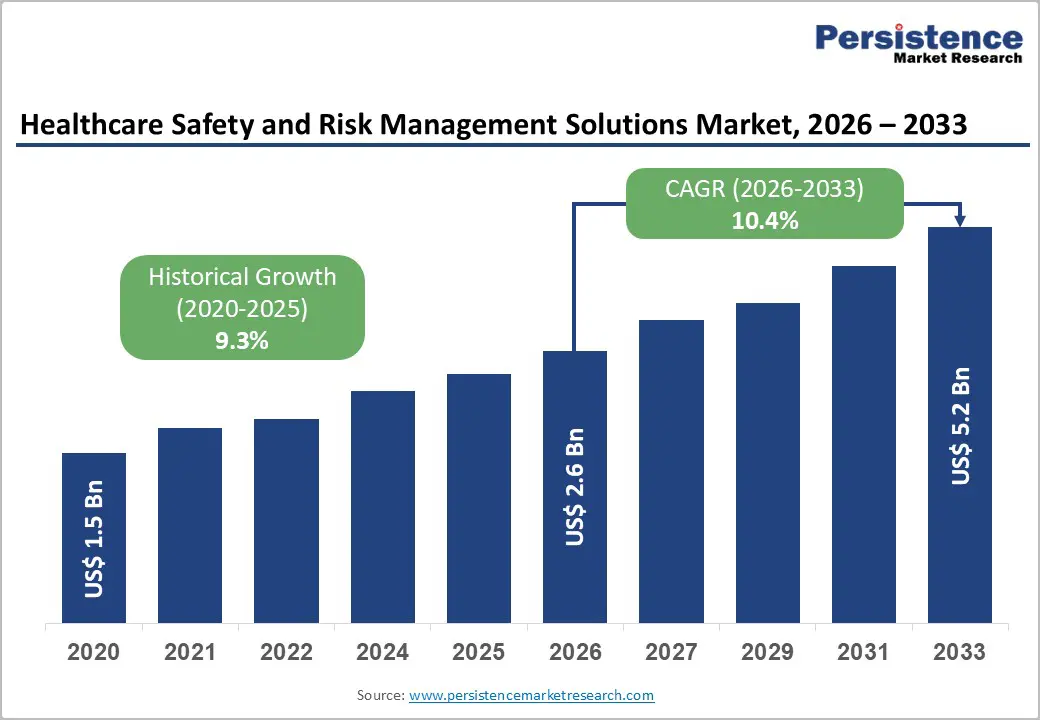
The global healthcare safety and risk management solutions market size is estimated to grow from US$ 2.6 billion in 2026 to US$ 5.2 billion by 2033. The market is projected to record a CAGR of 10.4% from 2026 to 2033. Advancements in IT systems and healthcare technologies are strongly accelerating the growth of digital healthcare IT solutions. The rapid development of mobile health platforms is transforming clinical workflows and becoming an integral extension of modern healthcare systems.
Additionally, federal guidelines and compliance mandates are driving hospitals and providers to adopt advanced digital systems to enhance care quality, operational transparency, and communication efficiency. The adoption of clinical communication and collaboration solutions has expanded across physicians, nursing teams, and critical care staff. Furthermore, lessons learned from COVID-19 have reinforced the importance of digital automation, enabling faster uptake of safety and risk management solutions in healthcare settings.
Key Industry Highlights:
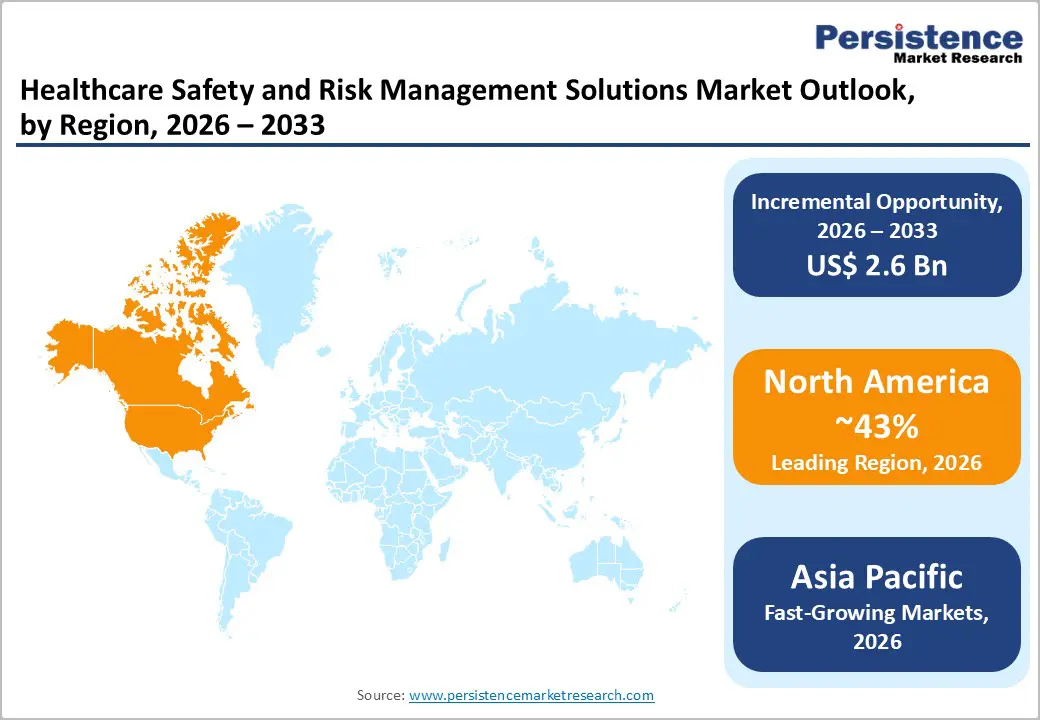
- Leading Region: North America remains the largest market, supported by mature healthcare IT adoption, stringent regulatory and accreditation frameworks, and a strong presence of safety and risk management software vendors.
- Fastest Growing Region: Asia Pacific is projected to grow at the quickest pace, driven by rapid hospital expansion in China, India, Japan, and ASEAN, along with increasing investment in cloud-based health IT and quality improvement programs.
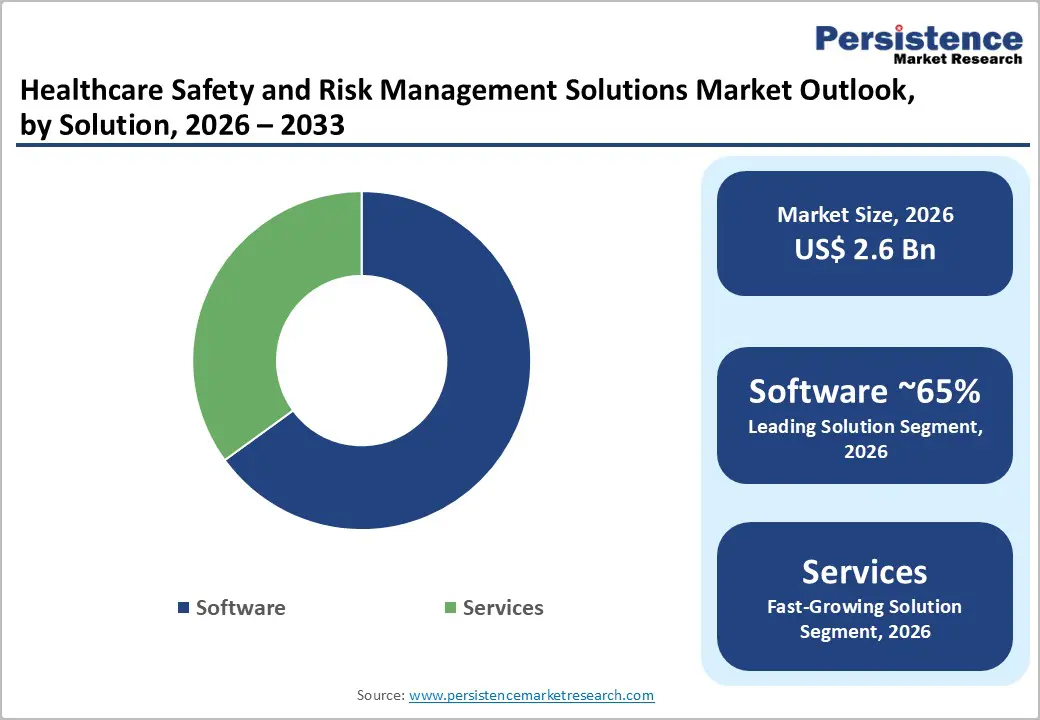
- Dominant Segment: The Software segment dominates by solution, with around 65% share in 2025, as healthcare providers prioritize integrated platforms for incident reporting, risk registers, and compliance management.
- Fastest Growing Segment: Cloud deployment is the fastest-growing and leading mode, with about 58% share in 2025, benefiting from scalability, easier updates, and alignment with broader growth in healthcare cloud computing and remote health management.
| Key Insights | Details |
|---|---|
| Healthcare Safety and Risk Management Solutions Market Size (2026E) | US$ 2.6 Bn |
| Market Value Forecast (2033F) | US$ 5.2 Bn |
| Projected Growth (CAGR 2026 to 2033) | 10.4% |
| Historical Market Growth (CAGR 2020 to 2025) | 9.3% |
Market Dynamics
Driver - Growing Need for Centralized Patient Data and Real-Time Analytics Driving Market Expansion
Growing complexities in healthcare delivery and increasing burden of chronic and lifestyle-related disorders are creating a strong need for centrally accessible patient information. Hospitals and care providers are focusing on structured medical records that help clinicians make informed and timely decisions. Centralized patient data enables traceability of treatment history, medication usage, diagnostic test results, and potential risk alerts, improving patient safety and transparency of care. Real-time analytics offered through safety and risk management platforms connect multiple data streams, including clinical records, lab information, logistical activities, adverse events, and procedure outcomes, into a single unified environment. This approach helps hospitals generate meaningful insights for risk prediction, workflow optimization, and care pathway enhancement.
These solutions are significantly improving operational quality across laboratories, emergency units, and intensive care settings. As healthcare systems gradually shift from volume-based treatment models to value-driven care, digital risk management solutions become crucial in driving accountability, reducing avoidable medical errors, preventing adverse events, and standardizing decision-making. Hospitals are increasingly using analytics dashboards, compliance reporting systems, and predictive risk tools to improve care planning, reduce readmissions, and support continuous performance evaluation. As a result, healthcare organizations are adopting digital safety and risk platforms not just for compliance, but as a core part of operational strategy, which will positively drive market growth.
Restraints - Security and Privacy Challenges Restricting Adoption of Risk Management Solutions
Security and privacy concerns continue to be a major restraint for the adoption of healthcare safety and risk management solutions. Hospitals handle highly sensitive medical records, treatment histories, diagnostic reports, insurance information, and patient identifiers, making data protection a critical responsibility. Ensuring that only authorized clinical or administrative staff can access the information, and that no data is altered, leaked, or erased without permission, remains a persistent challenge. The increased use of mobile devices adds further risk, as healthcare professionals frequently move across departments, wards, or offsite locations while accessing patient records. The possibility of transmitting data through unsecured networks or unintentionally exposing confidential information raises compliance risks for hospitals. Moreover, maintaining cybersecurity infrastructure, conducting continuous monitoring, and implementing strong authentication protocols increase operational overhead. Any breach not only leads to financial and legal repercussions but can also significantly damage institutional credibility. Thus, concerns about privacy, secure data transmission, and access control are slowing the full-scale adoption of digital safety and risk management platforms in healthcare facilities.
Opportunity - Acceleration of Cloud-Based, Analytics-Driven Safety Platforms
Acceleration of cloud-based and analytics-enabled platforms presents a strong growth opportunity for companies offering healthcare safety and risk management solutions. Cloud deployment enables hospitals, diagnostic networks, corporate healthcare chains, and ambulatory centers to operate on a unified safety system without investing heavily in servers or maintenance teams. Multi-site organizations can centralize incident tracking, manage risk documentation, and conduct remote safety audits in real time. Upgrades, compliance updates, and new modules can be deployed quickly across facilities, reducing downtime and improving service continuity. As organizations move toward interoperable digital systems, cloud-hosted platforms help maintain uniform governance standards across departments, locations, and subsidiaries.
Expanding analytical capabilities further strengthens this opportunity. Predictive analytics and machine-learning-based event detection support early recognition of operational hazards, treatment errors, or workflow deviations. Incorporation of real-time dashboards, natural language interpretation of incident descriptions, and automated alerting for repetitive patterns enhances responsiveness and transparency. These capabilities support value-based healthcare programs, reduce avoidable clinical events, and improve accreditation readiness. Vendors offering customized, scalable subscription-based platforms, specialized compliance modules, and integration with hospital information systems are positioned to gain a competitive edge. As digital maturity increases, analytics-oriented safety platforms will shift from supportive tools to strategic decision enablers for hospitals, unlocking long-term adoption.
Category-wise Analysis
By Solution Insights
Within the healthcare safety and risk management solutions landscape, software is the dominant segment, accounting for approximately 65% of the market in 2025. This reflects the critical role of configurable platforms in supporting risk and compliance management, incident tracking, and audit management programs across healthcare organizations. Modern incident reporting tools allow frontline staff to log events efficiently, trigger automated alerts, and support root cause analysis, enhancing organizational learning and minimizing repeat incidents.
Governance, risk, and compliance modules help providers meet regulatory requirements, accreditation standards, and internal policy objectives. Audit management features streamline inspection and quality survey preparation, reducing administrative burden. Healthcare providers increasingly prefer integrated software suites that combine incident reporting, risk registers, claims management, and compliance capabilities over standalone services, enabling a holistic approach to safety program implementation. As hospitals and healthcare networks focus on operational efficiency and regulatory adherence, the software segment is expected to maintain its leadership, driving widespread adoption of end-to-end safety management platforms.
By Deployment Insights
By deployment mode, cloud-based solutions are projected to hold around 58% share in 2026, surpassing traditional on-premise systems as healthcare organizations modernize their IT environments. Cloud platforms provide significant advantages in scalability, faster deployment, and simplified updates, allowing multi-site hospital networks to implement standardized workflows and analytics across locations with minimal infrastructure investment. The growing adoption of cloud computing and cloud-based health management solutions, which are expanding at mid-teen CAGRs, reflects institutional confidence in secure, compliant cloud hosting of sensitive health data, including adherence to HIPAA and European data protection regulations. Cloud-based safety and risk management tools also offer high availability, disaster recovery, and seamless integration with other cloud-native clinical and administrative systems. These benefits support efficient incident reporting, compliance tracking, and risk monitoring across organizations, reinforcing cloud deployment as the preferred choice for modern safety, audit, and compliance management solutions in healthcare.
Regional Insights
North America Healthcare Safety and Risk Management Solutions Market Trends
In North America, the market benefits from early adoption of healthcare IT, strong regulatory frameworks, and the presence of leading safety and risk management vendors. The region’s hospitals and integrated delivery networks have invested heavily in digital infrastructure, and the North American patient safety and risk management software market is projected to grow at double-digit CAGRs as organizations expand beyond basic incident logging to integrated governance, risk, and compliance suites. U.S. providers operate under stringent oversight from agencies such as CMS and accreditation bodies like The Joint Commission, which require robust processes for reporting and responding to sentinel events and safety incidents, intensifying demand for sophisticated incident and event reporting applications.
The North American innovation ecosystem also accelerates functionality advances, including AI-enhanced analytics, advanced dashboards, and seamless integration with electronic health records and workforce systems. Cloud-based deployment is particularly prominent, aligning with broader trends in healthcare cloud computing, where North America holds the largest share due to rapid uptake of cloud, AI, and big data tools in clinical and operational settings. This combination of regulatory pressure, technology maturity, and vendor density positions North America as the leading region in healthcare safety and risk management solutions over the forecast period.
Asia and Pacific Healthcare Safety and Risk Management Solutions Market Trends
The Asia Pacific region offers substantial growth potential driven by rapid healthcare expansion, increasing investment in hospital infrastructure, and accelerated digitization in countries such as China, Japan, India, and members of ASEAN. Many health systems are scaling up hospital capacity and specialty care, often accompanied by deployment of new electronic health records and hospital information systems, creating a favorable environment for integrated safety and risk modules. As governments in the region focus on improving the quality of care and reducing preventable harm, there is growing recognition of the economic burden of unsafe care and the role of standardized incident reporting and risk analytics in addressing it.
Asia Pacific also benefits from strong manufacturing and IT services capabilities, which support both local development of safety software and cost-effective implementation services. Cloud-based models are particularly attractive for emerging markets, allowing hospitals and health systems to leapfrog legacy architectures and implement modern incident management, compliance, and audit tools without extensive on-premises infrastructure. In parallel, increasing adoption of remote monitoring and cloud-based health management systems in the region reinforces the broader trend toward data-driven, connected care, into which safety and risk management solutions can integrate as part of a holistic digital health ecosystem.
Competitive Landscape
The healthcare safety and risk management solutions market is moderately fragmented, with a mix of specialized patient safety software companies, larger healthcare IT firms, and providers focused on governance, risk, and compliance. Leading players stand out by offering strong incident and event reporting features, seamless integration with electronic medical records, and analytics that turn safety data into practical insights for hospitals and care facilities. Companies are focusing on expanding cloud-based platforms, improving regulatory reporting, and creating flexible workflows suitable for hospitals, mental health centers, and skilled nursing facilities. Many vendors are forming partnerships with healthcare systems, acquiring complementary tools, and investing in advanced technologies such as predictive risk scoring and root cause analysis to strengthen their offerings and expand their presence in global markets.
Key Industry Developments:
- In February 2025, Censinet partnered with AWS to enhance healthcare risk management through AI-driven GRC and cybersecurity solutions.
- In February 2023, Origami Risk, a leading SaaS provider for risk, safety, and insurance solutions, launched a new employee health information platform. The solution centralizes and manages vaccination records, drug and alcohol screening results, and other health data related to pre-hire, ongoing, or post-exposure assessments required by employers.
- In July 2022, RLDatix, a provider of healthcare Governance, Risk, and Compliance (GRC) solutions, acquired Galen Healthcare Solutions, a provider of optimization, data migration, implementation, and archival services for healthcare IT systems.
Companies Covered in Healthcare Safety and Risk Management Solutions Market
- LogicManager, Inc.
- RiskWatch
- SapphireIMS (HxCentral)
- Riskonnect, Inc.
- Quantros
- The Patient Safety Company
- Healthicity LLC
- RLDatix
- Riskqual Technologies
- PowerHealth Solutions
- Verge Solutions, LLC
- Prista Corporation
- Conduent Inc.
- Clarity Group, Inc.
- Others
Frequently Asked Questions
The global healthcare safety risk management solutions market is projected to be valued at US$ 2.6 Bn in 2026.
Increasing patient data centralization, regulatory mandates, and demand for real-time risk analytics.
The global market is poised to witness a CAGR of 10.4% between 2026 and 2033.
Adoption of cloud-based platforms, predictive analytics, and multi-site standardized safety management solutions.
Major players include LogicManager, Inc., RiskWatch, SapphireIMS (HxCentral), Riskonnect, Inc., Quantros, The Patient Safety Company, and Healthicity LLC.


