




- Technology
- Face and Voice Biometrics Market
Face and Voice Biometrics Market Size, Share, and Growth Forecast 2026 - 2033
Face and Voice Biometrics Market by Technology (Face Biometrics, Voice Biometrics), by Component (Software, Hardware, Services), by End Use Industry (Banking, Financial Services & Insurance [BFSI], Government, Law Enforcement, Military & Defense, Healthcare, Commercial, IT & Telecom, Others), by Regional Analysis, 2026 - 2033

Face and Voice Biometrics Market Size and Trend Analysis
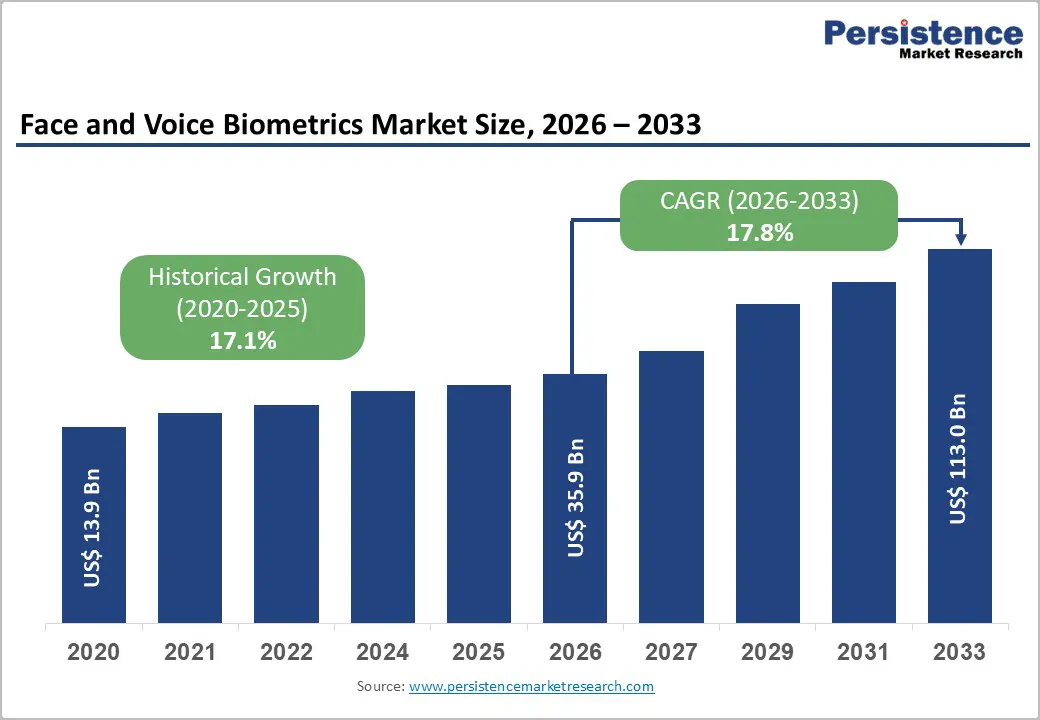
The global face and voice biometrics market size is expected to be valued at US$ 35.9 billion in 2026 and projected to reach US$ 113.0 billion by 2033, growing at a CAGR of 17.8% between 2026 and 2033.
The market growth is fueled by stringent regulatory mandates requiring strong customer authentication and the rising threat of deepfake-driven fraud, which necessitates advanced liveness detection. Organizations are increasingly shifting from traditional password-based systems to biometric authentication, especially in the BFSI sector, under regulations such as PSD2. Government-led national ID programs, such as India’s Aadhaar, further drive demand for secure, scalable biometric infrastructure across public and private sectors.
Key Market Highlights
- Leading Region: North America dominates the global face and voice biometrics market with a 39.3% market share, supported by advanced infrastructure, strong innovation ecosystems, and stringent identity-protection regulations.
- Fastest-Growing Region: Asia Pacific is the fastest-growing region, expanding at a
- 18–20% CAGR, driven by large-scale government biometric programs, including India’s Aadhaar with 1.3 billion enrollments, and rapid digitalization.
- Dominant Technology Segment: Face biometrics commands approximately 55% market share, driven by high accuracy, cost efficiency, seamless integration, and strong benchmark performance.
- Fastest Growing Component Segment: Software solutions are the fastest-growing component, expanding at 22.7% CAGR in the Asia Pacific due to rising demand for scalable, cloud-based, AI-powered platforms.
- Key Market Opportunity: Multimodal biometric systems combining face, voice, fingerprint, and iris recognition offer significant growth potential across government, defense, and BFSI sectors by enhancing security and user experience.
| Key Insights | Details |
|---|---|
|
Face and Voice Biometrics Market Size (2026E) |
US$ 35.9 Billion |
|
Market Value Forecast (2033F) |
US$ 113.0 Billion |
|
Projected Growth CAGR(2026-2033) |
17.8% |
|
Historical Market Growth (2020-2025) |
17.1% |
Market Dynamics
Market Growth Drivers
Regulatory Compliance and Strong Customer Authentication Mandates
Global financial regulators are increasingly requiring biometric authentication as a fundamental part of secure identity verification frameworks. Regulations such as the European Union’s PSD2 directive compel banks to implement strong customer authentication using knowledge, possession, or inherence factors, with biometrics fulfilling the “are” component. Similar guidelines across India, Thailand, Malaysia, and the Philippines mandate the use of biometrics in financial transactions, making it a critical, non-discretionary infrastructure.
These regulatory mandates have transformed biometric authentication into an essential requirement for banking and financial institutions. Thailand’s Bank of Thailand, for instance, requires facial recognition for high-value transfers, while Vietnam mandates biometric authentication for digital payments above specific thresholds. This widespread compliance-driven adoption ensures sustained investment in biometric systems, fostering global demand and technological advancement in secure authentication solutions.
Escalating Deepfake Fraud and Advanced Liveness Detection Requirements
The rapid rise of AI-generated deep-fake fraud has emerged as a significant catalyst for the biometrics market. Deepfake incidents have surged compelling organizations to strengthen authentication mechanisms with advanced liveness detection systems. Multimodal biometric solutions combining face, voice, fingerprint, and iris recognition are increasingly deployed to improve verification accuracy and prevent spoofing attempts, reinforcing trust in digital identity frameworks.
Organizations implementing advanced biometric systems report substantial reductions in fraudulent account creation and unauthorized access. By integrating presentation attack detection and anti-spoofing technologies, enterprises enhance security while achieving measurable operational benefits. This evolving threat landscape continues to drive substantial investments in biometric infrastructure, highlighting the urgent need for advanced, resilient authentication solutions across banking, government, and enterprise sectors.
Market Restraints
Privacy Concerns and Regulatory Data Protection Burdens
Stringent data protection regulations, such as the EU’s GDPR and California’s CCPA, impose rigorous compliance requirements on organizations that handle biometric data. Firms must obtain explicit user consent, enforce limited data retention, and implement robust security protocols, adding operational complexity and cost. Heightened public concern over potential misuse of biometric information further slows adoption, particularly in regions with strong privacy advocacy, such as Western Europe and North America.
Community opposition to facial recognition in public spaces has also influenced government policies, restricting surveillance and public deployment. The perceived vulnerability of centralized biometric databases raises trust issues among consumers and institutions. These factors collectively impede market penetration, requiring providers to balance security, compliance, and public acceptance while promoting the adoption of face and voice biometric technologies.
High Implementation Costs and Legacy System Integration Challenges
Deploying a comprehensive biometric infrastructure is capital-intensive, posing significant barriers for smaller organizations and enterprises with existing legacy authentication systems. Investments in specialized hardware such as high-resolution cameras, iris scanners, and voice recognition devices, alongside integration of complex software and employee training, create substantial upfront costs. Maintaining dual authentication systems during transition periods further increases operational expenses without immediate financial return.
These challenges are particularly acute for cost-sensitive enterprises and institutions in developing markets, where limited capital budgets and slow adoption. Integration with legacy IT systems often requires extensive customization, prolonging deployment timelines. Consequently, high costs and technical complexities continue to restrain the rapid market adoption of face and voice biometric solutions globally.
Market Opportunities
Multimodal Biometric Systems for Enhanced Security and User Experience
The convergence of face, voice, fingerprint, iris, and behavioral biometrics into integrated multimodal platforms presents significant growth opportunities, particularly in high-security sectors such as government, defense, and financial services. Multimodal systems enhance authentication reliability across diverse environments, reduce false positives, and address accuracy gaps seen in single-modality solutions, providing both security and operational efficiency for enterprises.
Technological advancements, such as walk-through face and iris recognition, enable the authentication of millions of individuals in real time without device interaction. These innovations open up expansion opportunities for system integrators and solution providers, especially in mobile banking, access control, and government services, where organizations prioritize robust security measures and a seamless user experience across multiple authentication points.
Emerging Contact-Free and Mobile Biometric Authentication in Healthcare and Government Sectors
Healthcare and government organizations are increasingly adopting contactless biometric authentication to improve operational efficiency and align with post-pandemic health preferences. Facial recognition for rapid patient check-in and secure identity verification is gaining traction across hospitals in the Asia Pacific, while advanced biometric systems are supporting smart city initiatives and national infrastructure projects in China, Japan, and South Korea.
Mobile biometric adoption is also rising rapidly, with widespread consumer familiarity due to smartphones featuring fingerprint or facial recognition. This trend creates opportunities for mobile banking, digital onboarding, and government service platforms, particularly in developing markets where traditional documentation systems are limited, enabling secure, scalable, and accessible remote authentication solutions.
Category-wise Insights
Technology Analysis
Face biometrics emerges as the leading technology segment, commanding approximately 55% market share, driven by its versatility, cost-effectiveness, and seamless integration into existing security infrastructure. Advanced AI and machine learning algorithms have significantly improved facial recognition accuracy, while non-intrusive deployment enables large-scale surveillance and access control without active user participation. Adoption is particularly strong in Asia Pacific, where over 100 cities have implemented facial recognition for law enforcement, achieving notable crime reduction rates.
The accessibility of face recognition across consumer electronics, mobile devices, and enterprise security systems has established it as the foundational technology for biometric authentication worldwide. Its proven operational performance in government, law enforcement, and commercial applications continues to attract investor confidence, solidifying its dominant market position and ensuring widespread adoption across various industry verticals.
Component Analysis
Software solutions represent the fastest-growing component segment, experiencing growth rates exceeding 22.7% CAGR in the Asia Pacific, while commanding a significant market share globally. Hardware components account for the majority of the remaining share, including specialized cameras, iris scanners, and voice recognition devices. The services segment, encompassing system integration, consulting, deployment support, and maintenance, represents approximately 15% of the market. Together, these components support diverse deployment models and industry applications.
Integration of AI and machine learning into biometric software enhances accuracy, operational efficiency, and resistance to sophisticated spoofing and deepfake attacks. Cloud-based deployment dominates due to ubiquitous accessibility, automatic scalability, and reduced infrastructure costs. This evolution creates opportunities for technology vendors, cloud service providers, and software developers offering AI-powered, flexible, reliable biometric authentication solutions to enterprises worldwide.
End Use Industry Analysis
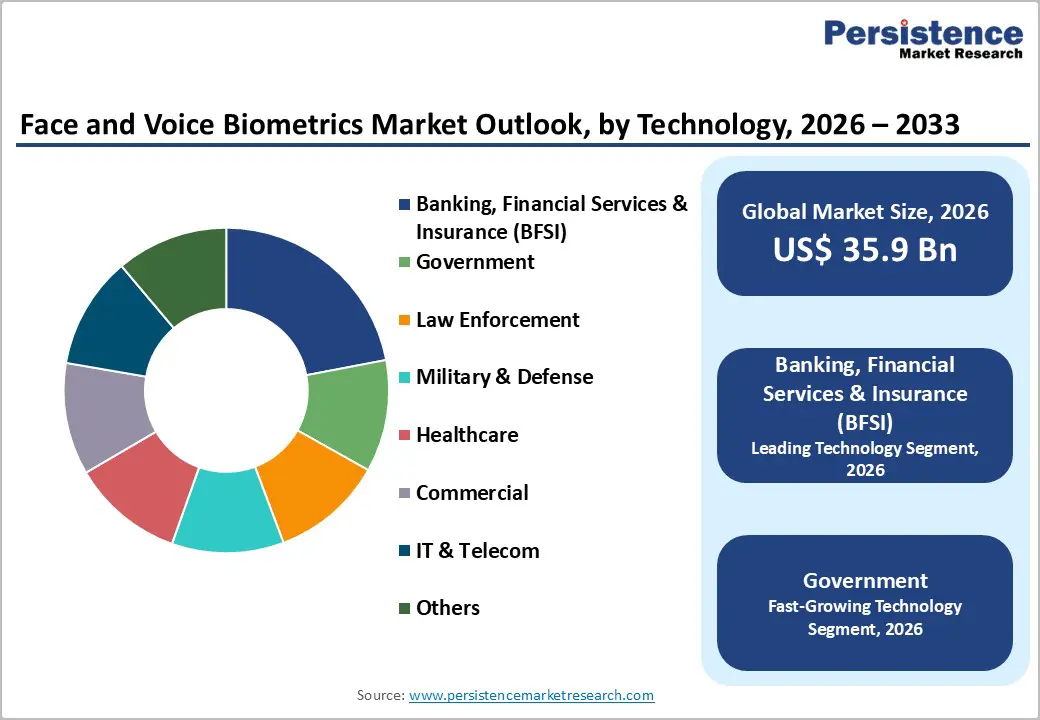
Banking, Financial Services & Insurance (BFSI) is the dominant end-use segment, accounting for approximately 42% market share, driven by regulatory mandates, fraud prevention needs, and customer experience improvement. BFSI institutions implement biometrics across mobile banking, online account access, payment verification, and in-branch identity checks to mitigate identity theft, account takeover, and unauthorized transactions while ensuring compliance with PSD2, KYC/AML, and GDPR frameworks.
The government sector is the fastest-growing end-use segment, fueled by national ID programs, law enforcement modernization, border security, and public safety applications. Law enforcement agencies worldwide increasingly leverage biometric systems for criminal investigations, suspect identification, and booking efficiency. Expanding government adoption across North America, Europe, and the Asia Pacific presents substantial opportunities for biometric system providers and service integrators focused on secure and scalable authentication solutions.
Regional Insights
North America Face and Voice Biometrics Market Trends and Insights
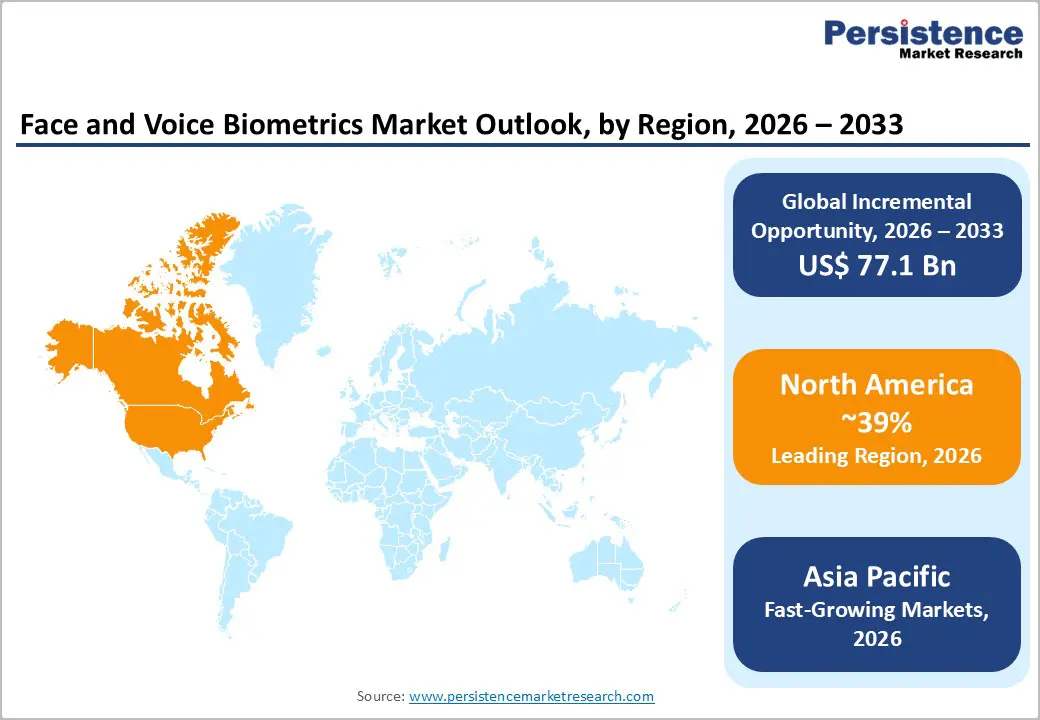
North America establishes clear market leadership, commanding 39.3% global market share in face and voice biometrics, supported by advanced technological infrastructure, mature innovation ecosystems, and stringent regulatory frameworks emphasizing identity protection. Early adoption by enterprises, coupled with substantial investments in AI and machine learning by technology leaders such as Microsoft, IBM, Okta, and Cisco, has reinforced regional dominance in biometric authentication solutions.
U.S. law enforcement adoption accelerates expansion, with over 100 police departments deploying facial recognition for bookings, suspect identification, and background verification. NIST benchmarking ensures high algorithmic performance and guides procurement. However, state-level privacy concerns in California, Massachusetts, and New York regarding public surveillance have influenced policy, potentially constraining government and commercial deployments despite overall federal emphasis on identity protection.
Europe Face and Voice Biometrics Market Trends and Insights
Europe experiences steady growth in biometric adoption, driven by regulatory harmonization and compliance mandates. The EU’s PSD2 directive has catalyzed widespread implementation in banking, with Germany, the U.K., and the Netherlands leading early adoption. France and Spain show slower uptake due to legacy systems and limited native technology vendors, though digital identity and cybersecurity initiatives continue accelerating adoption.
The region emphasizes privacy-first architectures, with federated learning models keeping biometric data on user devices in compliance with GDPR. Strong customer authentication and Open Banking initiatives drive demand for flexible, multi-party solutions. The European market is projected to grow at ~16% CAGR, with biometric authentication dominating KYC/AML and digital onboarding use cases across financial services and government sectors.
Asia Pacific Face and Voice Biometrics Market Trends and Insights
Asia Pacific is the fastest-growing regional market, commanding ~30.4% regional market share, fueled by rapid digital transformation, government-led biometric initiatives, and expanding mobile banking adoption. China leads regional deployment with smart city programs and centralized biometric databases, while India’s Aadhaar program supports over 1.3 billion enrolled citizens, driving extensive public and private sector adoption and enabling 1.5 billion monthly authentication transactions.
Voice biometrics is growing rapidly in India, with a projected 32.5% CAGR in adoption, driven by fintech expansion, digital payments, and financial inclusion initiatives. Mature markets like Japan and South Korea exhibit private sector uptake across mobile payments, consumer electronics, and enterprise security. Southeast Asian countries, including Thailand, Vietnam, the Philippines, and Malaysia, are increasingly implementing regulatory-mandated biometrics in banking and government, creating robust opportunities for regional and multinational technology providers.
Competitive Landscape
The face and voice biometrics market exhibits a moderately consolidated structure, with established multinational corporations, specialized solution providers, and innovative startups competing across multiple biometric modalities. Market leaders differentiate through proprietary technology, extensive enterprise and government customer bases, and investments in algorithmic accuracy, multimodal authentication, and anti-spoofing capabilities.
Expansion strategies focus on strategic acquisitions, technology partnerships, and regional growth, particularly in emerging economies. Emerging competitors capitalize on specialized offerings, including liveness detection, deepfake resistance, and AI-driven solutions. Cloud deployment, regulatory compliance, and flexible integration have become key differentiators, enabling smaller vendors to compete effectively alongside larger incumbents.
Key Market Developments
- In December 2025, NEC Corporation unveiled groundbreaking walk-through face and iris multimodal authentication technology combining world-leading face recognition capabilities (repeatedly ranked first in NIST benchmarks) with iris recognition to authenticate individuals from a database exceeding 100 million registered individuals while walking at a natural pace.
- In November 2024, Biometrics Institute's State of Biometrics Report 2025 reveals that 85% of industry stakeholders express significant concern about the impact of deepfakes on biometric systems, catalyzing accelerated investments in liveness detection, anti-spoofing technologies, and multimodal authentication approaches combining multiple biometric modalities to enhance resilience against synthetic media attacks.
- In February 2025, NEC Corporation partnered with a major U.S. healthcare provider to deploy face detection technology enabling rapid patient check-in and secure identity verification, streamlining hospital procedures and demonstrating biometric authentication expansion into healthcare sector applications addressing post-pandemic operational efficiency and security requirements.
Companies Covered in Face and Voice Biometrics Market
- NEC Corporation
- IDEMIA
- Thales Group
- Nuance Communications
- Aware Inc.
- Cognitec Systems
- Neurotechnology
- iProov
- Sensory Inc.
- Phonexia
- VoiceVault
- Verint Systems
- ID R&D
- BioID AG
- Pindrop Security
Frequently Asked Questions
The global face and voice biometrics market is expected to reach US$ 35.9 billion in 2026, driven by regulatory compliance, fraud prevention, and digital transformation initiatives.
Demand is driven by PSD2 and GDPR compliance, strong customer authentication mandates, deepfake fraud mitigation, and national ID programs such as Aadhaar with 1.3 billion enrollments.
North America leads the market with a 39.3% global market share, supported by advanced infrastructure, early enterprise adoption, and strong identity-protection regulations.
Face biometrics dominate the technology landscape with approximately 55% market share, driven by accuracy, scalability, and seamless integration across applications.
Leading market players include NEC Corporation, IDEMIA, Thales Group, Nuance Communications, and Aware, Inc.


