




- Technology
- Iris Biometrics Market
Iris Biometrics Market Size, Share, and Growth Forecast, 2026 – 2033
Iris Biometrics Market by Offering (Hardware, Software, Services), Deployment (On-Premises, Cloud-based, Hybrid), Application (Identity Verification & Enrollment, Access Control, Time & Attendance Management, Border & Immigration Control, Surveillance & Criminal Identification, Transaction Authentication, Others), Industry, and Regional Analysis for 2026 – 2033

Iris Biometrics Market Size and Trends
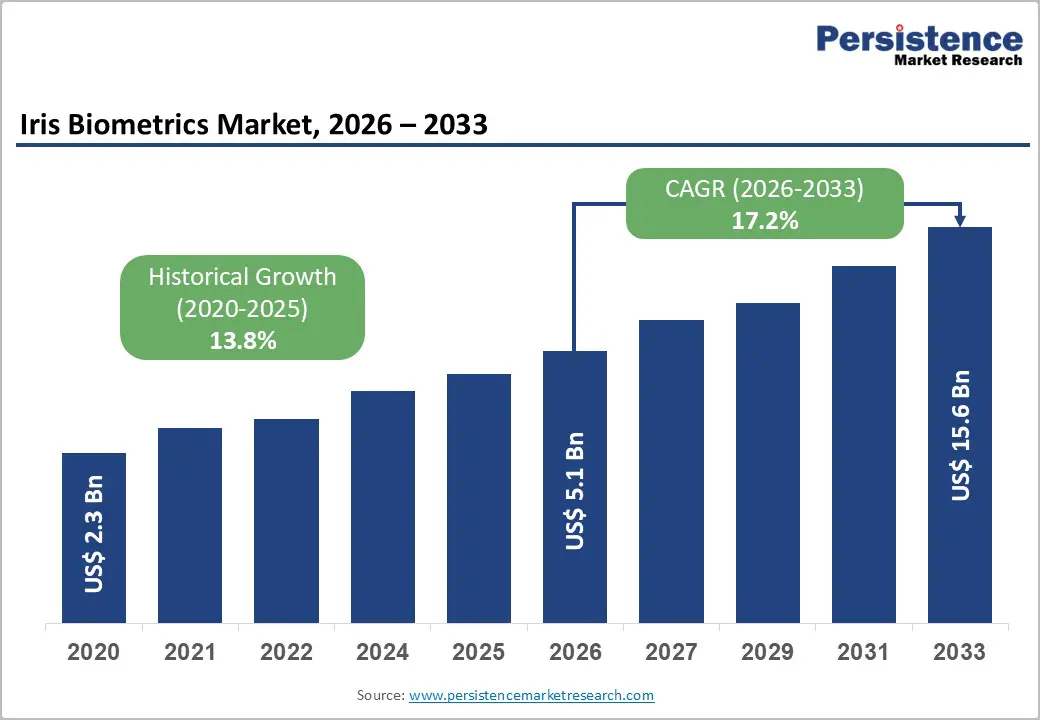
The global Iris Biometrics Market size is projected to rise from US$5.1 Bn in 2026 to US$15.6 Bn by 2033. It is anticipated to witness a CAGR of 17.2% during the forecast period from 2026 to 2033, driven by escalating demand for secure and contactless biometric authentication across critical infrastructure, heightened cybersecurity concerns pushing organizations to adopt advanced identity verification solutions, and government mandates for modernized border control and national identification systems. The convergence of artificial intelligence with iris recognition technology has substantially improved accuracy and processing speed, enabling seamless deployment across smartphones, airports, banks, and law enforcement agencies globally.
Key Industry Highlights:
- Leading Offering: Hardware dominates with over 52% market share in 2026, valued at more than US$ 2.7 Bn, driven by the need for highly reliable, tamper-resistant iris scanners and cameras in high-security environments. Software is the fastest-growing offering, driven by demand for scalable, updatable, AI-powered solutions and cloud-based identity verification.
- Leading Deployment: On-Premises leads with over 48% market share in 2026, valued at more than US$ 2.4 Bn, due to privacy, control, and real-time processing requirements in sensitive identity verification environments. Cloud-based deployment is the fastest-growing segment with a CAGR of 23.1%, driven by faster deployment, scalability, and pay-as-you-use models.
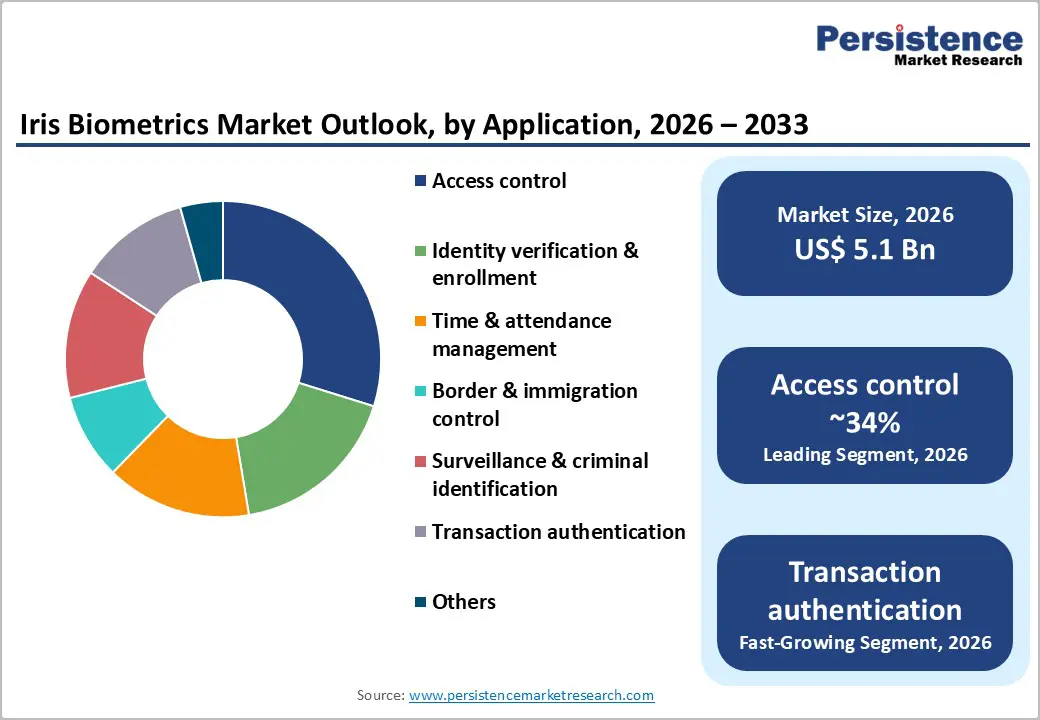
- Leading Application: Access Control holds the largest share at over 34% in 2026, valued at more than US$ 1.7 Bn, as organizations require fast, contactless, and accurate verification for secure entry points. Transaction Authentication is the fastest-growing application due to rising demand for fraud-resistant, contactless authentication in digital payments and mobile banking.
- Leading Industry: Government & public sector commands the largest share at over 31% in 2026, valued at more than US$ 1.6 Bn, driven by national ID programs, border control, and large-scale citizen enrollment systems. BFSI is the fastest-growing industry as banks modernize authentication systems to prevent fraud and meet KYC/AML compliance.
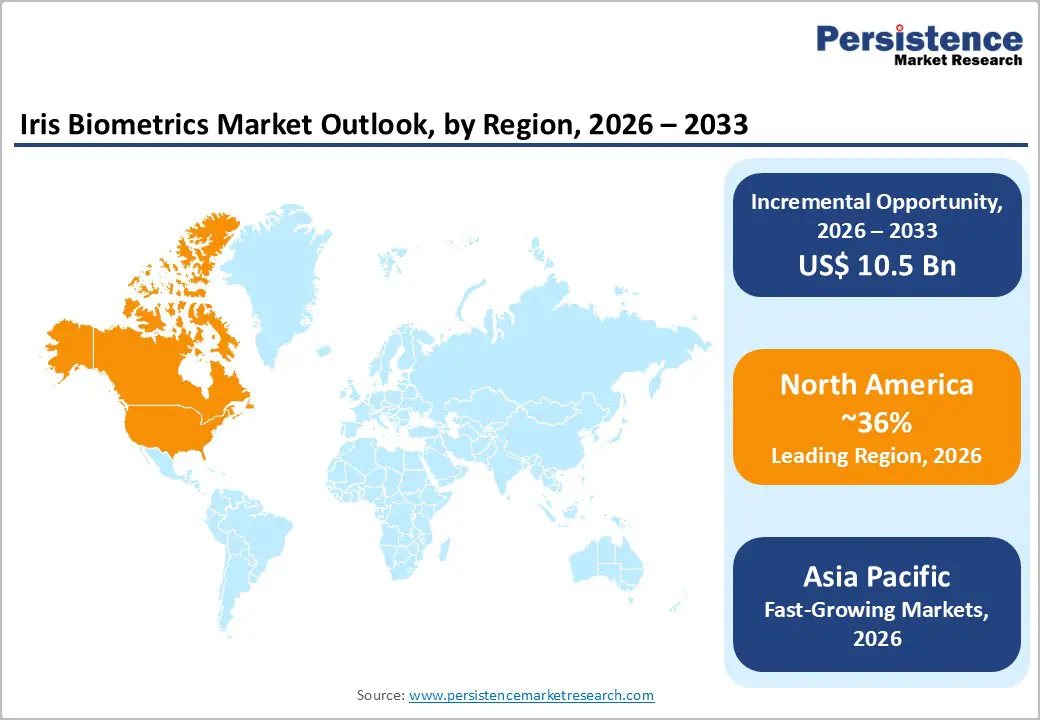
- Leading Region: North America leads with over 36% market share in 2026, valued at approximately US$ 1.8 Bn, supported by strong government adoption in border security and advanced biometric platforms. Asia Pacific is the fastest-growing region with a CAGR of 22.9%, driven by government identity programs, border control initiatives, and rapid adoption in BFSI and healthcare. Europe holds over 22% share in 2026, driven by regulatory compliance and large-scale border control deployments under GDPR and EES.
| Report Attribute | Details |
|---|---|
|
Iris Biometrics Market Size (2026E) |
US$5.1 Bn |
|
Market Value Forecast (2033F) |
US$15.6 Bn |
|
Projected Growth (CAGR 2026 to 2033) |
17.2% |
|
Historical Market Growth (CAGR 2020 to 2025) |
13.8% |
Market Dynamics
Driver
Integration of Artificial Intelligence and Machine Learning for Enhanced Accuracy
The integration of artificial intelligence and machine learning has significantly enhanced the accuracy and reliability of iris recognition systems. Advanced deep learning algorithms enable robust iris matching even under challenging conditions such as poor lighting, off-angle captures, and low-quality images. The incorporation of presentation attack detection (PAD) technologies strengthens protection against spoofing and biometric fraud. Cloud-based biometric analytics further improve processing speed and scalability, enabling near real-time authentication without compromising user experience. These technological improvements are driving the adoption of iris biometrics across banking, healthcare, and government sectors where high security and operational efficiency are critical.
Rising Adoption in Border Control and Government Security Infrastructure
Government agencies across the globe are increasingly adopting iris recognition as a core component of border control and national security infrastructure. The technology is being deployed at immigration checkpoints, airports, and law enforcement systems to enable fast, accurate, and contactless identity verification. Major border authorities and security agencies are integrating iris biometrics into large-scale identification and criminal investigation platforms. International airports are also implementing iris-enabled biometric gates to streamline passenger processing while enhancing security. These government-led deployments are driving long-term demand, generating recurring revenue for solution providers, and positioning iris recognition as a preferred biometric modality for high-security environments.
Restraint
High Capital Expenditure and Implementation Complexity
High upfront capital investment remains a key restraint for the iris biometrics market, driven by the need for specialized imaging hardware, infrared sensors, server infrastructure, and skilled workforce training. Deployment often requires complex integration with existing access control systems, databases, and security frameworks, leading to longer implementation timelines and higher engineering costs. Small and medium-sized enterprises face affordability challenges, limiting adoption in cost-sensitive sectors. Premium-priced optical components and ongoing maintenance further increase the total cost of ownership. Adoption has traditionally been concentrated among government bodies and large financial institutions, although emerging SaaS-based models are gradually lowering entry barriers by shifting costs from capital to operational expenditure.
Regulatory Compliance and Data Privacy Concerns
Regulatory frameworks such as the EU’s GDPR and U.S. state-level biometric privacy laws impose strict obligations on how iris biometric data is collected, processed, and stored. Organizations must ensure explicit user consent, transparency in data usage, and strong security safeguards, significantly increasing compliance requirements. Mandatory Data Protection Impact Assessments (DPIAs) add administrative workload and often delay deployment timelines. Data localization rules in some regions require biometric data to be stored within national borders, complicating global system architectures and raising costs. In privacy-sensitive markets, especially Europe, public concerns over surveillance and misuse of biometric databases have dampened adoption. The risk of heavy penalties for non-compliance further discourages organizations from rapid or large-scale implementation.
Opportunity
Smartphone and Mobile Device Integration for Consumer Authentication
Premium smartphone manufacturers are increasingly embedding iris recognition sensors to enable secure device unlocking, mobile payments, and application access, accelerating consumer adoption of iris biometrics. Successful deployments such as Samsung Galaxy devices and KB Kookmin Bank’s iris-based mobile banking in South Korea validate the technology’s reliability and user acceptance. Rapid growth of IoT devices and wearables is further driving demand for compact, low-power, miniaturized iris sensors. Ongoing sensor miniaturization and economies of scale are reducing costs, shifting iris recognition from enterprise-focused use to mass-market consumer authentication. This transition unlocks significant growth potential across smartphone users prioritizing biometric security over passwords.
?Expansion of Contactless Authentication in Financial Services and Healthcare
Financial institutions and healthcare providers are rapidly adopting iris recognition to strengthen security, enable contactless authentication, and meet KYC and AML compliance requirements. In BFSI, deployments such as Qatar National Bank’s partnership with Iris ID demonstrate the shift toward cardless, fraud-resistant transactions, driving the sector’s fastest projected CAGR as banks modernize legacy authentication systems. Healthcare organizations are leveraging iris biometrics for accurate patient identification, medication verification, and secure access to sensitive areas, reducing errors and improving patient safety. The post-pandemic surge in contactless interactions and accelerated digital transformation across both sectors significantly expands the addressable market. These create strong growth opportunities for iris biometric vendors offering integrated, scalable authentication solutions.
Category-wise Analysis
Offering Analysis,
Hardware dominates the global market, capturing more than 52% market share in 2026 with a value exceeding US$ 2.7 Bn, as organizations and governments are prioritizing highly reliable and tamper-resistant identification systems for security and access control. Iris scanners and cameras are fundamental physical components needed to capture precise eye patterns, and without them, the software cannot function. Industries value hardware investments for low error rates and real-time performance, making it essential over purely software solutions.
Software demonstrates significant growth as organizations increasingly need scalable, flexible, and updatable solutions that adapt to evolving security threats and compliance requirements. It enables rapid deployment across multiple devices and locations without the high costs of replacing hardware. It also supports advanced analytics, AI-based matching, and integration with existing identity systems, making iris recognition more accurate and user-friendly. As demand rises for cloud-based identity verification and remote authentication, software becomes the preferred option for seamless, centralized management and continuous improvement.
Deployment Analysis,
On-Premises dominate the market, capturing over 48% market share in 2026 with a value exceeding US$ 2.4 Bn, due to organizations prioritizing data privacy and control, especially where sensitive personal identity verification is involved. They also need real-time processing with minimal latency for security-critical environments. Many industries require solutions that integrate tightly with their existing infrastructure. On-premises help meet regulatory compliance and internal governance requirements without relying on third-party cloud hosting.
Cloud-based demonstrate the highest growth with a CAGR of 23.1% due to the need for faster deployment and scalability without heavy upfront hardware investment. It enables remote enrollment and authentication, which is essential for distributed workforces and digital services. Businesses also seek continuous updates and stronger security, like real-time threat monitoring, without managing the infrastructure themselves. The growing demand for flexible, pay-as-you-use models makes cloud solutions more attractive than traditional on-premises systems.
Application Analysis,
Access control holds over 34% of the market share in 2026, with a value exceeding US$ 1.7 Bn, as organizations increasingly need high-security authentication to protect sensitive facilities and data. Iris recognition offers fast, contactless, and accurate identity verification, which is crucial for secure entry points in government, banking, and critical infrastructure. Its low false acceptance and rejection rates make it reliable for preventing unauthorized access. Growing concerns around identity fraud and the need for compliance with stringent security standards further drive adoption.
Transaction authentication is expected to grow at the highest rate as financial institutions and digital payment platforms urgently need stronger, contactless identity verification to prevent fraud and reduce chargebacks. It provides highly accurate, spoof-resistant authentication, making it ideal for secure mobile banking, ATM access, and high-value online transactions. As digital payments expand, users demand faster, seamless experiences without sacrificing security. Regulators and banks are increasingly pushing for stronger KYC and AML compliance, driving the adoption of iris-based transaction verification.
Industry Analysis,
The government & public sector commands the largest market share at over 31% in 2026, with a value exceeding US$ 1.6 Bn, due to the requirement for highly reliable identity verification in large-scale national programs. Iris recognition offers fast, accurate, and tamper-resistant authentication, making it an ideal solution for voter registration, national ID systems, and social welfare distribution. The need to prevent fraud, improve citizen service delivery, and secure borders and immigration processes drives widespread adoption. Government projects often involve long-term funding and large deployments, further boosting market share.
BFSI is expected to grow at a significant rate due to banks and financial institutions facing intense pressure to prevent fraud and comply with strict KYC/AML regulations. It offers highly accurate, contactless authentication for customers onboarding, mobile banking, and ATM access, reducing identity theft and card-related fraud. It also supports secure transaction authentication and remote verification, which is crucial as digital banking expands. BFSI institutions prioritize customer trust and operational efficiency, making iris biometrics an attractive, scalable solution.
Regional Insights
North America Iris Biometrics Market Trends
North America accounts for over 36% of the Iris Biometrics market share in 2026, reaching approximately US$ 1.8 Bn, due to its role as a technology innovation hub and early adopter of advanced authentication solutions. The United States drives regional adoption through extensive use of iris recognition in border security, law enforcement, defense, and national identity systems, establishing it as a trusted standard for high-security identity verification. Federal agencies actively integrate iris data into shared biometric platforms, strengthening interoperability across public safety operations. The presence of major technology providers, particularly U.S.-based innovators offering multi-modal biometric solutions, further accelerates market maturity. While strong digital infrastructure and supportive policies favor adoption, rising privacy concerns and stricter data protection laws are pushing organizations to adopt transparent, privacy-by-design biometric frameworks.
Asia Pacific Iris Biometrics Market Trends
Asia Pacific is expected to grow at the highest rate with a CAGR of 22.9%, driven by strong regulatory focus on security, identity management, and data protection across the region. Adoption is led by government and public sector initiatives, particularly in border control, immigration, and national ID programs aligned with EU-wide security frameworks. Airports and transportation hubs increasingly deploy iris biometrics for secure staff access and passenger verification, improving efficiency while maintaining compliance with strict privacy standards such as GDPR. The banking and financial services sector is adopting iris recognition for high-security authentication, fraud prevention, and premium customer experiences. Advanced healthcare systems and research institutions also leverage iris biometrics for patient identification and clinical data security.
Europe Iris Biometrics Market Trends
Europe is expected to hold more than 22% share by 2026, driven by stringent regulatory environments, with GDPR driving explicit user consent, transparency, and strong data protection, which increases deployment complexity and costs. The EU’s Entry/Exit System has accelerated adoption at borders by replacing manual passport stamping with biometric verification, particularly across the Schengen Area. Major countries such as the UK, Germany, France, and Spain have implemented iris-enabled biometric gates at airports and border crossings to improve security and passenger flow while ensuring auditability. Adoption has also expanded toward multi-modal solutions combining iris and facial recognition to improve accuracy and compliance. While financial services and healthcare are adopting iris biometrics cautiously under privacy-by-design principles, overall growth remains steady.
Competitive Landscape
The iris biometrics market is relatively consolidated, dominated by a few key players with strong technological portfolios and deep expertise in biometric systems. Manufacturers compete by investing heavily in R&D to enhance accuracy, speed, and anti-spoofing capabilities, ensuring their solutions handle diverse environmental conditions and large-scale deployments. Firms also focus on strategic collaborations and certification with government agencies, especially for border control and national ID programs, to expand adoption and credibility.
Key Industry Developments
- In December 2025, NEC Corporation developed a walk-through multimodal biometric authentication system that combines face and iris recognition to verify individuals accurately and quickly while they are walking, both indoors and outdoors. This hands-free technology aims to enhance security and reduce congestion at critical facilities, with proof-of-concept trials starting in fiscal 2026 and implementation targeted for fiscal 2027.
- In September 2025, Iris ID launched the IrisAccess iA1000 series, a new non-contact access control device that uses Iris-Face Fusion technology for fast and highly accurate authentication. It features dual iris and face cameras, a circular LCD touchscreen, Wi-Fi/PoE, OSDP/Wiegand support, AES 256-bit encryption, PAD, and an optional multi-format card reader for mobile credentials.
Companies Covered in Iris Biometrics Market
- Thales Group S.A.
- IDEMIA Group
- NEC Corporation
- HID Global Corporation
- Iris ID, Inc.
- Iritech, Inc.
- Princeton Identity Inc.
- EyeLock LLC
- Aware, Inc.
- CMITech Co., Ltd.
- BioID GmbH
- IrisGuard UK Ltd.
- Others
Frequently Asked Questions
The global market is projected to be valued at US$5.1 Bn in 2026.
Rapid digital transformation, rising cyber threats, and stricter regulatory compliance are key drivers of the market.
The market is expected to witness a CAGR of 17.2% from 2026 to 2033.
Growing adoption of contactless biometric authentication in smartphones, ATMs, and smart cities, plus expanding use in border security and healthcare for faster, secure identity verification and compliance, creates strong market expansion potential.
Thales Group S.A., IDEMIA Group, NEC Corporation, HID Global Corporation, Iris ID, Inc., Iritech, Inc., Princeton Identity Inc. are among the leading key players.


