




- Telecommunications
- Application Programming Interface Security Market
Application Programming Interface Security Market Size, Share, and Growth Forecast 2026 - 2033
Application Programming Interface Security Market by Offering (Platform and Solutions, Services), by Vertical (BFSI, Government, IT and Telecom, Manufacturing, Retail and E-commerce, Media and Entertainment, Healthcare, Energy and Utilities, Others), by Application (Large Enterprise, Small and Medium Enterprises), by Deployment Mode (Cloud, On-premise, Hybrid), by Regional Analysis, 2026 - 2033

Application Programming Interface Security Market Size and Trend Analysis
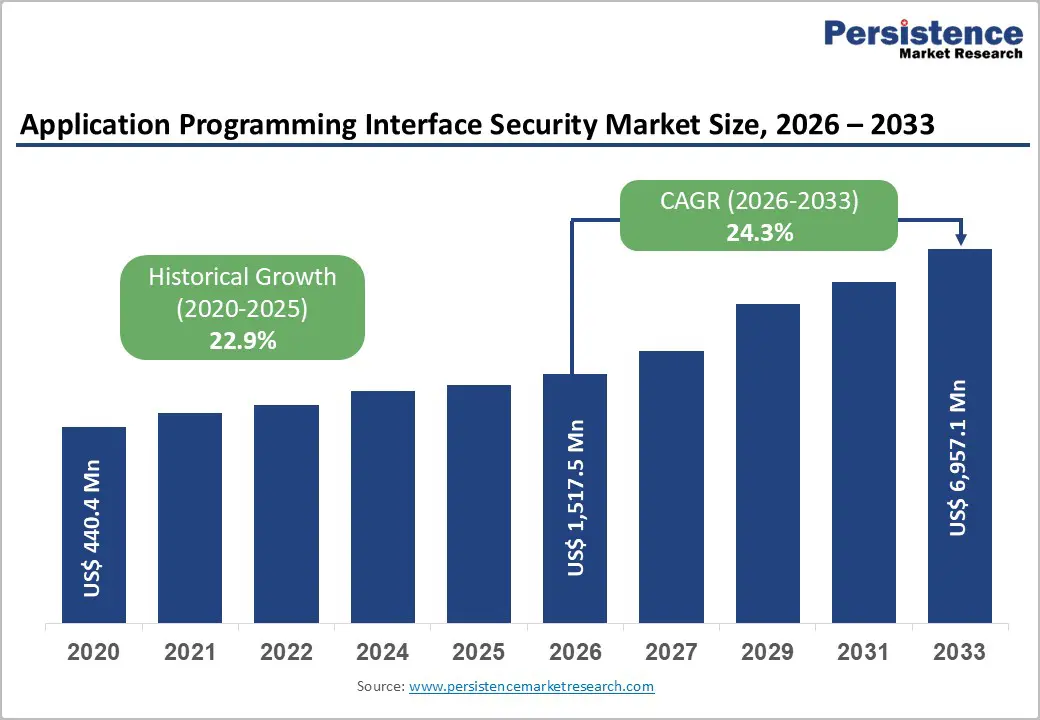
The global application programming interface security market size is expected to be valued at US$ 1,517.5 million in 2026 and projected to reach US$ 6,957.1 million by 2033, growing at a CAGR of 24.3% between 2026 and 2033.
The rapid expansion of digital platforms, mobile applications, and cloud services has significantly increased reliance on APIs for seamless system integration and data exchange. As organizations adopt microservices and cloud-native architectures, APIs have become critical infrastructure requiring robust protection. Rising incidents of API-targeted cyberattacks and data breaches are pushing enterprises to implement dedicated API security solutions. Additionally, regulatory frameworks such as GDPR and PCI DSS are reinforcing the need for stronger data protection and secure API management.
Key Market highlights
- Leading Region: North America holds 38% share in 2025, driven by strong cybersecurity infrastructure and high API adoption across enterprises.
- Fastest Growing Region: Asia Pacific accounts for 27% share and is the fastest-growing region due to rapid digitalization in China, India, and Japan.
- Leading Offering: Platform and Solutions lead with 55% share in 2025, supported by demand for integrated API protection platforms.
- Leading Application: Large Enterprises dominate with 65% share, driven by complex IT ecosystems and high API traffic volumes.
- Key Market Opportunity: Zero-trust API architectures are creating new opportunities as organizations strengthen authentication and continuous threat monitoring across digital platforms.
| Key Insights | Details |
|---|---|
| Application Programming Interface Security Market Size (2026E) | US$ 1,517.5 million |
| Market Value Forecast (2033F) | US$ 6,957.1 million |
| Projected Growth CAGR(2026 - 2033) | 24.3% |
| Historical Market Growth (2020 - 2025) | 22.9% |
Market Dynamics
Drivers - Rapid Expansion of API Usage Across Digital Platforms and Connected Ecosystems Driving Security Demand
The increasing reliance on APIs across digital platforms is a major factor accelerating demand for API security solutions. Enterprises are integrating APIs to enable seamless data exchange between mobile applications, cloud platforms, IoT devices, and partner networks. As organizations expand digital services and adopt microservices architectures, the number of APIs within enterprise environments continues to grow rapidly, creating a larger attack surface for potential cyber threats.
This growing API footprint exposes organizations to risks such as unauthorized access, data leakage, and malicious traffic. Cybersecurity reports have highlighted that APIs are frequently exploited entry points in web-based attacks, prompting enterprises to strengthen protection mechanisms. As a result, businesses are prioritizing advanced API security capabilities such as threat detection, authentication management, and traffic monitoring to safeguard sensitive data and maintain operational resilience.
Increasing Regulatory and Compliance Requirements Strengthening the Need for API Protection
Rising regulatory pressure related to data protection and cybersecurity is another key factor supporting the adoption of API security solutions. Governments and regulatory bodies across multiple regions are introducing frameworks that require organizations to implement strong security controls for digital infrastructure, including APIs. These regulations aim to ensure secure data exchange, protect consumer information, and reduce the risk of operational disruptions.
Compliance requirements are particularly significant in sectors such as finance, healthcare, and government services where sensitive data flows through API-based systems. Regulatory standards encourage organizations to adopt secure API gateways, identity verification mechanisms, and continuous monitoring tools. As companies seek to avoid regulatory penalties and strengthen cybersecurity frameworks, the demand for robust API security platforms and services continues to expand.
Restraints - Integration Challenges with Legacy Systems Limiting Seamless Adoption of API Security Solutions
Integrating modern API security solutions with legacy IT infrastructures remains a significant challenge for many organizations. Numerous enterprises continue to operate older systems that were not designed to support API-based architectures or modern security frameworks. As companies attempt to connect these legacy environments with newer cloud applications and digital platforms, compatibility issues, complex configurations, and prolonged deployment timelines often arise.
These integration difficulties can increase operational costs and slow down digital transformation initiatives. Organizations may need to redesign application interfaces, upgrade infrastructure components, or implement additional middleware to enable secure API communication. Such complexities discourage smaller organizations with limited technical resources from adopting advanced API security solutions, ultimately slowing the overall pace of market adoption.
High Implementation Costs and Shortage of Skilled Cybersecurity Professionals
The high cost associated with deploying comprehensive API security platforms acts as another barrier to wider market adoption. Implementing advanced security tools, monitoring systems, and identity management frameworks requires significant financial investment, particularly for organizations with large and complex IT environments. These costs can be challenging for small and medium enterprises that often operate with constrained cybersecurity budgets.
In addition to financial barriers, the shortage of skilled cybersecurity professionals further complicates deployment and management of API security systems. Specialized expertise is required to monitor API traffic, detect vulnerabilities, and manage evolving threats. Limited availability of trained professionals can delay implementation, reduce the effectiveness of security strategies, and restrict innovation in organizations attempting to strengthen their API protection capabilities.
Opportunities - Growing Adoption of Zero-Trust Security Models Creating New Opportunities for Advanced API Protection
The increasing adoption of zero-trust security frameworks is creating strong opportunities for the API security market. In a zero-trust environment, every API request is continuously verified regardless of whether it originates inside or outside the network. As organizations move toward cloud and hybrid infrastructures, zero-trust approaches help strengthen identity verification, access control, and real-time threat detection across distributed applications.
This shift is encouraging enterprises to invest in advanced API gateways, identity-based authentication systems, and policy-driven security platforms. Industries handling highly sensitive data, such as banking, healthcare, and government services, are particularly focused on zero-trust architectures to enhance data protection. Vendors developing intelligent security tools and automated policy enforcement systems can capitalize on these requirements and expand their presence in rapidly evolving digital ecosystems.
Expansion of Artificial Intelligence and IoT Ecosystems Increasing Demand for API Security Solutions
The rapid growth of artificial intelligence and Internet of Things (IoT) technologies is generating significant opportunities for API security providers. Connected devices, smart applications, and automated systems rely heavily on APIs to exchange data and enable real-time communication. As the number of connected devices continues to expand, the volume of APIs interacting across networks also increases, creating new security challenges.
Unsecured or poorly monitored APIs within IoT and AI ecosystems can expose organizations to cyber threats, unauthorized access, and data manipulation. This growing complexity is driving demand for advanced security capabilities such as automated threat detection, behavioral analytics, and machine-learning-based monitoring. Companies developing specialized security solutions tailored for AI-driven platforms and connected device networks are well positioned to benefit from the expanding digital landscape.
Category-wise Analysis
Offering Insights
Platform and Solutions lead the offering segment, accounting for around 55% of the market in 2025. This dominance is driven by strong enterprise demand for integrated security tools such as API gateways, traffic monitoring platforms, and runtime protection solutions that help detect and mitigate threats in real time. Organizations increasingly prefer centralized platforms that provide visibility, authentication control, and automated threat detection across complex API environments, making platform-based deployments a core component of modern cybersecurity strategies.
Services are expected to emerge as the fastest growing category as organizations seek specialized expertise to manage increasingly complex API ecosystems. Many enterprises lack the internal resources required to implement and maintain advanced API security frameworks. As a result, consulting, integration, and managed security services are gaining importance, helping businesses deploy secure API infrastructures while ensuring continuous monitoring and compliance with evolving cybersecurity requirements.
Vertical Insights
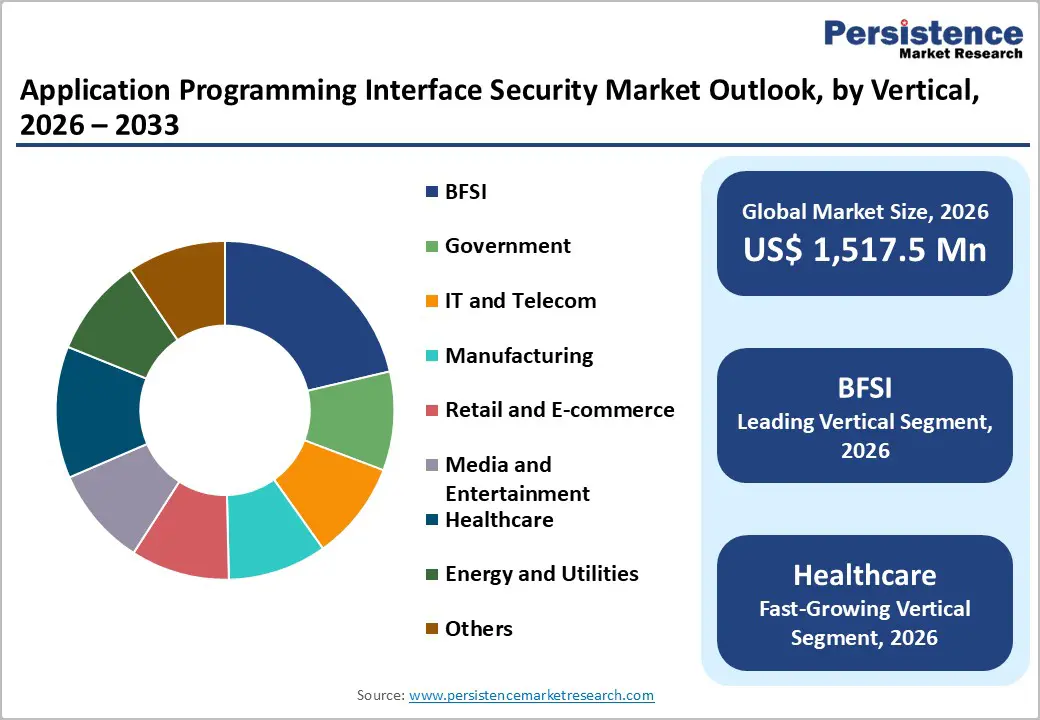
The BFSI sector represents the leading vertical segment, holding approximately 28% of the market in 2025. Financial institutions rely heavily on APIs to support digital banking platforms, payment systems, and third-party financial services integrations. Because these applications handle highly sensitive customer and transaction data, banks and financial service providers are investing heavily in advanced API security frameworks to protect against fraud, unauthorized access, and cyberattacks targeting financial infrastructures.
Healthcare is emerging as one of the fastest growing verticals as digital health systems, telemedicine platforms, and connected medical devices increasingly depend on APIs for data exchange. Healthcare organizations must ensure secure communication between applications while protecting patient information and complying with strict data protection regulations. This growing reliance on interconnected digital healthcare systems is accelerating the adoption of dedicated API security solutions across hospitals, research institutions, and health technology providers.
Application Insights
Large enterprises dominate the application segment, accounting for about 65% of the market in 2025. These organizations operate highly complex IT ecosystems with extensive API networks supporting digital services, cloud applications, and global operations. The large volume of API traffic and the critical nature of enterprise data require advanced monitoring, authentication, and threat detection capabilities, prompting major corporations to invest significantly in comprehensive API security platforms.
Small and medium enterprises are expected to represent the fastest growing application segment as digital transformation initiatives expand across smaller organizations. Increasing use of cloud applications, e-commerce platforms, and mobile services has led SMEs to adopt APIs for system integration and customer engagement. As cyber risks grow and awareness of API vulnerabilities increases, smaller businesses are gradually investing in scalable and cloud-based API security solutions to strengthen their cybersecurity posture.
Deployment Mode Insights
Cloud deployment holds the largest share of the deployment mode segment, capturing around 52% of the market in 2025. The widespread migration of enterprise applications to cloud environments has significantly increased the number of APIs used to connect services, platforms, and data sources. Cloud-based API security solutions offer scalability, centralized monitoring, and easier integration with modern application architectures, making them a preferred option for organizations managing dynamic digital infrastructures.
Hybrid deployment models are expected to grow rapidly as organizations seek to balance the flexibility of cloud systems with the control of on-premise infrastructure. Many enterprises operate mixed environments where sensitive data and legacy applications remain on internal systems while newer services run in the cloud. Hybrid API security solutions enable consistent protection across these environments, supporting secure data exchange and unified security management across distributed IT ecosystems.
Regional Insights
North America Application Programming Interface Security Market Trends
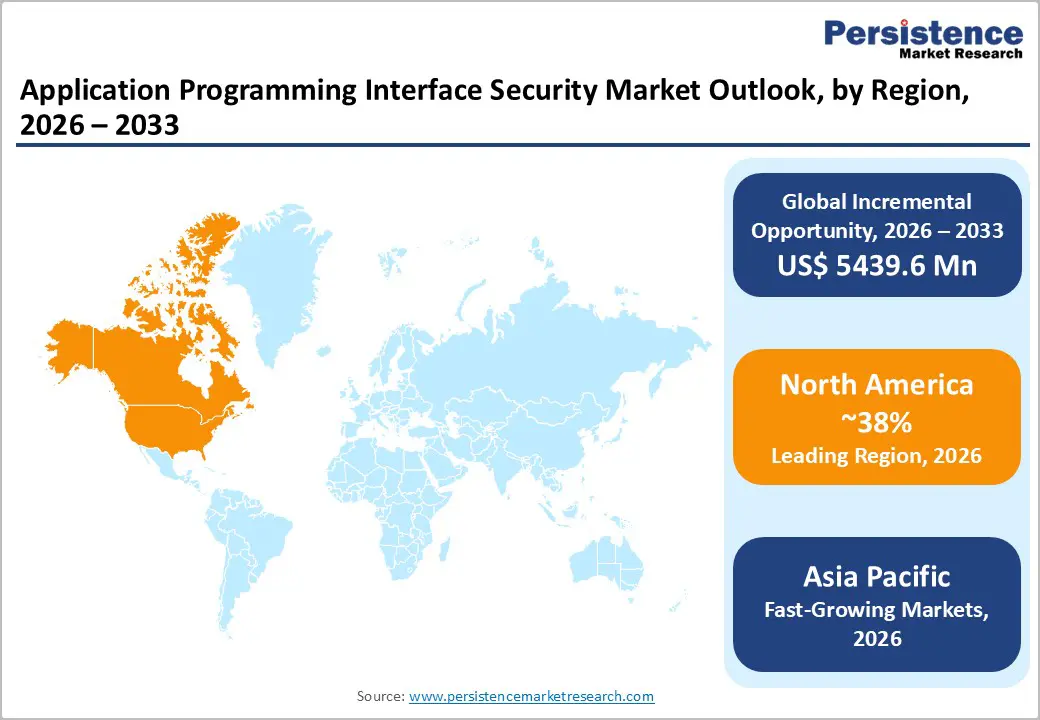
North America holds the largest share of the global API security market, accounting for approximately 38% of total revenue in 2025. The region’s leadership is largely driven by the strong presence of technology companies, advanced digital infrastructure, and widespread adoption of cloud-based services. The United States plays a central role, with enterprises across sectors such as banking, telecommunications, and e-commerce relying heavily on APIs to power digital services and platform integrations.
Rising cybersecurity threats and increasing regulatory oversight are further accelerating demand for API security solutions across the region. Government agencies and industry bodies have introduced guidelines focused on securing software supply chains and protecting digital services. Organizations are strengthening their cybersecurity frameworks by deploying advanced API monitoring, authentication controls, and runtime protection tools to secure complex digital ecosystems and protect sensitive enterprise data.
Europe Application Programming Interface Security Market Trends
Europe represents a rapidly evolving API security market and is projected to grow at a CAGR of approximately 23.1% during the forecast period. The region’s growth is strongly influenced by strict regulatory frameworks and heightened awareness around data protection. Countries such as Germany, the United Kingdom, and France are actively investing in cybersecurity technologies to safeguard digital infrastructure and prevent data breaches across financial, healthcare, and government systems.
Regulatory initiatives focused on operational resilience and cybersecurity compliance are encouraging organizations to strengthen their API protection strategies. Businesses across Europe are implementing advanced security controls to secure application interfaces used in digital banking, e-commerce, and enterprise platforms. As companies continue to expand digital services and cross-border data exchange, the adoption of dedicated API security platforms and monitoring tools is expected to increase steadily.
Asia Pacific Application Programming Interface Security Market Trends
Asia Pacific accounts for approximately 27% of the global API security market and continues to expand as digital transformation accelerates across emerging and developed economies. Countries such as China, India, Japan, and South Korea are witnessing rapid growth in mobile applications, digital payments, and cloud-based services, all of which rely heavily on APIs for system integration and data exchange across platforms.
Governments and regulatory bodies across the region are introducing stronger cybersecurity and data protection frameworks to address rising digital threats. Enterprises are increasingly adopting API security platforms to safeguard online services, financial transactions, and connected device ecosystems. As businesses scale digital infrastructure and integrate advanced technologies such as artificial intelligence and Internet of Things systems, demand for comprehensive API security solutions is expected to rise significantly across the region.
Competitive Landscape
The Application Programming Interface Security Market is moderately consolidated, with leading vendors maintaining strong positions through continuous innovation and advanced security capabilities. Market participants are focusing on developing intelligent security platforms that offer real-time threat detection, automated vulnerability identification, and comprehensive API visibility. Increasing demand for secure digital infrastructure has encouraged companies to expand product portfolios and integrate advanced analytics, authentication mechanisms, and behavioral monitoring tools.
Competition in the market is also shaped by strategic collaborations, technology integrations, and cloud-based service offerings. Vendors are investing in artificial intelligence-driven security solutions and scalable platforms designed to support complex API ecosystems. The growing adoption of API-centric architectures is further encouraging providers to develop flexible security models that address evolving enterprise cybersecurity requirements.
Key Market Developments
- In June 2025, Akamai Technologies introduced an enhanced API protection suite designed to strengthen application interface security. The update integrates advanced artificial intelligence-based threat intelligence capabilities to identify abnormal API behavior, improve real-time attack detection, and enhance enterprise protection against evolving cyber threats.
- In March 2024, Cloudflare expanded its API Shield platform by integrating post-quantum cryptography capabilities. This development aims to protect API communications against future quantum-computing threats while strengthening encryption standards and improving long-term security for enterprise cloud and application environments.
- In November 2024, Imperva launched automated API discovery tools designed to help organizations identify and monitor exposed APIs across complex infrastructures. The solution enhances visibility, supports regulatory compliance requirements, and improves detection of unmanaged or shadow APIs within enterprise networks.
Companies Covered in Application Programming Interface Security Market
- Google LLC (Apigee)
- Salt Security
- Noname Security
- Akamai Technologies, Inc.
- Data Theorem, Inc.
- Axway Software
- Imperva, Inc.
- Traceable AI
- Palo Alto Networks
- Fortinet, Inc.
- IBM Corporation
- Microsoft Corporation
- MuleSoft (Salesforce)
- Oracle Corporation
- 42Crunch
Frequently Asked Questions
The market is projected to reach US$ 1,517.5 million in 2026.
The market is driven by rising API adoption across digital platforms and stricter data protection regulations.
North America leads the market with 38% share in 2025.
Growing adoption of zero-trust architectures is creating major opportunities for advanced API security solutions.
Key players include Akamai Technologies, Cloudflare, Imperva, F5, and Salt Security.


