




- Specialty & Fine Chemicals
- U.S. Iodopropynyl Butylcarbamate Market
U.S. Iodopropynyl Butylcarbamate Market Size, Share, and Growth Forecast 2026 - 2033
U.S. Iodopropynyl Butylcarbamate Market by Product Type (Technical Grade, Cosmetic Grade), Application (Personal Care Products, Household Cleaning Products, Agricultural Products, Industrial), End-use (Cosmetics & Toiletries, Food & Beverage, Pharmaceutical, Textile), and Regional Analysis for 2026 - 2033

U.S. Iodopropynyl Butylcarbamate Market Size and Trend Analysis
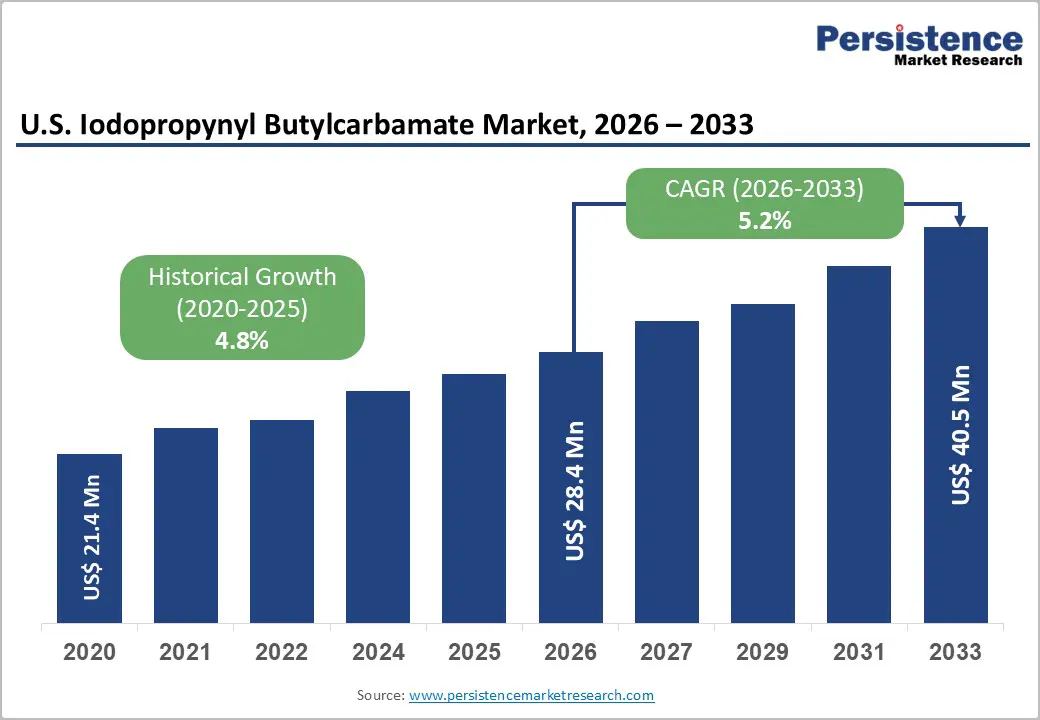
The U.S. iodopropynyl butylcarbamate market size is likely to be valued at US$ 28.4 million in 2026 and is projected to reach US$ 40.5 million by 2033, growing at a CAGR of 5.2% between 2026 and 2033.
This growth trajectory is driven primarily by rising consumer awareness of personal hygiene and product safety, which has amplified demand for effective preservatives in cosmetic and personal care formulations. According to the U.S. Food and Drug Administration (FDA), Iodopropynyl Butylcarbamate (IPBC) is approved for use in cosmetic products at concentrations up to 0.1%, providing reliable antimicrobial protection against fungi and bacteria.
Additionally, the U.S. Environmental Protection Agency (EPA) reregistered IPBC as a pesticide for wood preservation and industrial applications, confirming its safety profile when used according to label directions, thereby supporting market expansion across diverse application segments.
Key Market Highlights:
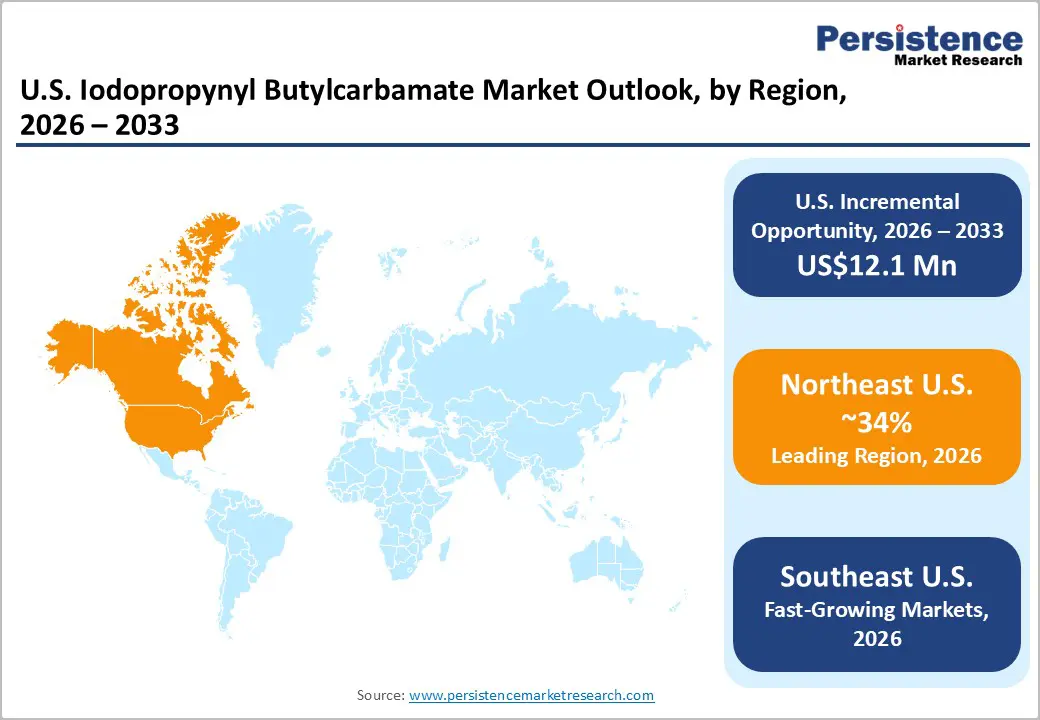
- Regional Leader: The Northeast U.S. region maintains market leadership in Iodopropynyl Butylcarbamate consumption, with 34% market share, driven by concentrated cosmetic manufacturing hubs and the presence of Arxada's primary production facility in Newark, NJ.
- Fastest Growing Region: The Southeast U.S. region emerges as the fastest-growing market, propelled by robust construction activity, wood preservation demand in humid climates, and expanding personal care manufacturing investments.
- Leading Segment: Cosmetic Grade rules product types at 62% share, prized for FDA-compliant purity in skincare.
- Fastest Growing Segment: Household Cleaning Products fastest-growing application amid hygiene surges post-pandemic.
- Kry Growth Opportunities: Expansion opportunities in textile and pharmaceutical preservation applications offer significant growth potential, particularly in antimicrobial fabrics, performance textiles, and topical pharmaceutical formulations requiring non-reactive, dermatologically compatible preservation systems.
| Key Insights | Details |
|---|---|
| U.S. Iodopropynyl Butylcarbamate Market Size (2026E) | US$ 28.4 Mn |
| Market Value Forecast (2033F) | US$ 40.5 Mn |
| Projected Growth CAGR (2026 - 2033) | 5.2% |
| Historical Market Growth (2020 - 2025) | 4.8% |
Market Dynamics
Drivers - Expanding Personal Care and Cosmetics Industry Driving Preservative Demand
The increasing consumer focus on hygiene and premium skincare products is significantly impacting the U.S. market for Iodopropynyl Butylcarbamate (IPBC). As a broad-spectrum preservative, IPBC effectively prevents bacterial and fungal growth in shampoos, lotions, and creams, helping extend shelf life amid rising demand. The expansion of the personal care sector has been accelerated by heightened hygiene awareness in the post-COVID-19 era. Consequently, IPBC usage has increased, as formulators prioritize effective preservation systems to prolong shelf life and prevent microbial contamination.
Furthermore, the growing adoption of household care wipes, particularly in baby care and facial cleansing, underscores the need for specialized preservation solutions. The Cosmetic Ingredient Review (CIR) Expert Panel has validated the safety of IPBC at concentrations up to 0.05% in cosmetic products, positioning it as a trusted ingredient among formulators. The growing Cosmetic Preservative Blends Market has further supported the adoption of IPBC, as manufacturers increasingly combine it with other antimicrobials to achieve broad-spectrum efficacy while maintaining consumer safety standards.
Surge in Wood Preservation and Construction Applications
The residential and commercial construction sectors in the United States continue to grow, driving significant demand for wood preservatives. According to the U.S. Census Bureau and the U.S. Department of Housing and Urban Development, new residential construction permits reached approximately 1.5 million units annually in 2024.
Isopropyl benzyl dimethyl ammonium chloride (IPBC) is commonly used in water-based wood preservatives and the paints and coatings market to protect lumber from decay, fungi, and mold, especially in humid regions. The Environmental Protection Agency's (EPA) reregistration of IPBC for pesticide applications ensures regulatory compliance, enhancing confidence among manufacturers and end users in the construction industry.
Restraints - Regulatory Restrictions and Environmental Concerns
The FDA and EPA have established strict regulations limiting IPBC (Iodopropynyl butylcarbamate) concentrations in cosmetics to a maximum of 0.1%, with a preference for rinse-off products. These regulations address concerns about skin sensitization and environmental risks, requiring manufacturers to reformulate products and conduct costly compliance testing, thereby slowing market adoption. Additionally, rising allergy concerns and demand for paraben-free options further pressure manufacturers.
Health Canada is also reviewing pest control products containing IPBC used in metalworking fluids, focusing on risks to workers handling these fluids and machinists exposed to them. This regulatory scrutiny, while limited to specific applications, introduces uncertainty regarding potential future restrictions on IPBC.
Shift Toward Natural Preservatives
The market is experiencing heightened competition from emerging natural and organic preservative alternatives, including plant-derived actives such as tea tree oil, fermented botanicals, and biocompatible silver-ion systems. Consumer demand for clean-label products is challenging the dominance of IPBC (Iodopropynyl Butylcarbamate), as natural antimicrobials are increasingly popular in the personal care industry. Additionally, regulatory efforts to promote transparency and eco-friendly options, along with rising raw material costs, are hindering the expansion of synthetic biocides, despite IPBC's efficacy.
Furthermore, the cosmetic preservatives market is witnessing innovation with the introduction of multi-functional and microbiome-friendly preservatives, which is increasing competitive pressure on traditional chemical preservatives. Manufacturers of premium and luxury personal care products are increasingly opting for natural or naturally derived preservatives, which may limit the adoption of IPBC in high-end cosmetics aimed at clean-beauty enthusiasts.
Opportunity - Rising Demand in Agricultural Formulations and Crop Protection
The agricultural sector offers a significant growth opportunity for IPBC, especially as a preservative in crop protection chemical formulations. IPBC effectively prevents microbial spoilage and helps maintain product stability in regions characterized by high humidity and temperature fluctuations. This is essential for ensuring both the shelf life and efficacy of agricultural chemicals. As U.S. farmers increasingly focus on enhancing crop productivity and ensuring food security, the demand for reliable preservatives in pesticide and fertilizer formulations is rising.
The EPA's re-registration of IPBC for pesticide use further confirms its safety profile, paving the way for broader adoption throughout the agricultural value chain. Companies investing in agricultural applications can benefit from this growing segment, which is expected to grow steadily in the coming years as precision farming and sustainable agriculture practices gain traction among U.S. farming communities.
Expansion in Textile and Pharmaceutical Preservation Applications
The textile and pharmaceutical industries represent untapped markets with significant potential for IPBC adoption. In textile manufacturing, IPBC acts as an effective antimicrobial agent that prevents microbial growth, fabric degradation, and unpleasant odors in performance textiles and sportswear. Rising consumer demand for antimicrobial fabrics, particularly in activewear and healthcare textiles, is driving manufacturers to incorporate IPBC into fiber treatments.
In the pharmaceutical sector, IPBC provides non-reactive preservation for topical medications and dermatological formulations, ensuring product safety and longevity without causing adverse reactions. As pharmaceutical companies strive to extend product shelf life and meet pharmacopeia standards, IPBC offers a viable solution. Market participants who develop specialized grades and formulations tailored to these sectors can unlock new revenue streams and diversify their customer base beyond traditional personal care applications.
Category-wise Insights
Product Type Analysis
Cosmetic Grade Iodopropynyl Butylcarbamate (IPBC) leads the U.S. market, holding approximately 62% of the market share. Approved by the FDA at low concentrations, it provides stability in moisture-rich products like lotions and shampoos, often outperforming technical grades in consumer-facing applications. Its versatility and safety profile contribute to its strong presence in response to the rising demand for beauty products. This grade maintains purity levels exceeding 98% and is specifically formulated for personal care products, including lotions, creams, shampoos, and facial cleansers.
The segment benefits from the growing market for Iodopropynyl Butylcarbamate in cosmetic applications, where manufacturers prioritize dermatologically tested ingredients with minimal risk of sensitization. On the other hand, Technical Grade IPBC, although having a smaller market share, remains vital for industrial applications such as wood preservation, paints, coatings, and metalworking fluids.
Application Insights
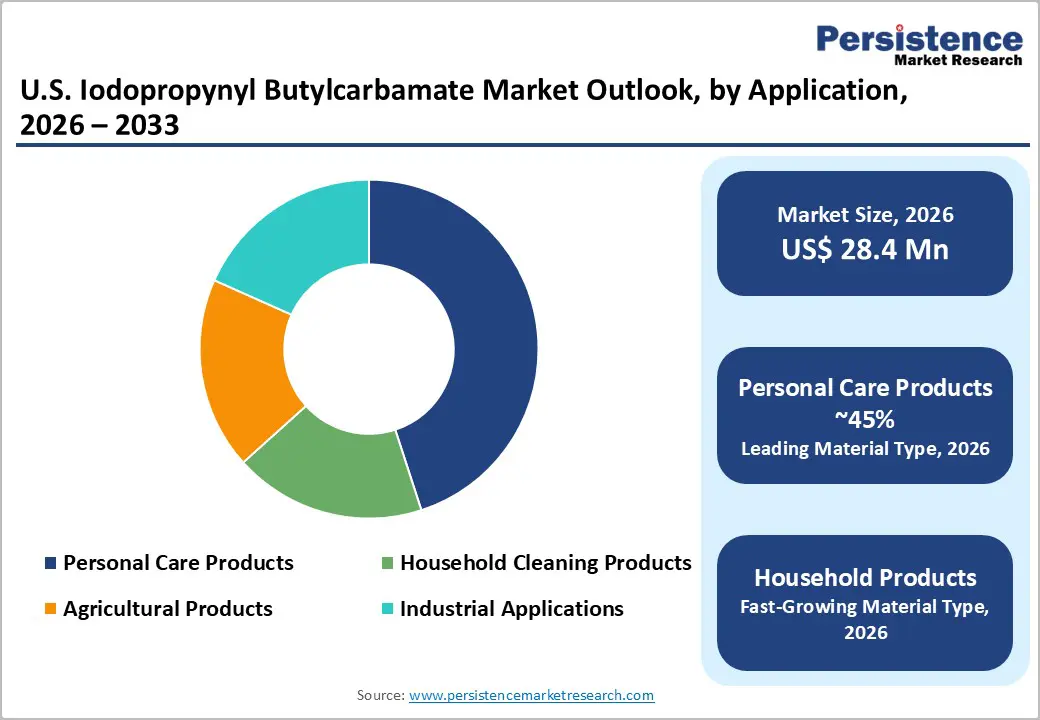
Personal care products hold about 45% of the market, including shampoos, wipes, and skincare products that help prevent microbial spoilage. This dominance is due to the widespread use of these products in skincare, haircare, and hygiene, where IPBC offers effective broad-spectrum antimicrobial protection at low concentrations. High hygiene standards and the need for extended shelf life further justify its leading position, especially in the U.S., where the demand is driven by the proliferation of premium products.
Companies such as Lonza, Evonik Industries AG, and Ashland have developed preservative blend systems that incorporate IPBC to meet evolving consumer expectations for effective yet gentle preservation. Furthermore, household cleaning products and industrial applications represent significant segments in the market, particularly for antimicrobial surface treatments and the preservation of metalworking fluids. These uses are supported by regulatory approval from the EPA for pesticide-related applications. The efficacy of IPBC at minimal doses reinforces its strong position in various industrial applications.
End-user Insights
Cosmetics and toiletries account for nearly 50% of market share in end-use applications, particularly for creams, foundations, and conditioners that require protection against fungal contamination. This segment includes makeup products, skincare formulations, body washes, and hair treatment products, where IPBC serves as a preservative to prevent microbial growth. According to the Cosmetic Ingredient Review, IPBC is highly compatible with skin and is classified in a category where allergic reactions are extremely rare, making it especially suitable for both leave-on and rinse-off cosmetic applications.
In the food and beverage sector, IPBC is primarily used for sanitizing packaging materials and processing equipment. It is regulated by the FDA as a food-contact substance due to its antimicrobial properties. The stringent FDA approvals and broad-spectrum efficacy support its dominance in the market as the beauty industry continues to grow and increase demand. The emphasis on consumer safety further reinforces its leadership position.
Regional Insights
Northeast U.S. Iodopropynyl Butylcarbamate Market Trends
The Northeast U.S. region leads the market for Iodopropynyl Butylcarbamate (IPBC), largely due to the presence of major cosmetic manufacturing hubs and personal care companies in states like New Jersey, New York, and Massachusetts. Arxada, which acquired Troy Corporation in November 2021, operates its main IPBC production facility in Newark, NJ. This strategic location enhances the region's role as a center for manufacturing and innovation.
The Northeast benefits from a strong regulatory framework established by the FDA and EPA, which ensures stringent quality standards and builds consumer confidence in products that contain IPBC. Furthermore, the concentration of research institutions and chemical innovation centers in the area enables ongoing product development and formulation optimization. Major cosmetic brands headquartered in the Northeast maintain solid partnerships with preservative suppliers, ensuring a steady demand for cosmetic-grade IPBC in applications such as skincare, haircare, and color cosmetics.
Southeast U.S. Iodopropynyl Butylcarbamate Market Trends
The Southeast U.S. is rapidly becoming the fastest-growing market for IPBC, fueled by strong construction activity and increasing wood preservation needs in humid climates. States like Florida, Georgia, and North Carolina are seeing significant growth in residential and commercial construction, with year-over-year increases in building permits, according to the U.S. Census Bureau. The region's high humidity levels necessitate effective wood protection against fungi, mold, and decay, driving demand for technical-grade IPBC in lumber treatment applications.
Furthermore, the Southeast is experiencing growth in personal care manufacturing as companies establish production facilities for both domestic and export markets. Competitive labor costs and a favorable business climate have attracted investments from major players, including Dow Chemical Company, seeking to expand their antimicrobial product offerings. Efforts to align regulations with EPA guidelines have also expedited product approvals, facilitating faster market entry for IPBC-based formulations. Moreover, the agricultural sector offers growth opportunities in preserving crop protection chemicals and maintaining their efficacy in challenging storage conditions.
Competitive Landscape
The U.S. Iodopropynyl Butylcarbamate market is moderately consolidated, with key specialty chemical manufacturers holding significant market share through diverse product offerings and technical expertise. Major players, like Arxada with its acquisition of Troy Corporation, focus on strategic expansion and differentiation via custom preservative blends and support services. Investments in research and development aim to create eco-friendly formulations and hybrid systems combining IPBC with natural antimicrobials.
Market leaders gain competitive advantages through integrated supply chains, proprietary technologies, and strong relationships with cosmetic brands. Emerging models utilize digital platforms for formulation guidance, helping customers optimize preservative selection based on various criteria.
Key Developments:
- December, 2024: Evonik Industries AG showcased its commitment to personal care innovation with expanded Verstatil® preservative blend portfolio, offering COSMOS-compliant and phenoxyethanol-free options that integrate advanced antimicrobial technologies for sensitive cosmetic formulations.
- November 2021: Arxada announced the acquisition of Troy Corporation, the original inventor of IPBC technology, creating a comprehensive microbial control solutions provider with enhanced IPBC manufacturing capabilities and global production facilities, including Newark, NJ.
Top Companies in U.S. Iodopropynyl Butylcarbamate Market
- Evonik Industries AG (Essen, Germany) is a leading specialty chemicals company offering comprehensive personal care solutions including the Verstatil® preservative blend range and dermosoft® multifunctional antimicrobial systems. The company provides digital tools such as the Personal Care Protection Guide to assist formulators in selecting optimal preservation strategies. Evonik emphasizes free-from formulations, offering paraben-free, formaldehyde-free, and halogen-free options that align with clean beauty trends while maintaining broad-spectrum efficacy.
- Lonza (Basel, Switzerland) is a prominent specialty chemicals and biotechnology company with extensive experience in antimicrobial and preservative technologies for personal care applications. The company has developed innovative preservative systems, including the Vantocil line launched in 2023, which addresses growing demand for eco-friendly and high-performance preservatives in cosmetic formulations. Lonza's strong market position stems from its robust research and development capabilities and established relationships with major cosmetic brands.
- Arxada (Switzerland) is a global specialty chemicals business and market leader in microbial control solutions and preservation additives, operating manufacturing facilities across three continents with enhanced IPBC capabilities following the Troy Corporation acquisition. Arxada serves over 3,000 customers globally through its comprehensive portfolio of preservatives and performance materials, offering technical support and regulatory expertise across major markets.
Companies Covered in U.S. Iodopropynyl Butylcarbamate Market
- Fengchen Group Company Limited
- Lonza
- Ashland specialty chemicals
- Vortex Products Limited
- Salicylates and Chemicals
- Thor Personal Care
- Jeen International Corp.
- Lincoln MFG-USA
- Arxada
- Evonik Industries AG
- Dow Chemical Company
- Akema Fine Chemicals
- Dalian Tianwei Chemical
Frequently Asked Questions
The U.S. Iodopropynyl Butylcarbamate market is projected to reach US$ 40.5 Mn by 2033, growing at a CAGR of 5.2% from US$ 28.4 Mn in 2026.
The primary drivers include expanding personal care and cosmetics industry requiring effective preservatives, surge in wood preservation demand due to robust construction activity, and FDA and EPA regulatory approvals supporting safety and efficacy across multiple applications.
Cosmetic Grade IPBC dominates with approximately 55% market share, driven by stringent purity requirements for personal care formulations and safety standards mandated by the CIR Expert Panel and FDA.
The Northeast U.S. region leads the market due to concentrated cosmetic manufacturing hubs, presence of Arxada's primary IPBC production facility in Newark, NJ, and robust regulatory framework supporting product innovation and quality standards.
Key opportunities include expansion in agricultural formulations and crop protection chemicals, growth in textile antimicrobial treatments for performance fabrics, and pharmaceutical preservation applications for topical medications.
Leading players include Arxada (which acquired Troy Corporation), Lonza, Evonik Industries AG, Dow Chemical Company, Ashland Specialty Chemicals, and Fengchen Group Company Limited.


