




- Automotive
- U.S. Car Wash Market
U.S. Car Wash Market Size, Trends, Share, and Growth Forecast 2026 - 2033
U.S. Car Wash Market by Service Type (Exterior Express Wash, Full-Service Wash, Detailing Services, Touchless Wash), by Wash Format (Tunnel/Conveyor Systems, In-Bay Automatic Systems, Self-Service Bays, Mobile/On-demand Car Wash), U.S. Region (Northeast, Southeast, Midwest, Southwest, and West), 2026 - 2033

U.S. Car Wash Market Size and Trend Analysis
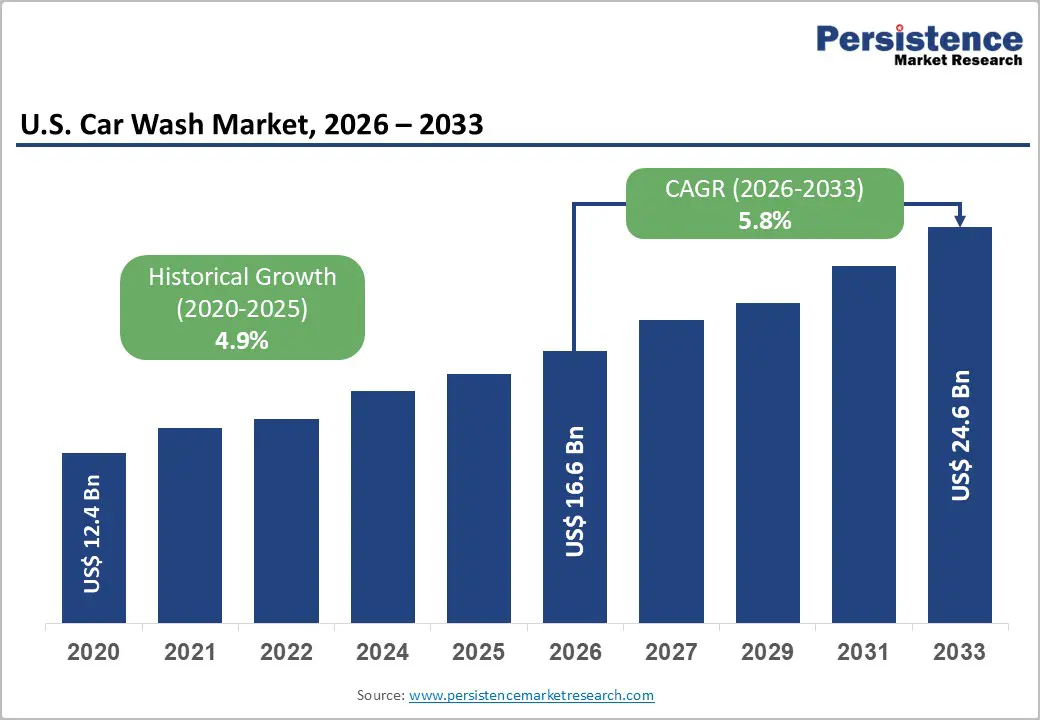
The global U.S. Car Wash Market market size is likely to be valued at US$ 1.4 billion in 2026 and is expected to reach US$ 2.1 billion by 2033, growing at a CAGR of 5.8% during the forecast period from 2026 and 2033. Rising preference for professional car wash services over at-home washing drives this growth. Subscription-based express tunnels and improved convenience support steady mid-single-digit revenue expansion.
Key Market Highlights
- Leading Region: The Southwest region leads with 45% market share, due to favorable weather, population growth, and year-round operations supporting the highest site densities and revenue per wash.
- Fastest-Growing Region: The West emerges fastest-growing region with rising CAGR of 7%, from rapid urbanization, technology adoption, and premium service demand in coastal markets.
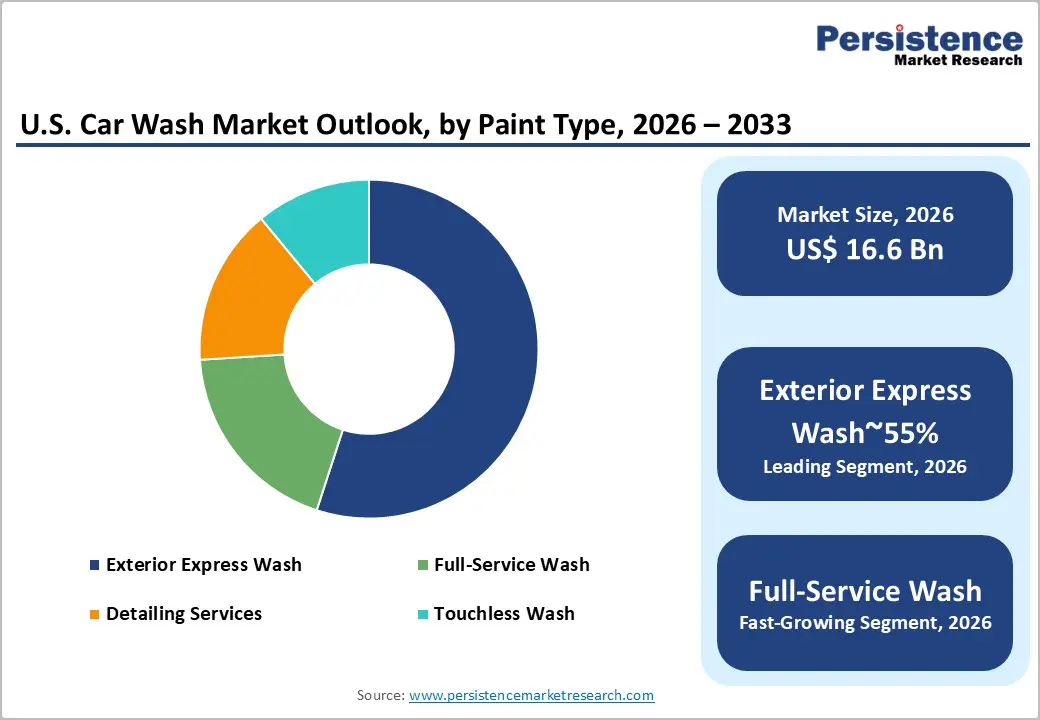
- Leading Segment: Exterior Express Wash dominates the service type, with a 55% share, driven by high throughput and subscription compatibility.
- Fastest-Growing Segment: Tunnel/Conveyor Systems is the fastest-growing wash format, enabling hundreds of vehicles per hour with integrated upsell capabilities.
- Opportunity: Subscription models scaling express tunnels create a key opportunity, generating predictable cash flows and customer retention.
| Key Insights | Details |
|---|---|
|
U.S. Car Wash Market Size (2026E) |
US$ 1.4 billion |
|
Market Value Forecast (2033F) |
US$ 2.1 billion |
|
Projected Growth CAGR(2026-2033) |
5.8% |
|
Historical Market Growth (2020-2025) |
4.9% |
Market Dynamics
Drivers - Rapid Urbanization and Busy Lifestyles Drive Demand for Fast, Automated Car Wash Services Supported by Digital Memberships and Convenient App-Based Experiences
Urbanization and fast-paced routines are driving strong demand for quick, automated car wash services. Consumers today prefer exterior express and tunnel washes that deliver consistent results within minutes. The rise of unlimited-wash memberships and app-based payments has made the service even more convenient, encouraging frequent visits. Consumer studies indicate that most drivers wash their vehicles once or twice a month, and more than 70% have shifted from at-home washing to professional facilities over the past decade. This behavior creates predictable, recurring revenue for operators.
Express wash formats suit metropolitan areas where residents have limited access to parking, water, or space for home washing. Mister Car Wash highlights continuous growth in its Unlimited Wash Club (UWC), supported by digital tools such as app-based account management, RFID, and license-plate recognition entry systems. The company’s 2025 communications emphasize that digital memberships convert occasional users into loyal subscribers, demonstrating how technology directly supports time-pressed urban customers seeking fast, seamless service.
Strong Environmental Regulations and Advanced Water-Recycling Technologies Enhance Sustainability, Compliance, and Competitive Strength for Modern Professional Car Wash Operators
Professional car wash operators increasingly focus on sustainable practices to meet growing environmental, municipal, and regulatory expectations. Compared to driveway washing, modern commercial sites use significantly less water and maintain strict control over wastewater discharge. New systems can recycle up to 90% of the water used through advanced reclaim technologies, while biodegradable cleaning agents further reduce environmental impact. These features help municipalities achieve stormwater and conservation objectives as regulations tighten across many U.S. states.
Operators actively market these sustainability advantages to appeal to environmentally conscious consumers. Autobell’s official materials illustrate this commitment, noting that its facilities treat and reuse virtually all wastewater using biological and advanced reclaim systems. New store developments also integrate full reclaim setups to reduce freshwater use and meet local environmental standards. This approach showcases how operators combine responsible resource management, regulatory compliance, and consumer-facing sustainability messaging to strengthen their competitive position in the market.
Restraints - Industry Fragmentation and Intense Local Price Competition Reduce Margins and Limit Growth Opportunities for Independent Car Wash Businesses Nationwide
The U.S. car wash industry remains highly fragmented, with an estimated 55,000–60,000 largely independent small businesses. This fragmentation intensifies price competition, especially in regions where multiple operators serve the same customer base. Smaller, non-differentiated sites often face margin pressure because they lack the purchasing power, marketing scale, and operational efficiency of national chains. In oversaturated areas, local operators are drawn into price wars that reduce profitability and limit reinvestment capacity.
Independents also struggle to compete with the advanced subscription programs and loyalty ecosystems offered by larger platforms. These national brands use data analytics, dynamic pricing, and stronger digital engagement to retain customers and increase visit frequency, while smaller operators often cannot match these capabilities. As the market shifts toward membership-driven models and technology-enabled operations, independents face growing difficulty maintaining competitive pricing, which ultimately restricts their long-term growth prospects and accelerates consolidation trends across the industry.
Rising Operational Costs and Increasing Regulatory Requirements Create Barriers to Expansion and Financial Pressure for Smaller Car Wash Operators
Car wash operators are facing increasing financial pressures due to rising labor costs, higher land prices, and escalating utility expenses. Building new sites in dense metropolitan areas has become more capital-intensive, limiting expansion opportunities for smaller players. At the same time, operators must navigate complex permitting requirements involving environmental guidelines, water-use restrictions, and wastewater discharge standards. These regulatory hurdles can delay new projects and increase upfront investment needs, especially when reclaim systems and advanced filtration technologies are required.
Utility rates, particularly for water and electricity, continue to climb, raising operational break-even thresholds. As a result, operators must achieve higher throughput to maintain profitability. Smaller businesses without scale advantages often struggle to absorb these costs or secure financing for upgrades. Overall, the combined impact of regulatory complexity, land scarcity, and cost inflation creates structural challenges that disproportionately affect independent operators and limit their ability to compete with larger, well-capitalized chains.
Opportunity - Express Tunnel Expansion and Subscription Membership Programs Generate Predictable Revenue, Higher Throughput, and Scalable Growth for Car Wash Chains
The expansion of express exterior tunnel formats, paired with subscription-based memberships, represents one of the strongest growth opportunities in the market. This model successfully converts occasional customers into reliable monthly subscribers, creating recurring revenue and predictable cash flows.
The 2025 U.S. Car Wash & Auto Detailing Industry Overview identifies subscription adoption as a core trend, with leading platforms converting 35% of visitors into unlimited-wash members. Such predictable revenue supports rapid clustering of new sites in high-traffic corridors. Tommy’s Express provides a clear operational example, with its 2025 franchise communications showcasing accelerated expansion of automated tunnel locations supported by app-based membership tools and license-plate recognition. These features enable efficient check-in, recurring billing, and customer retention, illustrating how operators leverage digital ecosystems and express formats to scale profitably.
Eco-Efficient Equipment and High-Performance Water Recycling Systems Deliver Cost Savings, Regulatory Benefits, and Sustainability Advantages for Operators
Eco-efficient technologies present strong opportunities for operators seeking lower operating costs, regulatory resilience, and sustainability-driven customer appeal. Modern systems, including high-efficiency spray nozzles, advanced reclaim units, and biodegradable chemical formulations, help reduce water consumption and minimise environmental impact. These investments create competitive advantages in markets facing water scarcity or strict conservation rules. Reclaim systems can now achieve water recycling rates of 95% or higher, enabling operators to maintain consistent service even during drought restrictions.
This also significantly reduces variable water expenses, strengthening margins. Brands that adopt green technologies often differentiate themselves among millennial and Gen Z consumers who prioritize sustainability. Quick Quack exemplifies this approach, highlighting reclaim systems that reuse up to 99% of water and limit per-wash consumption to 15–20 gallons, far below typical driveway-washing usage. These capabilities demonstrate how eco-efficient technologies enhance environmental compliance, reduce costs, and strengthen brand positioning in increasingly eco-conscious markets.
Category-wise Analysis
Service Type Insights
Exterior Express Wash remains the largest and fastest-growing service category, capturing roughly 55% of the market. This dominance is driven by high vehicle throughput, low labor requirements, and strong alignment with unlimited subscription programs. These formats are designed to process more than 100 vehicles per hour during peak periods, providing operators with attractive unit economics and consistent revenue generation. Commuters prefer these washes for their speed, simplicity, and predictable results.
Subscription-based models enable operators to maintain steady cash flow while encouraging frequent visits and customer loyalty. Because the service is standardized, chains can efficiently replicate successful formats across multiple locations and maintain consistent quality. The scalability of Exterior Express Wash operations supports aggressive national expansion strategies, enabling major brands to expand their footprints rapidly. As consumer demand continues shifting toward fast, automated solutions, this segment is expected to strengthen its market-leading position in the coming years.
Wash Format Insights
Tunnel and conveyor wash systems account for approximately 55% market share and remain the preferred format for both operators and customers seeking high efficiency and consistent quality. These systems can process large volumes of vehicles per hour, integrating advanced cleaning chemistry, foam applications, and high-performance drying technologies. Their capability to deliver upsell services, such as ceramic coatings, wheel cleaning packages, and tire shine, allows operators to increase revenue per visit.
Tunnel formats also maximize the value of prime real estate by optimizing vehicle flow and reducing wait times. National chains typically standardize their tunnel equipment to ensure operational consistency, cost control, and predictable maintenance cycles across all locations. This format’s efficiency and compatibility with subscription programs make it ideal for high-traffic urban and suburban markets. As chains continue scaling, tunnel systems remain the backbone of expansion efforts due to their strong throughput potential and ability to deliver premium service options that enhance profitability.
Competitive Landscape
The U.S. car wash market is transitioning from local owner-operator dominance to consolidation by regional platforms and national chains. Mister Car Wash, Driven Brands, Inc., Quick Quack Car Wash, and Zipcar Wash pursue roll-up strategies, greenfield builds, and membership-driven pricing. Active M&A pipelines emphasize site clustering and standardized operations. Technology platforms provide analytics, loyalty tools, and usage insights, maximizing customer lifetime value. Emerging trends include AI-driven pricing and predictive maintenance.
Key Market Developments:
- In October 2025, Quick Quack Car Wash reached a major expansion milestone by opening its 300th location in San Antonio, Texas, underscoring continued west-and-Sunbelt growth of its express wash footprint across multiple states.
- In February 2025, Zips Car Wash filed for bankruptcy protection, a major development for that brand’s restructuring, although not a new product launch or expansion.
Companies Covered in U.S. Car Wash Market
- Wash Depot
- Splash Car Wash
- Mister Car Wash
- Driven Brands, Inc.
- Suds Car Wash
- Take Five Oil Change
- Magic Hand Carwash
- True Blue Car Wash
- Squeaky Clean Car Wash
- Autobell Car Wash, Inc.
- Zips Car Wash
- Quick Quack Car Wash
- Tommy's Express Car Wash
- GO Car Wash
- ModWash
- Flagstop Car Wash
Frequently Asked Questions
The U.S. car wash market is poised to reach US$ 2.1 billion by 2033, expanding from US$ 1.4 billion in 2026 at 5.8% CAGR over from 2026 to 2033.
Demand grows from shift to professional facilities where 79% of drivers use car washes versus 47% in 1996. Express tunnels, subscriptions, and paint protection awareness fuel growth.
Exterior Express Wash leads with 55% share offering high throughput, minimal labor, and subscription compatibility processing 100+ vehicles per hour.
Southwest leads with dense sites from favorable weather, population growth, and year-round operations in Florida and Texas metros.
Subscription models scaling express tunnels generate predictable cash flows. Digital platforms increase retention while eco-technologies ensure regulatory compliance.


